

FundWatch uses our team's process to highlight the past quarter’s developments in the fund world. It is fact-based and uses performance analysis techniques which form part of our investment process
All data is from Lipper for Investment Association (IA) sectors and is calculated in total return terms in sterling for periods ending 30 June 2023.
This quarter’s report includes the following analysis:
- The CT MM Consistency Ratio – highlighting the surprisingly limited number of funds beating their peers on a regular basis.
- Tops and Bottoms – the ultimate winners and losers over the quarter.
- Sector Skews – the best and worst of the 57 IA sector averages.
- Risky Business – a look at the leading funds for combining first class longer-term returns with the lowest levels of volatility.
The MM Consistency Ratio
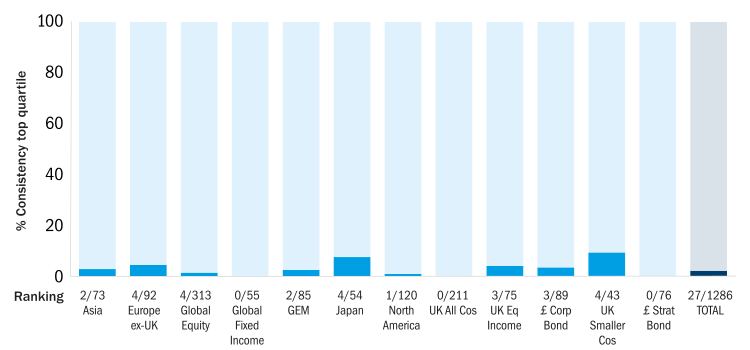
Top quartile performance rolling 3 years: 2.10%
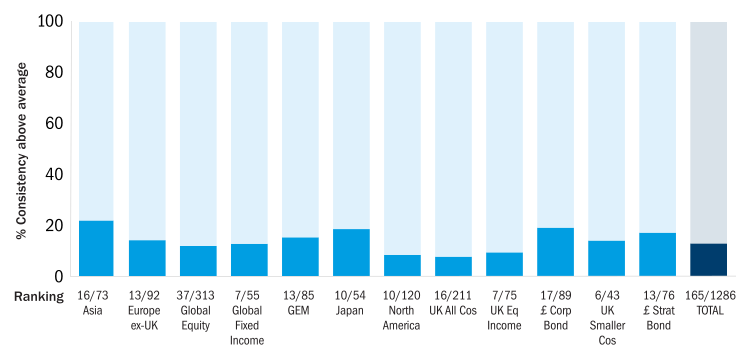
Above average performance rolling 3 years: 12.83%
Source: Lipper, 01.04.23 to 30.06.23,, percentage growth, total return.
The CT MM Consistency Ratio
Here we conduct a review of the 12 major market sectors, filtering out only those funds that are consistently above average in each of the last three 12-month periods, and for a harder test those consistently top quartile. In the 12 main sectors researched, there are currently 1,286 funds with a 3-year track record.
- The CT MM Consistency Ratio for top quartile returns over three years to the end of Q2 2023 has continued to improve. This quarter 27 funds achieved this feat, which equates to 2.1% of the selected universe, up from 1.8% in Q1. This ratio’s typical range over the time we have been running this research is c.2-4%.
- In a repeat of the first quarter, the IA UK Smaller Companies sector had the most consistently performing top quartile funds with an impressive 9.3% of offerings achieving this feat. The next best was the IA Japan sector with 7.4% of funds. The IA UK All Companies, IA Strategic Bond and IA Global Mixed Bond sectors failed to have any funds, with the IA North American sector only having one fund, achieving consistently top quartile returns in the 3 consecutive 12 month periods.
- Lowering the hurdle rate to simply above median in each of the last three 12-month periods also saw a significant pick up with 165 of the 1,286 funds delivering above median returns consistently, compared to 136 funds last quarter. This means this less demanding ratio rose to 12.8% from 10.8%.
- The IA Asia ex Japan sector had the most consistently above average funds with 22% achieving this feat. The next best was the IA £ Corporate Bond sector with 19.1% of funds qualifying. At the other end of the spectrum the IA UK All Companies sector had the least number of funds achieving rolling 12-month consistency for the 3 years at 7.6%. All sectors had a number of funds achieving above average consistency.
CT Multi-Manager comment
- The trend of increasing consistency continued in Q2, following a pickup in Q1 of this year. There were three trends of note – short dated in fixed income, smaller companies and value. There were only 2 passive vehicles that achieved top quartile consistency in the whole of the IA universe – both of these were Inflation Linked funds.
- We spend a decent amount of our time talking to sales contacts who seem to be pedalling their wares to an ever-decreasing circle of buyers. With this in mind, I was intrigued to observe that the number of funds in the IA universe has been on a steady rise since what felt like a dip at 1046 funds in Q2 of 2021. There are now 1286 funds in the universe – a 12% increase. The vast majority of this has been in funds classified in the IA Global sector which has risen from 199 to 313 funds, while the number of funds in all 3 of the IA UK equity sectors have actually fallen.
Tops and bottoms
Identifying the best and worst performers of all funds in the quarter across all 57 IA sectors.
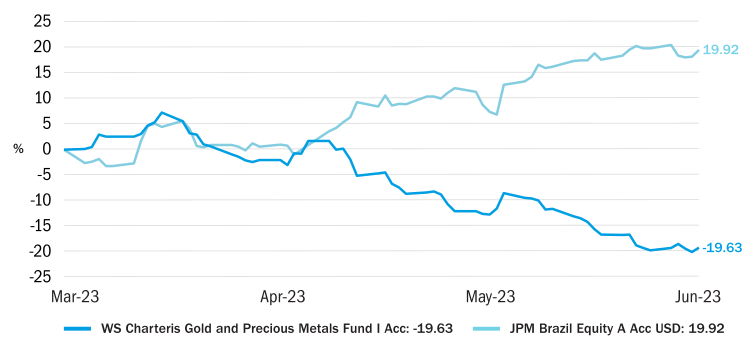
- The $133m JPM Brazil Equity fund led the table of IA funds in the quarter. Run by Luis Carrillo and Rachel Rodrigues, the fund has over a third of its assets invested in Financials, with 6 of the top 10 holdings in the sector. Having been the best performing major equity market in 2022, the Bovespa has continued to benefit from the tailwinds of falling inflation, with the central bank making early moves to raise interest rates as prices rose in 2021.
- The WS Charteris Gold and Precious Metals Fund compounded the falls in the gold and precious metals space. The £21m fund invests in companies that refine, produce and market in the space. The team of Ian and Mark Williams and Colin Robertson run this specialist portfolio with conviction positions. The fund currently has the vast majority of its holdings in Canadian businesses with silver being the largest exposure at c55%, over gold at 42%.
Tops and bottoms
Source: Lipper, 01.04.23 to 30.06.23, percentage growth, total return.
Sector skews
Identifying the best and worst performers in the quarter across all 57 IA sectors.
- Just 20 of the 57 IA sectors made positive ground in the quarter. 2 of these were money market sectors which returned around 1% each. These were only beaten by 12 other IA sector averages.
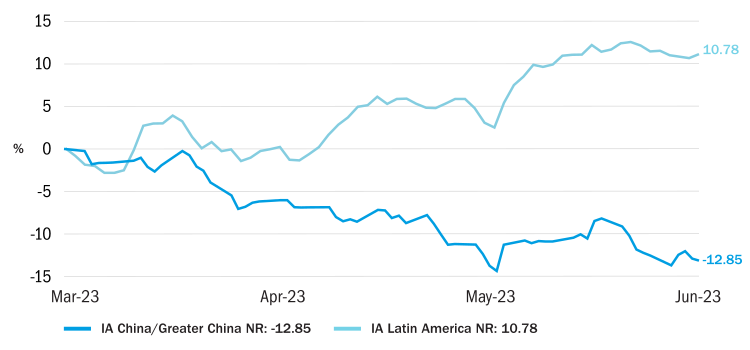
- There was something of a reversal of the first quarter of the year with the IA India/Indian Subcontinent sector second best, gaining 9.9%, having been at the bottom of the table in Q1. This was only beaten by the IA Latin American sector average which gained 10.8%. At the other end of the table there was a dominance of bond sector averages faltering, but it was the IA China/Greater China sector that secured the position at the bottom of the table losing 12.9%.
- All three IA UK sectors lost ground in the month with the UK All Companies the least bad, falling 0.8%. The IA UK Smaller Companies sector next best, losing 1.4%, with the IA UK Equity Income the worst at -1.7%.
- Turning to UK bonds, the change in prospects for interest rates in the face of persistently high inflation caused the ever-volatile IA UK Index Linked Gilt sector to tumble 8.8% as the most interest rate sensitive sector in the UK Bond space. The IA UK Gilt sector was close behind, losing 5.6%. The benefits of carry and a more active approach was apparent in the other UK Bond sectors. The IA £ High Yield sector gaining 1.4%, while the IA £ Strategic Bond sector average lost ground, falling 1.2%. It however was a reasonable distance ahead of the more duration exposure IA £ Corporate Bond sector average which fell 2.9%.
- The IA Targeted Absolute Return sector fell 0.7%. On a 12 month view this sector average has gained less than 1.5%, under half that of the return of the IA Standard Money Market sector average which gained over 3%.
- The returns for the Mixed Asset IA offerings continued to be tight. There was just over a 1% difference between each of the IA Mixed Investment 0-35% Shares, the IA Mixed 20-60% Shares and the IA Mixed Investment 40-85% Shares which all returned 0.1% or less.
- The 10% extra in US equities was most likely a strong factor, alongside the types of companies within this allocation, in the outperformance of the IA Global Equity sector (+2.5%) over the IA Global Equity Income sector (+1.1%) in a quarter that saw large cap tech dominate returns in the main.
Sector skews
Source: Lipper, 01.04.23 to 30.06.23, percentage growth, total return.
Currencies
It really has been quite an astonishing year in currency markets, with Sterling yet again dominating over other major currencies as the interest rate differential between major central banks focused minds. The recent ECB forum on central banking only served to highlight the differences in where the major central banks are in their cycle of rate rises, and how data dependent they have all become. Having such short-term influences on such a long term instrument as interest rates can only create more volatility from here.
Major currencies relative to sterling
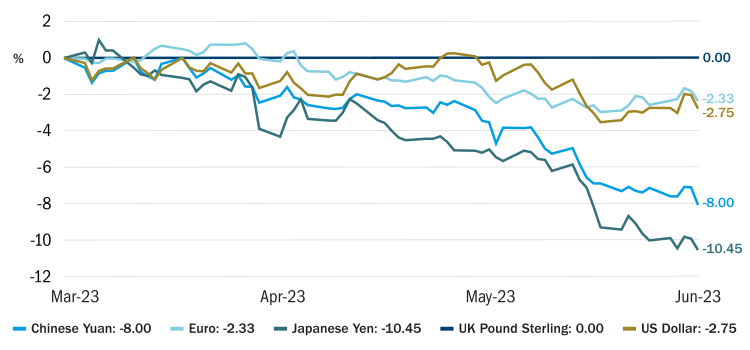
Source: Lipper, 01.04.23 to 30.06.23, Percentage growth, total return.
Risky business
Can you have your cake and eat it? Here we search for funds with good risk characteristics and establish which funds offer the holy grail of low risk and high returns. For this purpose, a longer time-period is required, so we look back over three years to the end of the quarter.
- In a repeat of Q1, measured to the end of Q2 2023, the M&G Short Dated Corporate Bond Sterling came the closest to securing the elusive crown of achieving top sector 3-year returns with bottom of the sector 3-year volatility with 99th percentile volatility and 2nd percentile returns within its peer group (the IA £ Corporate Bond sector). The 3 year returns for the fund are now less than 2%, but volatility is also incredibly low.
Looking ahead - and looking within...
- Economic growth trumped stubborn inflation and higher interest rates in a quarter that saw US equities and tech run and Apple reach its all time peak market cap and top off a return of over 50% year to date. We are at multi decade highs in interest rates in the major (and minor) economies of the world. So where is the pain? Ask anyone, consumer or corporate, who has to refinance their rolling debt to answer that question. It is generally accepted that it takes about 18 months for the impact of interest rates to have an effect in the real economy – just something to think about given the first hike was in December of 2021 for the UK, and March 2022 for the Federal Reserve in the US.
- The actions of the central bankers of the world are undoubtedly creating a meaningful impact on borrowers. However. for the first time in a long time those without a debt burden such as the 55% of the UK population that own their own home outright are now seeing an income generated from their liquid savings. Cash has become a viable asset class, however this is not the automatic phenomena that many assume. Many financial institutions are holding back in passing on rate increases. As is so often the case in investing, being active can make all the difference in the outcome you achieve.
Summary
In summary, we believe the performance numbers are – as always – well worth crunching to find trends, provide ideas, layer knowledge on how each fund performs and to generally provoke thought.
Of course, the analysis must be taken in context, and the qualitative work must be done to allow for fully informed judgments. We hope you found this review interesting, and if you have any questions, please contact:
Columbia Threadneedle Investments press office
Rob Burdett
Kelly Prior
If you would like further details or would like to discuss why we think these points are of interest, then please do contact us. We have our own observations and opinions on this analysis and would be happy to discuss them if appropriate.