



Key Takeaways
- The 4% Rule is helpful as a guide – a rule of thumb – to the level of income clients can expect from their retirement savings
- There are more sophisticated models that may provide better income in the early years of retirement and manage longevity risk
- There are a complex variety of factors that will ultimately determine the success of an individual’s retirement funding strategy
- Advising clients on their retirement income strategy is complex and as such carries a variety of expectations from the Financial Conduct Authority (FCA)
Introduction
When clients think about retiring, it’s natural for them to consider how much income they will need, and importantly, where that income will come from when they stop work. They may be able to work out the annual income they’d like in retirement, but it’s perhaps more difficult to know how much they will need to accumulate while working, to deliver that income sustainably when they retire.
While the state pension will provide a base level of income, most will recognise the need to make additional retirement savings through either a company pension, a personal pension or both. The current UK State Pension is £241.30 per week (just over £12,500 a year in 2026/27) for those with 35 or more years of National Insurance Contributions.
When clients come to retire, they can access any funds accumulated to cover living expenses. While individual scheme rules will vary, generally pension savings can be accessed from age 55 in the UK (Rising to 57 on 6th April 2028). However, the UK State Pension is not payable before the age of 67. Therefore, anyone wanting to retire before this age, will need to draw on their other resources to bridge the gap.
So, the big question for clients is, “How much will my pensions savings provide for me in retirement?”
Clients will need advice to explore the answer to that questions and to consider not just how much income they require in retirement, but how long it is likely to last. There are multiple factors that influence the sustainability of income including stock market returns, fixed income yields, inflation, rates of withdrawal and sequence of returns in the portfolio. With so much at stake for clients, the FCA have taken a keen interest as set out in their Thematic Review (TR24/1) which looked specifically at retirement income advice. Having a coherent and defined retirement income advice strategy is key for firms as well as their clients.
Since pension freedoms were introduced in the UK in 2015, there are various ways to take an income from pension savings including options like annuities and flexible drawdown or taking funds directly from the pension pot. The traditional approach prior to 2015 was to purchase an annuity to secure an income for life. This remains an option today, but the greater flexibility offered since 2015 means annuitisation is just one of the options available to clients. Each option provides different income and taxation profiles, and assessing the suitability of individual clients’ income strategies can be complex. In this article however, we’re focusing on the 4% Rule and retirement income strategies rather than pension product solutions.
What is the 4% Rule?
The 4% Rule is a well-known ‘rule of thumb’, used to provide an indication of how much clients could expect to draw from their pension pot over time.
“A retiree can withdraw 4% from their retirement savings and increase that withdrawal by inflation each year, without running out of money over a 30-year retirement period.”
The 4% Rule provides a useful indication of how much can be drawn from retirement savings while minimising the risk of running out of money. It was developed by William Bengen, a Financial Planner, in the 1990’s. Bengen used historical market data to factor in real-world market performance including market corrections, recessions and recoveries.
His research suggests that a retiree can withdraw 4% from their retirement savings each year and increase that withdrawal by inflation, without running out of money over a 30-year retirement period. Inflation proofing income in retirement is essential to maintain buying power as prices rise over time. While the detail of Bengen’s 1994 research suggests that an initial withdrawal rate of between 4.1% and 4.58% (even 4.7% in Bengen’s later writing) is safe, the round 4% figure prevails as the well-known rule of thumb guideline.
The 4% Rule has been widely adopted by financial planners and personal finance commentators. It is considered simple to understand and it offers a relatable solution that can help indicate a ‘safe’ level of income to draw from retirement savings. The topic of retirement income is complex however, and there are some limitations and revisions to the 4% Rule we will look into later in the article.
How does it work?
Bengen calculated the performance of a hypothetical portfolio made up of 50% stocks and 50% bonds. He looked at decades of market data, going back to the 1920’s. The data included multiple market ‘crashes’ including the ‘Great Depression’ of the 1930’s. This provided some realism in the research, as opposed to a purely mathematical exercise.
While past performance isn’t a guide to the future, if we accept that the real-world market data Bengen used is credible, it provides some substance to the 4% Rule. Subsequent studies have also confirmed that clients who happen to retire just ahead of a major market downturn like the dot.com bubble or Global Financial Crisis would have also fared well, using the 4% Rule.
The 4% Rule simply tells us we can calculate 4% of our retirement savings each year, add on an increase for inflation, and use this figure to determine our income for the following year. If we take an example of a portfolio worth £250,000 at outset, we can illustrate how the starting income would rise over time, to maintain buying power.
Year | Income | Inflation | Increase |
|---|---|---|---|
1 | 10,000 | 2.5% | £250 |
2 | £10,250 | 3.0% | £307.50 |
3 | £10,557.50 | 2.0% | £211.15 |
Asset Allocation and the 4% Rule
Bengen’s model used a 50/50 allocation of stocks and bonds. We wanted to expand that analysis and look across a variety of asset allocations to understand the relationship between the level of risk taken and the longevity of a clients’ retirement savings.
We started with £100,000 invested and included 4% withdrawals, rising with inflation at 2% p.a. We used 20-year rolling returns, sampled monthly back to the start of 1970. The chart below illustrates that even in the worst-case scenario outcomes, the final balance is positive.
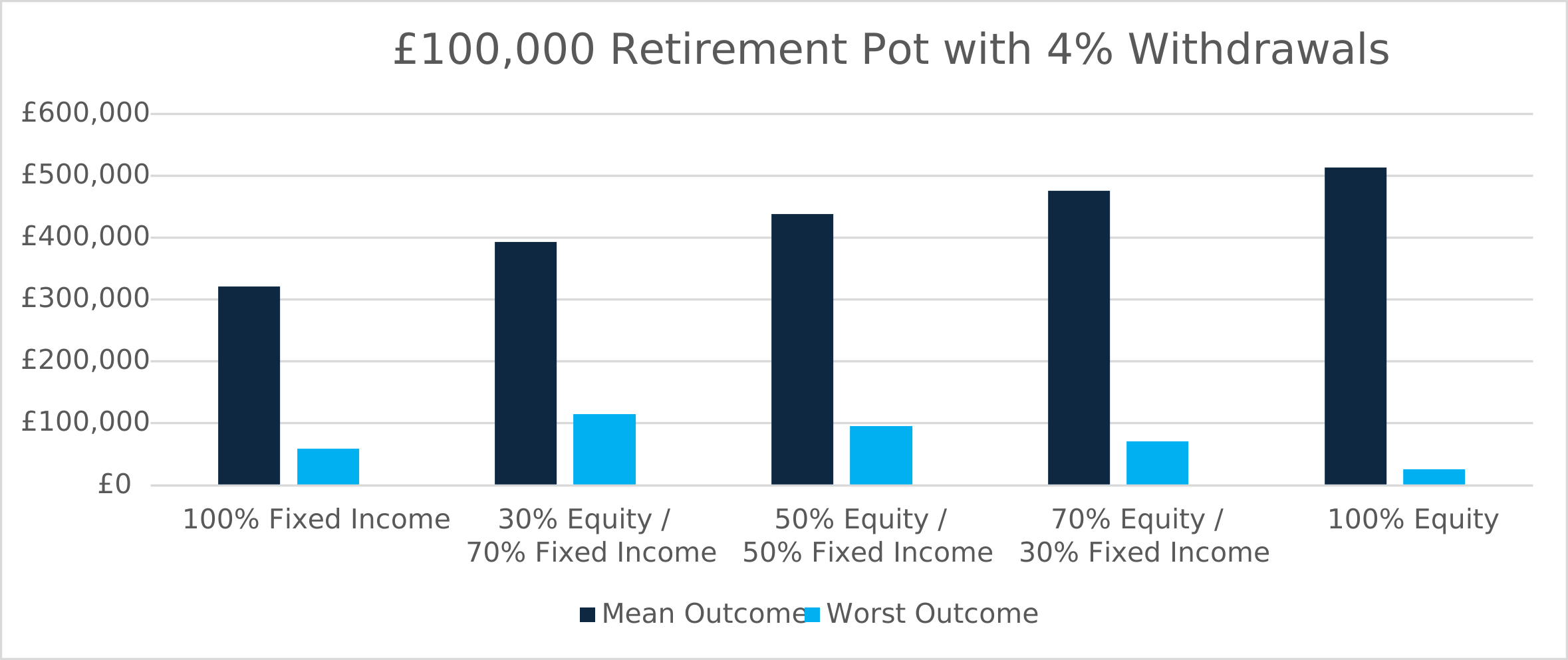
The chart above demonstrates that, on average, portfolios that maintain greater equity exposure outperform those that with greater fixed income exposure in most cases. However, greater equity exposure is likely to mean higher volatility and increased exposure to sequencing risk.
It’s noteworthy that the mean outcome for every portfolio resulted in significant sums remaining at the end of the 20-year period. On one hand this is encouraging, as it means that the ‘average’ client will be able to comfortably draw income for longer than 20 years as required. They may wish to leave a legacy or have funds accumulated for their later years where care funding may be needed. Our data suggests this is possible.
On the other hand, however, some clients may prefer to have a larger income in their early retirement years instead of a significant sum later in life.
With longer time horizons and/or increased withdrawal rates, the likelihood of running out of money increases.
What are the drawbacks and limitations of the 4% Rule?
Taking only 4% may not be enough for many clients
As a rough guide, client’s will need to have saved around 25 times their desired income, for a 4% rate of withdrawal to work. For those with more modest retirement savings, drawing just 4% a year may not provide sufficient retirement income, especially if retirement ahead of State Pension age is desired.
4% may be too cautious
Bengen identified that the 4% Rule was a cautious approach and catered for worst-case scenarios. Depending on clients’ attitude to risk and capacity for loss, higher withdrawals may provide a better outcome, albeit with potentially greater risk of running out of money.
In any event, individual circumstances must be explored carefully and advice and methodology underpinning that advice should be thoroughly documented. Small adjustments to withdrawal rates can have significant implications over the longer term. Cashflow modelling is one of the tools that should be regularly used to illustrate options and determine a suitable strategy.
The Risk of Accumulating Money
In our data, the average client who follows the 4% Rule ends up with significant sums accumulated. Ongoing reviews and careful assessment of client’s income needs, risk appetite and future plans will be required to ensure appropriate levels of withdrawal. While some clients may prefer to build capital while taking a retirement income – for things like later life care needs or to build a legacy, others will want to spend more in their earlier retirement years while health allows.
A more dynamic strategy with regular reviews may be more tailored to specific life stages and improve sustainability of income
A flat 4% withdrawal strategy is unlikely to reflect client’s real-world spending patterns in retirement. Retirees typically spend more in the early and later years of retirement, with reduced spending in the middle phase. This is because retirees tend to enjoy more active lifestyles early on, before slowing down as they age. In later years, spending may increase again for care costs.
A dynamic approach with guardrails may give higher income when needed and offer more sustainable income overall, but with some potential income compromises required in difficult markets.
The Guyton-Klinger Model
The Guyton-Klinger guardrails approach (Jonathan Guyton and William Klinger, 2006) is a dynamic withdrawal strategy designed to adapt to fluctuations in portfolio performance to manage failure risk and maintain longevity of income through retirement i.e. ensure clients don’t run out of money.
The Guyton-Klinger model prescribes the following approach:
- An initial withdrawal rate between 5.2% and 5.6% (based on US data), rising with inflation (CPI), capped at 6%
- A Prosperity Rule or upper guardrail for when the portfolio is performing well:
If the withdrawal rate drops 20% lower than the initial rate, due to a rising portfolio value, increase the withdrawals by 10% - A Capital Preservation Rule or lower guardrail to protect the longevity of the portfolio when investment performance suffers:
If the withdrawal rate rises 20% higher than the initial rate, due to a falling portfolio value, decrease the withdrawals by 10% - In the last 15 years of retirement, the lower guardrail can be removed if leaving a legacy sum is not a priority
Research shows that rules-based approaches are effective at providing early indicators of future portfolio failure. In Monte Carlo testing (where thousands of possible permutations are modelled to illustrate the range of possible outcomes), a rising Withdrawal‑Rate Ratio (WRR) was consistently associated with higher failure risk, often providing 10+ years of early warning.
Withdrawal Weight Ratio (WRR) = Annual Withdrawal Amount ÷ Portfolio Value
Example
If a £1,000,000 provides £40,000 a year in income
WRR = £40,000 ÷ £1,000,000 = 0.04 or 4%
If the portfolio falls in value to £800,000 and income remains the same the WRR rises
WRR = £40,000 ÷ £800,000 = 0.05 or 5%
In this scenario, a dynamic strategy like the Guyton-Klinger model would indicate that income should be reduced to protect the longevity of the portfolio.
As with any such model, market returns, inflation, client circumstances and risk tolerance will all impact on actual outcomes. Clients must also be able to adapt to reduced income if following this model over extended periods of poor market returns.
The Guyton-Klinger model uses historical US equity and treasury returns data. The differences between US and UK inflation, bond yields and currency exposure, mean UK investors may experience lower sustainable withdrawal rates and more frequent guardrail triggers.
Ongoing monitoring, capacity‑for‑loss assessment and clear documentation are essential to ensure the approach remains suitable under FCA requirements.
Sequence of Returns Risk – a Significant Consideration
The performance of a retiree’s investment portfolio during the early years of retirement has a significant impact on the longevity of their retirement income, even if average long-term returns are healthy. The sequence of returns, rather than the average return overall, is a major factor in the long-term performance of the portfolio.
The table below illustrates two retirees, both starting retirement with £1m portfolio and both taking a 4% income (plus inflation at 2.5%) for 30 years. In most years both clients achieved identical 6% returns on their portfolio, but client A suffered a 20% market fall in year 5. Client B suffered a 20% market fall in year 25.
Client A | Client B | |
|---|---|---|
Starting Balance | £1,000,000 | £1,000,000 |
Ending Balance | £181,688 | £887,362 |
Change | -£818,312 | -£112,638 |
In our model, both clients were able to draw a little over £1.75m in income over 30 years, however client A ended with over £700,000 less in their portfolio. This is simply down to timing of the market downturn affecting their portfolio in the early years. This downturn, in combination with their fixed withdrawals created permanent harm to the long-term returns of their retirement savings.
The Regulatory Perspective
Whichever retirement income strategy you implement with clients will require skilled ongoing advice to ensure good outcomes. The FCAs themes set out in 2024’s Retirement Income Review (TR24/1) need to be managed throughout to ensure suitability of advice, longevity of income and overall good outcomes.
The themes identified in the review are:
- Risk Profiling – both Attitude to Risk and Capacity for Loss need to be reassessed and reviewed specifically for decumulation.
- Income Withdrawal Strategies and Methodology – consideration of sustainability of withdrawals and robust, consistent cashflow modelling are required.
- Advice Suitability – thorough fact-finding and comprehensive notes capturing full information is required to demonstrate suitability.
- Control Frameworks – carefully managed, complete and accurate client data is needed along with governance practices and oversight of retirement advice.
- Periodic Review of Suitability – ongoing reviews are critical in retirement income planning. Firms must have processes to ensure reviews take place and that clients are not charged for reviews that don’t take place. Clear definition of what is covered is also expected to ensure consistency.
Conclusions
While the 4% Rule provides a simple, relatable, rule of thumb, real-world retirement income planning is multi-faceted. Like all financial planning, advisers need to balance clients wishes and aspirations with financial modelling and projections to deliver the most suitable outcomes.
Applying knowledge of the various strategies available, modelling those strategies with suitable cashflow planning and continuously reviewing progress in context with market conditions, income needs and the client’s risk appetite will ensure that client’s needs remain at the centre of their financial plan.
Educating clients remains an essential element of advice in retirement too. Insightful discussion about the balance of risk and reward, a dynamic approach to income, the role of annuities etc. all helps the client to feel informed and in control.
This consultative approach to ongoing advice will give clients not only a sustainable income but also the confidence to enjoy their retirement.