

Key Takeaways
- Despite the horror of events in the Middle East, the big issue for financial markets remains the prospects for interest rates, particularly US interest rates.
- Expect big cuts next year, much bigger than the market has priced in and much bigger than the Federal Reserve has been guiding.
- Progress will be data dependent. The Atlanta wage series, released on Friday, suggests the wage price spiral is no longer operating.
- US unemployment is continuing to edge higher in response to a revival in immigration and workers who exited the labour force during Covid, re-joining. Both trends have further to go.
Despite the horror and drama of events in the Middle East, the big issue for financial markets right now is the prospects for interest rates. And US interest rates matter more than any other. So, I’ll start there and explain why I think we will see big cuts next year, much bigger than the market has priced in and much bigger than the Federal Reserve has told us to expect. I’ll then consider whether interest rates in the UK and Europe might follow suit.
I have to concede that US data, so far this month, has not gone my way. The jobs data were strong and the details of the consumer price report showed areas where inflation looked sticky. As fears of recession in the US have receded in recent months and the ‘higher for longer’ view on official interest rates gained traction, the bond market took fright and yields rose. Finally, The Federal Reserve responded last Monday with a series of apparently coordinated speeches suggesting that bond yields had gone too far. The result was a significant bond market rally last week.
But progress from here will be data dependent. And I think that my view, on the prospects for lower interest rates and lower bond yields, will get support over the next few weeks.
US firms no longer losing staff to higher paying rivals
Wage inflation % change year on year
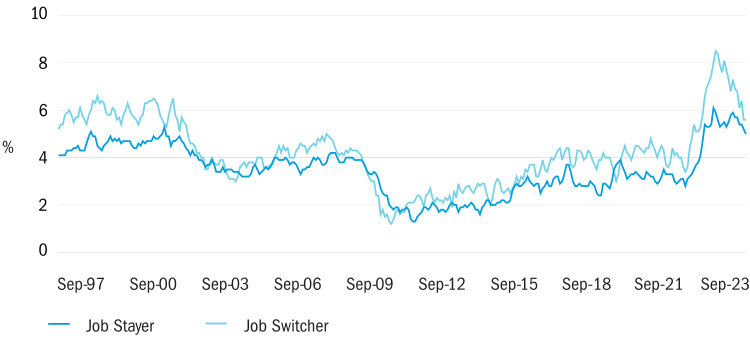
Source: Columbia Threadneedle Investments and Atlanta Federal Reserve as at 13 September 2023
I begin by drawing attention to further progress on wage inflation, based on the series complied by the Atlanta Federal Reserve and released on Friday evening. It showed a further significant fall in overall wage inflation. More importantly, the gap between those who changed jobs in the last year and those who stayed put, has narrowed substantially. That’s important because it suggests that firms are no longer losing staff to rivals and no longer having to pay more to attract new staff. Alongside other indicators, this suggests that the labour market is back to normal and is no longer a source of upward pressure: the wage price spiral is no longer operating.
The Atlanta wage series is influential in the Federal Reserve for two reasons. First is that it is available monthly and gives a clue to the wage measure that the Federal Reserve prefers, the employment cost index (ECI) that only comes out quarterly. The Atlanta index tracks the wages of specific individuals. As a result, it is not subject to the compositional effects that plague many other measures of wages. For example, if lots of low paid workers get jobs, the average wage would fall even though no one had had a wage cut. The downside is that it imparts an upward bias: wage inflation on the Atlanta measure averages 1% above the ECI. We get the next ECI numbers at the end of the month. And my calculations suggest that it could come in at 4.1 to 4.2%. That would be well below previous numbers. Still too high to be consistent with the Fed’s 2% target but clearly heading in the right direction.
Hopes of rate cuts in 2024 would also improve if US unemployment were to continue to edge higher. This has occurred despite strong jobs growth because labour supply has been even stronger, bolstered by a revival in immigration and workers who left the labour force during Covid re-joining. Both trends have further to go. The increase in unemployment so far has been modest and the level remains low but there are good reasons to expect a further increase: student loan repayments have restarted last month, a big hit to the incomes of those affected, so consumer demand will have been squeezed. Auto strikes will cut jobs directly and indirectly and a government shutdown remains a distinct possibility. We are likely to hit something called the Sahm rule early next year. This identifies a recession if the unemployment rate rises from its trough by 0.5% over three months. The increase to date is 0.4%. This rule is more accurate, especially as regards timing, than the more familiar yield curve which has been pointing to recession for almost a year now.
If we do get a recession, it should be mild and with wage and price inflation on a clear downward trend. I would expect the Fed to respond quickly, sometime early next year, and deliver over 100 bps of cuts in 2024.
In the UK, we get labour market data this week and I expect to see further progress from the Bank of England’s viewpoint. Wage and price inflation are much higher here than in the US but markets will take heart if the US pans out as I expect and rates and yields should fall here too, if I’m right. Europe should see a smaller effect and it may take longer for the ECB to react. We shall see.