
at
AT
Austria
de-AT
at_inst_classes
inst
Institutional
de
de
Insights

Fast-moving valuation case prompts Japan downgrade

The old adage “money makes the world go round” has never rung so true. In the investment world, money translates into corporate earnings and cash flows, which analysts have used for years to value companies.

But what happens when this “money” dries up? That is essentially what we have seen in the past few weeks – firms across the world, both big and small, have seen a liquidity crunch as spending by consumers and businesses has essentially ground to a sudden halt. Add to that the difficulty in predicting how countries will continue to be affected by and recover from Covid-19, and we have the ingredients for forecasting uncertainty. Valuing companies just became a whole lot harder.

In the absence of a clear trajectory around corporate cash flows and earnings, with many companies themselves withdrawing future guidance, using some of the more conventional valuation techniques such as price-to-earnings is challenging given the unknown denominator. So, during recent bouts of market volatility, we have found book value analysis a helpful tool in the equity valuation toolkit, given that it tends to be more static in nature.

Book value analysis essentially seeks to determine the realisable value of a company’s assets in the event of liquidation, ie, what is left for equity holders according to the company’s balance sheet. A 1x price-to-book value would imply that the market is only willing to pay the equivalent of book value for a company, or in other words does not believe that the company can deliver significant positive growth from its assets.

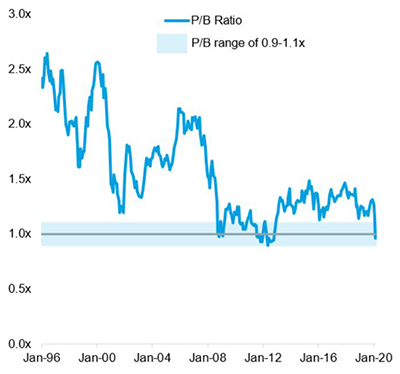
We applied this valuation lens to equity markets in early March, seeking to determine levels at which different regions would reach attractive enough levels for us to deploy our risk budget. As markets tracked downwards, Japan increasingly stood out with prices falling through 1x book values in mid-March – very close to the lows of the past 20 or more years (Figure 1). History tells us that prospective 12-month returns from these levels are asymmetric to the upside (Figure 2), hence we added to our Japanese equity exposure.

Figure 1: Price to book for TOPIX fell below 1x
p b ratio range of 0 9 1 1 x graph

Figure 2: Distribution of subsequent
1-year returns from a P/B starting
point of 0.9-1.1x
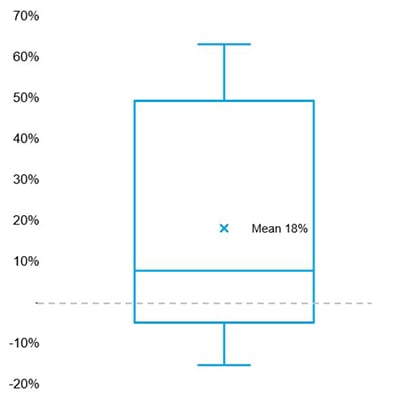
Chart with percentages mean 18 percent

Source for both charts: Columbia Threadneedle and Bloomberg, 31 March 2020.

However, with decade-high volatility, key valuation levels are being triggered more frequently and, with the fast-moving economic and human response to Covid-19, fundamentals are changing quickly too.

Japan’s outperformance

In the case of Japan, the equity market managed to outperform global equities by a stellar 13% over the second half of March, making relative valuations less attractive within a short space of time. Although still supported by the long-term structural improvement story of better corporate governance, Japan is a strongly cyclical and operationally leveraged market that is highly exposed to “sudden stops” in global activity; room for stimulus is also judged to be more constrained than elsewhere. And, unlike other regions, savage falls in earnings expectations had yet to come as of a week ago – unrealistic by our judgment.

In keeping with our investment process, where either changing valuations and/or fundamentals can prompt a change in view, we have downgraded Japan to a neutral from favour, reflecting those fuller relative valuations and softer fundamentals in the current global setting. Although we retain an overall preference for equities (alongside higher-grade credit), today it feels prudent to concentrate risk in less cyclical areas better placed to weather the storm.

In these abnormal times, money does not make the world go round – healthcare workers do. But markets remain open and dislocations will continue to emerge as the markets attempt to price the effects of this unprecedented and sudden stop to the normal flow of money.


20 April 2020
Share article
Hauptthemen
Verwandte Themen
Listen on Stitcher badge
Share article
Hauptthemen
Verwandte Themen

Wichtige informationen

Das hier zugrundeliegende Research und die Analysen sind von Columbia Threadneedle Investments für die eigenen Investmentaktivitäten erstellt worden. Aufgrund dieser sind möglicherweise bereits Entscheidungen noch vor dieser Publikation getroffen worden. Die Veröffentlichung zum jetzigen Zeitpunkt geschieht zufällig. Aus externen Quellen bezogene Informationen werden zwar als glaubwürdig angesehen, für ihren Wahrheitsgehalt und ihre Vollständigkeit kann jedoch keine Garantie übernommen werden. Alle enthaltenen Meinungsäußerungen entsprechen dem Stand zum Zeitpunkt der Veröffentlichung, können jedoch ohne Benachrichtigung geändert werden.

Verwandte Beiträge

15 Juni 2026

Anthony Willis

Senior Economist, Multi-Asset Solutions team

Market Perspectives: The ceasefire and its consequences

Reports of a potential US-Iran agreement mark a material shift in the Middle East risk backdrop.
8 Juni 2026

Anthony Willis

Senior Economist, Multi-Asset Solutions team

Market Perspectives: Goldilocks no more?

After a long run higher, US equities have been reminded that strong fundamentals do not eliminate volatility.
1 Juni 2026

Anthony Willis

Senior Economist, Multi-Asset Solutions team

Market Perspectives: Falling oil, rising optimism

Investor sentiment has improved as markets assess the possibility of further de-escalation between the US and Iran – whether through a broader agreement or an extension of the ceasefire.
17 Juni 2026

Tiffany Wade

Senior Portfolio Manager

David Goodman

Senior Equity Research Analyst

Beyond hype: AI benefits taking shape

AI is moving beyond the hype cycle, with real productivity gains beginning to emerge. The biggest investment opportunities may lie with companies that can translate adoption into durable competitive advantage.
16 Juni 2026

In Credit Weekly Snapshot – The only way is up

A peace deal between the US and Iran should see the Strait of Hormuz reopen, which triggered a sharp selloff in the oil price and a rally in bond markets. Read on for a breakdown of fixed income news across sectors and regions.
16 Juni 2026

Rosa Fenwick

Head of LDI Implementation

LDI market review and outlook June 2026 – Nothing Trumps political infighting

Political and geopolitical shocks have revived inflation and growth risks, complicating central banks’ easing plans and increasing pressure on UK gilts.
true
true

Wichtige informationen

Das hier zugrundeliegende Research und die Analysen sind von Columbia Threadneedle Investments für die eigenen Investmentaktivitäten erstellt worden. Aufgrund dieser sind möglicherweise bereits Entscheidungen noch vor dieser Publikation getroffen worden. Die Veröffentlichung zum jetzigen Zeitpunkt geschieht zufällig. Aus externen Quellen bezogene Informationen werden zwar als glaubwürdig angesehen, für ihren Wahrheitsgehalt und ihre Vollständigkeit kann jedoch keine Garantie übernommen werden. Alle enthaltenen Meinungsäußerungen entsprechen dem Stand zum Zeitpunkt der Veröffentlichung, können jedoch ohne Benachrichtigung geändert werden.

Das könnte Ihnen auch gefallen

Investmentansatz

Teamwork bildet eine wichtige Grundlage unseres Anlageprozesses, der so strukturiert ist, dass er die Ausarbeitung, Bewertung und Umsetzung fundierter und vielversprechender Anlageideen für unsere Portfolios erleichtert.

Fonds

Columbia Threadneedle Investments bietet eine umfangreiche Palette von Investmentfonds an, die eine Vielzahl von Anlagezielen abdeckt.

Anlagekapazitäten

Wir bieten eine breite Palette aktiv verwalteter Anlagestrategien und -lösungen, die globale, regionale und lokale Märkte und Anlageklassen abdecken.

Bitte bestätigen Sie einige Angaben zu Ihrer Person, um Ihr Präferenzzentrum zu besuchen

*Pflichtfelder

Etwas ist schiefgelaufen, bitte versuchen Sie es erneut

Vielen Dank. Sie können jetzt Ihr Präferenzzentrum besuchen, um auszuwählen, welche Einblicke Sie per E-Mail erhalten möchten.

Um zu sehen und zu aktualisieren, welche Erkenntnisse Sie von uns per E-Mail erhalten, besuchen Sie bitte Ihr Preference Center.