
pt
PT
Portugal
pt-PT
pt_intm_classes
intm
Intermediary
pt
pt
Insights

Asset Allocation Update – January 2020

Why add to (UK) equities?

What a difference a year makes. After a bruising 2018, last year allowed investors to capture the second-best return on a blend of global equities and long-dated bonds in 30 years. For stocks it was also a year of record multiple expansion, trounced on only one occasion since the late 1980s – in 2009, when markets were recovering from the crushing financial crisis. Ergo: in 2020, earnings will need to “grow in” to prices for the rally to have “legs” (Figure 1).
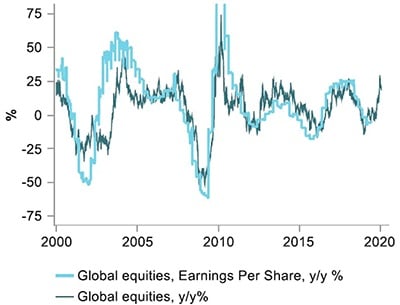
Figure 1: Global equities (MSCI) earnings per share vs. prices (lead 156 days)
Global equities earnings per share graph

Sources: Bloomberg, Macrobond and Columbia Threadneedle Investments, 27 January 2020.

There are at least two reasons to think that they may. First, threats around global trade and a harder Brexit are considerably lower than they were, even in mid-December1. Less uncertainty should allow business confidence and corporate earnings to recover somewhat in 2020, particularly in areas that were most sensitive to developments in each.

Second, on both consensus as well as our own forecasts, economic growth is poised to be almost “Goldilocks-like” – not so strong that interest rates will need to rise, nor so weak to rekindle fears of recession. Policymakers are thus postured to be “low for longer”, so the discount rate applied to anticipated earnings is likely to remain helpfully low, with credit spreads contained. The latter makes for uncomfortable broad-based equity investing, if bond markets are in the wrong place. But there are some exceptions – and the UK increasingly appears as one of them.
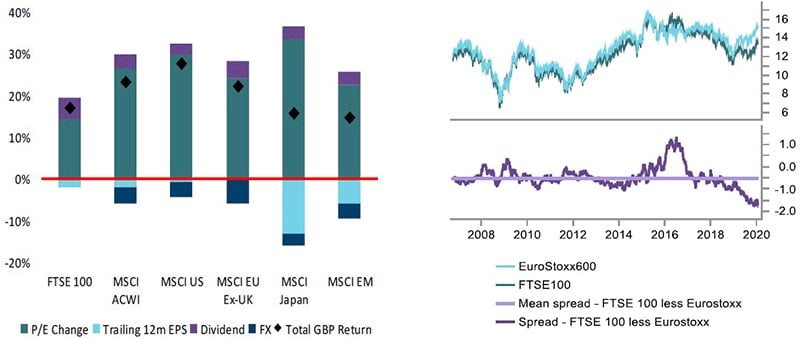
Figures 2 and 3: Disaggregated 2019 returns from a GBP perspective (lhs); Absolute and relative one-year forward P/E ratio
Ftse 100 msci graph

Uk equities back in favour

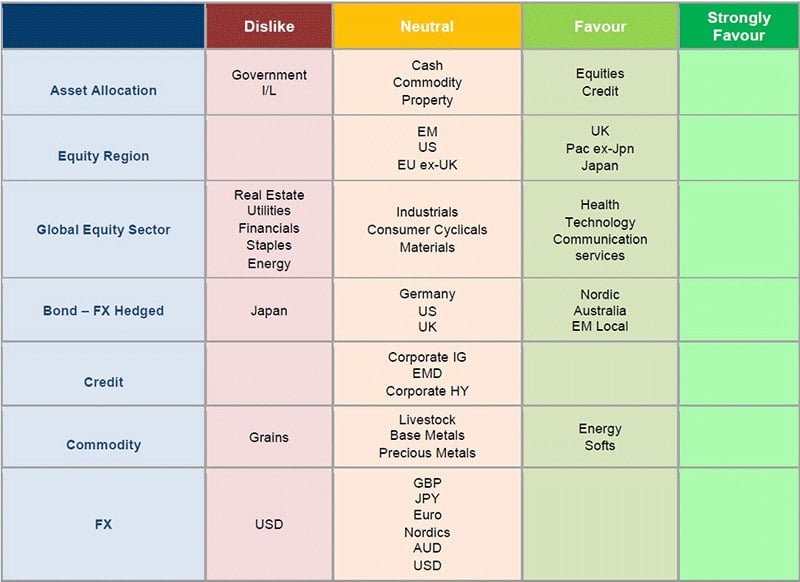
In early January we raised our allocation to UK stocks to favour, from neutral previously, thereby lifting equities overall to a preferred asset class. Although UK stocks participated in last year’s broader rerating (Figure 2), the move relative to other markets was sufficiently subdued that the gap between one-year forward P/Es widened to nearly two turns versus Europe and three-and-ahalf turns versus global equities – more than double historical averages and 15-year extremes (Figure 3). Investor underweights also appear extreme, notwithstanding the modest rise in ETF flows post the election.
That is not to say that the outlook for the UK is certain; rather it is meaningfully less uncertain than a month or two ago. Risks around the final destination of Brexit remain: with a weighty Conservative majority, the probability of a thin trade agreement might have in fact have risen, and the positive tail of a deal preserving the benefits of close alignment is diminished. Any deal or indeed extension of transition arrangements also requires agreement by all EU member states. Against this, however, the risks of higher corporate tax rates, nationalisation and a greater regulatory burden promised by a Jeremy Corbyn-led government have disappeared. And, of course, the UK is also an essentially defensive market, with decent dividends intact.
On balance, the UK market offers an attractive risk premium, both in its own context and particularly against other markets. The turn in analyst earnings revisions in recent weeks suggests greater optimism than that which is baked into current market valuations.
Figure 4: Asset allocation snapshot
Asset allocation dislike table

Source: Columbia Threadneedle Investments, 27 January 2020.

20 Janeiro 2020
Artikel delen
Key topics
Related topics
Listen on Stitcher badge
Artikel delen
Key topics
Related topics

1 This is not to say they are resolved – see https://www.piie.com/experts/peterson-perspectives/trade-talks-episode-118-ins-and-outs-us-china-phase-one-trade-deal for example. But the direction of travel has shifted.

Informação importante

A pesquisa e análise incluídas neste site foram produzidas pela Columbia Threadneedle Investments para suas próprias atividades de gerenciamento de investimentos, podem ter sido realizadas antes da publicação e são disponibilizadas aqui aliás. Quaisquer opiniões expressas são feitas na data da publicação, mas estão sujeitas a alterações sem aviso prévio e não devem ser vistas como conselhos de investimento. As informações obtidas de fontes externas são consideradas confiáveis, mas sua precisão ou integridade não pode ser garantida.

Related Insights

19 Janeiro 2026

Anthony Willis

Senior Economist, Multi-Asset Solutions team

Market Perspectives: How serious is the US threat to Europe over Greenland?

It’s been another busy week in terms of geopolitics as the US continues to ramp up rhetoric around the ownership of Greenland.
12 Janeiro 2026

Anthony Willis

Senior Economist, Multi-Asset Solutions team

Weekly Perspectives: What could unsettle financial markets?

In terms of geopolitical newsflow it has been a very busy start to 2026. We have seen attention on Venezuela, Iran and Greenland to name but a few. Thus far, however, financial markets remain untroubled.
5 Janeiro 2026

Anthony Willis

Senior Economist, Multi-Asset Solutions team

Weekly Perspectives: Will the latest geopolitical shock derail markets?

Welcome to the first market perspectives of 2026. Today we focus on geopolitics and US actions in removing Venezuelan President Maduro over the weekend.
22 Janeiro 2026

Daisuke Nomoto

Portfolio Manager, Japanese Equities

Simon Morton-Grant

Client Portfolio Manager

The early innings: Why Japan's structural story has years to run

Corporate governance reforms, capital reallocation and attractive valuations create a compelling multi-year investment thesis.
20 Janeiro 2026

In Credit Weekly Snapshot – It’s not easy being Greenland

US ambitions in Greenland, and the subsequent levying of tariffs on nonsupportive European nations, have dominated headlines.
20 Janeiro 2026

Gary Smith

Head of EMEA Client Portfolio Manager team, Fixed Income

Luke Copley

Client Portfolio Manager, Fixed Income

Why investors should choose active for fixed income

Passive fixed income strategies may look efficient, but their structural flaws have long created opportunities for active managers to shine.
true
true

Informação importante

A pesquisa e análise incluídas neste site foram produzidas pela Columbia Threadneedle Investments para suas próprias atividades de gerenciamento de investimentos, podem ter sido realizadas antes da publicação e são disponibilizadas aqui aliás. Quaisquer opiniões expressas são feitas na data da publicação, mas estão sujeitas a alterações sem aviso prévio e não devem ser vistas como conselhos de investimento. As informações obtidas de fontes externas são consideradas confiáveis, mas sua precisão ou integridade não pode ser garantida.

Também poderá gostar de

Sobre nós

Milhões de pessoas em todo o mundo confiam na Columbia Threadneedle Investments para gerir o seu dinheiro. Acompanhamos investimentos para investidores individuais, consultores financeiros, gestores de património, bem como companhias de seguros, fundos de pensões e outras instituições.

Contactos

Para mais informações sobre a Columbia Threadneedle Investments ou os nossos produtos, entre em contacto connosco ou com o seu consultor.

Responsabilidade social corporativa

Nuestro objetivo consiste en obtener resultados positivos que satisfagan las necesidades de nuestras partes interesadas, y nos comprometemos a actuar siempre de forma responsable y transparente, velando por los intereses de las personas que nos confían la gestión de sus inversiones.