






Insights
Diversification
The securitised universe covers a multitude of sub-sectors including: residential mortgage-backed, both non-agency and government-sponsored enterprise (GSE) or agency; commercial mortgage-backed; and asset-backed securities involving a range of receivables from student loans and auto loans to credit card debt. In addition, collateralised loan obligations (CLOs) provide exposure to pools of corporate debt typically aimed at small- to mid-market companies.
Such variety means there is a broader range of economic drivers (the housing cycle, consumer sentiment) versus traditional corporate bonds and their business cycle sensitivity. At a security level, exposure to a deep asset pool offers greater diversification of idiosyncratic risk relative to the issuer risk of a single corporate bond.
Higher quality, higher yields
The global financial crisis (GFC) fundamentally transformed the securitisation market. The regulatory response post-GFC brought substantial reforms that lead to significant improvements in security and quality standards and ultimately drove greater investor protection. The 2010 Dodd-Frank Act introduced risk retention requirements, mandating that originators retain some form of credit risk in the deal. This created a strong alignment of incentives. Enhanced disclosure requirements now provide much more detailed information about underlying assets, including loan-level data and standardised reporting formats.
These reforms have delivered tangible benefits in terms of tighter underwriting standards and higher asset quality, along with more rigorous income verification, improved borrower qualification criteria, and generally lower loan to values (LTVs), promoting better affordability.
In addition to rising asset quality, there are also stronger structural protections and credit enhancement within securitisations to help minimise credit losses – for example, senior tranches will typically be significantly over-collateralised.
Despite the high quality of the asset class, securitised credit typically offers a spread premium over similarly rated corporate bonds. This rewards investors for the complexity of undertaking asset pool quality analysis and understanding the details of each deal structure. Typically, the asset class must be researched by specialist analyst teams.
The spread premium also exists in part due to some of the inherent market inefficiencies of the asset class. The securitised market is more segmented than corporate bonds, with different investor types targeting different market segments (based on risk/return appetite or regulatory treatment – especially the capital charges for banks and insurers). This can create relatively less competition for pricing, allowing for wider spreads.
There is an element of additional reward premium for the negative convexity risk of some securitised assets, typically residential mortgage-backed securities (MBS) that allow for early repayment: when rates fall, prepayments accelerate and therefore the life of the security shortens. This reduces the total income received, while duration can extend when rates rise. This opens a rich relative value opportunity set where, based on proprietary analysis of expected prepayment behaviour, it is possible to identify attractively priced securities and harvest some of this risk premium.
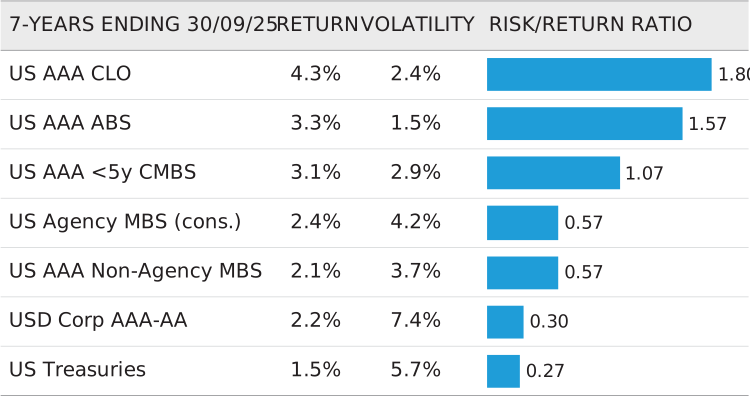
Given the mix of higher quality and higher yields on offer, securitised assets have historically outperformed comparable corporate credit, both on an absolute return and risk-adjusted basis.
Source: Bloomberg, ICE, Citi, Columbia Threadneedle, as of 30 September 2025. Based on total return index data in USD terms. CLO: Collateralised loan obligations. ABS: Asset-backed securities. CMBS: Commercial mortgage-backed securities. MBS: Mortgage-backed securities. Cons: constrained. All data annualised.
Lower market sensitivity
Most securitised assets typically have a weighted average life of three to six years. Therefore they have a generally lower spread duration sensitivity versus similar-rated corporate bonds, where issuance typically pools around seven to 10 years (and has been increasingly termed out as issuers take advantage of the compressed spread environment).
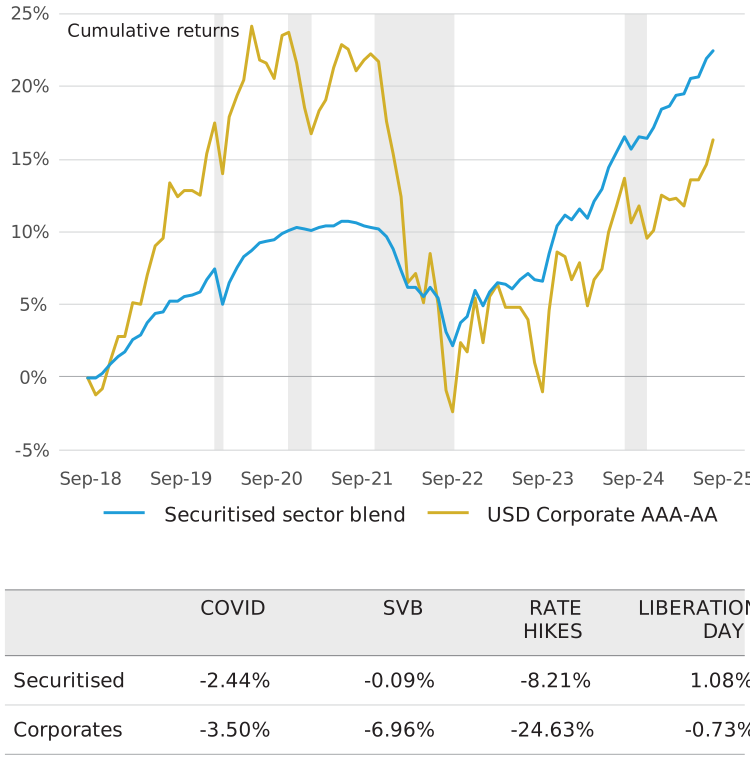
In addition, many securitised deals (and especially CLOs) offer floating-rate coupons, eliminating interest rate volatility. The combination of lower rate and credit sensitivity has historically driven attractive risk-adjusted returns for senior tranche securitised assets versus corporate bonds in times of market stress (Figure 2). The floating structure has also resulted in a lower correlation to traditional fixed income sectors, and especially versus typical LDI portfolios – a useful feature in some collateral resilience scenarios.
Source: Bloomberg, ICE, Citi, Columbia Threadneedle, as of 30 September 2025. Grey bars on the chart represent the ‘shocks’ listed in the table from left to right. Based on total return index data in USD terms. Period: seven years ending 30 September 2025. SVB: Silicon Valley Bank. Securitised sector blend = equal-weighted return of the five securitised sub-sectors analysed in Figure 1.
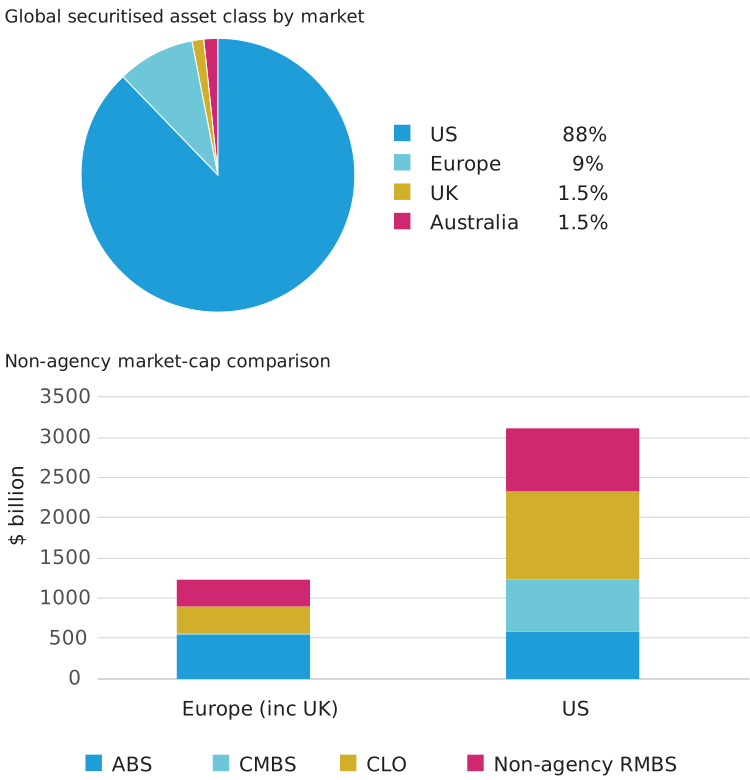
The US is the dominant securitised market globally, accounting for close to 90% of outstanding issuance (Figure 3 top). The market-cap of US assets is around $15 trillion, versus around $1.5 trillion in Europe. A key differentiator in the US is the presence of GSE or agency MBS deals that underpin the asset class from a liquidity and flow perspective. Overall, US assets tend to have higher liquidity, supported by a larger investor base and more frequent issuance.
In non-agency sectors, the greater breadth of deal types in the US is clear – with securities that provide exposure to an array of consumer sectors, commercial deals and a deep economy of smaller- to medium-sized businesses that underly the CLO industry (Figure 3 bottom). Geographic diversification can also be significant, versus many country-specific European structures.
Source: Bloomberg, Columbia Threadneedle, as of 31 October 2025.
The US market also attracts a broader investor base, with participants including money managers, pension funds, hedge funds, banks and insurers – so there is no dominant pension scheme position. The diverse nature of this base means the risk of correlated sales from a concentrated investor base is much lower than in regional European ABS markets.
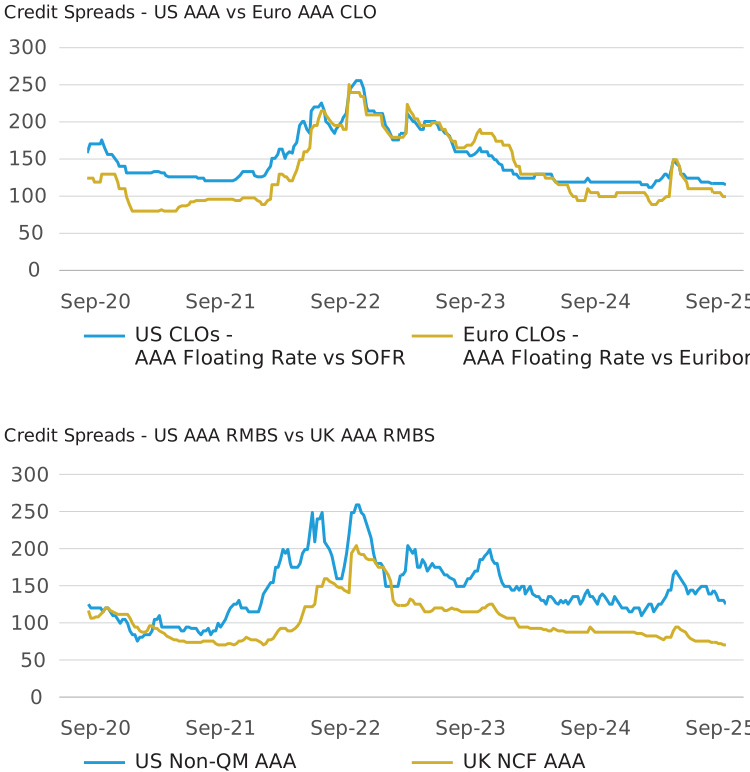
Additionally, there is a strong valuation argument for the US market: high grade US assets have typically demonstrated a yield advantage over comparable European and UK deals (Figure 4).
Source: BofA Global Research, Markit, ICE Data Indices, Wells Fargo Securities Yield Book, as at 31 October 2025
The are a number of key benefits of using US securitised assets as a collateral waterfall management tool for European LDI investors. These are:
LDI focus: Diversification benefits of US securitised credit
Key topics



For use by professional clients and/or equivalent investor types in your jurisdiction (not to be used with or passed on to retail clients). For marketing purposes.
This document is intended for informational purposes only and should not be considered representative of any particular investment. This should not be considered an offer or solicitation to buy or sell any securities or other financial instruments, or to provide investment advice or services. Investing involves risk including the risk of loss of principal. Your capital is at risk. Market risk may affect a single issuer, sector of the economy, industry or the market as a whole. The value of investments is not guaranteed, and therefore an investor may not get back the amount invested. International investing involves certain risks and volatility due to potential political, economic or currency fluctuations and different financial and accounting standards. The securities included herein are for illustrative purposes only, subject to change and should not be construed as a recommendation to buy or sell. Securities discussed may or may not prove profitable. The views expressed are as of the date given, may change as market or other conditions change and may differ from views expressed by other Columbia Threadneedle Investments (Columbia Threadneedle) associates or affiliates. Actual investments or investment decisions made by Columbia Threadneedle and its affiliates, whether for its own account or on behalf of clients, may not necessarily reflect the views expressed. This information is not intended to provide investment advice and does not take into consideration individual investor circumstances. Investment decisions should always be made based on an investor’s specific financial needs, objectives, goals, time horizon and risk tolerance. Asset classes described may not be suitable for all investors. Past performance does not guarantee future results, and no forecast should be considered a guarantee either. Information and opinions provided by third parties have been obtained from sources believed to be reliable, but accuracy and completeness cannot be guaranteed. This document and its contents have not been reviewed by any regulatory authority.
In Australia: Issued by Threadneedle Investments Singapore (Pte.) Limited [“TIS”], ARBN 600 027 414. TIS is exempt from the requirement to hold an Australian financial services licence under the Corporations Act 2001 (Cth) and relies on Class Order 03/1102 in respect of the financial services it provides to wholesale clients in Australia. This document should only be distributed in Australia to “wholesale clients” as defined in Section 761G of the Corporations Act. TIS is regulated in Singapore (Registration number: 201101559W) by the Monetary Authority of Singapore under the Securities and Futures Act (Chapter 289), which differ from Australian laws.
In Singapore: Issued by Threadneedle Investments Singapore (Pte.) Limited, 3 Killiney Road, #07-07, Winsland House 1, Singapore 239519, which is regulated in Singapore by the Monetary Authority of Singapore under the Securities and Futures Act (Chapter 289). Registration number: 201101559W. This advertisement has not been reviewed by the Monetary Authority of Singapore.
In Hong Kong: Issued by Threadneedle Portfolio Services Hong Kong Limited 天利投資管理香港有限公司. Unit 3004, Two Exchange Square, 8 Connaught Place, Hong Kong, which is licensed by the Securities and Futures Commission (“SFC”) to conduct Type 1 regulated activities (CE:AQA779). Registered in Hong Kong under the Companies Ordinance (Chapter 622), No. 1173058.
In Japan: Issued by Columbia Threadneedle Investments Japan Co., Ltd. Financial Instruments Business Operator, The Director-General of Kanto Local Finance Bureau (FIBO) No.3281, and a member of Japan Investment Advisers Association and Type II Financial Instruments Firms Association.
In the UK: Issued by Threadneedle Asset Management Limited, No. 573204 and/or Columbia Threadneedle Management Limited, No. 517895, both registered in England and Wales and authorised and regulated in the UK by the Financial Conduct Authority.
In the EEA: Issued by Threadneedle Management Luxembourg S.A., registered with the Registre de Commerce et des Sociétés (Luxembourg), No. B 110242 and/or Columbia Threadneedle Netherlands B.V., regulated by the Dutch Authority for the Financial Markets (AFM), registered No. 08068841.
In Switzerland: Issued by Threadneedle Portfolio Services AG, Registered address: Claridenstrasse 41, 8002 Zurich, Switzerland.
In the Middle East: This document is distributed by Columbia Threadneedle Investments (ME) Limited, which is regulated by the Dubai Financial Services Authority (DFSA). For Distributors: This document is intended to provide distributors with information about Group products and services and is not for further distribution. For Institutional Clients: The information in this document is not intended as financial advice and is only intended for persons with appropriate investment knowledge and who meet the regulatory criteria to be classified as a Professional Client or Market Counterparties and no other Person should act upon it.
This document may be made available to you by an affiliated company which is part of the Columbia Threadneedle Investments group of companies: Columbia Threadneedle Management Limited in the UK; Columbia Threadneedle Netherlands B.V., regulated by the Dutch Authority for the Financial Markets (AFM), registered No. 08068841.
Columbia Threadneedle Investments is the global brand name of the Columbia and Threadneedle group of companies. © 2025 Columbia Threadneedle. All rights reserved.
For use by professional clients and/or equivalent investor types in your jurisdiction (not to be used with or passed on to retail clients). For marketing purposes.
This document is intended for informational purposes only and should not be considered representative of any particular investment. This should not be considered an offer or solicitation to buy or sell any securities or other financial instruments, or to provide investment advice or services. Investing involves risk including the risk of loss of principal. Your capital is at risk. Market risk may affect a single issuer, sector of the economy, industry or the market as a whole. The value of investments is not guaranteed, and therefore an investor may not get back the amount invested. International investing involves certain risks and volatility due to potential political, economic or currency fluctuations and different financial and accounting standards. The securities included herein are for illustrative purposes only, subject to change and should not be construed as a recommendation to buy or sell. Securities discussed may or may not prove profitable. The views expressed are as of the date given, may change as market or other conditions change and may differ from views expressed by other Columbia Threadneedle Investments (Columbia Threadneedle) associates or affiliates. Actual investments or investment decisions made by Columbia Threadneedle and its affiliates, whether for its own account or on behalf of clients, may not necessarily reflect the views expressed. This information is not intended to provide investment advice and does not take into consideration individual investor circumstances. Investment decisions should always be made based on an investor’s specific financial needs, objectives, goals, time horizon and risk tolerance. Asset classes described may not be suitable for all investors. Past performance does not guarantee future results, and no forecast should be considered a guarantee either. Information and opinions provided by third parties have been obtained from sources believed to be reliable, but accuracy and completeness cannot be guaranteed. This document and its contents have not been reviewed by any regulatory authority.
In Australia: Issued by Threadneedle Investments Singapore (Pte.) Limited [“TIS”], ARBN 600 027 414. TIS is exempt from the requirement to hold an Australian financial services licence under the Corporations Act 2001 (Cth) and relies on Class Order 03/1102 in respect of the financial services it provides to wholesale clients in Australia. This document should only be distributed in Australia to “wholesale clients” as defined in Section 761G of the Corporations Act. TIS is regulated in Singapore (Registration number: 201101559W) by the Monetary Authority of Singapore under the Securities and Futures Act (Chapter 289), which differ from Australian laws.
In Singapore: Issued by Threadneedle Investments Singapore (Pte.) Limited, 3 Killiney Road, #07-07, Winsland House 1, Singapore 239519, which is regulated in Singapore by the Monetary Authority of Singapore under the Securities and Futures Act (Chapter 289). Registration number: 201101559W. This advertisement has not been reviewed by the Monetary Authority of Singapore.
In Hong Kong: Issued by Threadneedle Portfolio Services Hong Kong Limited 天利投資管理香港有限公司. Unit 3004, Two Exchange Square, 8 Connaught Place, Hong Kong, which is licensed by the Securities and Futures Commission (“SFC”) to conduct Type 1 regulated activities (CE:AQA779). Registered in Hong Kong under the Companies Ordinance (Chapter 622), No. 1173058.
In Japan: Issued by Columbia Threadneedle Investments Japan Co., Ltd. Financial Instruments Business Operator, The Director-General of Kanto Local Finance Bureau (FIBO) No.3281, and a member of Japan Investment Advisers Association and Type II Financial Instruments Firms Association.
In the UK: Issued by Threadneedle Asset Management Limited, No. 573204 and/or Columbia Threadneedle Management Limited, No. 517895, both registered in England and Wales and authorised and regulated in the UK by the Financial Conduct Authority.
In the EEA: Issued by Threadneedle Management Luxembourg S.A., registered with the Registre de Commerce et des Sociétés (Luxembourg), No. B 110242 and/or Columbia Threadneedle Netherlands B.V., regulated by the Dutch Authority for the Financial Markets (AFM), registered No. 08068841.
In Switzerland: Issued by Threadneedle Portfolio Services AG, Registered address: Claridenstrasse 41, 8002 Zurich, Switzerland.
In the Middle East: This document is distributed by Columbia Threadneedle Investments (ME) Limited, which is regulated by the Dubai Financial Services Authority (DFSA). For Distributors: This document is intended to provide distributors with information about Group products and services and is not for further distribution. For Institutional Clients: The information in this document is not intended as financial advice and is only intended for persons with appropriate investment knowledge and who meet the regulatory criteria to be classified as a Professional Client or Market Counterparties and no other Person should act upon it.
This document may be made available to you by an affiliated company which is part of the Columbia Threadneedle Investments group of companies: Columbia Threadneedle Management Limited in the UK; Columbia Threadneedle Netherlands B.V., regulated by the Dutch Authority for the Financial Markets (AFM), registered No. 08068841.
Columbia Threadneedle Investments is the global brand name of the Columbia and Threadneedle group of companies. © 2025 Columbia Threadneedle. All rights reserved.
The analysis included on this website is for professional investors in EMEA APAC. This material should not be considered as an offer, solicitation, advice or an investment recommendation. This communication is valid at the date of publication and may be subject to change without notice. Any opinions expressed are made as at the date of publication but are subject to change without notice and should not be seen as investment advice. Information obtained from external sources is believed to be reliable but its accuracy or completeness cannot be guaranteed.
I have read and accept the terms and conditions of this site:

Sed ut perspiciatis unde omnis iste natus error sit voluptatem accusantium doloremque laudantium