
GB
gb
GB
en-GB
gb_intm_classes
intm
Intermediary
en
en

Is the US about to move into recession?

Before discussing the US, it’s worth highlighting the exceptionally good news in Europe of late. Last year, soaring natural gas prices led to high inflation and fears of recession and electricity blackouts in Europe. But a remarkably mild January coupled with a strong response in terms of reduced demand and increased supply have transformed the situation. Gas prices have tumbled. Coupled with much lower reported inflation, last week saw the biggest fall in German bund yields since unification over 30 years ago. Europe’s problems aren’t over yet, but the outlook has definitely brightened.

Turning to the US, Friday’s employment data showed another big rise in jobs and a decline in unemployment to the lowest level in modern times. So why am I talking of recession? The reason relates to the purchasing managers’ index for services. This slumped from a healthy 56.5 to 49.6, below the threshold of 50 that signals contraction. We have been waiting for this index to fall this low because it has a high weight on the housing sector, which is clearly in recession.

US Purchasing Managers’ Indices move into recession territory
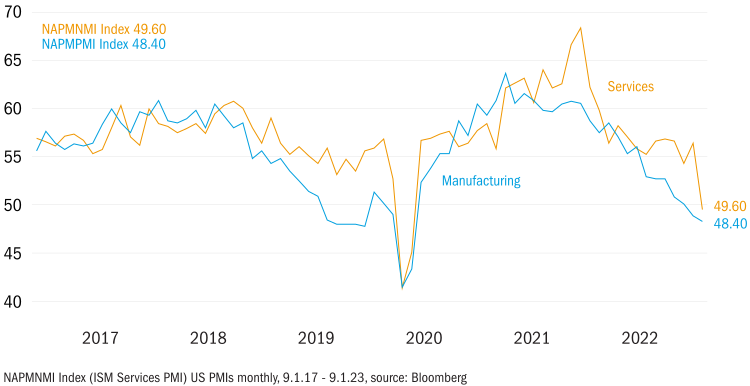
US Purchasing Managers’ Indices move into recession territor

Of course, one data point does not prove anything, but we think the overall tide is turning. One of the key supports for the US economy over the last year has been consumer spending, which remained strong despite the squeeze on real incomes. Households have been drawing on the huge fiscal support – ‘covid piggy banks’ – provided during the pandemic to fund their spending. Their confidence has been boosted by the low level of unemployment and, in recent months, by declining gasoline prices. But the covid piggy banks are beginning to run out and inflation has eroded the real value of existing savings.

Even if the economy does slow, as we expect, and demand for labour weakens, there is a long way to go before the Federal Reserve will feel confident that inflation is under control. This week should see another decline in both headline and core inflation, as measured by the consumer price index. The problem is that wage inflation is still too high. Don’t be misled by the decline in average hourly earnings figures published last week as they are distorted by compositional effects. The average increase fell because more low paid workers were employed. We got a much better read from the Atlanta wage tracker which showed that underling wage inflation remains high, far too high to be consistent with the Fed’s 2% inflation target. Even more worrying for the Fed is that wage rises for job switchers are accelerating so firms are being forced to raise pay for their existing workforce to avoid losing them to rivals.

The Fed’s preferred measure of wage inflation is the employment cost index. That’s only published quarterly, but it comes out at the end of January. That will matter more than this week’s CPI numbers.

So, what does all this mean for markets? First, weak economic data has been taking the pressure off bond markets and leading to a rally in equities. But if, as I expect, we need a recession to control wage and price inflation, equities would struggle as margins come under pressure. Second, the improvement in inflation is welcome but the Fed will not feel reassured until they see a sustained fall in wage increases. And unemployment needs to rise well above the current level of 3.5% to achieve that.

There is much talk of a pivot by the Fed and the markets pricing in only a modest further increase in Fed funds rate with cuts later this year. I expect the Fed to raise rates further than the markets expect and to hold them at that level for an extended period. A pause not a pivot.

We will hear from Jerome Powell, chair of the Fed, at a major conference in Sweden this week. I think he will push back on market optimism about US interest rates and this will be bad news for bonds and equities.


Steven Bell
Chief Economist, EMEA
Risk disclaimer

The value of investments and any income derived from them can go down as well as up as a result of market or currency movements and investors may not get back the original amount invested.

Views and opinions expressed by individual authors do not necessarily represent those of Columbia Threadneedle.

You might be interested in...

21 September 2026

Market Perspectives: The roadmap for central banks

After a series of policy meetings across the major central banks, the direction of travel for interest rates remains finely balanced.
7 September 2026

Market Perspectives: Why does the Fed have to hike rates?

Central bank policy is back at the forefront of investor attention as inflation data challenges expectations of an imminent easing cycle.
7 September 2026

Market Perspectives: Second guessing the central banks

Central banks are back in focus as investors enter a busy run of September policy meetings. The European Central Bank meets this week, followed by the Bank of England, the US Federal Reserve and the Bank of Japan next week.

Why Columbia Threadneedle for low-cost multi-asset

Columbia Threadneedle Universal MAP redefines value through active multi-asset solutions and business support at a passive price point. Fund OCFs at 0.29%-0.39%.

Our Portfolio

The Columbia Threadneedle Universal MAP and Sustainable MAP ranges offer risk-controlled portfolio options designed to cover a host of client growth, income and sustainability needs.

Important information

Columbia Threadneedle Investments is the global brand name of the Columbia and Threadneedle group of companies.

For professional investors only.

This financial promotion is issued for marketing and information purposes only by Columbia Threadneedle Investments in the UK.

The Fund is a sub fund of Columbia Threadneedle (UK) ICVC III, an open ended investment company (OEIC), registered in the UK and authorised by the Financial Conduct Authority (FCA).

English language copies of the Fund’s Prospectus, summarised investor rights, English language copies of the key investor information document (KIID) can be obtained from Columbia Threadneedle Investments, Cannon Place, 78 Cannon Street, London, EC4N 6AG, email: [email protected] or electronically at www.columbiathreadneedle.com. Please read the Prospectus before taking any investment decision.

The information provided in the marketing material does not constitute, and should not be construed as, investment advice or a recommendation to buy, sell or otherwise transact in the Funds. The manager has the right to terminate the arrangements made for marketing.

Financial promotions are issued for marketing and information purposes; in the United Kingdom by Columbia Threadneedle Management Limited, which is authorised and regulated by the Financial Conduct Authority; in the EEA by Columbia Threadneedle Netherlands B.V., which is regulated by the Dutch Authority for the Financial Markets (AFM); in Switzerland: Issued by Threadneedle Portfolio Services AG, Registered address: Claridenstrasse 41, 8002 Zurich, Switzerland. In the Middle East: This document is distributed by Columbia Threadneedle Investments (ME) Limited, which is regulated by the Dubai Financial Services Authority (DFSA). For Distributors: This document is intended to provide distributors with information about Group products and services and is not for further distribution. For Institutional Clients: The information in this document is not intended as financial advice and is only intended for persons with appropriate investment knowledge and who meet the regulatory criteria to be classified as a Professional Client or Market Counterparties and no other Person should act upon it.

Thank you. You can now visit your preference centre​ to choose which insights you would like to receive by email.

Thank you. You can now visit your preference centre​ to choose which insights you would like to receive by email.