

GB
gb
GB
en-GB
gb_inst_classes
inst
Institutional
en
en
For use by professional clients and/or equivalent investor types in your jurisdiction (not to be used with or passed on to retail clients).
View from space of the sun rising over Planet Earth

Insights

Global technology investing: AI and beyond

Vimal Patel
Vimal Patel
Senior Portfolio Manager

We sat down with two of our global technology portfolio managers to get an insight into what they are watching across the sector.

AI may dominate the technology conversation, but the investment opportunity extends well beyond it. Two of our global technology portfolio managers offer their perspectives on the opportunities, risks and trends shaping the sector in the year ahead.

As leading tech investors, what technology topics are top of mind for you right now?

Patel: For us, the risk factors, particularly around interest rates, are front and centre. What is driving the rates is the question – it’s tied to oil and then oil is tied to ongoing geopolitical tensions. This AI capex build-out is dependent on debt capital along with operating cash flow from the big hyperscalers.

Narang: In my over 30-year career as a technology investor, I don’t believe there has ever been a more important time to follow what is happening in the credit markets. The revenue growth rates, profitability, operating cash flows and the cost and availability of capital will help determine how long this build-out can last. We are closely monitoring long-term interest rates, credit spreads and the sheer amount of capital being raised across the AI ecosystem. We are seeing a growing divergence between the hyperscalers, Microsoft, Alphabet and Amazon, which have strong balance sheets and cash flow, and some newer AI infrastructure players that are more dependent on external financing. 

Outside of this dynamic, agentic AI, the adoption of open-source models, disruption across the software stack and AI safety remain major themes for us. Longer term, the key question is whether the industry can continue to fund this unprecedented build-out while generating attractive returns on that capital.

It has been shaping up to be a strong year for technology, but we have seen shifts in leadership. How do you think investors should think about tech leadership heading into 2027?

Narang: It has been a dynamic year. Early in the year, semiconductors and AI infrastructure significantly outperformed, while software lagged due to concerns around AI disruption. As the year progressed, investors began differentiating among software business models, and areas such as cybersecurity and infrastructure software emerged as beneficiaries.

We think that differentiation becomes even more important heading into 2027. Investors will increasingly focus on which companies can convert AI investments into durable revenue growth, earnings and cash flow. Rising financing costs, periodic pauses in spending and questions around return on investment could all create volatility along the way. For that reason, patience, diversification and active stock selection remain critical.

Patel: And as we go into 2027, we’re going to start to see a broadening out of the tech market where we may see more of the dislocated stocks start to do better. The market should begin to appreciate that not everything is about AI or AI capex. There is a broad set of companies that are taking AI to market and monetising it – whether it be software names, internet names, non-AI semiconductor names or IT hardware stocks. There’s tremendous value in many of these companies; they have strong cash flow, attractive valuations and good capital allocation programmes.

Narang: We think investors should remain selective even though the broader tech market’s valuations are not meaningfully different from their long-term averages. It’s important to remember that valuations across technology are not uniform, and market leadership can change quickly. The winners over the next several years are likely to be those companies that can demonstrate sustainable returns on AI investments rather than simply the largest spending plans. Staying diversified across business models and technology subsectors remains an important part of long-term success. 

Patel: We don’t think there’s anything amiss on the AI capex trade either – we just think there’s tremendous value in other areas.

Are there implications from the massive wave of technology company debt issuance on their equities, either individually or for the broader tech sector?

Patel: The bulk of the trillion dollars of hyperscaler capex comes from four companies that have good balance sheets and operating cash flow. The debt issuances are mostly investment grade; they’re a supplement to the operating cash flow and can likely continue irrespective of where interest rates may be going. The smaller neoclouds, which are former bitcoin miners, warrant more caution. They don’t have operating cash flow and are predominantly reliant on the debt markets to fund their investments. 

Hyperscalers are building out their AI capacity

Estimated capital spending in US$ billions
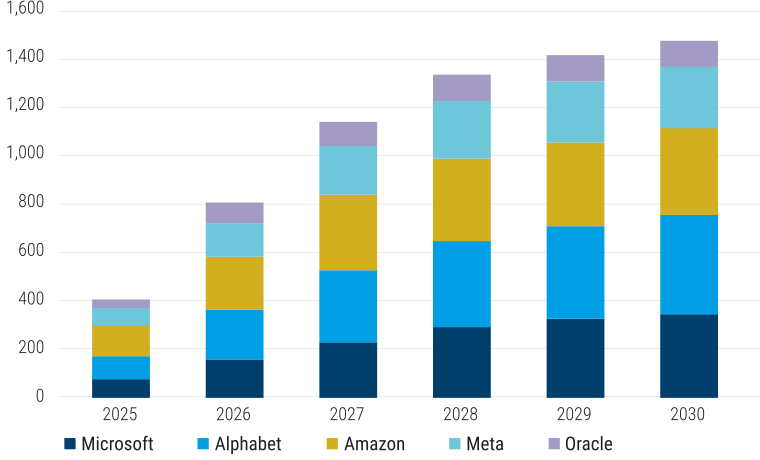
Hyperscalers are building out their AI capacity: Estimated capital spending in US$ billions

Source: Columbia Threadneedle Investments estimates, June 2026.

Narang: This is one of the most important debates in technology today. Beyond traditional investment-grade issuance, we are seeing data-centre financing, chip financing and equity raises across the ecosystem. We work closely with our fixed-income colleagues because changes in rates, credit spreads and financing availability can ultimately influence equity outcomes.

Hyperscalers are issuing debt to fund AI initiatives

Debt issuance in US$ billions
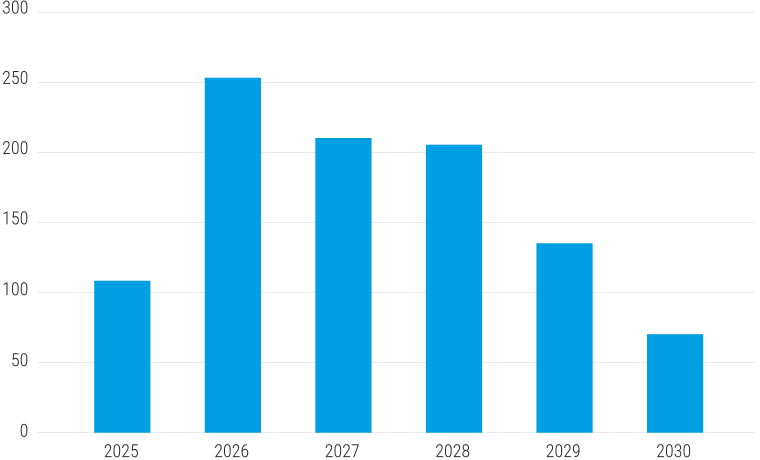
Hyperscalers are issuing debt to fund AI initiatives: Debt issuance in US$ billions

Source: Columbia Threadneedle Investments estimates, June 2026.

While the hyperscalers generally have the balance sheet strength and cash flow to support these investments, other parts of the ecosystem are more dependent on favourable financing conditions. Recent stress among several neocloud providers has reinforced the importance of understanding not only demand for AI infrastructure, but also the durability of the capital structure supporting that demand. Understanding the cost of capital is becoming just as important as understanding the technology itself.

We’ve seen the potential for disruption in parts of the technology sector as AI continues to gain traction. Are there areas that you think will continue to see these disruption fears?

Patel: I don’t think there’s anything that hasn’t been affected yet. First, it was the software as a service; then, concerns about agentic AI impacted the internet companies. I think the market reaction was to punish everything in software and now certain stocks are coming out of the ashes.

Narang: Technology moats are dynamic. Sustained leadership requires continuous innovation, a willingness to disrupt your own business and the ability to scale successfully. Companies that combine innovation leadership with pricing power and operational scale tend to create the most durable competitive advantages. We are monitoring closely how large language models may impact various parts of the software stack, as well as how personal AI agents could reshape existing business models over time. Certain business models relying on a single advantage, such as some application software providers, face potential disruption risk.

Patel: Not all software is going to rebound, but we’re focused on infrastructure and vertical software as opposed to application software.

What are some of the biggest concerns about the current state of global technology investing over the coming year?

Narang: We are monitoring government regulation, geopolitical tensions, energy prices, AI safety and the health of the credit markets. From an investment perspective, one of the most important questions is whether the returns from today’s AI spending emerge on the timeline investors expect. AI demand will likely see periods of volatility, digestion and changing investor sentiment. At some point, we would also expect hyperscaler capital spending growth to moderate. Our job is to distinguish between temporary volatility and more meaningful changes in the underlying fundamentals.

Patel: It’s also upon us to make sure we’re not just broadly buying all technology. We are seeing a bifurcation in the tech market and that in a higher interest rate environment we need to be more active stock pickers. Rates matter and therefore business models matter too.

What opportunities are you seeing outside the United States?

Patel: Our philosophy is first to find the best technology company in a given industry, and then no matter where that company may be, we initiate a position. We’re spending a lot more time in Japan, Korea and Taiwan looking for new ideas, but again finding the best company drives our process as opposed to the geographic location.

Narang: We also try to own great businesses in our strategy regardless of market cap or geographic location. We’re looking for sustainable competitive advantages, high barriers to entry, high barriers to scale and strong returns. Focusing on the moat of the business has been our north star and has served our clients well. We see opportunities in leading technology business models located in South Korea, Taiwan, Japan and the Netherlands, for example.

How do you differentiate between innovation and hype?

Narang: Rather than focusing solely on what could go right, we place a significant emphasis on understanding what could go wrong. That discipline comes from my time as a short seller and helps the team identify risks early, challenge consensus assumptions, avoid speculative market areas and maintain a strong focus on downside protection. Great technologies do not always make great investments if the underlying business model or financing structure is not sustainable.

In terms of overhyped fads versus true disruptors, we think by looking at revenue growth rates of disruptive companies, understanding the true value proposition, by talking to end users and by seeing how quickly leading incumbents are able to respond – which if it’s easy may suggest it’s evolutionary, not disruptive – are all ways to calibrate whether they may be meaningful disruptors.

Patel: I would emphasise our deep research process. Our analysts are industry experts as well as stock experts. Moreover, we have a venture team that looks at private investment opportunities. We want to know what’s going on in the industry, along with the stocks themselves.

When doing stock research, we look for growth at a reasonable price. To find a real sustainable advantage, we look at bottom line metrics – free cash flow, earnings before interest, taxes, depreciation and amortisation and earnings per share. We want to own real companies with real earnings at reasonable prices. In addition, we want to marry our valuation discipline with a strong product cycle that can yield enhanced earnings over time.

The bottom line

Narang: AI remains one of the most important innovation cycles we have seen in decades, but we are equally focused on the risks and the financing required to support it. Demand is broadening across chips, power, memory, software, payments and security, but the central question remains whether this unprecedented level of capital investment can translate into durable, profitable growth.

In our view, the most attractive opportunities will be the companies that can demonstrate sustainable revenue growth, margin expansion and cash-flow generation while maintaining strong competitive positions and financial discipline.

Patel: The key question for us when looking at our investments is are they relevant in a new world? We believe companies with robust multi-year secular growth profiles and strong barriers to entry, specifically those that are among only a handful of companies doing what they do, are likely to benefit over the longer term. It’s incumbent upon us to keep evaluating each company to make sure that they’re still relevant. And change is coming fast.


Key topics

Subscribe to insights

Get the most out of your email by tailoring the types of insights and information you would like to receive from us.

Latest articles

We sat down with two of our global technology portfolio managers to get an insight into what they are watching across the sector.
The AI financing wave is weighing on the weakest credits within high yield. The key question is, will the stress be contained at the bottom of the spectrum?
Last week's UK Budget proved, as expected, to be a non-event for financial markets. Rather than tackling the major macroeconomic decisions facing the UK, it deferred them.
Key topics
Related topics

Important information

For use by professional clients and/or equivalent investor types in your jurisdiction (not to be used with or passed on to retail clients). For marketing purposes.

This document is intended for informational purposes only and should not be considered representative of any particular investment. This should not be considered an offer or solicitation to buy or sell any securities or other financial instruments, or to provide investment advice or services. Investing involves risk including the risk of loss of principal. Your capital is at risk.  Market risk may affect a single issuer, sector of the economy, industry or the market as a whole. The value of investments is not guaranteed, and therefore an investor may not get back the amount invested. International investing involves certain risks and volatility due to potential political, economic or currency fluctuations and different financial and accounting standards. The securities included herein are for illustrative purposes only, subject to change and should not be construed as a recommendation to buy or sell. Securities discussed may or may not prove profitable. The views expressed are as of the date given, may change as market or other conditions change and may differ from views expressed by other Columbia Threadneedle Investments (Columbia Threadneedle) associates or affiliates. Actual investments or investment decisions made by Columbia Threadneedle and its affiliates, whether for its own account or on behalf of clients, may not necessarily reflect the views expressed. This information is not intended to provide investment advice and does not take into consideration individual investor circumstances. Investment decisions should always be made based on an investor’s specific financial needs, objectives, goals, time horizon and risk tolerance. Asset classes described may not be suitable for all investors. Past performance does not guarantee future results, and no forecast should be considered a guarantee either. Information and opinions provided by third parties have been obtained from sources believed to be reliable, but accuracy and completeness cannot be guaranteed. This document and its contents have not been reviewed by any regulatory authority.

In Australia: Issued by Threadneedle Investments Singapore (Pte.) Limited [“TIS”], ARBN 600 027 414.  TIS is exempt from the requirement to hold an Australian financial services licence under the Corporations Act 2001 (Cth) and relies on Class Order 03/1102 in respect of the financial services it provides to wholesale clients in Australia. This document should only be distributed in Australia to “wholesale clients” as defined in Section 761G of the Corporations Act.  TIS is regulated in Singapore (Registration number: 201101559W) by the Monetary Authority of Singapore under the Securities and Futures Act (Chapter 289), which differ from Australian laws.

In Singapore: Issued by Threadneedle Investments Singapore (Pte.) Limited, 3 Killiney Road, #07-07, Winsland House 1, Singapore 239519, which is regulated in Singapore by the Monetary Authority of Singapore under the Securities and Futures Act (Chapter 289). Registration number: 201101559W. This advertisement has not been reviewed by the Monetary Authority of Singapore.

In Hong Kong: Issued by Threadneedle Portfolio Services Hong Kong Limited 天利投資管理香港有限公司. Unit 3004, Two Exchange Square, 8 Connaught Place, Hong Kong, which is licensed by the Securities and Futures Commission (“SFC”) to conduct Type 1 regulated activities (CE:AQA779). Registered in Hong Kong under the Companies Ordinance (Chapter 622), No. 1173058.

In Japan: Issued by Columbia Threadneedle Investments Japan Co., Ltd. Financial Instruments Business Operator, The Director-General of Kanto Local Finance Bureau (FIBO) No.3281, and a member of Investment Management Association of Japan and Type II Financial Instruments Firms Association.

In the UK: Issued by Threadneedle Asset Management Limited, No. 573204 and/or Columbia Threadneedle Management Limited, No. 517895, both registered in England and Wales and authorised and regulated in the UK by the Financial Conduct Authority.

In the EEA: Issued by Threadneedle Management Luxembourg S.A., registered with the Registre de Commerce et des Sociétés (Luxembourg), No. B 110242 and/or Columbia Threadneedle Netherlands B.V., regulated by the Dutch Authority for the Financial Markets (AFM), registered No. 08068841.

In Switzerland: Issued by Threadneedle Portfolio Services AG, Registered address: Claridenstrasse 41, 8002 Zurich, Switzerland.

In the Middle East: This document is distributed by Columbia Threadneedle Investments (ME) Limited, which is regulated by the Dubai Financial Services Authority (DFSA).  For Distributors: This document is intended to provide distributors with information about Group products and services and is not for further distribution. For Institutional Clients: The information in this document is not intended as financial advice and is only intended for persons with appropriate investment knowledge and who meet the regulatory criteria to be classified as a Professional Client or Market Counterparties and no other Person should act upon it.

This document may be made available to you by an affiliated company which is part of the Columbia Threadneedle Investments group of companies: Columbia Threadneedle Management Limited in the UK; Columbia Threadneedle Netherlands B.V., regulated by the Dutch Authority for the Financial Markets (AFM), registered No. 08068841.

Columbia Threadneedle Investments is the global brand name of the Columbia and Threadneedle group of companies. © 2026 Columbia Threadneedle. All rights reserved.

Related Insights

29 October 2026

Client Portfolio Manager, Emerging Market Equities

Emerging Markets: A broadening opportunity

We explain how we’ve navigated recent market moves across emerging markets and why we see opportunities broadening across countries, sectors and companies.
29 October 2026

Client Portfolio Manager

Global Head of Japanese Equities

Too Big to Bundle: Why Japan merits a dedicated equity allocation

For decades, corporate Japan was defined by stagnation—low growth, entrenched management teams and idle capital on balance sheets. Today, that landscape looks markedly different.
28 October 2026

Portfolio Manager, UK Equities

The UK: The path from squeeze to spending

We look at how the UK domestic economic cycle operates and why the UK consumer recovery could be closer than you think.
3 November 2026

In Credit Weekly Snapshot – Tech it to the limit

The AI financing wave is weighing on the weakest credits within high yield. The key question is, will the stress be contained at the bottom of the spectrum?
2 November 2026

Senior Economist, Multi-Asset Solutions team

Market Perspectives: UK Budget 2026: The consequences

Last week's UK Budget proved, as expected, to be a non-event for financial markets. Rather than tackling the major macroeconomic decisions facing the UK, it deferred them.
29 October 2026

Client Portfolio Manager, Emerging Market Equities

Emerging Markets: A broadening opportunity

We explain how we’ve navigated recent market moves across emerging markets and why we see opportunities broadening across countries, sectors and companies.

Important information

For use by professional clients and/or equivalent investor types in your jurisdiction (not to be used with or passed on to retail clients). For marketing purposes.

This document is intended for informational purposes only and should not be considered representative of any particular investment. This should not be considered an offer or solicitation to buy or sell any securities or other financial instruments, or to provide investment advice or services. Investing involves risk including the risk of loss of principal. Your capital is at risk.  Market risk may affect a single issuer, sector of the economy, industry or the market as a whole. The value of investments is not guaranteed, and therefore an investor may not get back the amount invested. International investing involves certain risks and volatility due to potential political, economic or currency fluctuations and different financial and accounting standards. The securities included herein are for illustrative purposes only, subject to change and should not be construed as a recommendation to buy or sell. Securities discussed may or may not prove profitable. The views expressed are as of the date given, may change as market or other conditions change and may differ from views expressed by other Columbia Threadneedle Investments (Columbia Threadneedle) associates or affiliates. Actual investments or investment decisions made by Columbia Threadneedle and its affiliates, whether for its own account or on behalf of clients, may not necessarily reflect the views expressed. This information is not intended to provide investment advice and does not take into consideration individual investor circumstances. Investment decisions should always be made based on an investor’s specific financial needs, objectives, goals, time horizon and risk tolerance. Asset classes described may not be suitable for all investors. Past performance does not guarantee future results, and no forecast should be considered a guarantee either. Information and opinions provided by third parties have been obtained from sources believed to be reliable, but accuracy and completeness cannot be guaranteed. This document and its contents have not been reviewed by any regulatory authority.

In Australia: Issued by Threadneedle Investments Singapore (Pte.) Limited [“TIS”], ARBN 600 027 414.  TIS is exempt from the requirement to hold an Australian financial services licence under the Corporations Act 2001 (Cth) and relies on Class Order 03/1102 in respect of the financial services it provides to wholesale clients in Australia. This document should only be distributed in Australia to “wholesale clients” as defined in Section 761G of the Corporations Act.  TIS is regulated in Singapore (Registration number: 201101559W) by the Monetary Authority of Singapore under the Securities and Futures Act (Chapter 289), which differ from Australian laws.

In Singapore: Issued by Threadneedle Investments Singapore (Pte.) Limited, 3 Killiney Road, #07-07, Winsland House 1, Singapore 239519, which is regulated in Singapore by the Monetary Authority of Singapore under the Securities and Futures Act (Chapter 289). Registration number: 201101559W. This advertisement has not been reviewed by the Monetary Authority of Singapore.

In Hong Kong: Issued by Threadneedle Portfolio Services Hong Kong Limited 天利投資管理香港有限公司. Unit 3004, Two Exchange Square, 8 Connaught Place, Hong Kong, which is licensed by the Securities and Futures Commission (“SFC”) to conduct Type 1 regulated activities (CE:AQA779). Registered in Hong Kong under the Companies Ordinance (Chapter 622), No. 1173058.

In Japan: Issued by Columbia Threadneedle Investments Japan Co., Ltd. Financial Instruments Business Operator, The Director-General of Kanto Local Finance Bureau (FIBO) No.3281, and a member of Investment Management Association of Japan and Type II Financial Instruments Firms Association.

In the UK: Issued by Threadneedle Asset Management Limited, No. 573204 and/or Columbia Threadneedle Management Limited, No. 517895, both registered in England and Wales and authorised and regulated in the UK by the Financial Conduct Authority.

In the EEA: Issued by Threadneedle Management Luxembourg S.A., registered with the Registre de Commerce et des Sociétés (Luxembourg), No. B 110242 and/or Columbia Threadneedle Netherlands B.V., regulated by the Dutch Authority for the Financial Markets (AFM), registered No. 08068841.

In Switzerland: Issued by Threadneedle Portfolio Services AG, Registered address: Claridenstrasse 41, 8002 Zurich, Switzerland.

In the Middle East: This document is distributed by Columbia Threadneedle Investments (ME) Limited, which is regulated by the Dubai Financial Services Authority (DFSA).  For Distributors: This document is intended to provide distributors with information about Group products and services and is not for further distribution. For Institutional Clients: The information in this document is not intended as financial advice and is only intended for persons with appropriate investment knowledge and who meet the regulatory criteria to be classified as a Professional Client or Market Counterparties and no other Person should act upon it.

This document may be made available to you by an affiliated company which is part of the Columbia Threadneedle Investments group of companies: Columbia Threadneedle Management Limited in the UK; Columbia Threadneedle Netherlands B.V., regulated by the Dutch Authority for the Financial Markets (AFM), registered No. 08068841.

Columbia Threadneedle Investments is the global brand name of the Columbia and Threadneedle group of companies. © 2026 Columbia Threadneedle. All rights reserved.

Icon checked

Thank you. You can now visit your preference centre​ to choose which insights you would like to receive by email.

Icon checked

Thank you. You can now visit your preference centre​ to choose which insights you would like to receive by email.