GB
gb
GB
en-GB
gb_inst_classes
inst
Institutional
en
en
Insights

Human rights, corporate wrongs & investment impacts

Respect of human rights can help drive the long-term sustainability and success of any corporation. For certain strategies that target sustainable outcomes, we seek to invest in companies whose output is beneficial to society and achieved sustainably, respecting the rights of all stakeholders.
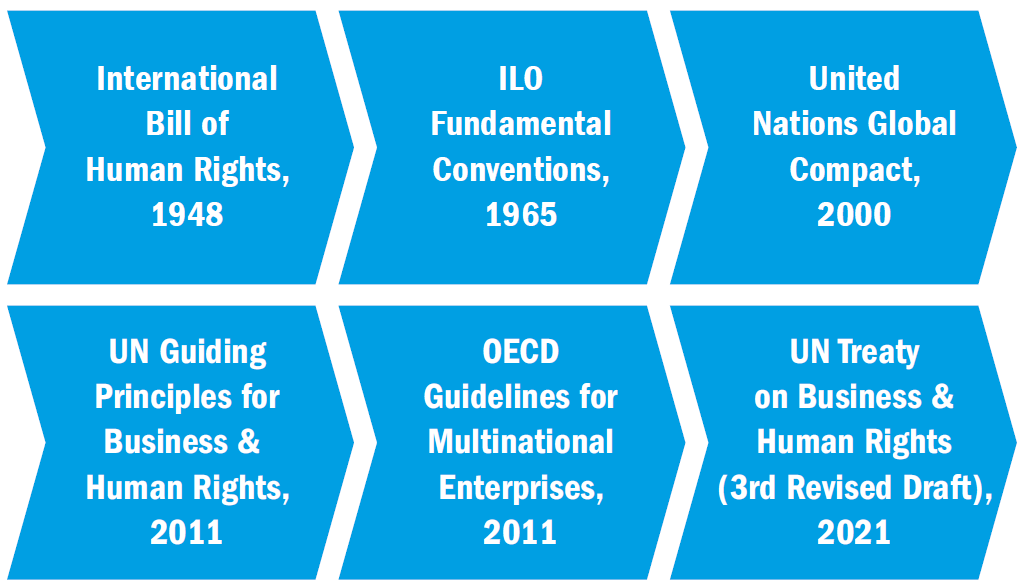
In considering human rights we need to understand how they have evolved, and continue to do so (Figure 1). The conventions by which we live were shaped after the second world war and directed at nation states to ensure basic economic, social, cultural and political rights. Life since then has increasingly been influenced by multinational enterprises so scrutiny has shifted to the boardroom, though not yet through legally binding instruments.

Figure 1: A history of human rights

A history of human rights Fig 1
Source: United Nations/OHCHR/ILO.
In 2000, the UN Global Compact introduced non-binding principles for businesses to support and respect human rights, ensuring they are not complicit in abuse. The UN Guiding Principles on Business and Human Rights built on this foundation. The three pillars of the principles – protect, respect and remedy – reflect the responsibilities of nation states and corporations and the right of victims to redress if abuses take place. We may see the principles develop into a legally binding convention, with the UN Human Rights Council due to discuss the third draft of a Treaty on Business and Human Rights (BHR) in October 2021.
A ratified treaty could see businesses obliged to implement Human Rights Due Diligence (HRDD) and ensure access to effective remedy for victims of abuse. The obligations may extend to communities impacted – even indirectly – by business operations. The OECD Guidelines for Multinational Enterprises give us a taste of things to come: though not legally binding, the investigations it prompts can lead to legal and financial liabilities, and reputational damage.
A key weakness of the UNGP and OECD Guidelines concerns the lack of access to effective remedy for victims in developing countries. This issue is being addressed in the proposed BHR. The treaty introduces a state obligation to regulate corporates under their jurisdiction or control, including transnational activities. This means multinational enterprises may be liable for human rights abuse in their global supply chains. To date, it has been challenging for victims to seek redress in such circumstances. Attempts are usually made through the 1789 US Alien Tort Statute (ATS) or via tortuous mediation using the OECD Guidelines. A ratified BHR could make redress simpler, increasing the prospect of legal liabilities for companies without HRDD or those complicit in abuse.

Vigilant active management

As investors, we need to be vigilant for digressions and engage where we have concerns. While third-party data providers are useful in flagging potential concerns, changes in company scores and ratings are a starting point for us to research, engage and act. Where there is tangible evidence of mitigating action, we can justify ownership and promote dialogue to ensure concerns are addressed. In this way we build relationships with our companies and realise long-term value.
Teleperformance is a global digital integrated business services company listed in Paris. In early 2020, allegations of poor working conditions emerged as pandemic-induced lockdowns took hold. On engaging with management, it was clear they faced a logistical challenge but had acted to ensure employees’ safety and wellbeing. When we spoke to the CFO in April, the company had transitioned over 40% of its workforce, or 120,000 people, to working from home. Those who could not were being employed in a clean office environment, open to independent inspection. Actions were co-ordinated through an Executive Crisis Committee, which met daily, and a broader forum of 100 senior business leaders.
After our meeting, UNI Global Union, an international labour union, submitted a case to the National Contact Point (NCP) in France alleging contravention of the OECD Guidelines. An ESG data provider cut Teleperformance’s rating. But we maintained a positive view as we had evidence of remediation. We followed managers’ progress closely, meeting with the investor relations team in June and the Deputy CEO in August 2020.

The NCP mediation process between Teleperformance and UNI resulted in a Final Statement on 5 July 2021, summarised in the following excerpt:1 “The NCP notes that, following an emergency management phase, Teleperformance has deployed and continues to implement a policy to prevent, manage and monitor the pandemic in all its subsidiaries in order to address health risks associated with the pandemic. This policy broadly corresponds to the expectations of corporate due diligence recommended by the OECD Guidelines.”

While the NCP Final Statement confirms mitigating action, the deterioration in dialogue between UNI and Teleperformance highlights the challenges of mediation under a non-binding framework. The legal basis provided by a treaty could ensure more rigorous negotiation and settlement. We continue to monitor Teleperformance’s progress; the Covid-19 pandemic may have permanently changed its operating model, return profile and growth prospects.

A second case concerns Nestlé, one of the world’s largest food and beverage brands. Rather than pursuing OECD mediation, complainants alleged human rights abuses by Nestlé, as well as other firms, using the US ATS. The lawsuit was dismissed in June 2021 as the ATS could not be applied extraterritorially. However, it highlighted the problem of child labour and forced labour across global commodity supply chains. While already aware of Nestlé’s progress in this area, the case prompted us to review its HRDD policies and practices. We held a call with the Head of its Cocoa Plan, the supply chain in which the abuses were alleged.

Nestlé launched its Cocoa Plan in 2009 to help farmers improve their livelihoods through education and community support. It was the first in the industry to develop a Child Labour Monitoring and Remediation System (CLMRS) in 2012, acknowledging problems highlighted by independent assessors. Impact assessments published by the Fair Labor Association and the Danish Institute for Human Rights are evidence of progress. In 2019, the CLMRS had grown to monitor 78,580 children and engaged with 15,740 of them to prevent underage employment. This is achieved through initiatives ranging from facilitating access to education by providing birth certificates, to offering bridging classes and vocational training.2

Nestlé sources 46% of its cocoa sustainably through the Cocoa Plan, and has an ambitious 100% target for 2025.3 Progress towards this goal was key when we decided to invest for the Pan European Sustainable Outcomes strategy. Nestlé’s integration of human rights into its policies and practices is shown through a variety of ongoing initiatives aimed at systemic change. For example, it is helping children re-enter education, pooling labour to avoid their employment, raising household earnings through incomegenerating activities for women and agricultural training to boost yields by up to 4x. While some, including ESG ratings agencies, penalise Nestlé for the presence of child labour, we praise its transparency and ongoing efforts to address it. Controversy still exists, but tangible mitigating action is evident.

These case studies illustrate the challenges involved in controversy analysis and anticipating regulatory change in the field of human rights. Controversy presents risks and opportunities, and as much depends on mitigating actions as the circumstances in which it was created. We anticipate further scrutiny in the wake of BHR discussions in October and are already holding companies to account as investor and regulatory expectations rise. This focus on human rights will remain a cornerstone of our approach in the Pan European Sustainable Outcomes strategy.

8 December 2021
Andrea Carzana
Andrea Carzana
Portfolio Manager
Andrew McKee
Andrew McKee
Senior Investment Analyst, Responsible Investment
Share article
Key topics
Related topics
Listen on Stitcher badge
Share article
Key topics
Related topics

1 OECD, https://mneguidelines.oecd.org/database/instances/fr0030.htm, 2021.
2 https://www.nestle.com/sites/default/files/2019-12/nestle-tackling-child-labor-report-2019-en.pdf
3 As of 2020. https://www.nestle.com/csv/rawmaterials/nestle-cocoa-plan

Important Information

The research and analysis included on this website has been produced by Columbia Threadneedle Investments for its own investment management activities, may have been acted upon prior to publication and is made available here incidentally. Any opinions expressed are made as at the date of publication but are subject to change without notice and should not be seen as investment advice. Information obtained from external sources is believed to be reliable but its accuracy or completeness cannot be guaranteed.

Related Insights

19 November 2025

Natalia Luna

Senior Investment Analyst, Sustainability Research

Vicki Bakhshi

Director, Responsible Investment

Evaluating the impact of the energy transition: Our systematic view of risks and opportunities

The energy transition is a global megatrend set to drive capital flows for decades to come. In a complex and fragmented political and policy environment, investors to understand the underlying economics.
14 November 2025

Natalia Luna

Senior Investment Analyst, Sustainability Research

Olivia Watson

Senior Analyst, Sustainable Research

AI growth: energy, emissions and water considerations

Artificial intelligence is hungry for power and thirsty for water. We discuss advances and innovations that could alleviate the problems and highlight related investment opportunities.
17 October 2025

Tenisha Elliott

Sustainability Research Analyst

Thematic Insight: Getting in shape for the food system transformation

Ultra-processed foods, chronic disease, growing awareness of the link between diet and health ... no wonder the global food system is undergoing profound change.
22 December 2025

Asset Allocation update - November 2025

We have seen a softening in market momentum led by US equities and based around two factors. Firstly, there are reduced expectations for an interest rate cut in the aftermath of the October’s Federal Reserve (Fed) meeting.
19 December 2025

Christopher Hult

Portfolio Manager, Investment Grade Credit

Tammie Tang

Portfolio Manager, Investment Grade Credit

Investment grade credit: Positioning for decompression

With valuations stretched, macro headwinds blowing and spreads near post-global financial crisis tights, our portfolio managers look at the state of the IG market
16 December 2025

In Credit Weekly Snapshot – Look to the future now, it’s only just begun

After an eventful 2025, what might be in store for 2026? Elsewhere, despite a few hurdles throughout the year, core investment grade markets are ending the year tighter than they started.
true
true

Important Information

The research and analysis included on this website has been produced by Columbia Threadneedle Investments for its own investment management activities, may have been acted upon prior to publication and is made available here incidentally. Any opinions expressed are made as at the date of publication but are subject to change without notice and should not be seen as investment advice. Information obtained from external sources is believed to be reliable but its accuracy or completeness cannot be guaranteed.

You may also like

Investment approach

Teamwork defines us and is fundamental to our investment approach, which is structured to facilitate the generation, assessment and implementation of good, strong investment ideas for our portfolios.

Funds and Prices

Columbia Threadneedle Investments has a comprehensive range of investment funds catering for a broad range of objectives.

Investment Strategies

We offer a broad range of actively managed investment strategies and solutions covering global, regional and domestic markets and asset classes.

Thank you. You can now visit your preference centre to choose which insights you would like to receive by email.

To view and control which insights you receive from us by email, please visit your preference centre.

Woman listens to music through headphones
Play Video

CT Property Trust- Fund Manager Update

Sed ut perspiciatis unde omnis iste natus error sit voluptatem accusantium doloremque laudantium