



AI is reinforcing prime office demand in the short term, but the bigger question is whether productivity gains will ultimately limit hiring and space needs.
Artificial intelligence (AI) is not yet a negative driver of office demand. Leasing data shows incremental demand from AI-related tenants and continued resilience in prime assets. Early labour market effects are emerging through hiring behaviour rather than layoffs.
However, AI is simultaneously a new source of demand and a credible long-term risk to labour intensity. While the data currently supports prime office demand in the near term, over time it increases dispersion risk between prime and secondary assets.
Here we look at both the bear and bull case for what could happen, as well as the key debate that will ultimately shape the outcome: productivity versus headcount.
The bear case: structural risks building but not yet visible
AI may slow white-collar employment growth
The central risk here is slower hiring rather than outright job destruction. Most estimates suggest AI changes how work is done rather than whether work exists. BCG estimates that around 50%-55% of jobs will be reshaped over the next two to three years, with 10%-15% eliminated over a five-year horizon – an adjustment driven primarily through productivity rather than layoffs.1
However, early labour market signals are emerging. Goldman Sachs highlights that AI is already affecting hiring dynamics in white-collar sectors, with technology sector employment falling below its long-term trend.2 At the margin, AI appears to be reducing payroll growth rather than causing outright job losses. The effect is most pronounced at the entry level, where job growth in AI-exposed occupations has slowed or turned negative, particularly for junior roles. Firms are increasingly questioning the need to expand headcount where AI can absorb routine cognitive tasks, with hiring freezes and natural attrition becoming the primary adjustment mechanism.
The implication for offices is structural. Marginal office demand is driven by headcount growth rather than existing occupancy. A sustained slowdown in hiring will reduce incremental demand, with the adjustment likely to come through slower expansion rather than active contraction in occupied space.
AI exposure is concentrated in core office occupations
AI exposure is highest in cognitive roles. Finance, legal, consulting and technology – the core tenant base for prime CBD offices – are among the most exposed sectors. The current impact is augmentation: workers become more productive, but over time fewer employees may be required for the same output. The sectors that drive prime office demand are therefore also the most exposed to efficiency-driven headcount pressure.
AI as the fourth disruptor of office demand
Over the past two decades, densification reduced space per employee, co-working introduced flexibility, and hybrid working reduced average attendance. Each was initially framed as an existential threat; none led to the disappearance of the office. Instead, they changed how space was used.
AI is best understood as the fourth wave. Like prior disruptors, it primarily affects utilisation rather than existence. The key distinction is that AI targets labour intensity directly, whereas previous disruptors affected how space was used. The risk is that productivity gains reduce headcount growth, even as new demand and new workflows emerge. The precedent suggests adjustment rather than dislocation, but because AI operates directly on the core tenant base, the medium-term impact is more uncertain than prior cycles.
The bull case: market data remains supportive
AI is already a meaningful source of demand
AI demand is now a measurable feature of leasing activity across global gateway office markets. In the US, the technology sector accounted for 16.8% of leasing in 2025, rising to 22.7% in Q1 2026, driven in part by large AI transactions.3
At the landlord level, BXP reports that leasing in New York, Boston and San Francisco is supported by AI-driven tenants, with demand concentrated in prime buildings and occupancy improving.4 In San Francisco, the wider recovery remains uneven, but AI firms are a key source of incremental demand. CBRE data shows AI-led leasing concentrated in a small number of markets, with San Francisco and Silicon Valley accounting for roughly two-thirds of activity since 2019.5
In London, the pattern is similar. AI companies accounted for roughly a third of tech leasing in 2025, with activity concentrated in knowledge clusters such as King’s Cross or Euston and along major transport corridors. British Land and Landsec both link leasing momentum to AI-led occupiers. In Paris, AI-specific leasing is less explicitly disclosed, but the outcome is consistent: both Gecina and Colonial report strong interest from AI tenants in the northern part of the CBD, while clusters of AI tenants are emerging around the 13th district.6 Across markets, demand is clustered, quality-driven and strategic – AI is currently additive to office demand (Figure 1).
Figure 1: AI is additive to office demand
AI company office leasing activity by market and year
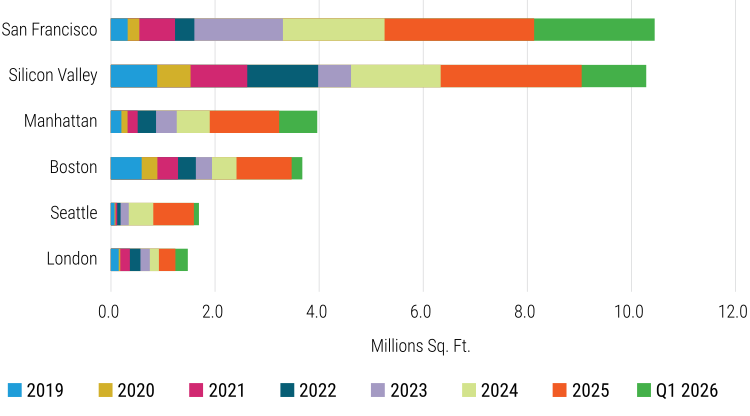
Source: CBRE Research, Q1 2026. Note: includes all leases of VC-backed companies and some public companies whose primary business is AI products and services. Silicon Valley and Boston include office and R&D property leases.
No evidence that AI is reducing office footprints
There is no observable link between AI adoption and shrinking office footprints. Leasing volumes are recovering in major markets, occupancy in prime assets remains stable, and landlord commentary does not point to any structural change linked to AI.
BXP, British Land, Landsec and Gecina all report strong demand for high-quality space, with AI associated with expansion rather than contraction. AI companies prioritise collaboration, hiring density and proximity to talent, clustering in gateway cities with access to venture capital funding, institutional capital and skills.
The disconnect between narrative and data remains wide – the bear case is forward-looking; the bull case is observable.
Overall office vacancy rates have declined fastest in Manhattan and San Francisco, each by about 3% between 2023 and 2025. London, Toronto and Silicon Valley also had decreased vacancy in that period. Certain submarkets and high-quality building categories within tech gateway markets have seen rent growth related to demand from tech and AI companies. These submarkets include San Francisco’s downtown and Mission Bay; Silicon Valley’s Sunnyvale, Mountain View and Palo Alto; Seattle’s Bellevue; and Manhattan’s Flatiron and Park Avenue South/Madison Square districts.
Flight to quality dominates
The office market is highly bifurcated. Demand is concentrated in prime buildings, with tenants continuing to consolidate into central locations with strong amenities and connectivity. AI reinforces this trend – these firms prioritise quality over cost, allowing prime landlords to gain share even where total demand remains moderate.
Supply constraints provide a floor in prime markets
Supply remains limited in core locations. New development is constrained and obsolescence is removing older stock. This is reducing effective supply at the same time as demand concentrates in a subset of high-quality buildings.
The key implication is not a collapse in demand, but a widening gap between prime and secondary assets – prime offices remain supported while secondary assets face structural pressure.
The key debate: productivity versus headcount
The long-term outcome depends on a single question: does AI increase output while maintaining employment, or does it reduce the need for labour?
If productivity dominates without reducing headcount, office demand is supported – companies grow and invest in better space. If efficiency reduces headcount, demand weakens gradually but persistently, particularly in sectors with high AI exposure.
Historically, productivity shocks have reshaped employment rather than reduced it. The difference with AI is its impact on entry-level and support roles, which are key drivers of incremental office demand.
Current evidence supports the first scenario. AI firms are expanding, leasing is improving and occupancy is stable – but hiring patterns are already changing. The balance between productivity and labour demand will determine the long-term trajectory of office markets.
The bottom line
In the short term, AI is neutral to positive for prime office demand, generating new leasing activity and reinforcing the flight to quality. There is no evidence that AI is reducing office footprints today, and market data and landlord commentary remain supportive.
The risk sits in the medium term, where AI could reduce labour intensity and slow demand growth. Key indicators to watch include the pace of hiring in AI-exposed sectors, leasing volumes in prime versus secondary markets, and corporate headcount strategy among major technology firms. For now, however, the data points in one direction: AI is acting as a demand driver for prime offices, not a disruption. We believe the most likely outcome is a slower and more uneven demand profile over time, rather than a sharp decline.