



Competition for capital is heating up. Persistent government deficits combined with a long overdue acceleration in corporate capex means bond markets face a wave of new supply. Is this a risk or opportunity?
Is this the right time for corporates to be spending?
Why not? Tariff clouds are clearing, most central banks have dialled back restrictive monetary policy, and in aggregate the world will benefit from additional fiscal stimulus in 2026. Rates markets face some well-flagged challenges – a bumpy disinflation journey and resilient but uneven growth (obscured by unreliable economic data). But for credit, this backdrop isn’t all too concerning. Some stickiness in prices suggests that corporates have sufficient pricing power to pass rising costs (or tariff effects) on to consumers. Credit doesn’t need blockbuster economic growth to perform well; it just needs to steer clear of recession.
A capex boom is overdue
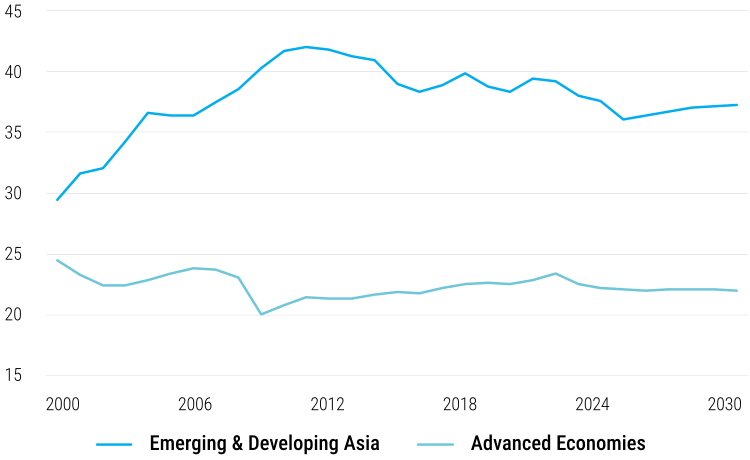
The past 30 years has seen a marked decline in fixed capital formation in developed economies, as production was generally outsourced to a booming Asian economy (accelerated by China’s accession to the World Trade Organisation in 2001). The western corporate world saw great benefits from cheap Chinese manufactured goods, including the ability to keep domestic wages depressed. As Western jobs were exported to Asia, so too went investment in productive capacity, prompting a long trend of falling hours worked, stagnant productivity and low capital investment (Figure 1).
Figure 1: Investment as a share of GDP (%)
Source: Bloomberg, IMF, as of February 2026
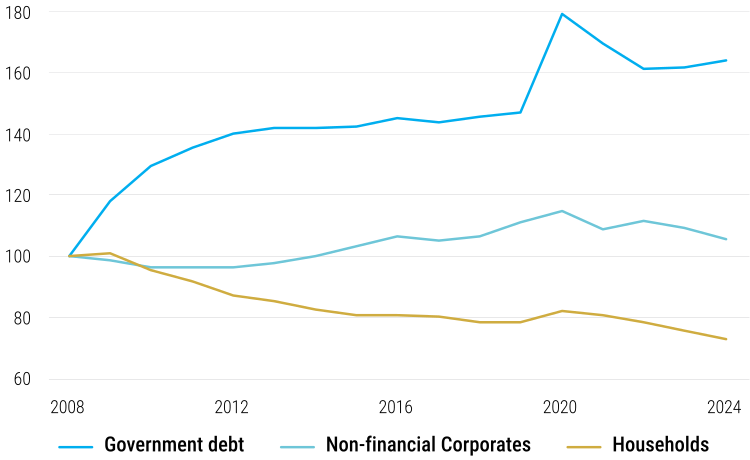
This trend was compounded by the global financial crisis in 2008, which drove a decade of economic austerity and – more importantly – a concerted deleveraging of private sector balance sheets (Figure 2).
Figure 2: Debt-to-GDP growth in the US
Source: Bloomberg, IMF, as of February 2026. Data indexed to 31 December 2008 = 100
Why is the capex trajectory changing? There is nothing quite like an inflation shock to drive social change. Lower income Western workers are demanding real wage gains now. Political priorities have also changed – the slow but deliberate path of deglobalisation, which started back in the first Trump administration, has empowered greater labour market collectivism.
Politicians are tuned into the changing tide. Note, for example, the jump in tax relief on business investment across several developed economies. In the US particularly, the One Big Beautiful Bill Act (OBBBA) allows for 100% expensing of capital expenditure (capex) depreciation in the year of purchases, and the ability to add depreciation/amortisation for the purposes of interest expense deduction. Combined, these measures reduce the aftertax cost of debt-fuelled capex for corporates.
We are in the midst of a multi-year capex upswing (Figure 3), which should promote a productivity boom. And then along comes a major technological innovation at the just the right time … artificial intelligence (AI).
Figure 3: The drivers of the capex cycle (across government and corporate sectors )
Capital for labour | As the wage share of GDP rises, so begins the
trend of substituting labour with capital. The push
for automation intensifies.
|
Structural trends: the 3Ds
| Deglobalisation: supply-chain independence
requires new investment.
Decarbonisation/climate transition spending.
Defence spending. |
AI | The next leg in the AI story will see a broadening
out of spending, benefitting adopters, enablers
and developers. |
The AI capex revolution – what are the fixed income impacts?
Technology companies are now finding many consumer and enterprise applications for AI, driving massive demand for computational infrastructure buildout. These include hardware, networking, storage solutions and energy demand/grid upgrades. As a result, we are likely to see capex activity across sectors beyond tech and into utilities, telecommunications and real estate (in the form of data centres).
Market expectations for the total, full-value-chain AI spending in coming years vary wildly and are being revised frequently. At present, our best estimate is that $6 trillion of new investment will be required over the next five years. At the centre of this are the hyperscalers – Alphabet, Amazon, Meta, Microsoft and Oracle. We expect these companies combined will commit to more than $500 billion a year in capex by 2030.
In 2025, much of the hyperscaler capex was funded with free cashflow generation, which remains prodigious. However, we expect that $1.5 trillion of the $6 trillion in future spending could be funded with external financing – from a mixture of public credit markets, private markets, off-balance sheet structures and asset-backed lending. Even with such a diversified funding mix we expect fixed income markets to be central to AI infrastructure development. The relatively lower cost of debt financing, versus using retained earnings or equity, is a key driver.
Since most hyperscalers start from strong fundamental metrics, the focus here should be on bond market capacity not credit quality. As an example, Meta, whose annual target of $125 billion capex for 2026 and beyond (double its 2025 spend), should still result in positive free cashflow generation after capex. As a result, its net leverage is likely to increase only from around 0.2x to 0.4x – ie not a credit rating event.
On market capacity, we believe the net new issuance in public investment grade credit could approach around $1 trillion over five years. Considering the current size of the global universe is $14 trillion, this amounts to a 7% increase in bond supply (around 1.4% a year). This is noticeable but not problematic. We may well see some periods of market indigestion (and spread widening) if supply is concentrated in any single short period.
As a comparator, global banks issued more than $1 trillion of new bail-in or senior non-preferred bonds for regulatory compliance between 2016 and 2022. That was around $150 billion new supply annually into a global credit market that was smaller at the time (around $9 trillion). Banking sector spreads underperformed on a relative basis, but overall the asset class performed strongly.
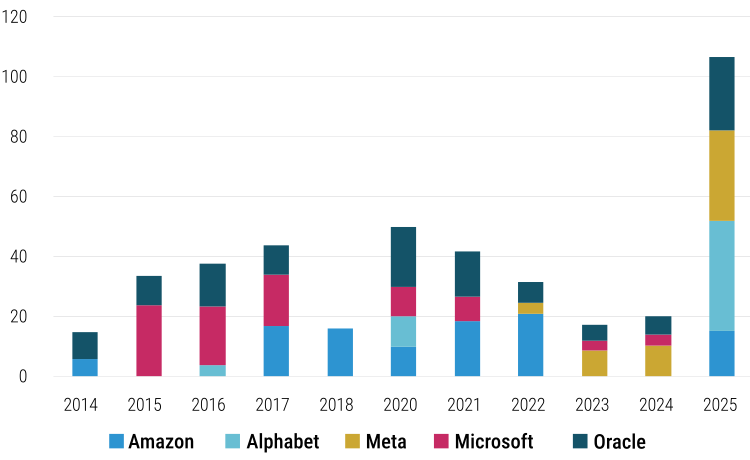
We see parallels for tech this time around – some relative underperformance, but nothing to derail global credit markets overall. This also reflects our belief that markets are not complacent to the risks of increased supply, even as demand for corporate bonds remains insatiable and valuations remain compressed. Market caution was in evidence in 2025 when hyperscalers pursued a first wave of jumbo issuance (Figure 4) that saw $110 billion of new supply (triple their annual average issuance over the past decade). The deals came with a clear premium over existing bonds (around 10bp-12bp higher yields); this was a concession that triggered a general repricing of high quality credit curves, and some underperformance of the tech sector within global indices.
Figure 4: Hyperscaler bond issuance (US$ billions)
Source: Bloomberg, as of January 2026
Sector-specific implications
Real estate / Asset-backed Securities (ABS)
Data storage and networking infrastructure are critical to the rollout of AI technologies. We are seeing a rush to acquire land and build data centre sites to warehouse this hardware. Interestingly, the real estate purchasing activity of hyperscalers moves these businesses further away from their traditionally asset-lite operating models.
So far, securitisations have been a popular form of financing for data centres – where the future cashflows from hyperscaler leasing payments (and power charges) underpin the bond coupons. The bottlenecks of data centre development make the near-term demand outlook for their associated securitised bonds attractive. However, we are cautious on some aspects of this sector.
As computing efficiency evolves, it will be difficult to assess the obsolescence risk of data centre equipment – which is the basis of the collateral underpinning these deals. Further, there is an inherent mismatch in the asset-liability dynamics: tech firms often sign short-term computing contracts, of three to four years, but commit to long-term data centre leases of five to 20 years. This creates potential imbalances if demand shifts in future. This is exacerbated by the fact that many of these deals come with high tenant concentration risk. Indeed, data centre ABS expose investors to the performance of the tenant, not just the underlying real estate.
Many data centre ABS will require refinancing in the coming years. Any downturn in valuations or changes in capitalisation rates could pose challenges. As such, we believe there is “maturity wall” risk down the line.
Given these risks, rating agencies have tended to cap data centre ABS senior tranche ratings at single A. Compared to similar rated consumer ABS, data centres have typically offered a small concession, around 25bps-50bps in higher yields. Some relative value exists, but we are minded to be cautious given the risks ofinvesting in a young and rapidly evolving asset class.
Utilities/hybrids
The power-intensive nature of data centres, and their water demands for cooling systems, will be a constraint on AI adoption without significant investment into energy generation and transmission grids. As a result, we expect to see rising capex commitments across the utilities sector.
We see this as an opportunity – and a good way to participate in the AI theme. In general, the sector starts from a lower credit rating/higher leverage base versus tech, but this is offset by some key safeguards. For example, many power companies will contract with minimum revenue agreements, thus mitigating the risk of reduced power demand. Furthermore, in the regulated utility sector, capex will typically drive an increase in the “regulated asset base”. This means the company can earn greater “allowable” revenues across its entire customer base under its regulatory framework. As a result, cashflow profiles are likely to be more resilient regardless of what direction the AI industry takes.
Utility firms also have the option to issue hybrid debt. This is a form of financing that can be used to bolster balance sheets. Hybrids receive 50% equity treatment from rating agencies in their calculation of leverage. As such, capital raising through hybrids can often be used to defend existing credit ratings. Meanwhile, the structural features of hybrids – subordination, callability, coupon deferral – drive higher yields, relative to traditional senior bonds, to attract investors.
There has recently been a significant positive development in the hybrid space. In 2024, Moody’s aligned with other major agencies to assign 50% equity treatment, and it also allowed 30-year final maturity bonds to be classed as hybrids, in addition to perpetual debt. This opened the door for US utilities to join the asset class, alongside the much longer history of European issuance. As such, the global hybrid universe has doubled in size over the past three years to more than $300 billion, of which around 40% is from the utility sector, providing greater opportunity/yield for investors willing to take the additional credit risk.
Financials and private debt
Private market credit will be a major source of capital for AI capex, including innovative structures like Meta’s “Beignet” deal to fund a large data centre through a private debt joint venture1.
If primary issuance in public markets starts to weigh on tech bond valuations meaningfully, then the opportunistic and flexible nature of hyperscaler financing may drive a greater pivot into private markets. This dynamic, unlike previous cycles, could act as a release valve for public credit spread pressure.
Much has been written on the risks of rapid lending growth within private credit. Lending exuberance, and its associated deterioration in underwriting standards, does merit close attention – these can be signals of late cycle dynamics. However, we do not think that private credit poses systemic risks. The sector operates with long-term capital lockups and has a large financing base among institutional investors. The prevailing wisdom is that this investor cohort – insurers, pension funds, sovereign wealth etc – has the capacity to absorb the potential losses and liquidity risks of a private credit downturn (albeit this thinking has not been tested).
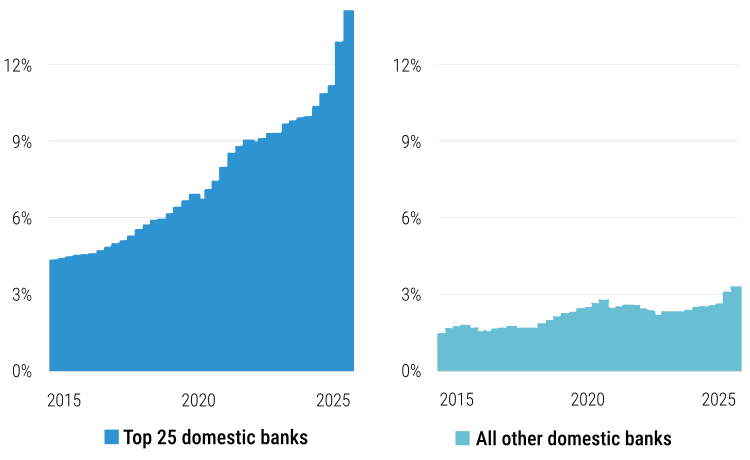
It is more relevant to consider the interconnectedness between private credit and the banking system. Lending to non-deposit financial institutions (NDFIs) – the channel within which private credit managers operate – has soared in recent years, and now represents around $1.5 trillion of loans, or circa 12% of the total US banking system loans, according to the US Federal Reserve (Fed)2. This is concentrated among the largest “universal banks”, with exposure among smaller and regional banks still relatively low (Figure 5).
A key risk is the potential for widespread financial stress to trigger a coordinated drawdown of credit lines that private debt funds have arranged with banks. According to stress tests completed by the Fed in mid-2025, a sizeable industry-level drawdown event of $136 billion would be expected to decrease the aggregate CET1 capital ratio of the largest US banks from 13.02% to 12.94%, and the Liquidity Coverage Ratio would decrease by two percentage points to 120%. These relatively minor impacts are not in the realms of a systemic risk event. However, an incremental worsening in bank fundamental metrics is likely to see some pressure on their credit spreads.
Figure 5: Loans to NDFIs as a share of total loans, by bank type
Source: US Board of Governors of the Federal Reserve System/Moody’s Ratings. Note, quarterly data are from Q4 2015-Q2 2025
The bottom line
Technological advancement and a capex boom can drive productivity gains – which are generally supportive for corporate profits. Dispersion of returns within credit will be a theme, with those companies with larger investment opportunities the winners. The risk for creditors comes from the potential mismatch between the quantum of debt raised for capex versus the realised increase in revenue streams.
Unlike recent cycles, this expansion in corporate sector balance sheets will compete with already fierce government spending projections. As such, the competition for capital will intensify. The government spending dynamic is driving heightened uncertainty for inflation forecasting, and thus monetary policy – creating interest rate volatility. Macro cycles are likely to be shorter and sharper as a result. This backdrop introduces greater variability into the corporate capex cycle – companies will be rewarded for being opportunistic with their financing plans, and investors even more so. Investors will need to be increasingly nimble to capitalise on pricing opportunities – and position with a tactical mindset.
Given the uncertainties ahead, at Columbia Threadneedle we prefer to engage in the AI theme selectively – looking at sector-specific opportunities and differentiating those issuers with the greatest balance sheet flexibility. We do not believe that the increase in capex poses a systemic risk for the asset class overall.
Sector view summary
Outlook | Outlook | |
|---|---|---|
Tech | – Strong starting position for leverage & balance sheet health. – Concessions for new supply can provide an attractive opportunity to cover some underweights in the sector. – Spreads can modestly underperform the global index, but no major concerns. | |
Utilities | – Resilient cashflow profiles and balance sheet safeguards are clear positives, regardless of the direction the AI industry takes. Hybrid issuance will be an opportunity to access high quality businesses at attractive yields- | |
ABS | – Some relative value exists, but we are cautious on data centre ABS given the risks of investing in a young and rapidly evolving asset class – Uncertainty around future collateral valuations and reliance on underlying tenant business success are key risks | |
Financials | – Banks unlikely to be derailed by private credit lending stresses, but any negative headlines will be a source of near-term spread volatility. – For universal banks who are most exposed, and where current spread valuations are compressed, look for rotation opportunities into peers with less asymmetric risk/return outlooks. |