


global
GLOBAL
GLOBAL
en
global_noInvestor_classes
noInvestor
noInvestor
en
en
For use by professional clients and/or equivalent investor types in your jurisdiction (not to be used with or passed on to retail clients).
Stylized topographic map showing mountainous terrain and a coastal region connected by multiple curved routes, illustrating global connectivity, trade, or investment flows across geographic landscapes.

Insights

LDI market review and outlook August 2026 – plus ça change, plus c’est la même chose

Rosa Fenwick
Rosa Fenwick
Head of LDI Implementation

Purported and temporary ceasefires and the ongoing depletion of inventories kept the focus on the Strait of Hormuz. Hopes were raised with a Memorandum of Understanding creating a partial reopening in mid-June, however fiery rhetoric and ceasefire breaches soon prevented a sustained increase in shipping leaving many ships stranded. The uncertainty and ultimate lack of progress has caused volatility in oil and thus rate change expectations from day-to-day, as the binary nature of the closure of the Strait complicates projections for central banks. Meanwhile in the UK a new Prime Minister was anointed, bringing a change in policy tone yet with the same fiscal constraints, potentially limiting space to manoeuvre.

If this sounds like a broken record that is because it is – the Strait of Hormuz has dominated global headlines since the end of February with no resolution in sight, albeit with a brief fillip for markets during the Memorandum of Understanding in mid-June until that fragile ceasefire failed to hold.  Volatility in oil prices is now the new normal, responding with alacrity to each rumour of closure or reopening of the Strait.  Analysts believe that the pressure on oil prices should be much higher than is playing out in markets and consider China to be the saviour through reducing imports substantially and drawing down inventories and decreasing usage.  However, a word of caution is that this state of affairs cannot continue indefinitely, particularly as Iran proxies attack alternative oil shipping routes.  The continued pressure on oil and other production inputs is taking its toll on global economies but with an uneven impact – Europe has been particularly vulnerable and is showing early signs of stagflationary risks despite the EUR11bn of fiscal measures to cushion the effect.  As a consequence, the ECB chose to hike the base rate to provide an early counter – this can be seen versus an ‘active’ hold in the UK and no change in the US despite the new Fed Chair Kevin Warsh taking the helm.

If this sounds like a broken record that is because it is – the Strait of Hormuz has dominated global headlines since the end of February with no resolution in sight, albeit with a brief fillip for markets during the Memorandum of Understanding in mid-June until that fragile ceasefire failed to hold.  Volatility in oil prices is now the new normal, responding with alacrity to each rumour of closure or reopening of the Strait.  Analysts believe that the pressure on oil prices should be much higher than is playing out in markets and consider China to be the saviour through reducing imports substantially and drawing down inventories and decreasing usage.  However, a word of caution is that this state of affairs cannot continue indefinitely, particularly as Iran proxies attack alternative oil shipping routes.  The continued pressure on oil and other production inputs is taking its toll on global economies but with an uneven impact – Europe has been particularly vulnerable and is showing early signs of stagflationary risks despite the EUR11bn of fiscal measures to cushion the effect.  As a consequence, the ECB chose to hike the base rate to provide an early counter – this can be seen versus an ‘active’ hold in the UK and no change in the US despite the new Fed Chair Kevin Warsh taking the helm.

Closer to home the UK always has time for some politics.  The much-anticipated drubbing that Labour received in the May local elections accelerated the demise of Prime Minister Keir Starmer.  Indeed, within a month the new Prime Minister Andy Burnham transitioned from Mayor of Greater Manchester to be elected as an MP and then elevated uncontested to Prime Minister.  Previous comments about being ‘in hock to the bond markets’ led to some nervousness in markets but since taking the role his rhetoric has been far more conciliatory.  This is despite clear signs that the new PM has an agenda which will cost money; support for struggling households and pubs, higher defence spending and welfare reform.  Few would argue that these are not admirable goals, but the question is how he and the new Chancellor John Healey will pay for them.  At present the Government have committed to maintaining the current fiscal rules (with some wiggle room on investment) and to the Labour manifesto of the last election, yet there are some signals that that may change.  The bond market vigilantes appear to be in wait and see mode until the Autumn Budget scheduled for the 28th October.

In the meantime, the Debt Management Office (DMO) and Bank of England (BoE) have been making hay while the sun shines.  The DMO continues its innovative journey suggesting dual tranche and switch auctions and the market welcomed the news that they are committing to expanding T-bill issuance and enhancing liquidity within that market through a standing repo facility.  The trend of shortening issuance so as not to cause distress at the longer tenors has persisted throughout the second quarter, supporting the market in the face of political uncertainty.  From a weighted average maturity high in 2000 of 30yrs, the WAM has now fallen below 10yrs. The fact that at the start of the year multiple rate cuts were priced into the market has been a boon for the BoE as they can provide a tightening aspect to the market without changing the Bank Rate – an ‘active’ hold.  Market expectations around rate hikes and the number and speed is almost entirely dependent on news-flow regarding the Strait of Hormuz.  The BoE have increased their scrutiny on the functioning of markets with particular focus on the repo market; this is especially important as the direction of travel is to use repo as the marginal monetary policy tool.  Despite a negative reaction to the consultation, it seems clear that the direction of travel is towards action to reduce leverage, focused on leveraged hedge fund strategies which could cause market disruption when unwound rapidly.  From a pure ecosystem perspective, it appears more likely that some form of mandatory minimum haircut could be required, with the devil being in the detail – who is impacted, what level they are set at, whether at portfolio or trade level, etc.  The long-awaited Financial Stability Report was also released by the BoE.  This contained the hoped-for consultation on easing of leverage ratio requirements.  This would increase balance sheet capacity which for some could then be deployed into gilts, thus supporting gilt performance vs swaps and absorbing additional supply.  The key is for some – it is possible this balance sheet could be diverted to other products and indeed the BoE would rather it was focused on lending to households.  Another mention of repo market reform was made within the document, indicating that benefits may be smaller than anticipated if aligned with repo market changes.  Nevertheless, it was welcomed as a move to simplify regulations and was seen as positive by the market.

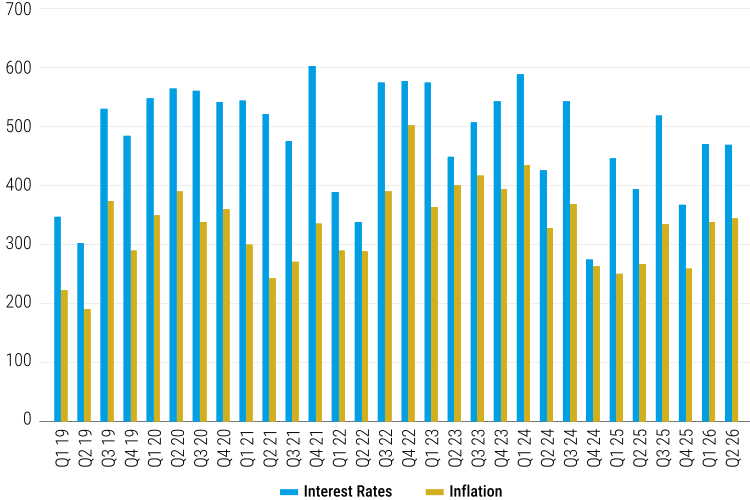
Total interest rate liability hedging activity remained consistent at £36.2 billion, whilst inflation hedging rose slightly to £34.9 billion.  Increased focus on hedge accuracy within LDI mandates whether preparing for buy-out or looking to run on resulted in trade activity, as well as some opportunities in relative value transactions.  In recent years the UK’s bond market has been seen as good value particularly by insurance companies weighing them up versus expensive corporate bonds.  This had resulted in some idiosyncratic behaviours particularly in index-linked gilts.  This interest has turned aside from the UK to consider other bonds such as in the US or Europe.

The chart below describes hedging transactions as an index based on risk. Note that transactions include switches from one hedging instrument into another. It should be noted that as the index is constructed by using the rate of change of risk traded by each counterparty per quarter, it allows the introduction (or removal) of counterparties in the survey.

Chart 1: Index of UK pension liability hedging activity (based on £ per 0.01% change in interest rates or RPI inflation expectations i.e. in risk terms)
Graph for LDI UKV review and outlook

Source: Columbia Threadneedle Investments. As at 30 June 2026

The funding ratio index published by the Pension Protection Fund showed little change in funding levels quarter-on-quarter (131.2% at end June vs 131.4% at end March).  Strength in equity markets offset slightly lower yields balancing the impact on the funding ratio.

Market Outlook

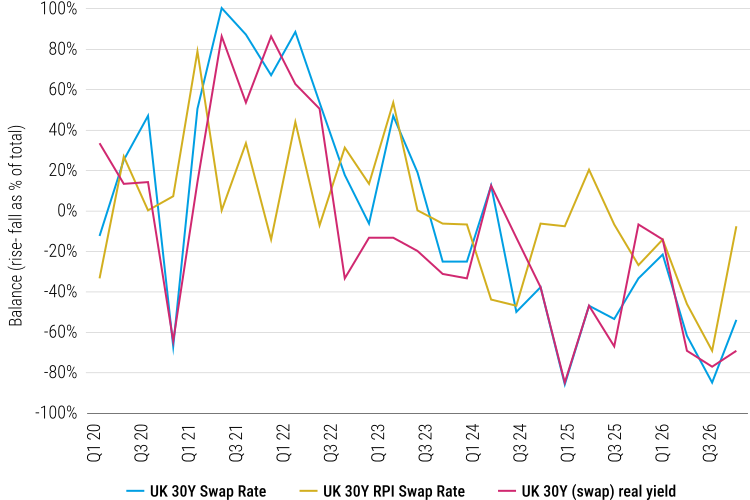
We also asked investment bank derivatives trading desks for their opinions on the likely direction of key rates for liability hedging. The aim is to get information from those closest to the market to aid investors in their decision-making.

The results are shown below as the number of those predicting a rise less those predicting a fall, as a percentage of the number of responses. The larger the balance, the more responses predict a rise. A negative balance indicates more responses predicting a fall.

Chart 1: Index of UK pension liability hedging activity (based on £ per 0.01% change in interest rates or RPI inflation expectations i.e. in risk terms)
graph

Source: Columbia Threadneedle Investments. As at 30 June 2026

Last quarter our counterparties expected a fall in all three metrics which was borne out in interest rate and inflation, however the fall in inflation proved dominant as a result of a temporarily positive outlook on the Iran conflict and real yields rose.  Looking forward once again our counterparties predict falls albeit with very low conviction for the inflation swap rate.  Arguments for a fall in swap rates is focused on a much hoped for resolution of the Iran conflict and a pick-up in demand from LDI and insurance whilst supply in the longer maturities is kept to a minimum.  Yet the fiscal situation and market expectations could impact this view; higher spending without appropriate taxation would lead to a higher term premium and thus higher yields – however this eventuality seems to be discounted by the market at present.  The lack of conviction in inflation reflects the binary impact of the closure of the Strait of Hormuz.  Oil and natural gas remain volatile and will likely become more so as inventories continue to be depleted.  The severity of the drought in the UK and Europe whether through wildfires or its impact on crops could also contribute to a higher inflationary environment and risks becoming entrenched in sentiment.  Lack of meaningful index-linked gilt supply may limit the scope for inflation rates to rise significantly.

If you would like to learn more about any of the topics discussed, please contact your client director.


Key topics

Subscribe to insights

Get the most out of your email by tailoring the types of insights and information you would like to receive from us.

Latest articles

If this sounds like a broken record that is because it is – the Strait of Hormuz has dominated global headlines since the end of February with no resolution in sight, albeit with a brief fillip for markets during the Memorandum of Understanding in mid-June until that fragile ceasefire failed to hold.
US debt has reached $40 trillion, up by about a third in less than five years. The Treasury has tried to contain long-end pressure, but investors remain sceptical.
The US 30-year Treasury yield is at its highest since 2001. Although the level is not extreme historically, the speed of the rise is.
Key topics
Related topics

Important information:

For use by professional clients and/or equivalent investor types in your jurisdiction (not to be used with or passed on to retail clients). For marketing purposes.

This document is intended for informational purposes only and should not be considered representative of any particular investment. This should not be considered an offer or solicitation to buy or sell any securities or other financial instruments, or to provide investment advice or services. Investing involves risk including the risk of loss of principal. Your capital is at risk. Market risk may affect a single issuer, sector of the economy, industry or the market as a whole. The value of investments is not guaranteed, and therefore an investor may not get back the amount invested. International investing involves certain risks and volatility due to potential political, economic or currency fluctuations and different financial and accounting standards. The securities included herein are for illustrative purposes only, subject to change and should not be construed as a recommendation to buy or sell. Securities discussed may or may not prove profitable. The views expressed are as of the date given, may change as market or other conditions change and may differ from views expressed by other Columbia Threadneedle Investments (Columbia Threadneedle) associates or affiliates. Actual investments or investment decisions made by Columbia Threadneedle and its affiliates, whether for its own account or on behalf of clients, may not necessarily reflect the views expressed. This information is not intended to provide investment advice and does not take into consideration individual investor circumstances. Investment decisions should always be made based on an investor’s specific financial needs, objectives, goals, time horizon and risk tolerance. Asset classes described may not be suitable for all investors. Past performance does not guarantee future results, and no forecast should be considered a guarantee either. Information and opinions provided by third parties have been obtained from sources believed to be reliable, but accuracy and completeness cannot be guaranteed. This document and its contents have not been reviewed by any regulatory authority.

In Australia: Issued by Threadneedle Investments Singapore (Pte.) Limited [“TIS”], ARBN 600 027 414. TIS is exempt from the requirement to hold an Australian financial services licence under the Corporations Act 2001 (Cth) and relies on Class Order 03/1102 in respect of the financial services it provides to wholesale clients in Australia. This document should only be distributed in Australia to “wholesale clients” as defined in Section 761G of the Corporations Act. TIS is regulated in Singapore (Registration number: 201101559W) by the Monetary Authority of Singapore under the Securities and Futures Act (Chapter 289), which differ from Australian laws.

In Singapore: Issued by Threadneedle Investments Singapore (Pte.) Limited, 3 Killiney Road, #07-07, Winsland House 1, Singapore 239519, which is regulated in Singapore by the Monetary Authority of Singapore under the Securities and Futures Act (Chapter 289). Registration number: 201101559W. This advertisement has not been reviewed by the Monetary Authority of Singapore.

In Hong Kong: Issued by Threadneedle Portfolio Services Hong Kong Limited 天利投資管理香港有限公司. Unit 3004, Two Exchange Square, 8 Connaught Place, Hong Kong, which is licensed by the Securities and Futures Commission (“SFC”) to conduct Type 1 regulated activities (CE:AQA779). Registered in Hong Kong under the Companies Ordinance (Chapter 622), No. 1173058.

In Japan: Issued by Columbia Threadneedle Investments Japan Co., Ltd. Financial Instruments Business Operator, The Director-General of Kanto Local Finance Bureau (FIBO) No.3281, and a member of Japan Investment Advisers Association and Type II Financial Instruments Firms Association.

In the UK: Issued by Threadneedle Asset Management Limited, No. 573204 and/or Columbia Threadneedle Management Limited, No. 517895, both registered in England and Wales and authorised and regulated in the UK by the Financial Conduct Authority.

In the EEA: Issued by Threadneedle Management Luxembourg S.A., registered with the Registre de Commerce et des Sociétés (Luxembourg), No. B 110242 and/or Columbia Threadneedle Netherlands B.V., regulated by the Dutch Authority for the Financial Markets (AFM), registered No. 08068841.

In Switzerland: Issued by Threadneedle Portfolio Services AG, Registered address: Claridenstrasse 41, 8002 Zurich, Switzerland.

In the Middle East: This document is distributed by Columbia Threadneedle Investments (ME) Limited, which is regulated by the Dubai Financial Services Authority (DFSA). For Distributors: This document is intended to provide distributors with information about Group products and services and is not for further distribution. For Institutional Clients: The information in this document is not intended as financial advice and is only intended for persons with appropriate investment knowledge and who meet the regulatory criteria to be classified as a Professional Client or Market Counterparties and no other Person should act upon it.

This document may be made available to you by an affiliated company which is part of the Columbia Threadneedle Investments group of companies: Columbia Threadneedle Management Limited in the UK; Columbia Threadneedle Netherlands B.V., regulated by the Dutch Authority for the Financial Markets (AFM), registered No. 08068841.

Columbia Threadneedle Investments is the global brand name of the Columbia and Threadneedle group of companies. © 2025 Columbia Threadneedle. All rights reserved.

Related Insights

20 July 2026

Head of LDI Implementation

Q2 2026 repo update

The Iran conflict and the impact of the closure of the Strait of Hormuz on energy prices dominated the second quarter.
29 June 2026

Head of LDI Implementation

Euro LDI Update: Inflation pressures mark the start of a new cycle

Inflation and growth risks are back in focus, unsettling central bank easing plans and raising pressure across Eurozone markets.
16 June 2026

Head of LDI Implementation

LDI market review and outlook June 2026 – Nothing Trumps political infighting

Political and geopolitical shocks have revived inflation and growth risks, complicating central banks’ easing plans and increasing pressure on UK gilts.
25 August 2026

In Credit Weekly Snapshot – Take it to the limit (one more time)

US debt has reached $40 trillion, up by about a third in less than five years. The Treasury has tried to contain long-end pressure, but investors remain sceptical.
18 August 2026

In Credit Weekly Snapshot – If I could turn back time

The US 30-year Treasury yield is at its highest since 2001. Although the level is not extreme historically, the speed of the rise is.
18 August 2026

In Credit Weekly Snapshot – A little less conversation

The US July jobs report had plenty to say – little of it good. The economy shed 23,000 jobs versus consensus expectations for an 80,000 gain. Rates markets reacted swiftly, trimming expectations for future rate rises.

Important information:

For use by professional clients and/or equivalent investor types in your jurisdiction (not to be used with or passed on to retail clients). For marketing purposes.

This document is intended for informational purposes only and should not be considered representative of any particular investment. This should not be considered an offer or solicitation to buy or sell any securities or other financial instruments, or to provide investment advice or services. Investing involves risk including the risk of loss of principal. Your capital is at risk. Market risk may affect a single issuer, sector of the economy, industry or the market as a whole. The value of investments is not guaranteed, and therefore an investor may not get back the amount invested. International investing involves certain risks and volatility due to potential political, economic or currency fluctuations and different financial and accounting standards. The securities included herein are for illustrative purposes only, subject to change and should not be construed as a recommendation to buy or sell. Securities discussed may or may not prove profitable. The views expressed are as of the date given, may change as market or other conditions change and may differ from views expressed by other Columbia Threadneedle Investments (Columbia Threadneedle) associates or affiliates. Actual investments or investment decisions made by Columbia Threadneedle and its affiliates, whether for its own account or on behalf of clients, may not necessarily reflect the views expressed. This information is not intended to provide investment advice and does not take into consideration individual investor circumstances. Investment decisions should always be made based on an investor’s specific financial needs, objectives, goals, time horizon and risk tolerance. Asset classes described may not be suitable for all investors. Past performance does not guarantee future results, and no forecast should be considered a guarantee either. Information and opinions provided by third parties have been obtained from sources believed to be reliable, but accuracy and completeness cannot be guaranteed. This document and its contents have not been reviewed by any regulatory authority.

In Australia: Issued by Threadneedle Investments Singapore (Pte.) Limited [“TIS”], ARBN 600 027 414. TIS is exempt from the requirement to hold an Australian financial services licence under the Corporations Act 2001 (Cth) and relies on Class Order 03/1102 in respect of the financial services it provides to wholesale clients in Australia. This document should only be distributed in Australia to “wholesale clients” as defined in Section 761G of the Corporations Act. TIS is regulated in Singapore (Registration number: 201101559W) by the Monetary Authority of Singapore under the Securities and Futures Act (Chapter 289), which differ from Australian laws.

In Singapore: Issued by Threadneedle Investments Singapore (Pte.) Limited, 3 Killiney Road, #07-07, Winsland House 1, Singapore 239519, which is regulated in Singapore by the Monetary Authority of Singapore under the Securities and Futures Act (Chapter 289). Registration number: 201101559W. This advertisement has not been reviewed by the Monetary Authority of Singapore.

In Hong Kong: Issued by Threadneedle Portfolio Services Hong Kong Limited 天利投資管理香港有限公司. Unit 3004, Two Exchange Square, 8 Connaught Place, Hong Kong, which is licensed by the Securities and Futures Commission (“SFC”) to conduct Type 1 regulated activities (CE:AQA779). Registered in Hong Kong under the Companies Ordinance (Chapter 622), No. 1173058.

In Japan: Issued by Columbia Threadneedle Investments Japan Co., Ltd. Financial Instruments Business Operator, The Director-General of Kanto Local Finance Bureau (FIBO) No.3281, and a member of Japan Investment Advisers Association and Type II Financial Instruments Firms Association.

In the UK: Issued by Threadneedle Asset Management Limited, No. 573204 and/or Columbia Threadneedle Management Limited, No. 517895, both registered in England and Wales and authorised and regulated in the UK by the Financial Conduct Authority.

In the EEA: Issued by Threadneedle Management Luxembourg S.A., registered with the Registre de Commerce et des Sociétés (Luxembourg), No. B 110242 and/or Columbia Threadneedle Netherlands B.V., regulated by the Dutch Authority for the Financial Markets (AFM), registered No. 08068841.

In Switzerland: Issued by Threadneedle Portfolio Services AG, Registered address: Claridenstrasse 41, 8002 Zurich, Switzerland.

In the Middle East: This document is distributed by Columbia Threadneedle Investments (ME) Limited, which is regulated by the Dubai Financial Services Authority (DFSA). For Distributors: This document is intended to provide distributors with information about Group products and services and is not for further distribution. For Institutional Clients: The information in this document is not intended as financial advice and is only intended for persons with appropriate investment knowledge and who meet the regulatory criteria to be classified as a Professional Client or Market Counterparties and no other Person should act upon it.

This document may be made available to you by an affiliated company which is part of the Columbia Threadneedle Investments group of companies: Columbia Threadneedle Management Limited in the UK; Columbia Threadneedle Netherlands B.V., regulated by the Dutch Authority for the Financial Markets (AFM), registered No. 08068841.

Columbia Threadneedle Investments is the global brand name of the Columbia and Threadneedle group of companies. © 2025 Columbia Threadneedle. All rights reserved.

For professional investors in EMEA APAC only

Legal and regulatory disclosures

The analysis included on this website is for professional investors in EMEA APAC. This material should not be considered as an offer, solicitation, advice or an investment recommendation. This communication is valid at the date of publication and may be subject to change without notice. Any opinions expressed are made as at the date of publication but are subject to change without notice and should not be seen as investment advice. Information obtained from external sources is believed to be reliable but its accuracy or completeness cannot be guaranteed. 

I have read and accept the terms and conditions of this site:

Icon checked

Thank you. You can now visit your preference centre​ to choose which insights you would like to receive by email.

Icon checked

Thank you. You can now visit your preference centre​ to choose which insights you would like to receive by email.