


Luke Casey
Senior Client Portfolio Manager, Head of Client Strategy
It’s hard to focus on any other topic but the unprecedented AI boom that has engulfed markets.
Almost four years on from the
‘GPT moment’ that kicked off the AI data centre build out, there
are still no signs of a slowdown in investment. History offers no
shortage of capital booms that ended in bust. From the railroad
mania to the dot-com bubble to shale and China’s investment
boom, all great capital buildouts often trace the same arc.
That’s not to say they don’t leave us with better technology and
higher living standards on the other end. AI’s imprint on society
is permanent and undeniable, but as investors in the midst of
one of the largest capital cycles ever, it is only prudent to ask
whether the spending has outrun the returns
We assess the question above around four fault lines:
hyperscaler financing, deal circularity and concentration, AI
monetisation, and physical constraints.

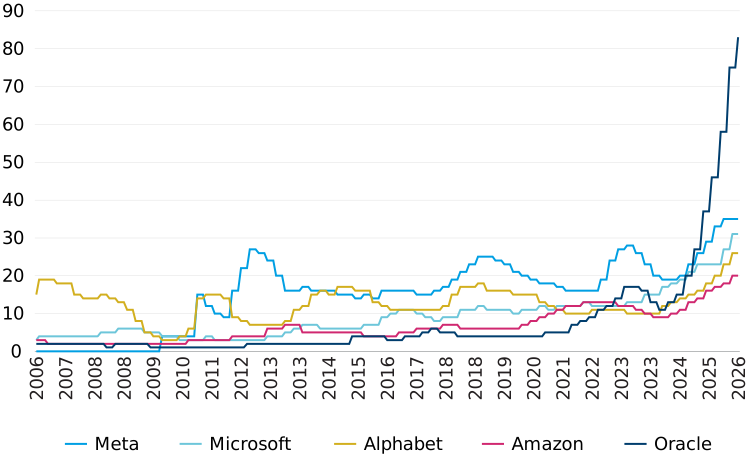
Hyperscaler financing: For years the hyperscalers (Alphabet,
Amazon, Meta, Microsoft and now Oracle) funded their
operations with internal cash flows and still returned billions
to shareholders in the form of buybacks and dividends. That
era is now ending with capex as a percent of sales at record
highs ranging from 20% for Amazon to 83% for Oracle.
Hyperscaler Capex/Sales %*
Source: Refinitiv Datastream
* Capex understates true investment as it excludes operating and
finance leases which have been used to procure data centre capacity
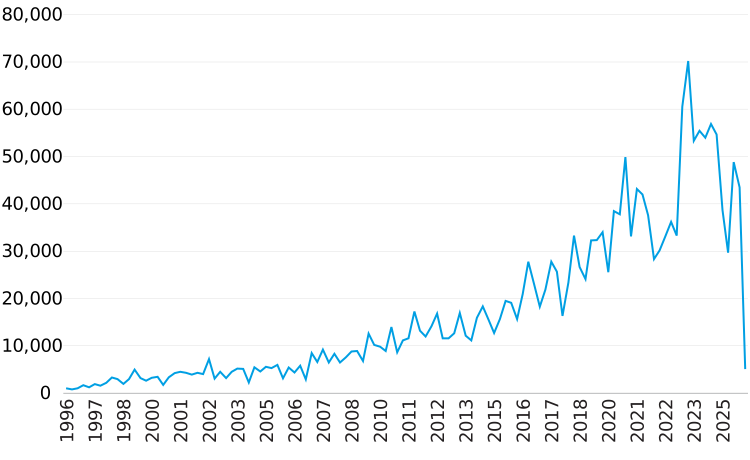
Free cash flow (operating cash flows minus capex) has
vanished and rather than returning cash to shareholders the
hyperscalers are now demanding cash in the form of equity
and debt issuances
Hyperscaler Free Cash Flow (quarterly, $bn)
Source: Refinitiv Datastream
In the first 5 months of the year, they have issued $159bn
of bonds, 47% more than all of last year. Notable equity
issuances include $85bn from Alphabet and $25bn from
Oracle this quarter.

Deal circularity and concentration: Rather than dispersing
into the broader economy, the billions being spent by the
hyperscalers are circulating amongst a small interlocking set
of players. Four direct customers make up 65% of Nvidia’s
revenues up from 36% last year with the CFO stating that
large cloud providers make up more than half of data centre
revenue. Nvidia then recycles these profits, funding demand
for its own chips through deals with OpenAI,xAI, Anthropic
and various other neoclouds. The hyperscalers have also
funded their own demand with Microsoft, Amazon and
Google taking stakes in Anthropic, and Microsoft holding
a 27% stake in OpenAI. Together, OpenAI and Anthropic
make up more than half of the $2tn backlog across major
cloud providers.1
This circularity has made demand appear
more organic and durable than it is. Large bets have also
concentrated on a few industry leaders today which could
look very different tomorrow.

Monetisation: The problems around financing and circularity
are all solved if AI demand is durable and profits can be
captured by the likes of OpenAI and Anthropic. Here the
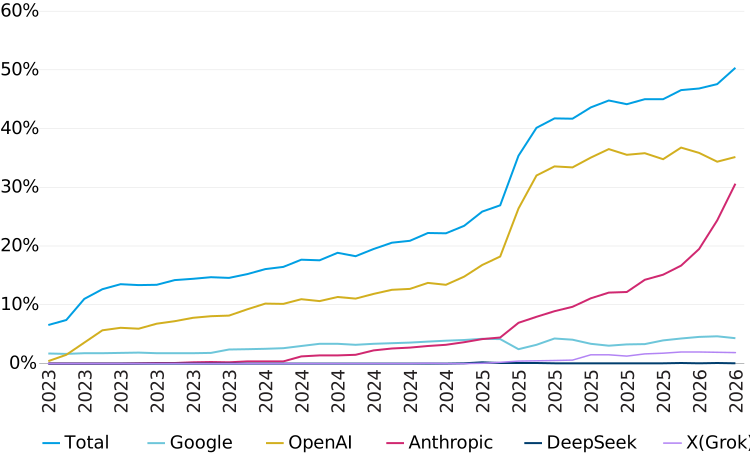
bulls have a strong case. Revenue has grown exponentially
with OpenAI and Anthropic reporting annualized revenue run
rates of $25 billion and $30 billion respectively. According to
the Ramp AI Index just over 50% of US businesses have a
paid AI subscription.
Share of US Businesses with paid subscriptions to AI models, platforms and tools
Source: Ramp AI Index
It is still unclear whether these enterprises are realising
value as a result. Dated survey data reveals mixed results.
The January 2026 Deloitte State of AI in Enterprise
report claimed that 66% of organizations report that AI is
successfully improving employee productivity while only
20% currently see a measurable impact on revenue.2
This
follows a November 2025 MIT NANDA survey that stated
95% of generative AI pilots delivered zero measurable P&L
impact.3
More importantly, even if enterprise demand is robust and
long-term, what premium will model providers be able to
charge in what is increasingly becoming a commoditized
business? Here, the Chinese playbook is by now familiar.
Pursue market share above near-term profits and win by
delivering goods as good if not better than the incumbents’
at a fraction of the price. It has eaten the world’s lunch
particularly in solar, EV’s and batteries and perhaps soon to
be frontier AI.
The latest AI development this quarter was the release of
Z.ai’s (formerly Zhipu AI) GLM-5.2 which almost matches
the performance of Anthropic’s Opus 4.8 and Open AI’s GPT
5.5 and outperforms Google’s Gemini 3.5 at roughly onesixth the cost. On a related note, China has now also built
the world’s most powerful supercomputer. The LineShine
computer in Shenzhen displaced US computer El Capitan in
the Top500 rankings released this month.4
For the bulk of enterprise AI there is likely no need to be
at the frontier. Microsoft recently announced they were
considering using cheaper DeepSeek models after AI bills
soared.5
Data from OpenRouter suggests the model provider
landscape has become highly fragmented.6
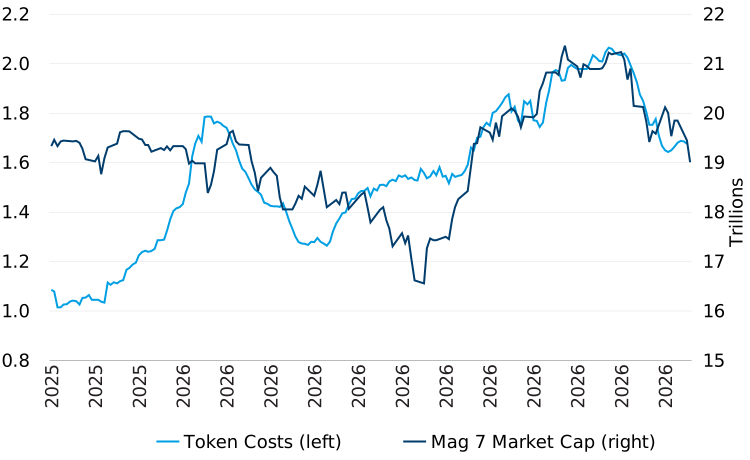
The rise of cheaper Chinese models, which are steadily
gaining in performance has been behind the recent fall in
token costs.
Silicon Data LLM Token Price Index and Magnificent 7 Market Cap
Source: Refinitiv Datastream
The chart above shows an expenditure weighted index of
the blended price the market actually pays per million LLM
tokens. It has a surprisingly tight fit with the MAG 7 over the
last year, perhaps as a live tracker of the market’s willingness
to pay for AI and hence the sustainability of the capex boom.
Ultimately, the moment of truth may arrive if and when
Anthropic and OpenAI IPO and public markets finally
weigh their real earning power against their vast compute
commitments. Leaked financials from OpenAI show them
losing a staggering $20.92bn in 2025 up from $8.78 in
2024.7

Finally, the data centre build out has run into hard physical
limits. In particular, a shortage of transformers and other
electrical components has left 30-50% of 2026 data centre
projects delayed or cancelled. 16 GW of capacity was planned
for 2026 but only 5GW of capacity is under construction.8
This further complicates the return on investment picture
for hyperscaler and various other neocloud capex. Whilst
the spending and depreciation clock has begun, the revenue
generating moment continues to be deferred. This again is
hardly a problem for China which added 543 GW of power
capacity in 2025. Cumulative additions to power capacity
since 2021 exceed what the US has built in its entire history.9
USA! USA! USD! USD!
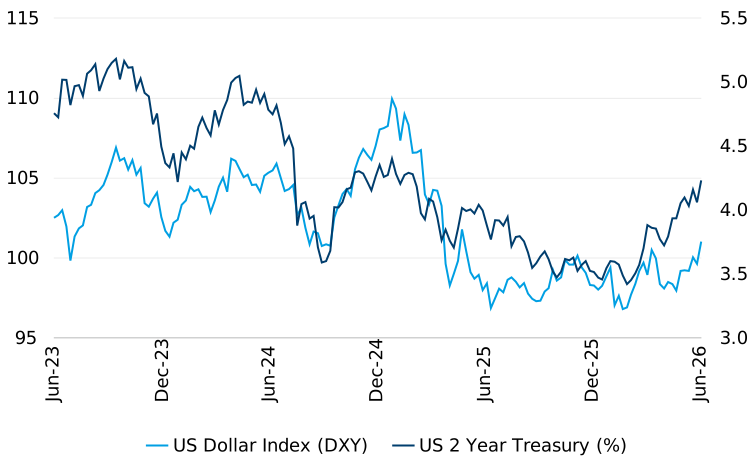
The most immediate catalyst of recent US Dollar strength has
been the Federal Reserve’s shift under new chair Kevin Warsh.
At his first meeting on 17 June, Warsh vowed to “deliver price
stability”, and with 9 of the 18 Fed members seeing at least one
hike this year, the Fed looks prepped to move should inflation
continue to drift in the wrong direction. — a dramatic swing
from March when no officials anticipated rises. The two-year
Treasury yield surged to 4.22%, its highest in 16 months, as
markets 25 bps increase by March next year.
US dollar versus US 2-year Treasury
Source: Refinitiv Datastream
Underpinning the Fed’s stance is the strength of the US
economy. The US added 172,000 jobs in May, more than double
Wall Street expectations, and core inflation rose to 2.9%.
Bullish dollar bets in the futures market rose by the most since
2018 to their highest level in more than a year, driven partly by a
renewed belief in US exceptionalism.
The conflict in the Middle East — which began at the end of
February with the closure of the Strait of Hormuz — initially drove
energy prices higher, boosting inflation in the US to above 4%.
Although a US-Iran truce has since been signed, the dollar has
remained firm. The Fed’s preferred headline PCE inflation gauge
has risen to 3.8%, nearly double its 2% target. Many economists
believe it is too late to stave off another bout of high inflation
even if the Strait is fully reopened.
A key structural driver is the widening interest rate differential
between the US and the rest of the world. In the Eurozone and
UK — hit harder by the energy shock due to their dependence
on imports — rate rise expectations have receded more quickly,
as those economies face the prospect of slower growth.
The buoyancy of US stock markets, boosted by SpaceX’s
blockbuster IPO and enthusiasm around artificial intelligence,
has also drawn investors back to the dollar.
But we need to put the recent move in context. The dollar
rallied about 3% at the onset of the Iran conflict, but those
gains have already faded. Part of the story is relative central
bank positioning — with the ECB, BoJ and BoE all shifting more
hawkishly than the Fed, the interest rate backdrop hasn’t been
as supportive for the dollar as you might expect.
The Final Word
The UK is set to welcome its seventh Prime Minister in 10
years. Keir Starmer’s resignation, less than two years after a
commanding 2024 victory, followed a steady erosion of political
capital over the last few months. In particular local elections
in May saw Labour’s national equivalent vote share fall to
17%, behind Reform UK at 26%. Andy Burnham, who served
as mayor of Manchester from 2017 to 2026 looks most likely
to replace Starmer in what is becoming an impossible job to
keep. He inherits an economy with a tax share of GDP at 34% yet
perpetually on the brink of a fiscal crisis. The UK has avoided
recession primarily due to strong levels of population growth
which have averaged 1.2% over the last 5 years but come at
the cost of social backlash to immigration. Productivity growth
meanwhile has been non-existent. Whether Burnham’s arrival
brings some more ambitious plans for growth remains to be
seen. Perhaps, with a bit of luck, an England World Cup victory
is the spark the country needs to lift it out of its economic lull
and bring about some much-needed optimism.