



As the U.S. marks 250 years, CEO Ted Truscott reflects on its strengths: a dynamic economy, deep capital markets, and a culture of ingenuity driving innovation and growth.
This moment stands as both a milestone and an inflection point. What has defined the U.S. economy over the past two and a half centuries is not continuity, but reinvention — from the Industrial Revolution to the Information Age, and now into a new era shaped by artificial intelligence (AI) and energy transformation.
Today, we stand at the early stages of another profound transition. The forces reshaping the global economy — innovation at scale, shifting geopolitical dynamics and a more capital-intensive growth mode — are redefining how value is created and where opportunity lies. For investors, the lesson is clear; the most compelling opportunities lie not in simply participating in growth, but in identifying where the next phase of transformation is taking — and positioning ahead of it.
U.S. markets: Strength in focus
At the core of U.S. economic leadership is the depth and sophistication of its capital markets. Across equities, fixed income, and derivatives, capital generally flows efficiently to promising ideas — often at significant speed and scale.
The U.S. stands as the largest equity market globally. As shown in the chart below, it totals roughly $80 trillion in market capitalization, compared with just under $60 trillion across other major markets combined, including China, Japan, the U.K. and India.
The U.S. is the largest equity market globally
Exchange market capitalisation ($ in trillions)
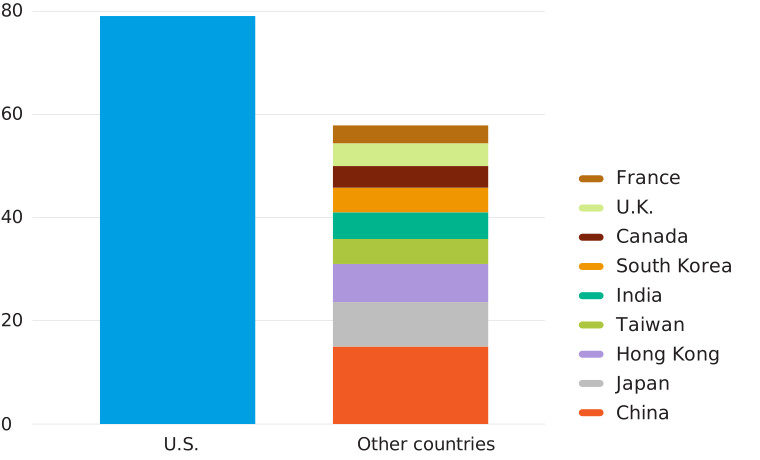
Source: Bloomberg Financial L.P. Data as of May 29, 2026.
Alongside a deep equity market, U.S. Treasury bonds — especially long-term securities — have anchored fixed income for over 50 years. Competitive auctions (1963) and 30-year bonds (1977) strengthened this foundation, later reinforced by the evolution of U.S. mortgage markets. This infrastructure provides transparency, liquidity and participation that underpin long-term growth.
Reinvention as a competitive advantage
U.S. capitalism is both a source of enduring strength and constant disruption. Its system of creative destruction — where companies are built, challenged and replaced — remains a core driver of economic progress. Reinvention is not optional; it is shaped by technological change, shifting industries and management effectiveness. The companies that endure do so by continually rediscovering and sharpening their core value proposition. This dynamism is reflected at the macroeconomic level: U.S. GDP growth has consistently outpaced that of other developed economies (see below chart).
Iconic examples illustrate both invention and renewal. FedEx began as a 1965 term-paper idea for time-sensitive delivery and scaled into a $1 billion global logistics company within a decade. Apple, by contrast, demonstrates the power of reinvention; after pioneering personal computing and faltering in the 1990s, its resurgence under Steve Jobs transformed it into one of the world’s most valuable companies. Together, these stories underscore a defining truth — enduring success depends not just on innovation at inception, but on the ability to continually refine a company’s core value.
U.S. GDP growth engine powers ahead
GDP growth across development markets, 1960 to present (current U.S. $, trillion)
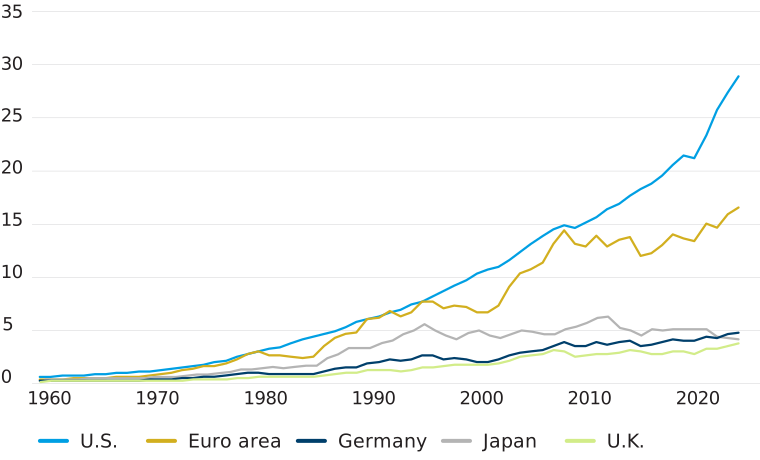
Source: World Development Indicators, World Bank. Data as of June 9, 2026.
Built for resilience
The endurance of the U.S. economy lies in its ability to absorb shocks and adapt quickly, reflecting both effective policy intervention at critical moments and increasingly agile corporations. While periods like the Great Depression were exacerbated by policy missteps, more recent crises, such as the Global Financial Crisis, demonstrate how timely, informed intervention can stabilize the system and limit deeper economic damage.
Equally important is the adaptability of U.S. corporations and leadership. Well-run companies have continually evolved in response to changing conditions, supported by experienced management teams and faster information flows. At the market level, deep, transparent capital markets provide continuous pricing signals, enabling efficient capital reallocation amid volatility. Together, effective policy frameworks, strong corporate leadership, and highly functional markets underpin the U.S. economy’s ability to withstand disruption and sustain its global strength.
America’s innovation edge
Innovation remains the defining force behind the enduring strength of the U.S. economy — and today it is being reshaped by a transformative wave in AI. Like the personal computer in the 1980s, AI represents a profound inflection point, already driving productivity gains, reshaping industries and redefining how companies plan. Its reach is broad, nearly every company we engage with is actively exploring its potential.
This innovation engine extends far beyond technology. In healthcare and biotechnology, advances in genetic science and targeted therapies are improving the outlook for conditions such as sickle cell disease, transforming others like cystic fibrosis into more manageable diseases and opening new frontiers in medical progress. These breakthroughs are enabled by a uniquely American ecosystem.
At the same time, rising geopolitical fragmentation, weakening global cooperation and slowing trade introduce new risks. The tension between accelerating innovation and declining globalization will shape the investment landscape in the years ahead.
Although global innovation is highly competitive, the U.S. maintains a durable edge built on scale, capital and a deep innovation ecosystem (see below chart).
America’s innovation edge is structural. Open markets, strong institutions, and the rule of law create an environment where ideas can be funded, challenged and scaled. Even in complex, long-cycle transformations such as energy, the commitment to innovation remains unwavering. In a world marked by geopolitical tension and economic uncertainty, it is this capacity to continuously reinvent — to imagine, invest and build — that sustains U.S. leadership and drives long-term growth.
U.S. among global leaders in innovation
Country ranking by number of patents (millions)
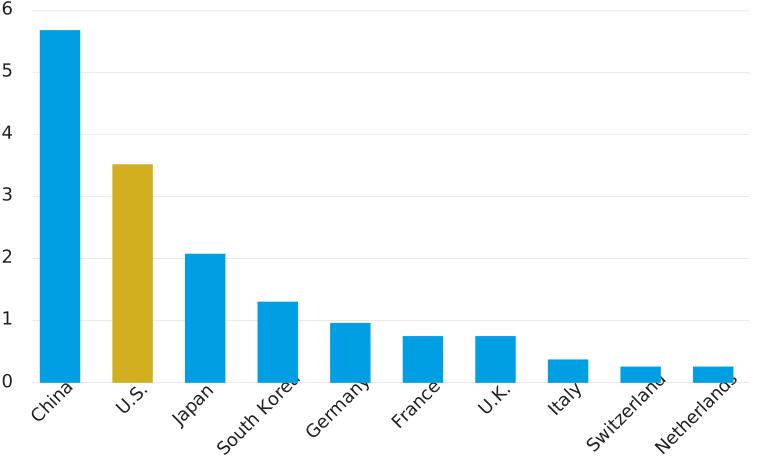
Source: World Intellectual Property Organization (WIPO) statistics database, as of May 2026.
Risk-taking as a defining trait
Risk-taking is deeply embedded in the American economic model — fueling innovation, shaping markets and driving long-term growth. At its core is a reinforcing dynamic: confidence drives liquidity, and liquidity reinforces confidence. As investors take risks, capital accelerates, ideas scale and markets function more efficiently.
This system depends on conviction in uncertainty. Markets are not just for pricing risk — they allocate capital based on differentiated views. Confidence will be tested, often unexpectedly, but the willingness to take risk at the margin keeps markets adaptive, dynamic and forward-looking.
Importantly, this culture of risk-taking is fortified by strong and enduring institutions. The rule of law, deep and transparent capital markets, and world-class universities create an environment where risk can be taken with clarity and trust. A balanced regulatory framework enables experimentation without stifling innovation, while research institutions replenish the pipeline of ideas and talent. Any erosion of the rule of law or challenge to the independence of institutions such as the Federal Reserve, however, could pose a risk to the strength and dynamism of the U.S. model.
America’s role in a multipolar world
The U.S. continues to play a central role in global markets, anchored by the dominance of the U.S. dollar in trade and finance. The breadth of that dominance, as shown in the chart below, is a critical source of U.S. resilience and flexibility. This position provides a significant structural advantage, particularly the ability to borrow in its own currency.
The U.S. dollar's global reach
U.S. dollar share (%)
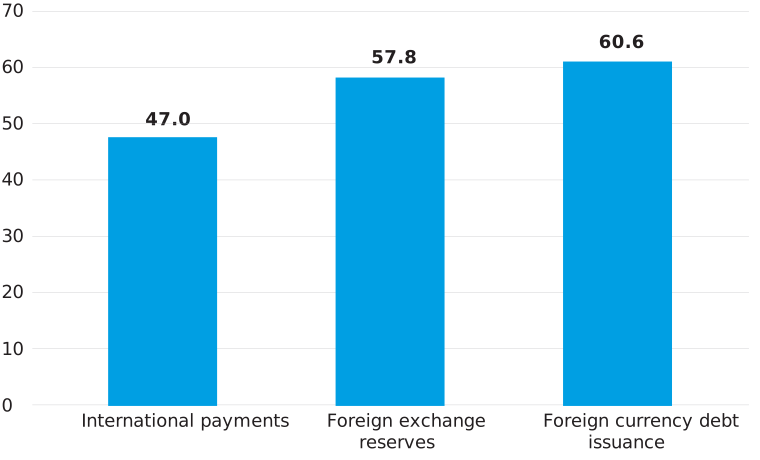
Source: Federal Reserve Board – The International Role of the U.S. Dollar – 2025 Edition, accessible data.
Historically, U.S. leadership has been most evident in moments of global crisis. From shaping the post–World War II economic order to deploying unprecedented support during COVID-19, the U.S. has repeatedly acted as an anchor within the global system. Its capacity to respond at scale has been critical to global resilience.
Today, that role is evolving in a more fragmented, multipolar world. Globalization is slowing, national priorities are rising and cooperation is less certain — making U.S. leadership even more critical. With unmatched economic scale, institutional strength and innovative capacity, the U.S. remains uniquely positioned to shape outcomes as both a stabilizing force and central player in a more competitive global system.
The next era
Looking ahead, American leadership will be defined by how we harness — and coexist with — AI. Like past technological revolutions, AI can reshape productivity, industries and everyday life. The opportunity is immense, but so is the responsibility to maximize its impact while preserving critical thinking, sound judgment and institutional trust. How the U.S. integrates AI across business, education and government will shape not just growth, but the quality of that growth.
For investors, this era will demand greater discipline. Innovation creates opportunity but also widens the gap between narrative and reality. Success will depend on distinguishing enduring value from compelling stories, while staying anchored in fundamentals.
The bottom line
At 250 years, the United States remains a young, evolving economy — defined by its ability to adapt and reinvent. That capacity will shape the next chapter of American growth and leadership.
What endures is its foundation: a dynamic economy, deep capital markets and a culture of ingenuity that turns ideas into investable opportunity.
For investors, the challenge — and opportunity — is to look forward with clarity and conviction. Because the real story isn’t the past 250 years, but what lies ahead.