



Four London airports have set out plans to increase their capacity. With the costs running into the billions what will the projects actually deliver and, perhaps most importantly, who will pay for it? Bondholders take note ….
In 2024, UK airports carried 292 million passengers against a population of 69 million. That is 98% of 2019 levels (ie pre-Covid). Among the five largest UK airports, Heathrow, Manchester and Stansted all exceed 2019 levels at +4%, +5% and +6% respectively, with Heathrow, Gatwick and Luton all within touching distance of their stated capacity (Heathrow are 2 million above). In their 2024 long-term aviation outlook (using 2023 traffic as a baseline), the European Organisation for the Safety of Air Navigation (commonly known as Eurocontrol) expect annual UK flight growth of 1.3% a year to 2050. This equates to a 42% rise on 2023 levels or an extra 114 million passengers. In the context of this, and backed by London’s position as the second best financial centre globally (according to the Global Financial Centres Index), and its attractiveness as a tourist destination, airport expansion is back on the menu.
Thoughts on individual projects
In the table below we have pieced together publicly available information on the four largest London expansion projects. We have adjusted costings to 2024 prices and scaled them in order to give a cost per extra million passengers. These four airports plan extra capacity of 124.5 million versus a Eurocontrol-expected increase of 114 million.
Heathrow | Gatwick | Luton | Stansted | |
|---|---|---|---|---|
Traffic 2024 (millions) | 83.9 | 43.2 | 16.9 | 29.6 |
Stated capacity (millions) | 82 | 45 | 18 | 35 |
Current excess capacity | -1.9 | 1.8 | 1.1 | 5.4 |
Expansion aim | 150 | 80 | 32 | 43 |
Extra capacity | 68 | 35 | 14 | 8 |
Expansion cost (£ billion) | £33bn (2024 prices) | £2.2bn (2022 prices) | £2.4bn (first costing in 2023 assuming 2022 prices) | £1.1bn (2023 prices) |
Notes | Heathrow costings for runway plus new terminal. Excludes improvements to existing infostructure. | Northern runway, moving 12 metres. | Phase 1: Expand existing terminal. Phase 2: New terminal and rail links. | £600mn for terminal expansion. £500mn for larger security hall, taxiway upgrade and broader refurbishments. |
Inflation adjustment | 1 | 1.07 | 1.07 | 1.03 |
2024 prices | 33.00 | 2.35 | 2.56 | 1.13 |
Cost per 1mn passengers (£) | 485,294,118 | 67,005,714 | 182,742,857 | 140,937,500 |
Timing for extra capacity | Third runway operational within a decade. 150 million of capacity by 2065. | Runway could be operational by 2030. | 2019 submission saw 25 milion capacity and new terminal by 2027 and 32 million capacity by 2038 (now targeting 2043). | First part of extra capacity in 2029. Ambition to reach 43 million by the next decade. |
Planning permission | Approval target: 2029 | Approved: October 2025 | Approved: April 2025 | Approved: October 2023 (planning permission) |
Heathrow: The estimated £33 billion expansion cost delivers an additional terminal, three new satellite terminals, extra airfield infrastructure and a new full-length runway (including the diversion of the M25). The expansion is the costliest, yet to be fully approved and one of the farthest into the future. Heathrow is unique in its role as the UK’s only hub airport (meaning it facilitates connecting flights, which can make otherwise non-viable point-to-point routes feasible), it has the highest proportion of business traffic (23% versus 10% for Gatwick), and has 98% of carriers being full cost (of which carriers lean on premium customers), which is supportive of lower customer price sensitivity. To expand, Heathrow requires planning reform from the government, airspace modernisation and a return to an A- credit rating at Fitch. The Civil Aviation Authority is also revisiting the current regulatory model in an effort to suppress high passenger charges.
Gatwick: This project screens favourably in terms of cost per one million passengers. However what £2.2 billion delivers is unclear. Gatwick’s expansion involves moving the existing standby runway 12 metres, allowing both runways to operate simultaneously. However, it is not clear how much extra terminal capacity (if any) is created. We understand that the runway is the main capacity constraint. However, increasing capacity by 78% using existing terminals would be a stretch. Additionally, we assume the pricing is subject to revisions, as this costing was revealed in 2023.
Luton: Phase one of the plan retains a single runway but creates extra taxiways and expands its existing (sole) terminal (originally on an eight-year timeline starting in 2019). Phase two will add new railway links alongside a second terminal. The cost per additional passenger screens higher than Gatwick or Stansted. The costing, which is larger than Gatwick or Stansted, should be seen in the context of Luton being 40% smaller than Stansted and having a primarily ultra-low-cost carrier base (Wizz and Ryanair), so you would expect more price sensitivity here, especially given Ryanair recently cut three million seats to Spanish airports following a 6.5% charge increase.
Stansted: From a fixed income perspective our preferred project. This is due to less operational complexity (the retention of one terminal and runway and its location further away from large population centres, meaning less need for local housing purchases) and costings are lower than Luton and screen similar to Gatwick on a cost-per-1 million passengers basis. Stansted have costed the terminal expansion and departure lounge reconfiguration element of this at £600million. The owner, Manchester Airports Group, is also in the fortunate position of already having excess capacity and approval for the expansion. The first additional part of capacity is expected in 2029. Stansted also have the lowest airport charges of the London airports, according to Gatwick Airport at a recent investor roadshow (Figure 1).
Figure 1: Net airport charges1 (£s per passenger, 2023)
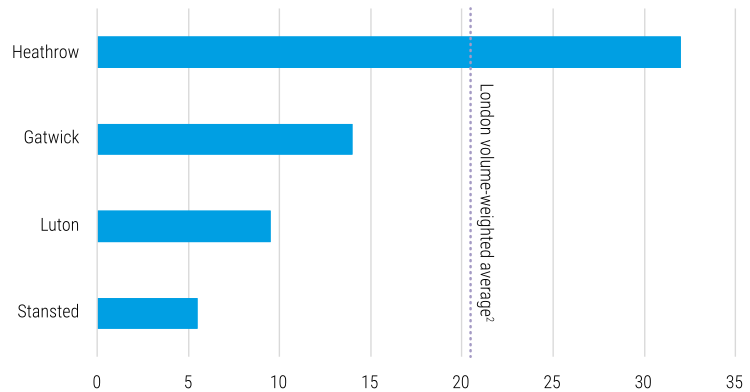
Source: Company information / Oxera data / London City Airport Annual Report 2023. Notes: 1Calculated based on 2023 annual reports, inflated to 2024 prices. Luton based on year-to-date 2024 aero yield/pax. Other airports based on Oxera data. 2Average weighted by 2023 passenger volumes.
Who is paying for this?
Not the government. The expansions will be funded by a combination of debt, equity and retained cash flows in the absence of sufficient war chests or divestitures. Higher cash flows can be driven by higher traffic volumes (which won’t happen instantaneously) or higher margins (efficiency comes over time). However, upfront funding comes in the form of higher airport charges (up to around 25% of ticket prices), which are set based on bilateral negotiations with airlines or through regulatory mechanisms in the case of economically regulated airports like Heathrow. For example, as part of Heathrow’s upcoming five-year plan they are seeking a 17% tariff uplift and a £2 billion equity contribution (derived from deferred dividends) alongside bondholder financing. The problem each airport faces, to varying degrees, is how far can they raise tariffs without becoming uncompetitive – a problem somewhat alleviated by expansions in the UK and wider Europe (for example, Amsterdam, Madrid and Frankfurt).
Winners and losers
Winners: The government and the wider economy. Heathrow claim their expansion will add 0.4% to the UK’s GDP by 2050; Luton, Stansted and Gatwick claim there will be an extra £1.5 billion, £2 billion and £1 billion of economic activity respectively following the completion of their projects. You would expect some interim capacity and benefits to be felt as the projects approach completion, and if executed correctly the government is getting something for nothing in the long run.
Losers: Larger incumbent airlines in the short to medium term. Airlines will be expected to partially foot the bill for these expansions, with airports trying to sway airlines with the prospect of better services and more capacity for growth. However, the attractiveness of this prospect depends on the extent to which airlines expect to grow – they could pay for opening themselves up to more competition. Higher capacity will almost certainly reduce the value of lucrative Heathrow slots that are traded between airlines, which have previously been traded for as much as £75 million.
Unclear: Bondholders will also be expected to fund growth and as such face exposure to project risk (think HS2). However, this will very much depend on the equity holder contribution and the extent to which airports are allowed to raise tariffs. Heathrow are targeting a rating upgrade to A- ahead of expansion and view that as a contingency to growth. It is also unclear where the consumer sits in all this. On one hand, airport tariffs will be – at least partially – passed on to the consumer; but limited slots and anti-competitive underutilised slot retention will restrict competition and isn’t supportive of competitive ticket prices. Having more slots at a hub airport such as Heathrow could also open more direct routes, with connecting traffic having the potential to make routes to certain destinations viable that otherwise would not have been on a point-to-point basis.
The bottom line
The successes of each expansion will hinge on balancing the needs of airlines and customers alongside debt and equity investors. London’s airports have proven their resilience during previous crises but now face a new challenge: funding their expansions while maintaining competitiveness, as well as appeasing financial markets that may react emotionally to headlines. Being active investment managers, we are afforded the opportunity to invest in an airport that compensates us for its expansion risk rather than buying the whole sector.
Airports, interestingly, benefit from a fiscally constrained UK government eager to support growth despite declining productivity. And with London’s enduring status as a cultural and financial hub, the appetite to visit (and escape) persists. In a sector where strategic execution and market sentiment can shift rapidly, adaptability isn’t optional – it’s essential. For those seeking to turn long-term aviation growth into resilient returns, active management stands out as the smarter choice.