




Insights
As we enter 2026, the question of how sustainable is Japan’s renaissance has evolved into a fundamental question/query: are we witnessing a temporary market cycle or the early stages of a structural transformation that could reshape Japan for decades? The evidence increasingly points to the latter. What began as a governance-driven rally in 2023 has revealed itself as something far more profound – a convergence of forces that mirrors the early stages of America’s great wealth creation cycle of the 1980s
Across boardrooms in Tokyo, the conversation has fundamentally changed from cash retention and stability to an urgent focus on shareholder returns and capital efficiency.
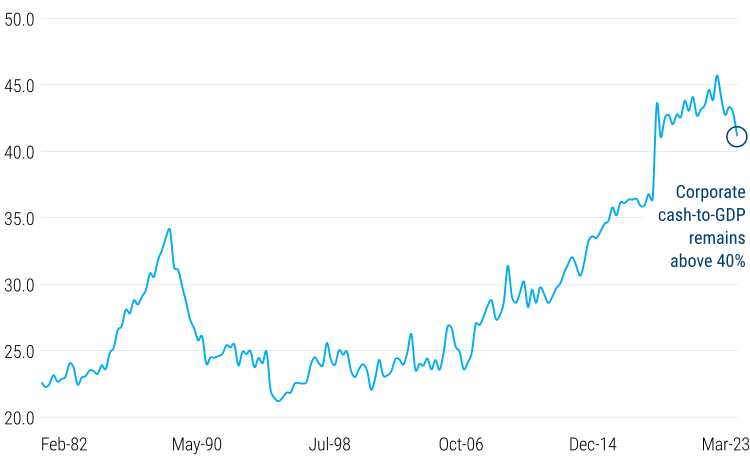
The numbers tell the story of a transformation gathering momentum. Japanese companies returned 60% of net income to shareholders in 2025, yet they are still sitting on the cash equivalent to 40% of GDP – more than double the US ratio (Figure 1). This isn’t a problem to be solved overnight; it is a multi-year opportunity that will systematically unlock value as companies learn to deploy capital more efficiently. We are already seeing evidence of this shift. Share buybacks have multiplied nine times since 2012, cross-shareholdings continue to unwind, and dividends have doubled in 10 years. These are not temporary measures driven by market pressure – they represent a fundamental shift in how Japanese business operates. The revolution has begun, but we are still in the early chapters.
Source: Nomura, November 2025. Chart shows cash and deposit/GDP for all industry ex financial.
Governance reform alone doesn’t explain the timing of this renaissance. Three powerful catalysts are converging to create a ‘why now’ moment that makes this transformation particularly compelling.
Japanese households are finally awakening from decades of financial dormancy. Sitting on $14 trillion in assets (nearly five times France’s entire GDP), half of which is languishing in cash, millions of savers are beginning to invest against a backdrop of persistent inflation. Improved NISA accounts (Japan’s tax-free investment scheme) are accelerating this shift from savings to investment, securing sustained equity inflows for years ahead.
Prime minister Sanae Takaichi’s administration builds on Abenomics but charts a new course. Where Abe aimed to defeat deflation and restore growth with monetary and fiscal policies, Takaichi pursues ‘Sanaenomics’ – a strategy that fuses economic growth with national security under the banner of Economic Security and Strategic Investment. This isn’t just policy evolution; it is a fundamental reimagining of Japan’s global positioning. With fiscal and monetary support, the government is partnering with private industry to dominate tomorrow’s critical technologies: artificial intelligence (AI), semiconductors, quantum computing, shipbuilding, cybersecurity, and digital content. The momentum is building, and Japan is positioning itself to reclaim a place towards the world’s economic summit.
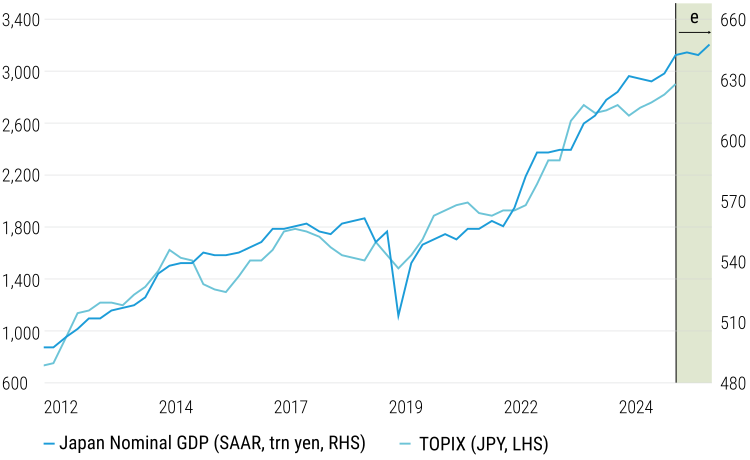
Nominal GDP growth is projecting upward, and the TOPIX historically tracks this trajectory (Figure 2). Crucially, this growth stems from robust domestic demand – a marked departure from Japan’s export-dependent recovery patterns of the past.
Source: Cabinet Office, Morgan Stanley Research. TOPIX (pt), Japan nominal GDP (trillion yen). e=Morgan Stanley Research estimates. November 2025.
What makes this convergence particularly compelling is that Japanese valuations remain attractive despite recent gains. The TOPIX is currently trading at a fraction of its bubble peak of 64x price/earnings, with more than a third of index companies still below book value. Relative to US markets, Japanese equities trade at a significant discount. This positions Japan as a natural beneficiary of any rotation away from US exceptionalism.
Japan’s investment story is evolving beyond its traditional automation and digital transformation themes. The new administration’s strategic vision, combined with structural shifts, is unlocking opportunities across unexpected sectors.
As AI reshapes global markets, Japan faces a unique opportunity. With its shrinking workforce, AI adoption addresses productivity challenges without the job displacement fears plaguing other nations. This demographic reality transforms potential disruption into competitive advantage.
Japan’s economic miracle left behind a legacy that now demands attention. Infrastructure built 40-50 years ago during the high-growth and bubble eras requires comprehensive renovation. This isn’t cyclical demand, it’s structural necessity. Construction companies stand to benefit from decades of sustained activity renovating buildings, upgrading facilities, and rebuilding aging transportation networks.
Geopolitical tensions are reviving an ancient truth: maritime control shapes global power. The Takaichi administration has designated shipbuilding as strategic, promising comprehensive public-private support as defense and maritime equipment sectors benefit from rising international instability.
Once ‘the nation’s kitchen’ (Japan’s main hub for rice trade and economic activity), Osaka lost ground to Tokyo after the 1990’s bubble burst. Now, with the Ishin Party’s coalition influence, momentum builds behind Osaka’s ‘sub-capital’ vision. Major projects such as the Integrated Resort, the Osaka Station redevelopment, and the Hokuriku Shinkansen extension signal economic revival ahead.
This market segment has quietly grown into an economic force in Japan. ‘Oshikatsu’ – supporting favorite idols, anime characters, VTubers, and athletes – now rivals the global anime industry in market size, revealing untapped commercial potential in Japan’s cultural exports.
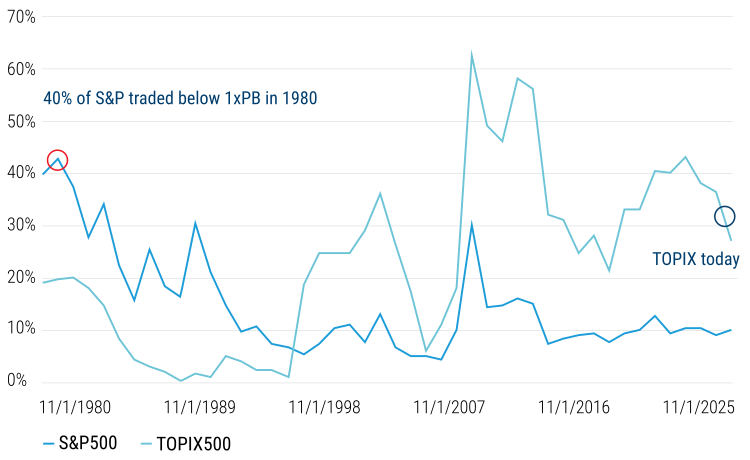
The parallels to America’s transformation in the early 1980s are striking and instructive. Back then, 40% of US stocks traded below book value – almost identical to Japan today (Figure 3). American companies were directionless after the stagflation of the 1970s, just as Japanese firms remained shell-shocked decades after their bubble burst.
Source: Morgan Stanley MUFG Research, November 2025.
The catalyst in both cases was the same: a corporate awakening focused on shareholder returns. Ronald Reagan’s deregulation and the shift towards M&A-driven restructuring launched the greatest wealth creation cycle in modern history. Japan is following an eerily similar script, with governance reforms systematically pushing return on equity (ROE) higher across the market.
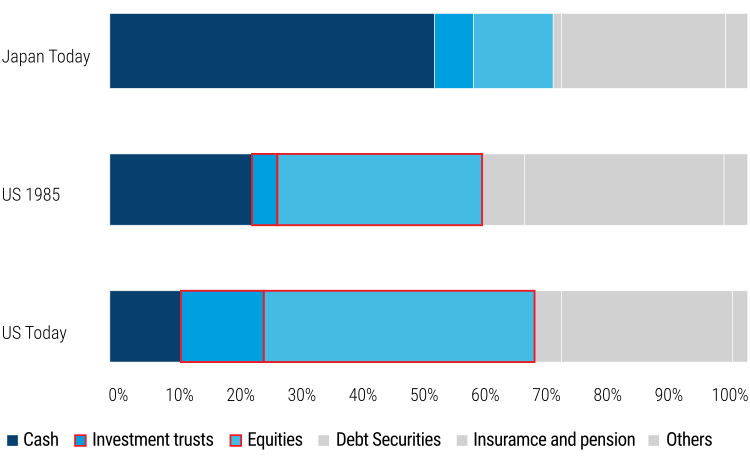
The retail investor revolution also provides another compelling parallel. Equity and investment trusts comprised just 36% of US household allocation in 1985, growing to 55% today. Japan currently sits at 19% – way below 1985 US level – and the trajectory is clear (Figure 4). With 50% of assets still in cash, the potential for reallocation into equities dwarfs what America experienced four decades ago. Japan’s NISA accounts are following a similar transformative path that 401(k)s and IRAs carved in the US, potentially unlocking trillions in household savings for equity investment.
Source: Bloomberg and SMBC, December 2025. Chart shows the ratio of stocks with a price-to-book ratio below 1 within the Japan-US universe. Calculated monthly since January 1980
Japan’s transformation demands an active investment approach. The evidence is clear: the median active Japan equity manager outperforms the MSCI Japan index over every time period in the past decade. Active managers are well positioned to create genuine alpha opportunities from a market riddled with inefficiencies.
Japan has 4,000 listed companies, yet only 35% have a return on equity above 10%. This means the majority languish at or below their cost of capital. For passive investors this creates an uncomfortable reality: they are forced to own underperforming companies simply because they exist in the index. Active management enables investment in attractively priced, high-quality companies, as well as in names poised for transformation. Furthermore, more than 60% of these Japanese companies are covered by one sell side analyst or none at all, compared to 70% of US small caps that each attract three or more analysts. This research vacuum is a treasure map for active managers willing to dig deeper. While the market sleeps on corporate Japan’s transformation, skilled managers are unearthing tomorrow’s winners.
Our quality core investment approach strategically targets these opportunities. We focus on exceptional, inexpensive businesses with strong fundamentals and management teams dedicated to unlocking shareholder value. This methodology has consistently delivered alpha throughout Japan’s transformation.
Japan’s renaissance isn’t a cyclical upturn, it is a structural transformation that could span decades. The convergence of corporate governance reform, demographic-driven capital reallocation, political realignment, and attractive valuations creates a compelling multi-year investment thesis.
Like America in the 1980s, Japan stands at the threshold of a generational wealth creation cycle. But we are still in the early innings. The governance revolution is accelerating, household capital is just beginning to mobilise, and political momentum favors continued reform.
The structural drivers remain intact, the runway for reform extends years ahead, and the opportunity for active managers to generate alpha has rarely been more compelling. We believe Japan’s renaissance is just beginning – and those who recognise its structural nature today will be best positioned to benefit from the transformation ahead.
Hauptthemen


For use by professional clients and/or equivalent investor types in your jurisdiction (not to be used with or passed on to retail clients). For marketing purposes.
This document is intended for informational purposes only and should not be considered representative of any particular investment. This should not be considered an offer or solicitation to buy or sell any securities or other financial instruments, or to provide investment advice or services. Investing involves risk including the risk of loss of principal. Your capital is at risk. Market risk may affect a single issuer, sector of the economy, industry or the market as a whole. The value of investments is not guaranteed, and therefore an investor may not get back the amount invested. International investing involves certain risks and volatility due to potential political, economic or currency fluctuations and different financial and accounting standards. The securities included herein are for illustrative purposes only, subject to change and should not be construed as a recommendation to buy or sell. Securities discussed may or may not prove profitable. The views expressed are as of the date given, may change as market or other conditions change and may differ from views expressed by other Columbia Threadneedle Investments (Columbia Threadneedle) associates or affiliates. Actual investments or investment decisions made by Columbia Threadneedle and its affiliates, whether for its own account or on behalf of clients, may not necessarily reflect the views expressed. This information is not intended to provide investment advice and does not take into consideration individual investor circumstances. Investment decisions should always be made based on an investor’s specific financial needs, objectives, goals, time horizon and risk tolerance. Asset classes described may not be suitable for all investors. Past performance does not guarantee future results, and no forecast should be considered a guarantee either. Information and opinions provided by third parties have been obtained from sources believed to be reliable, but accuracy and completeness cannot be guaranteed. This document and its contents have not been reviewed by any regulatory authority.
In Australia: Issued by Threadneedle Investments Singapore (Pte.) Limited [“TIS”], ARBN 600 027 414. TIS is exempt from the requirement to hold an Australian financial services licence under the Corporations Act 2001 (Cth) and relies on Class Order 03/1102 in respect of the financial services it provides to wholesale clients in Australia. This document should only be distributed in Australia to “wholesale clients” as defined in Section 761G of the Corporations Act. TIS is regulated in Singapore (Registration number: 201101559W) by the Monetary Authority of Singapore under the Securities and Futures Act (Chapter 289), which differ from Australian laws.
In Singapore: Issued by Threadneedle Investments Singapore (Pte.) Limited, 3 Killiney Road, #07-07, Winsland House 1, Singapore 239519, which is regulated in Singapore by the Monetary Authority of Singapore under the Securities and Futures Act (Chapter 289). Registration number: 201101559W. This advertisement has not been reviewed by the Monetary Authority of Singapore.
In Hong Kong: Issued by Threadneedle Portfolio Services Hong Kong Limited 天利投資管理香港有限公司. Unit 3004, Two Exchange Square, 8 Connaught Place, Hong Kong, which is licensed by the Securities and Futures Commission (“SFC”) to conduct Type 1 regulated activities (CE:AQA779). Registered in Hong Kong under the Companies Ordinance (Chapter 622), No. 1173058.
In Japan: Issued by Columbia Threadneedle Investments Japan Co., Ltd. Financial Instruments Business Operator, The Director-General of Kanto Local Finance Bureau (FIBO) No.3281, and a member of Japan Investment Advisers Association and Type II Financial Instruments Firms Association.
In the UK: Issued by Threadneedle Asset Management Limited, No. 573204 and/or Columbia Threadneedle Management Limited, No. 517895, both registered in England and Wales and authorised and regulated in the UK by the Financial Conduct Authority.
In the EEA: Issued by Threadneedle Management Luxembourg S.A., registered with the Registre de Commerce et des Sociétés (Luxembourg), No. B 110242 and/or Columbia Threadneedle Netherlands B.V., regulated by the Dutch Authority for the Financial Markets (AFM), registered No. 08068841.
In Switzerland: Issued by Threadneedle Portfolio Services AG, Registered address: Claridenstrasse 41, 8002 Zurich, Switzerland.
In the Middle East: This document is distributed by Columbia Threadneedle Investments (ME) Limited, which is regulated by the Dubai Financial Services Authority (DFSA). For Distributors: This document is intended to provide distributors with information about Group products and services and is not for further distribution. For Institutional Clients: The information in this document is not intended as financial advice and is only intended for persons with appropriate investment knowledge and who meet the regulatory criteria to be classified as a Professional Client or Market Counterparties and no other Person should act upon it.
This document may be made available to you by an affiliated company which is part of the Columbia Threadneedle Investments group of companies: Columbia Threadneedle Management Limited in the UK; Columbia Threadneedle Netherlands B.V., regulated by the Dutch Authority for the Financial Markets (AFM), registered No. 08068841.
Columbia Threadneedle Investments is the global brand name of the Columbia and Threadneedle group of companies. © 2026 Columbia Threadneedle. All rights reserved. columbiathreadneedle.com
For use by professional clients and/or equivalent investor types in your jurisdiction (not to be used with or passed on to retail clients). For marketing purposes.
This document is intended for informational purposes only and should not be considered representative of any particular investment. This should not be considered an offer or solicitation to buy or sell any securities or other financial instruments, or to provide investment advice or services. Investing involves risk including the risk of loss of principal. Your capital is at risk. Market risk may affect a single issuer, sector of the economy, industry or the market as a whole. The value of investments is not guaranteed, and therefore an investor may not get back the amount invested. International investing involves certain risks and volatility due to potential political, economic or currency fluctuations and different financial and accounting standards. The securities included herein are for illustrative purposes only, subject to change and should not be construed as a recommendation to buy or sell. Securities discussed may or may not prove profitable. The views expressed are as of the date given, may change as market or other conditions change and may differ from views expressed by other Columbia Threadneedle Investments (Columbia Threadneedle) associates or affiliates. Actual investments or investment decisions made by Columbia Threadneedle and its affiliates, whether for its own account or on behalf of clients, may not necessarily reflect the views expressed. This information is not intended to provide investment advice and does not take into consideration individual investor circumstances. Investment decisions should always be made based on an investor’s specific financial needs, objectives, goals, time horizon and risk tolerance. Asset classes described may not be suitable for all investors. Past performance does not guarantee future results, and no forecast should be considered a guarantee either. Information and opinions provided by third parties have been obtained from sources believed to be reliable, but accuracy and completeness cannot be guaranteed. This document and its contents have not been reviewed by any regulatory authority.
In Australia: Issued by Threadneedle Investments Singapore (Pte.) Limited [“TIS”], ARBN 600 027 414. TIS is exempt from the requirement to hold an Australian financial services licence under the Corporations Act 2001 (Cth) and relies on Class Order 03/1102 in respect of the financial services it provides to wholesale clients in Australia. This document should only be distributed in Australia to “wholesale clients” as defined in Section 761G of the Corporations Act. TIS is regulated in Singapore (Registration number: 201101559W) by the Monetary Authority of Singapore under the Securities and Futures Act (Chapter 289), which differ from Australian laws.
In Singapore: Issued by Threadneedle Investments Singapore (Pte.) Limited, 3 Killiney Road, #07-07, Winsland House 1, Singapore 239519, which is regulated in Singapore by the Monetary Authority of Singapore under the Securities and Futures Act (Chapter 289). Registration number: 201101559W. This advertisement has not been reviewed by the Monetary Authority of Singapore.
In Hong Kong: Issued by Threadneedle Portfolio Services Hong Kong Limited 天利投資管理香港有限公司. Unit 3004, Two Exchange Square, 8 Connaught Place, Hong Kong, which is licensed by the Securities and Futures Commission (“SFC”) to conduct Type 1 regulated activities (CE:AQA779). Registered in Hong Kong under the Companies Ordinance (Chapter 622), No. 1173058.
In Japan: Issued by Columbia Threadneedle Investments Japan Co., Ltd. Financial Instruments Business Operator, The Director-General of Kanto Local Finance Bureau (FIBO) No.3281, and a member of Japan Investment Advisers Association and Type II Financial Instruments Firms Association.
In the UK: Issued by Threadneedle Asset Management Limited, No. 573204 and/or Columbia Threadneedle Management Limited, No. 517895, both registered in England and Wales and authorised and regulated in the UK by the Financial Conduct Authority.
In the EEA: Issued by Threadneedle Management Luxembourg S.A., registered with the Registre de Commerce et des Sociétés (Luxembourg), No. B 110242 and/or Columbia Threadneedle Netherlands B.V., regulated by the Dutch Authority for the Financial Markets (AFM), registered No. 08068841.
In Switzerland: Issued by Threadneedle Portfolio Services AG, Registered address: Claridenstrasse 41, 8002 Zurich, Switzerland.
In the Middle East: This document is distributed by Columbia Threadneedle Investments (ME) Limited, which is regulated by the Dubai Financial Services Authority (DFSA). For Distributors: This document is intended to provide distributors with information about Group products and services and is not for further distribution. For Institutional Clients: The information in this document is not intended as financial advice and is only intended for persons with appropriate investment knowledge and who meet the regulatory criteria to be classified as a Professional Client or Market Counterparties and no other Person should act upon it.
This document may be made available to you by an affiliated company which is part of the Columbia Threadneedle Investments group of companies: Columbia Threadneedle Management Limited in the UK; Columbia Threadneedle Netherlands B.V., regulated by the Dutch Authority for the Financial Markets (AFM), registered No. 08068841.
Columbia Threadneedle Investments is the global brand name of the Columbia and Threadneedle group of companies. © 2026 Columbia Threadneedle. All rights reserved. columbiathreadneedle.com

Sed ut perspiciatis unde omnis iste natus error sit voluptatem accusantium doloremque laudantium
*Pflichtfelder
Etwas ist schief gelaufen. Bitte versuche es erneut