
at
AT
Austria
de-AT
at_inst_classes
inst
Institutional
de
de
Insights

Covid-19 index: when might life return to ‘normal’? – March 2021

As one of the world’s largest economies the US is a key focus for investors. With every country attempting to return to normality following the coronavirus pandemic, we are monitoring when US economic activity might get back on track, as well as other measures of “normality” such as entertainment and leisure, high street shopping, and schools reopening. The result is an index that measures progress toward a post-pandemic world.

Our Return to Normal index

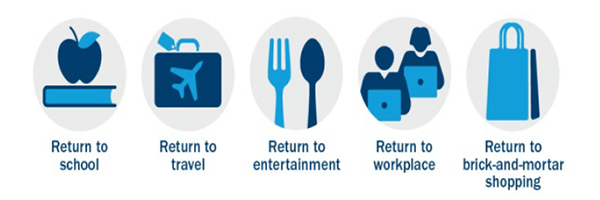
With the US Covid-19 vaccination program well underway, the Return to Normal Index measures human activity data relative to pre-pandemic levels. The index is constructed by our data scientists and fundamental analysts and tracks activities in the US, including travel, returning to work and school, brick-and-mortar shopping and eating out. By design, the index is focused on measuring components of daily life rather than economic indicators such as GDP growth. The percentage level will move closer to 100 as daily life normalises, and our analysts will update it on a regular basis.

What has changed?

Since our February update, the Return to Normal Index has ticked up only slightly (Figure 1). This is not surprising: large segments of the population are still not eligible to get a vaccination. But the good news is that Covid cases, hospitalisations and positivity rates continue to fall precipitously, and vaccine distribution is accelerating. Among the index subcomponents (explained below), return to in-person schooling is rising because many counties are moving away from remote learning and back to school attendance or hybrid models.

Activity numbers won’t necessarily all return to where they were before Covid. The index could hit “normal” at a point lower than the 100 level due to continued changes in behaviour, like working from home and reduced business travel. The definition of the future normal is evolving, and the index’s normal threshold will reflect our data science and fundamental research insights.

Figure 1: The Return to Normal Index tracks activity compared with pre-pandemic levels as we progress to post-Covid life

March 1 60 procents of normal range

Source: Columbia Threadneedle Investments, 1 March 2021

What are we monitoring, and where is it at?

We are analysing the time people spend engaging in a broad set of activities outside their homes (Figure 2). The index components have implications for economic growth, but the primary objective is to monitor how close or far we are to returning to normal life.

Figure 2: Tracking inputs
Graph Index Normal life

Our index suggests we are still 40% below pre-Covid activity levels. The levels of subcomponent activity vary: the return to brick-and-mortar stores is 31% below its pre-Covid levels, while a normal work routine is 32% below pre-Covid levels. The subcomponent with the lowest level is travel/entertainment, which is 61% below pre-Covid levels.

What could drive change?

Faster vaccine distribution and uptake could accelerate the path to normal (ie, the upside case). Developments that could impede a return to normal (ie, the downside case) include the emergence of variants that are resistant to current vaccines or slower uptake of the vaccine in certain places (because of people’s unwillingness to get vaccinated or shortfalls in supply).

Figure 3: The Return to Normal Index over time – level as of 1 March: 60%

Normal range and estimated path across the years graph

Source: Columbia Threadneedle Investments, 1 March 2021

The index provides a framework as we analyse companies. It is a roadmap for what normal activity might look like after Covid and how long it will take to get there. The information allows us to test a company’s own assumptions and make adjustments in our views as needed.

For investors, the Columbia Threadneedle Return to Normal Index can act the same way: it’s an additional input to consider as they research their individual asset allocation and portfolio decisions.

Understanding where we are on the path to normal life will be a critical question in 2021. This data input can help inform investors’ asset allocation decisions and set expectations on market activity.


10 März 2021
Paul DiGiacomo
Paul DiGiacomo
Head of Equity Research
Share article
Hauptthemen
Verwandte Themen
Listen on Stitcher badge
Share article
Hauptthemen
Verwandte Themen

Important Information

The research and analysis included on this website has been produced by Columbia Threadneedle Investments for its own investment management activities, may have been acted upon prior to publication and is made available here incidentally. Any opinions expressed are made as at the date of publication but are subject to change without notice and should not be seen as investment advice. Information obtained from external sources is believed to be reliable but its accuracy or completeness cannot be guaranteed.

Verwandte Beiträge

17 Juni 2026

Tiffany Wade

Senior Portfolio Manager

David Goodman

Senior Equity Research Analyst

Beyond hype: AI benefits taking shape

AI is moving beyond the hype cycle, with real productivity gains beginning to emerge. The biggest investment opportunities may lie with companies that can translate adoption into durable competitive advantage.
8 Juni 2026

Simon Morton-Grant

Client Portfolio Manager

Japan – the renaissance continues

Japan equities continue to deliver double-digit returns, supported by record foreign inflows and growing AI-driven optimism across the market.
27 Mai 2026

Europa ist gegenüber dem anhaltenden Konflikt misstrauisch

Die Märkte hatten für Europa 2026 ein zweistelliges Wachstum erwartet, das jedoch von der Nahost-Krise beeinträchtigt wurde.
2 Juli 2026

Guillaume Langellier

Senior Credit Research Analyst

Should investment grade prime office landlords worry about AI?

AI is reinforcing prime office demand in the short term, but the bigger question is whether productivity gains will ultimately limit hiring and space needs.
30 Juni 2026

In Credit Weekly Snapshot – The tied is high

Events in the Middle East continue to influence economic policy, with central banks revisiting future rate moves as the oil price returns to pre-conflict levels.
29 Juni 2026

Anthony Willis

Senior Economist, Multi-Asset Solutions team

Market Perspectives: Postcard from Milan: What’s in store for H2?

As investors look ahead to the second half of 2026, the market backdrop appears somewhat less fraught than it did during the first six months of the year.
true
true

Important Information

The research and analysis included on this website has been produced by Columbia Threadneedle Investments for its own investment management activities, may have been acted upon prior to publication and is made available here incidentally. Any opinions expressed are made as at the date of publication but are subject to change without notice and should not be seen as investment advice. Information obtained from external sources is believed to be reliable but its accuracy or completeness cannot be guaranteed.

Das könnte Ihnen auch gefallen

Investmentansatz

Teamwork bildet eine wichtige Grundlage unseres Anlageprozesses, der so strukturiert ist, dass er die Ausarbeitung, Bewertung und Umsetzung fundierter und vielversprechender Anlageideen für unsere Portfolios erleichtert.

Fonds

Columbia Threadneedle Investments bietet eine umfangreiche Palette von Investmentfonds an, die eine Vielzahl von Anlagezielen abdeckt.

Anlagekapazitäten

Wir bieten eine breite Palette aktiv verwalteter Anlagestrategien und -lösungen, die globale, regionale und lokale Märkte und Anlageklassen abdecken.

Bitte bestätigen Sie einige Angaben zu Ihrer Person, um Ihr Präferenzzentrum zu besuchen

*Pflichtfelder

Etwas ist schiefgelaufen, bitte versuchen Sie es erneut

Vielen Dank. Sie können jetzt Ihr Präferenzzentrum besuchen, um auszuwählen, welche Einblicke Sie per E-Mail erhalten möchten.

Um zu sehen und zu aktualisieren, welche Erkenntnisse Sie von uns per E-Mail erhalten, besuchen Sie bitte Ihr Preference Center.