


Filter insights on this page
Repo rates are expressed relative to SONIA, and the chart below displays the average repo rates that we have achieved over the past four quarters for three, six, nine and 12-month repos, shown as a spread to average SONIA levels at the time. The volatility and market uncertainty that resulted from the mini-Budget also weighed upon funding markets, particularly for shorter dated trades as can be seen from the achieved spreads below. Note that during the fourth quarter of 2022 no repos were traded with a 12m tenor so the chart reflects the previous quarter’s value.
Capabilities
Media type
Themes
The secondary impact of the mini-Budget crisis centred around collateral and the velocity of movement; rather than a lack of balance sheet for repo funding (a la March 2020). Yet, the difficulties around collateral substitutions and settlements did in many cases prompt a review by individual banks’ credit officers, resulting in a temporary reduction or hiatus in repo balance sheet provision in some cases. Once these reviews were completed balance sheet availability opened up again – some with the addition of haircuts to provide additional protection to the bank. Of course, the momentous lack of certainty in the future path of interest rates also impacted the typical repo spread to SONIA as trading a fixed rate forced the banks to take a conservative view on where yields could reach.
Indicative current pricing shows leverage via gilt TRS for a six-month tenor is very bank dependent but is on average similar to repo – this depends on the bank’s view of the repo market and whether they are impacted by Net Stable Funding Ratio regulations (NSFR). Part of the reason for higher costs for TRS is a reflection of the lack of straight-through-processing available. Columbia Threadneedle are engaging with various market providers and participants to redefine TRS and the way it is traded and confirmed.
The monetary loosening cycle continued its momentum, with the US Federal Reserve cutting their rate by 1.5% over the quarter (after a slow start to the year) and the Bank of England also completing their much-anticipated Christmas cut of 0.25%, bringing the Base Rate to 3.75%. This was in contrast to the ECB, who remained on hold throughout the fourth quarter with some market participants holding the belief that the next move will be a rate increase as early as the first half of 2026.
All data and sources Columbia Threadneedle Management Limited, as at 30 June 2024 and Valid to: 30 September 2024
Regions

Market Update
What was your New Year’s resolution? The markets were determined to enjoy falling inflation and bank rates whilst Prime Minister Keir Starmer was focused upon tackling the cost of living. However President Trump’s resolution appeared to be along the lines of ‘just do it’ – starting the year with the extra-judicial capture of the Venezuelan President and effective annexation of the country and ending the quarter deep in the quagmire of the Iran conflict. These actions have served to stymie market expectations, causing significant increases (and volatility) in energy prices as the Strait of Hormuz – the primary route for Middle Eastern oil – remained closed. This in turn had a knock-on impact on inflationary concerns and thus bank rate decisions, resulting in rapid changes in market expectations for rate hikes across the US, Europe and the UK.
The UK went from pricing in two rate cuts in 2026 to two rate hikes by the end of the quarter (a swing of 100bps) with four rate hikes priced at the extremes. These pressures also challenge the Chancellor’s plans, both in terms of the fiscal rules and potential additional support for those badly affected by rising fuel costs. The UK is very sensitive to inflationary pressures as a large net importer of energy and due to mechanisms such as the household energy cap. Given the sole mandate of the Bank of England is to control inflation through monetary policy a sustained increase in a supply-side shock in inflation will hamper their ability to reduce the Bank Rate even in the face of falling growth considerations driven by spikes in energy costs and related products such as factory and farming inputs e.g. fertiliser. As a consequence, the Bank of England held the base rate at 3.75% throughout the first quarter of 2026.
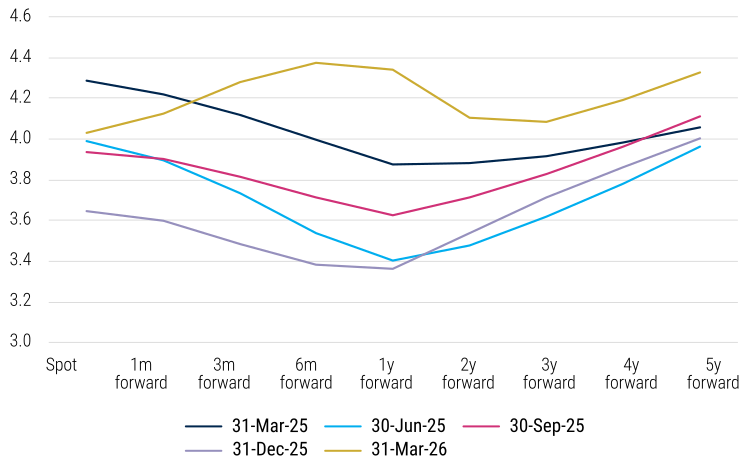
The market’s view of where long-term rates could move to in the future is encapsulated in forward rates. The chart below shows where the six-month SONIA swap rate (spot) is currently and at various forward rates out to five years. The market reaction to the Iran conflict has wiped out the expectations of multiple rate cuts this year indeed to the extent of pricing in multiple rate hikes over the course of 2026. One-year forward rate expectations have consequently risen by 0.98% over the quarter.
Figure 1: Six-month SONIA rate
Source: Barclays Live, as at 31st March 2026
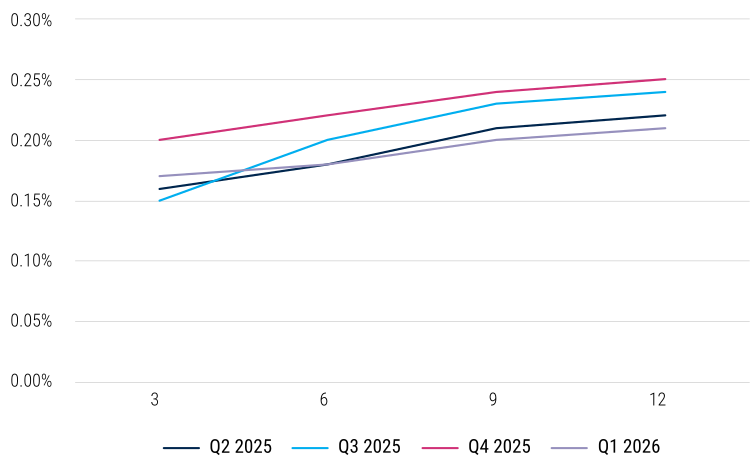
Repo rates are expressed relative to SONIA, and the chart below displays the average repo rates that we have achieved over the past four quarters for three, six, nine and 12-month repos, shown as a spread to average SONIA levels at the time. Repo spreads have diminished in the first quarter as is usual post year end – what is more interesting is that spreads have remained relatively consistent or even improved throughout the volatility seen in March from the Iran conflict. This is a reflection of hedge fund unwinds of leveraged positions; the most popular trade of 2025 and early 2026 was to hold global steepeners – in effect gaining a positive return if longer dated yields rose relative to short-dated yields. The changing geopolitics have caused the opposite to occur and this positioning has now been unwound as the market moves have caused significant losses on this trade. In turn this has resulted in a greater availability of repo balance sheet for other market participants.
Figure 2: Spread to SONIA
Source: Columbia Threadneedle Investments, as at 31st March 2026
In September 2025 the Bank of England released a consultation paper to address the stability and structure of the repo market. Forty market participants (including Columbia Threadneedle Investments) responded to the consultation to provide their views on the proposals and the Bank of England has now published its feedback statement. There were two main suggestions within the consultation paper, namely the potential for a greater or mandatory central clearing requirement and for mandatory minimum haircuts on bilateral positions. Whilst we support the aim of strengthening the resilience of the repo market, our concerns were echoed by the other participants, noting the challenges with access and margin requirements of the existing central clearing model and noting the pro-cyclicality of initial margin in times of market stress exacerbating demand on the repo funding market. The proposed introduction of minimum haircuts on a broad market basis could increase funding costs, reduce market liquidity and potentially drive leverage into other areas of the market with the possibility of diminishing demand for government debt. The Bank of England has committed to continuing its work to enhance the resilience of the market throughout 2026 and intends to publish a comprehensive update in early 2027 on next steps.
Credit Repo
Following the gilt crisis in 2022, we are seeing interest from clients in credit repo and an appetite from more and more banks to support the same. Credit repo allows portfolios with directly held credit to raise cash to support hedging without selling their credit once their gilt positions are depleted. Pricing is highly bank and bond dependent and as a corollary can also be ‘special’ or in high demand. Specials in the corporate bond market are typically fleeting rather than persistent as is seen in the gilt market and, as such, credit repo should be thought of as a short-term contingency solution rather than a long-term funding tool. However, it is a beneficial addition to the toolbox and something we are putting in place for relevant portfolios. It has now grown from a niche offering to one with relatively widespread availability; however, pricing and appetite varies considerably, necessitating engagement to ensure the appropriate access to counterparties in the event of credit repo being needed. An alternative to credit repo is to margin gilt repo with corporate bonds; however, for this to have use in a crisis it means paying the cost of the less liquid collateral on an ongoing basis, thereby increasing the overall cost of funding in the portfolio.
Alternate Funding
Repo funding generally remains cheaper for creating leveraged exposure to gilts over the lifetime than the equivalent total return swap (TRS) and so continues to be used within our LDI portfolios. However, pricing for total return swaps can be very bond specific and, where the bank counterparty can obtain an exact netted position, the rate can be extremely competitive. TRS can be longer dated, with maturities ranging from one to three years and even five years, as compared to repo which typically vary in term from one to 12 months. Hence, TRS can be beneficial for locking in funding costs for longer and for minimising the roll risk associated with shorter-term repo contracts. On the other hand, repo facilitates tactical portfolio adjustments more easily and tends to be slightly cheaper. We ensure portfolios have access to both repo and TRS for leveraged gilt funding, so we can strike the right balance between cost, flexibility, and minimisation of roll risk. It is essential to maintain a range of counterparties to manage the funding requirements of a pension fund. We have legal documentation in place with a diversified suite of 24 counterparties for GMRA (Global Master Repo Agreement) and ISDA (International Swaps and Derivatives Association).
Indicative current pricing shows leverage via gilt TRS for a six-month tenor is very bank dependent but is on average similar to repo – this depends on the bank’s view of the repo market and whether they are impacted by Net Stable Funding Ratio regulations (NSFR). Part of the reason for higher costs for TRS is a reflection of the lack of straight-through-processing available. Columbia Threadneedle are engaging with various market providers and participants to redefine TRS and the way it is traded and confirmed.
Another way to obtain leverage in a portfolio is to leverage the equity holdings via an equity total return swap (or equity futures). An equity TRS on the FTSE 100 (where the client receives the equity returns) would indicatively price around 0.17% higher than the repo (also as a spread to six-month SONIA). Clearly, this pricing can vary considerably from bank to bank and at different times due to positioning, which gives the potential for opportunistic diversification of leverage.
Contingent NBFI Repo Facility (CNRF)
We welcome the efforts of the Bank of England to create a repo facility for Non-Bank Financial Institutions (NBFIs) – known as the Contingent NBFI Repo Facility (CNRF). In January the Bank of England released more details of the facility and eligibility criteria. At the outset the client or fund must own over £2bn of gilts, there is a concentration limit of £500m of a specific gilt and each client has a borrowing limit of 50% of gilt holdings rounded to the nearest billion. Participants will need to pay an annual fee for access as well as committing to participate in periodic test trades and providing regular information to the Bank. Technically, the facility will be structured as a secured borrowing arrangement rather than a traditional repo so investors will need to ensure they have the appropriate permissions for regular borrowing to use the facility. Please get in touch if you would like to know more about this facility.