


Filter insights on this page
Repo rates are expressed relative to SONIA, and the chart below displays the average repo rates that we have achieved over the past four quarters for three, six, nine and 12-month repos, shown as a spread to average SONIA levels at the time. The volatility and market uncertainty that resulted from the mini-Budget also weighed upon funding markets, particularly for shorter dated trades as can be seen from the achieved spreads below. Note that during the fourth quarter of 2022 no repos were traded with a 12m tenor so the chart reflects the previous quarter’s value.
Capabilities
Media type
Themes
The secondary impact of the mini-Budget crisis centred around collateral and the velocity of movement; rather than a lack of balance sheet for repo funding (a la March 2020). Yet, the difficulties around collateral substitutions and settlements did in many cases prompt a review by individual banks’ credit officers, resulting in a temporary reduction or hiatus in repo balance sheet provision in some cases. Once these reviews were completed balance sheet availability opened up again – some with the addition of haircuts to provide additional protection to the bank. Of course, the momentous lack of certainty in the future path of interest rates also impacted the typical repo spread to SONIA as trading a fixed rate forced the banks to take a conservative view on where yields could reach.
All data and sources Columbia Threadneedle Management Limited, as at 30 June 2024 and Valid to: 30 September 2024
Regions

A benign start to the year was dragged back to reality by the twin terrors of conflict in the Middle East and UK politics. Every day the Strait of Hormuz remained closed, the potential inflationary and negative growth impacts grew, weighing on central banks’ plans to follow a monetary easing path. In the UK there was the added spice of an anticipated leadership challenge, due to the ruling Labour party experiencing heavy losses in the English local council and devolved Scottish and Welsh Parliamentary elections.
At the turn of the year, the path forward seemed clear for monetary policy. In the UK the expectation was for at least one more rate cut, as the Bank of England’s Monetary Policy Committee (MPC) fine-tuned their expectations for the neutral rate. Indeed, some expected significantly more cuts, even positing approaching a terminal rate of 2.75%. In the US, political pressure and the end of the tenure of Federal Reserve Chair Jerome Powell also led to expectations for significantly lower rates. Yet the surprise US and Israel joint attack on Iran threw all of this into doubt. The impact was particularly felt in the UK, as markets moved from pricing in cuts to, at some points, pricing in four rate hikes to tackle energy-led inflation. This market-led tightening of monetary factors has so far permitted the MPC to remain on hold at a base rate of 3.75%; however, rhetoric certainly points to hikes remaining on the horizon. Even if there is tolerance to look through temporary inflationary impacts, once these start feeding through into second round effects such as wage growth pressure, there is a risk that inflationary expectations become anchored at higher levels, prompting action.
Amidst the global market instability, the long-awaited local and devolved Parliamentary elections were held and, as predicted, resulted in significant gains for the Green and Reform parties and delivered a potential knock-out blow to Prime Minister Starmer’s administration. Whilst these elections do not change the Westminster majority enjoyed by the Labour party, it is becoming clear that there is division and a lack of faith in his authority. The apparent front-runner is Andy Burnham, Mayor of Greater Manchester, who is now challenging in a by-election to return to Westminster – a requirement for leadership of the party. For now, the market is in wait and see mode, partially reassured by spokespeople for Andy Burnham committing to maintaining Chancellor Rachel Reeves’ fiscal rules. However, that is hard to square that with his platform of nationalising industries. These factors have increased the risk premium in UK markets, offset as much as humanly possible by the sterling work of the Debt Management Office (DMO) in their sensitive and thoughtful approach to managing significant issuance – i.e. by decreasing the maturity of issuance to target pockets of demand.
Demand for UK debt has shifted considerably in recent years. The bond market had historically one of the longest durations in the world, prompted by the need for pension funds to hedge long dated commitments to members and bolstered by the Bank of England’s (BoE) asset purchasing programme to support the economy. Never has this been more evident than in the 2020 issuance of a bond maturing in 2061 with a coupon of 0.5% – for 40-year debt to attract such a low rate is simply incredible. Since those heady days LDI demand has largely stepped away, as pension funds have high hedge ratios and the BoE has switched to being a seller through its Quantitative Tightening process. Recent analysis of who is buying gilts these days point to the banks stepping up; their demand is largely concentrated in the shorter maturities and in recent months have been taking advantage of attractive levels relative to swaps and relative to alternative High Quality Liquid Assets (HQLA) such as reserves held at the BoE (remunerated at base rate). Gilts attract a 0% risk weight as GBP government guaranteed paper. Whether or not this demand will persist will depend on levels and regulations around leverage ratios: if a proposed relaxation of leverage ratio constraints is enacted then it will free up balance sheet to expand demand which could be channelled into gilts. Any expansion in Treasury bill (T-bill) issuance, as is being mooted by the DMO, will also fit well with bank-led demand.
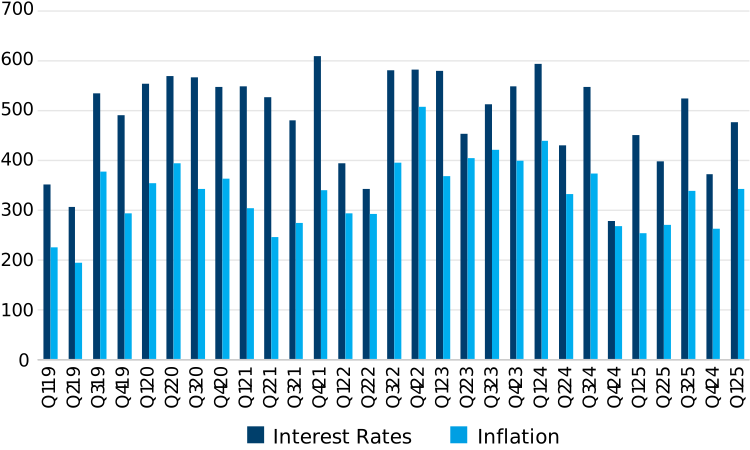
Total interest rate liability hedging activity increased to £36.3 billion, whilst inflation hedging also rose to £34.3 billion. LDI demand, long suppressed, has continued to grow, albeit from a low base as hedge accuracy increased in importance, as shorter dated tenors responded differently to longer dated tenors. The adjustment in rate expectations was particularly punitive for those holding an overweight to shorter dated assets, such as credit, without correcting for that in the overall hedge. Rising yields provided an attractive entry level for those with improving funding ratios driven by equities disregard of global events. The performance of major equity indices such as the S&P 500 has never been as concentrated in so few stocks, as the power of the AI-driven tech companies seems to grow and grow. On that front there has been a marked increase in pension funds considering equity protection strategies to maintain some upside exposure but defend against reversals. If you would like to learn more about this, please contact your client director.
The chart below describes hedging transactions as an index based on risk. Note that transactions include switches from one hedging instrument into another. It should be noted that, as the index is constructed by using the rate of change of risk traded by each counterparty per quarter, it allows the introduction (or removal) of counterparties in the survey.
Chart 1: Index of UK pension liability hedging activity (based on £ per 0.01% change in interest rates or RPI inflation expectations i.e. in risk terms)
Source: Columbia Threadneedle Investments. As at 31 March 2026
The funding ratio index published by the Pension Protection Fund showed an increase in funding levels quarter-on-quarter (131.4% at end March vs 130.2% at end December). Buoyant equity markets restricted falls on the asset side and rising yields lowered liability valuations.
Market Outlook
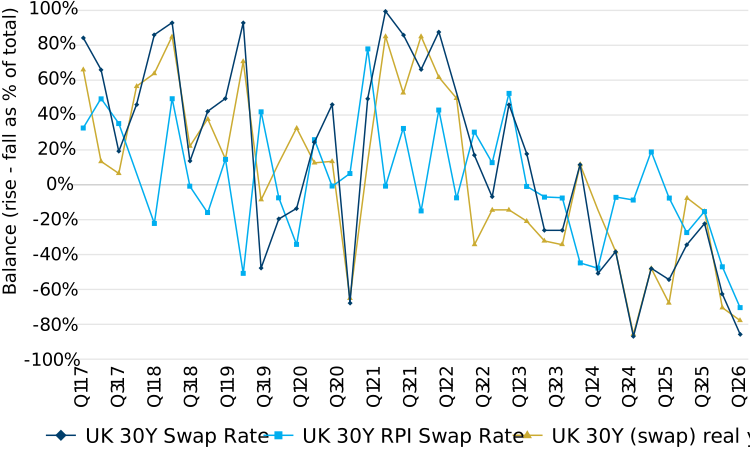
We also asked investment bank derivatives trading desks for their opinions on the likely direction of key rates for liability hedging. The aim is to get information from those closest to the market to aid investors in their decision-making.
The results are shown below as the number of those predicting a rise less those predicting a fall, as a percentage of the number of responses. The larger the balance, the more responses predict a rise. The more negative the balance, the more responses predict a fall.
Chart 2: Change in swap rates over the next quarter
Source: Columbia Threadneedle Investments. As at 31 March 2026
Last quarter our counterparties expected a fall in all three metrics. Unfortunately, they could not predict the conflict in Iran and the consequent global rising yield phenomenon. Their forward-looking expectations are again for falls in all three metrics, predicated on the hope and wish that the conflict is soon resolved and that the inflationary pressures that are building up can be dissipated. However, it is likely that the rebuilding of global oil reserves and other input products will take a long time to be repaired. The UK is peculiarly exposed to energy shocks, given high natural gas imports increasing the vulnerability of gilts vs other major economies’ bond markets. Conversely, if the situation is resolved it gives the potential for gilts to outperform, assuming the UK political situation is resolved satisfactorily.
If you would like to learn more about any of the topics discussed, please contact your client director.