


A joint paper by The Good Economy and Columbia Threadneedle Investments
From 17th‑century Dutch flood defences to modern social bonds, fixed income has long financed vital public needs – emerging as a powerful, scalable force for measurable social impact.
A rich history
It is estimated that about 65% of the Netherlands would be under water at high tide were it not for its dikes, dunes and pumps, so this financing was essential to saving lives and preventing loss of major urban areas.2 To this day, Dutch water authorities continue to benefit from bond market capital, with bond issuance occurring multiple times a year – often exceeding €1 billion in value – to fund vital flood defence and water management systems, with financial institutions, such as NWB Bank3, continuing to provide capital in support of this.
This isn’t an isolated example of fixed income vehicles delivering positive social impact. For more than 200 years in the United States, municipal bonds have been a solution to funding capital-intensive projects that meet social needs and drive economic growth – raising private investment for critical social and economic infrastructure such as hospitals, schools, water and heating systems, roads and other transport infrastructure.
Perhaps one of the best examples of how fixed income markets evolved to finance social needs is in the UK. UK housing associations began as charitable quasi-investment vehicles in Victorian times, with philanthropists such as Peabody and Octavia Hill founding trusts to provide housing for urban poor. These early schemes attracted private investors by offering modest fixed returns (4%-5%) while maintaining affordable rents – conceptually, very similar to fixed income.
While much of the 20th century in the UK saw a state-dominated housing system, the 1988 Housing Act encouraged housing associations to borrow private capital at scale, with associations using rental income to service the debt. The Housing Finance Corporation was founded in 1987 specifically to raise bond finance for housing associations, acting as an intermediary and allowing smaller associations to access capital markets. By the mid-to-late 2000s bond finance was a core funding source for social housing. The global financial crisis accelerated the shift dramatically, with associations issuing large volumes of long-dated fixed income bonds to the tune of many billions of pounds a year. These often came with 20-40-year maturities, fixed coupons and investment grade ratings, and were secured on housing assets or rental streams – in effect a fully mature social infrastructure bond market.
The model works particularly well for fixed‑income investors due to:
- Predictable cashflows (regulated rent largely linked to inflation)
- Strong asset backing (bonds are commonly backed by large pools of housing stock)
- Low defaults (the sector is heavily regulated)
- Asset-liability match (housing assets last decades, bonds are often 30+ years
The UK housing association sector is effectively a late-20th-century reinvention of the centuries-old social infrastructure finance practiced by the Dutch water boards. Similar to other sectors essential for social needs, social housing is an example of a regulated, asset‑backed system where predictable rental income supports large‑scale issuance of long‑dated fixed income instruments to fund affordable housing.
These are just a few examples among a long-standing and wide spectrum of entities and sectors which use the bond market to fund critical projects that deliver social outcomes. These range from governments and government-related bodies to non-profit and development banks and listed and privately held corporates. The use of bond market capital is also often of a consequential scale, with primary market bond issuance amounting to hundreds of millions, or even several billions, on any one day, and the strongest issuers accessing such funding multiple times a year.
With the urgency to mobilise capital for global social challenges increasingly recognised and acknowledged, the global bond market, with its estimated $140 trillion size and $10 trillion of annual primary market capital, will continue to play a crucial and scalable role going forward.
What good looks like in impact fixed income
Although impact investment has a long history, the formalisation of the term has only occurred over the past couple of decades. This is particularly due to the work of the Global Impact Investing Network (GIIN), which defines impact investing as “investments made with the intention to generate positive, measurable social and environmental impact alongside a financial return”.
Despite this formalisation, impact capital allocators’ adoption of listed fixed income remains relatively nascent. One reason for this is that impact investing has generally evolved through private assets and listed equities. Here, a narrower investible universe supports the ability for engagements to have direct influence on governance or on measurable outcomes, thus enabling more direct attribution to impact creation. By contrast, the scale and diversity of fixed income supports a wider spectrum of issuer types, which means that bondholders, while not owners, remain critical providers of capital. As such, fixed income can be viewed as supporting an impact model based on contribution to outcomes rather than direct attribution.
Dual objective = dual proprietary research process
In considering a model based on contribution, it is our experience that a ‘good’ fixed income impact investment approach is one with a highly active management style, where proactive actions are defined and reflected under multiple components of portfolio construction and management. This includes the sourcing, screening, due diligence, selection and engagement of bonds in which to invest. This thorough process is such that the capital allocator can optimise for the dual objectives of financial return and positive social outcomes.
Financial alpha
A capital allocator’s definition of financial return will reflect their specific needs. However, in promoting the principle of ‘not sacrificing financial return’, and to actively encourage impact industry growth, a financial return benchmark should be selected that aligns with the broad market as opposed to a narrower subset that might reflect differing risk-and-return and concentration characteristics.
With this in mind, delivery of financial alpha requires the active manager to carry out proprietary entity-level financial research. This should integrate environmental, social and governance (ESG) considerations into entity level screens and outputs, such that the investment opportunity is clear and/or ranked according to expected financial risk and reward potential. Within fixed income, proprietary research will not only occur at the entity level, but also at the security selection level. This is because a single entity can have many bonds outstanding, each varying according to specific terms including the bond’s currency, size, tenor, capital structure or covenant features.
Social alpha
Similarly, the delivery of social outcomes should utilise a proprietary research approach, whereby key impact considerations are embedded into evidence-based rankings to reflect risk/ reward potential. Social alpha can be reflected in evidence including an investment’s social outcome area, the targeted population and the extent it is underserved, or the extent of additional contributions such as new project financing, new beneficiaries served or strong commitments to reporting transparency. As with the financial alpha, proprietary research should occur at both entity level and security level.
Each process on its own would inform a specific position sizing according to conviction and risk, but taken together they help to optimally balance dual objectives.
Proactive and comprehensive engagement
Active engagement is necessary not just to mitigate against unintended financial or social risks, but also to positively influence and improve the potential for financial or social outcomes.
Engagement can occur with issuers for an extended period, in some cases years, before a fixed income investment is deemed eligible. Indeed, the opportunity may never make it into the portfolio since it could be decided that the opportunity is not sufficiently aligned to either the financial or social objectives.
Unlike equities, whereby engagement can occur at a level that influences governance and strategy, fixed income engagement instead enables contributory influence.
This includes supporting the spectrum of issuing entities on their path to improving how bond market capital is structured and financed and how frequently. Examples of how bond holders can influence issuer behaviour, and thus the growth of social solutions via bond market capital, include securing commitments to increasing additionality and new project financing, commitments to improved targeting of essential outcome areas or underserved communities, and commitments to improved transparency and reporting.
Clear oversight and reporting commitment
It is considered good practice to have an independent oversight function to support and oversee the delivery of the financial objective. Similarly, it is also good practice to have an independent oversight function to support and oversee the delivery of the social outcomes objective. This ensures the financial objectives do not disproportionately dilute the social objectives. Additionally, the oversight function can also support delivery of the social outcomes reporting, which should align with industry best practice.
Case study: Columbia Threadneedle Investments’ Global Social Bond
We see our Global Social Bond strategy as a successor to the social investing seen through history, and from our gathered experience of social bond investing see it as demonstrative of ‘good’ practices.
The strategy invests across a wide range of issuers including sovereigns, development finance institutions, corporates and financial institutions, reflecting the breadth of the bond market.
In terms of types of bonds, the portfolio spans social, green and sustainability bonds alongside selected general corporate purpose bonds across both developed and emerging markets. Approximately 80% is allocated to use-of-proceeds bonds, with the remainder assessed for their contribution to social outcomes at the issuer level (Figure 1).
Figure 1: Specific use-of-proceeds
Global Social Bond strategy bond breakdown
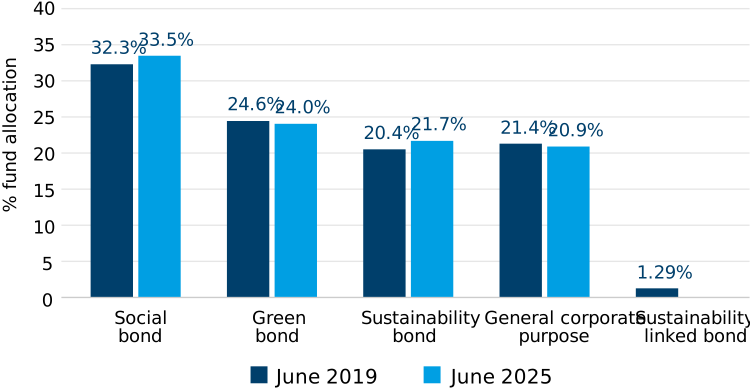
Source: Columbia Threadneedle Investments, as of May 2026
Linking investments to outcomes
The strategy contributes to a range of outcome areas including affordable housing, healthcare, education and economic resilience. Here are some examples of bonds in which our strategy has invested:
Affordable housing
The UK continues to face rising homelessness, with growing waiting lists and insufficient new supply. The strategy has engaged with Bromford Flagship, a major housing association, to encourage a greater focus on social rent provision. This engagement helped strengthen a commitment to deliver 2,000 homes annually, with 50% allocated to social rent (up from 33%), alongside initiatives to support employment and skills development. In 2025, Bromford issued a £300 million inaugural sustainability bond, which the strategy supported in the primary market.
Health and welfare
The strategy has invested in Gilead Sciences, a leading developer of treatments for diseases such as HIV, hepatitis and cancer, with a focus on underserved populations. Engagement with the company centred on understanding its access programmes including its efforts to expand availability in low- and middle-income countries through cost reductions, partnerships and voluntary licensing. In 2024, Gilead made millions of treatments available globally, alongside targeted initiatives to address barriers to care.
Education
The strategy supported the Asian Development Bank’s education bond after we met with management to better understand the bank’s approach to inclusive education. The investment supports programmes targeting vulnerable groups, including students with disabilities, and includes initiatives such as assistive technology, specialist education and skills development projects in Southeast Asia.
Economic regeneration
Coming full circle historically, the strategy is invested in NWB Bank, which finances the Dutch public sector including flood defence infrastructure. Engagement focused on understanding use of proceeds and improving additionality, with our investment supporting water management systems that protect communities and economic activity.
Engagement in practice
Engagement is central to the strategy’s approach and is guided by a structure that combines insight- and outcomes-driven objectives. This includes improving transparency, strengthening frameworks, increasing additionality and enhancing targeting towards underserved populations.
Most engagement takes place through direct dialogue with issuers, helping to inform both investment decisions and ongoing monitoring. Between June 2024 and June 2025, we conducted 158 engagements, with our efforts leading to measurable outcomes.
For example, engagement with NatWest contributed to a greater proportion of bond proceeds being directed towards new lending, increasing additionality. Dialogue with Australia’s National Broadband Network (NBN) supported the issuance of its first sustainability bond aimed at expanding broadband access in underserved communities. Engagement with the Australian Treasury helped strengthen the design and reporting of its inaugural green bond framework, including clearer articulation of social co-benefits. Meanwhile, work with NRW Bank in Germany encouraged more targeted lending to small and medium-sized enterprises in economically disadvantaged regions in the Ruhr.
These examples illustrate how targeted investment combined with active engagement can influence issuer behaviour, strengthen market practices and contribute to meaningful social outcomes at scale.
Next steps for the market
There is a clear opportunity to strengthen the role of fixed income in impact investing in multiple ways.
For asset managers
- Develop clear and credible impact strategies for fixed income
- Invest in robust assessment and reporting frameworks
- Integrate engagement as a core part of the investment process
For asset managers
- Recognise fixed income as a key component of core strategic asset allocation and impact portfolios
- Diversify allocation of capital across both public and private markets
- Set clear expectations on outcomes and reporting
For policymakers and regulators
- Support consistent and practical disclosure frameworks
- Encourage high-quality reporting standards
- Enable innovation across both labelled and unlabelled approaches
The bottom line
From 17th‑century Dutch water boards to today’s social and sustainable bond markets, fixed income has long financed solutions to society’s most pressing needs. The difference now is not the role of bonds, but the growing ability to use them with greater intention and clarity.
Modern challenges – climate change, inequality and economic resilience – require capital at scale and over long time horizons. Fixed income is uniquely equipped to meet this need, offering access to diverse issuers in a structured, transparent way.
Impact in fixed income is delivered not through ownership, but through direction – via capital allocation, participation in issuance and active engagement. These levers allow investors to influence how capital is raised and used.
For us, this is the opportunity: to harness the scale of fixed income more deliberately, making it not just part of impact investing, but central to achieving it.
Fixed income at Columbia Threadneedle Investments
- Columbia Threadneedle Investments is the global asset management arm of Ameriprise Financial, a Fortune 500® company4 with more than $1.7 trillion in assets.5
- Columbia Threadneedle has more than $680 billion of assets under management across equities, fixed income, asset allocation solutions and alternatives.
- Columbia Threadneedle has more than $250 billion of fixed income assets globally, where our investment ethos is built on research intensity and collaborative culture.
- Tammie Tang is Deputy Global Head of Investment Grade Credit, where she helps oversee more than $50 billion in global investment grade assets, and is lead fund manager for the Global, European and UK social bond funds.
Fixed income at Columbia Threadneedle Investments
Leading social impact advisory firm with a strong reputation as a trusted advisor in impact investment, with an extensive track record towards the measurement and management of sustainable and social impact. Core partner to our Global Social Bond Strategy.