


At a glance
- AI opportunities are broadening beyond semiconductors as capital expenditure moves through the infrastructure value chain.
- Demand for compute, power, electrical equipment, cooling and grid capacity is creating both opportunities and constraints.
- Scenario analysis suggests graphics processing unit (GPU) demand could continue to rise sharply, but bottlenecks may shape the pace of data centre buildout and distribution of returns.
- The scale of AI infrastructure spending may also have broader economic effects, including crowding-out risks and inflationary pressure.
The artificial intelligence (AI) boom is dominating the narrative in global equity markets and reshaping the investment opportunity set. The story is not just about the technology but the multi-year industrial and economic transformation unfolding in distinct waves, each with its own beneficiaries.
As capital flows increase, opportunities are emerging well beyond the most visible AI companies. The challenge is to understand how demand for compute translates into requirements for energy, cooling, electrical equipment, real estate and materials – and where supply constraints could alter the pace of growth.
From AI enthusiasm to investable implications
The investment case for AI is no longer confined to a narrow set of technology leaders. As the theme matures, leadership is likely to rotate across the value chain, from chips and cloud platforms to power infrastructure, industrial equipment and companies enabling large-scale deployment.
That breadth matters because AI is increasingly an infrastructure cycle as much as a technology or semiconductor story. Company-level research, management engagement and cross-sector analysis help test where demand is durable, where expectations may be excessive and where physical constraints could become material to earnings.
Mapping the AI value chain: Four waves of growth
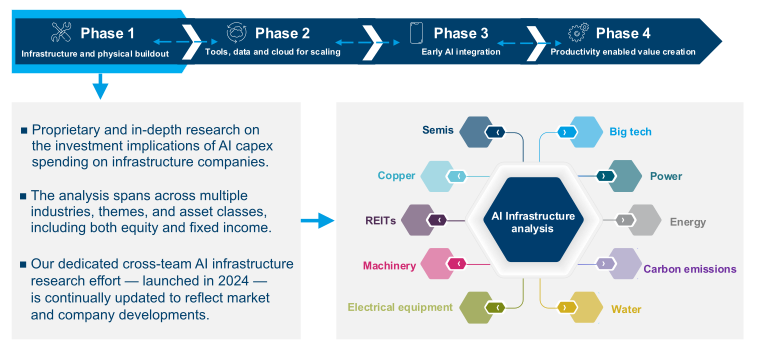
To help understand AI as an investment theme, we have developed a framework of four waves or phases of growth. Today, we are concentrated on the first wave – the physical construction of AI infrastructure like data centres, which is the most capital intensive. The second wave is in its early stages and involves data architecture and cloud platforms as companies deploy AI at scale. The third wave emerges when enterprises integrate AI, as some are beginning to across their businesses. The fourth wave centres on value creation, as technology increasingly drives productivity gains across companies.
Figure 1: A bottom-up view of AI infrastructure demand
Source: Columbia Threadneedle Investments, July 2026
Following the opportunity across the AI ecosystem
Our multi-wave analysis helps us frame, explore and exploit related investment opportunities. The first wave of AI growth is centred on the infrastructure build-out, where opportunities are most immediate but also most exposed to capacity constraints. While semiconductors remain central, the demand impulse is spreading into energy, power, cooling, electrical and industrial equipment, grid infrastructure and data centre real estate. Sustainability considerations – including emissions, water usage and labour availability – are also becoming critical variables in determining where projects can be delivered and at what cost.
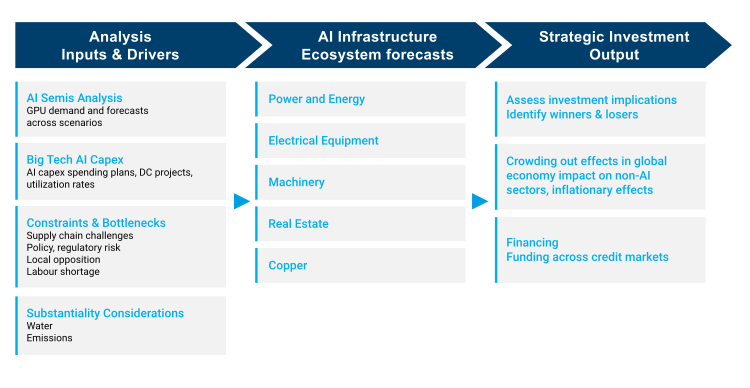
We view the demand for AI computing capacity to be a useful starting point. This can be assessed through big technology capital expenditure plans, semiconductor supply, equipment availability and the pace at which AI models and use cases expand. Set against that demand are multiple supply-side constraints, from power availability and grid connection timelines to component shortages and construction bottlenecks.
We assess this dynamic by analysing a range of bull, base and bear scenarios for compute demand – essentially the GPUs needed to develop and train AI. Given the complexity and uncertainty, we analysed the investment implications across all three scenarios. Notably, even under our base case we see demand for GPUs increasing exponentially, driven by expanding AI use cases, chip and model improvements, scaling laws for training and inference, and the development of AI agents.
The implications extend across several sectors. Rising compute demand increases the need for energy generation, transmission equipment, cooling systems, machinery, data centre capacity and key materials. The most attractive opportunities are likely to be found where demand visibility is high, pricing power is resilient and supply constraints support returns rather than erode them.
Figure 2: A comprehensive framework to forecast AI-driven demand across industries and scenarios
Source: Columbia Threadneedle Investments, July 2026
Implications of a $3.5 trillion boom – a range of opportunities and emerging constraints
Given the growth and duration of this AI-driven cycle, we see broad investment opportunities across the AI infrastructure value chain.
We are currently updating our analysis and reviewing AI demand projections. Among other areas, we are closely analysing the implications of constraints on data centre development arising from multiple factors: specialised labour shortages (particularly electricians, engineers, procurement and construction), equipment delays, and long lead times for transformers, turbines and AI components. We are also cognisant of evolving policies and regulations at the state level in the US, where we observe growing political resistance to data centre proliferation due to affordability concerns and community opposition to projects in local areas.
Our team is also considering the ‘crowding out’ effects of this investment cycle. If AI investment reaches $3.5 trillion, that figure represents nearly 3% of global GDP. It could delay other non-AI projects and have inflationary impacts across the broader economy. These dynamics are something we are beginning to analyse in detail.
The bottom line
AI’s next phase will not be driven by headlines alone, but by where capital is flowing, where bottlenecks are emerging and which businesses are best placed to capture the build-out. In our view, that makes deep, cross-sector research essential to identifying the most compelling opportunities across the AI value chain – and to staying selective as this powerful theme evolves.