

No regions in the world are immune to social challenges. Rising inequality, aging populations, housing shortages, and climate-related risks are straining public systems. For example, in Europe and North America, affordable housing remains out of reach for millions, while healthcare systems face mounting pressure from demographic shifts. Governments alone cannot bridge these gaps, which is where institutional investors can play a critical role. By mobilizing private capital at scale, they can fund solutions that deliver both financial returns and measurable social impact.
Why is this relevant for institutional investors?
Because social instability creates economic risk. Social factors (such as housing shortages, education, and limited job opportunities) shape health and life outcomes. Inadequate housing, for example, is widely recognized as a key social determinant of health1, which in turn affects people’s ability to work2 and develop skills3. These factors are deeply interconnected and can reinforce one another, creating compounding effects that translate into systemic economic risks and weakened economic resilience at both the company and macroeconomic level. Rising inequality has been shown to dampen economic growth and erode human capital, while also contributing to eroding social license to operate4, social tension and political pressure for policy intervention5. For long-term investors, these systemic pressures can ultimately translate into lower and more volatile returns.
A strong and resilient society depends on six interconnected pillars: Housing, Healthcare, Education, Employment & Skills, Food Security, and Financial Inclusion. These areas form the foundation for stability and opportunity. Addressing these pillars effectively requires more than funding, it requires applying guiding principles6 that promote better working conditions, fair income, and a just and inclusive society. Ultimately, ensuring that progress across all six pillars leads to overall positive social outcomes.

And how investible is it?
Private Markets | ||
|---|---|---|
Corporates | ||
Real Assets | ||
Public Markets | ||
|---|---|---|
Corporates & Sovereigns | ||
Real Assets | ||
Source: Columbia Threadneedle Investments, May 2026.
Asset class focus:
Fixed Income (Public markets, Corporate & Sovereigns)
Historically, impact investment has been associated with illiquid, higher risk private investment (often equity-based) into ventures that have a very direct outcome. Nevertheless, fixed income offers unique advantages that make it an effective asset class for financing social impact:
- Scale and reach: Enables large-scale funding through ringfenced use of proceeds, for instance to support state budgets largely dedicated to healthcare (such as vaccination programmes and hospitals), or to fund initiatives like aid programmes assisting Ukrainian refugees in Poland.
- Targeted impact: Bonds ensure use of proceeds are directed to specific social outcomes, can be secured on tangible assets, and can be issued from ‘ring-fenced’ regulated businesses or subsidiaries.
- Vast issuer universe: Includes governments, agencies, housing associations, regulated utilities, and social enterprises.
- Investor Contribution: Liquidity provides an opportunity to signal support for a specific theme or solution to the market. At the same time, liquidity enables divestment if an engagement approach is proven to be ineffective.
- Data accessibility: Compared to private market investments, publicly traded fixed income investments benefit from data that is publicly available or that can more easily be estimated.
Real Assets (Private markets, Real Estate)
Real estate has long been a central pillar of impact investment, given its ability to deliver tangible, place‑based outcomes. As an asset class, it offers distinctive features to generate measurable social and environmental benefits:
- Direct, visible impact: Investment flows directly into physical assets such as affordable housing, community facilities, or sustainable buildings, creating clearly observable outcomes. Its physical nature enables transparent impact measurement, from operational energy performance data and embodied carbon reductions to tenant engagement metrics and community use indicators.
- Dual social–environmental potential: Green buildings and energy efficient retrofits reduce carbon emissions while improving health, comfort, and affordability, enabling investors to address climate and social resilience at the same time.
- Investor contribution: Real estate underpins long term access to essential services and social needs which can be catalytic in regions and areas where market gaps persist (eg: housing, healthcare, or education facilities).
- Revitalising communities: Regeneration delivers wider social benefits creating jobs and community renewal.
Disclaimer: While we highlight two asset classes as illustrative examples of how to achieve social impact within an allocation, we note that social impact opportunities are not limited to these areas and can be pursued across a broader range of asset classes.
The Columbia Threadneedle Investment Fiduciary Approach – illustrated for social impact
Strategic Positioning: The client’s objectives are the starting point of our process. We begin by clearly identifying the client’s financial and non-financial objectives. This first step is crucial to understand the direction of the impact strategy and to ensure the investment strategy is feasible. This strategy is captured in a Theory of Change, a framework that summarizes how the investment strategy is expected to achieve the desired positive social impact. It ensures clarity, measurable goals, and accountability, giving shape and direction.
Key outcomes:
- Impact ambitions are defined (for example, though themes or SDGs)
- Impact thesis is summarized in a Theory of Change
Sample Theory of Change for Social Impact:
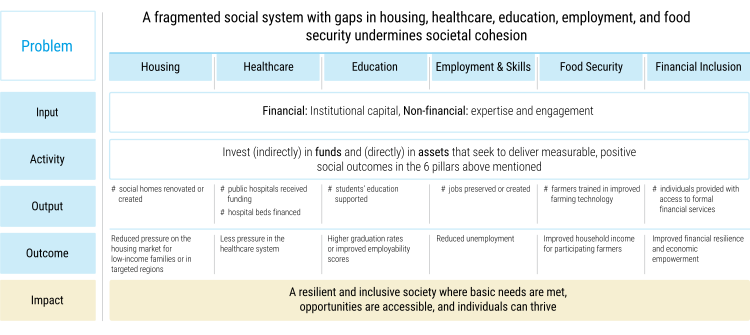
Source: Columbia Threadneedle Investments, May 2026.
Delivering Strategic Advice: Based on the client’s impact objectives, we map the investment universe using our global research capabilities, external impact databases, and market intelligence. This step includes an initial market analysis to identify relevant investment opportunities that aligned with the defined criteria and ambitions. Together with the client, we define the asset class, and size that fit the impact ambitions. We illustrate findings with concrete investment cases, ensuring transparency and actionable insights for the client.
Key outcomes:
- Mandate scope and constraints are defined:
- Asset class
- Size (€ millions)
- A market analysis including the investment opportunities available within the defined client preferences
Constructing the Mandate: We anchor the impact strategy in the client’s Responsible Investment (RI) policy, using the social impact pillars that are relevant to the client (such as Housing, Healthcare, Education, Employment & Skills, Food Security, or Financial Inclusion) as a reference framework to help structure future investment decisions. Together these elements are translated into a concrete short- and medium-term investment plan, aligning objectives with actionable steps and measurable outcomes.
Key outcome:
- Responsible investment policies which include impact investing strategy and goals
Implementing & Managing Mandate: We evaluate potential investments against the client’s impact, risk, and return criteria. In addition to a thorough Investment and Operational Due Diligence by the multi-asset team, an Impact Due Diligence will also be conducted in collaboration with third-party experts, following international industry best practices. From an initial long list of 7–10 funds, we perform detailed analysis and present a short list of 3–4 funds to the client for final allocation decisions.
Key outcomes:
- Standardized Due Diligence (DD): Columbia Threadneedle conducts the Investment and Operational DD and our partner Phenix Capital Group, an impact investing consultant, will conduct the Impact DD
- Offering advice to the client on fund selection
Reporting & Oversight: We ensure that selected funds report on the use of proceeds across the six focus pillars following recognized industry standards for impact reporting. A Monitor, Evaluate, and Learn (MEL) process is implemented by the Fiduciary team to track progress, assess effectiveness, and continuously improve our impact approach, ensuring transparency and accountability.