




Artificial intelligence (AI) is driving one of the largest infrastructure investment cycles in decades. But converting billions of dollars of planned spending into operating data centres will depend on more than access to electricity. Grid connections, specialised equipment, skilled labour and political support may all determine how quickly projects move from announcement to operation.
Investors often view power availability as the defining constraint on AI data-centre development. Our proprietary bottom-up analysis presents a more nuanced picture. By modelling additions to US power supply by technology and timeline through 2030, we find that generation capacity at the system level could support significant data-centre growth. The more immediate challenge may be delivering that power where and when it is needed.
This distinction has important investment implications. As the AI build-out advances, opportunities are emerging across utilities, electrical equipment, cooling, construction and behind-the-meter (BTM) power technologies. Yet the potential beneficiaries will not be determined by demand alone. In our view, the companies best positioned to resolve the infrastructure constraints could capture some of the most compelling opportunities.
Key takeaways
- Power generation may not be the primary near-term constraint. Our bottom-up model suggests additions to US power supply could support meaningful data-centre growth, although capacity and transmission conditions vary significantly by region.
- Other bottlenecks may determine the pace of development. Grid interconnection, power equipment, construction labour and community or political opposition could delay projects even when sufficient generation capacity exists.
- Hybrid power can help bridge the gap. Gas turbines, fuel cells, reciprocating engines and battery storage can allow selected projects to begin operating while they await full grid connections.
- Investment opportunities extend across the infrastructure ecosystem. Potential beneficiaries include regulated utilities and suppliers of electrical equipment, cooling systems, backup power and other technologies that help overcome constraints.
The build-out of AI data centres is happening at scale across the US, yet the timing and eventual magnitude of this infrastructure transformation remain uncertain. In a phase of AI’s evolution that’s centred on the construction of physical infrastructure, the pace of progress is key for investment opportunities.
Potential beneficiaries range across the data centre value chain. They include the big US utility companies, as well as electrical equipment makers, cooling suppliers, engineering, procurement and construction (EPC) companies, and industrial companies that provide hybrid power solutions.
Yet much depends on how many data centres are built and when. Our bottom-up research framework shows near-term supply additions adequately meeting power demand from new data centres, suggesting power may not be the only bottleneck to data centre growth. Other relevant constraints include shortages of skilled labour and some power equipment, growing local opposition and the wild card of political opposition.
To help understand the data centre build-out’s evolution, we built a proprietary bottom-up power analysis – modelling supply additions by technology and by timeline in the US to assess what the electric system can realistically produce through to 2030. Our analysis helps distinguish between the availability of power at the system level and the equipment, transmission and construction constraints affecting individual projects. Frequently, it seems that investors may conflate power availability with other factors such as the availability of industrial power equipment within a data centre.
A bottom-up view of US power capacity
When forming our bottom-up model of US power supply, we started with the utilities’ and independent power producers’ announcements of new power plants set to be commissioned through 2030. Our view is that future supply will come from both new generation from different sources and improved utilisation of existing grid infrastructure, which should contribute to power availability. The inclusion of this factor differentiates our work. Even modest improvements in transmission and generation utilisation, power flow management, and storage optimisation will unlock significant additional power.
The chart below shows our forecast of annual incremental US power supply through to 2030. Solar is the dominant near-term contributor, while our estimates suggest that natural-gas generation and grid-optimisation measures together account for roughly 70% of incremental power supply through 2030. Nuclear is not expected to have a material impact until after 2030.
Powering the AI build-out
Forecast incremental annual US power supply 2025-2030E terawatt-hours (TWh)
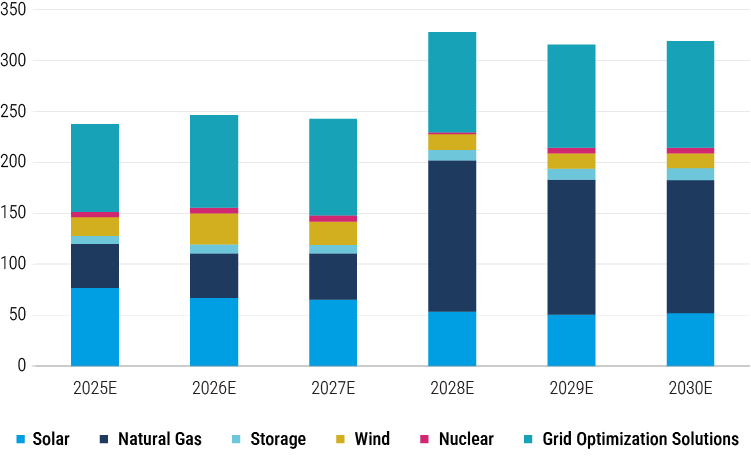
Source: Columbia Threadneedle Investments analysis, July 2026. While our power-supply forecast is modelled in TWh, our analysis is presented in gigawatts (GW) given it is the standard industry metric used to describe data-centre capacity. 1TWh equals 1,000 GWh.
Assuming approximately 65% of incremental power capacity is available for data centres, with the balance supporting broad economic growth and electrification, our model suggests power availability is not necessarily the primary near-term bottleneck for data-centre growth. Based on our current assumptions, we concluded that the grid could theoretically support approximately 31 GW of incremental data-centre capacity additions in 2026, rising to around 169 GW of cumulative grid-supported data-centre capacity by 2030.
These figures represent system-level potential rather than guaranteed project delivery. The framework does not consider BTM generation – gas turbines, fuel cells and batteries. To overcome near-term transmission constraints in select areas, these BTM sources are increasingly being used as bridge solutions until projects can connect to the grid. It is worth noting that some regions have power and transmission constraints, while others still have surplus capacity.
Myriad constraints: from equipment to skilled labour to political risk
Our power model therefore suggests that US generation capacity should accommodate meaningful data-centre growth. But power sufficiency at the system level does not mean projects can get built and powered up on time. Our review of bottlenecks beyond power for data-centre development indicates that other critical constraints are looming.
Sufficient generation capacity does not guarantee that projects can be connected, equipped and completed on schedule. Our company research points to shortages of transformers, turbines and other electrical equipment, as well as constraints in engineering and construction labour. These bottlenecks could limit the pace of deployment even where electricity is theoretically available.
Community concerns about electricity costs, noise, water use and land requirements are contributing to opposition to some projects. As the November 2026 midterm elections approach, these issues could receive greater political attention, adding uncertainty to permitting and development timelines.
The bottleneck scorecard
Assessing the potential impact of constraints:
Constraint | Severity |
|---|---|
Community and political opposition | Critical |
EPC / construction labour | Critical |
Power transformers | Critical |
Gas turbines (BTM equipment) | Significant |
Grid interconnection | Significant |
800V DC architecture transition* | Significant |
Cooling and electrical equipment | Emerging |
*As AI servers become more power-intensive, data-centre operators are evaluating higher-voltage direct-current architectures. Proponents argue that 800V DC systems can distribute power more efficiently to ultra-high-density AI racks, although adoption remains at an early stage and is expected to be concentrated in the most demanding AI training environments.
Key
Critical = binding today. Directly limits GW delivery and no near-term resolution.
Significant = creates meaningful delays. Partially addressable through workarounds.
Emerging = adds cost and complexity but not the ceiling. Manufacturers expanding sufficiently.
Source: Columbia Threadneedle Investments analysis, July 2026.
Hybrid power as a bridge
For projects facing lengthy grid-connection timelines, BTM generation can provide a bridge to operation. Hybrid configurations combine available grid capacity with on-site sources such as gas turbines, reciprocating engines or fuel cells, supported by battery storage to improve resilience and balance power delivery. Fuel cells, for instance, are winning data-centre contracts for two simple reasons: they can typically be swiftly deployed in under a year, and their low emissions profile is less likely to raise air-quality concerns. However, according to our analysis they are not the cheapest option and are currently mainly used for smaller requirements of below 100 megawatts.
Investment opportunities across the spectrum
The investment opportunities arising from today’s extraordinary infrastructure build-out can be found across a broad range of energy and industrial sectors.
Electric utilities are likely investment beneficiaries. We prefer regulated utilities, especially those which are vertically integrated and are poised to benefit from infrastructure investments across generation, transmission and distribution capital projects. For these entities, the load growth from data centres should spread fixed costs over more units of consumption, potentially benefitting residential customer affordability. The companies supplying BTM power such as gas turbines, fuel cells and batteries are also worth highlighting. Lastly, scarcity could benefit data centre equipment makers, including makers of switchgear, transformers and cooling technologies.
The bottom line
The AI infrastructure build-out is creating opportunities across the power ecosystem, but electricity supply is only part of the equation. Grid connections, equipment, skilled labour and political support will also shape the pace of development and determine where opportunities emerge.
Our bottom-up, cross-sector approach and research help us track these constraints, identify shifts in momentum and uncover the most compelling investment opportunities.