


Filter insights on this page
Repo rates are expressed relative to SONIA, and the chart below displays the average repo rates that we have achieved over the past four quarters for three, six, nine and 12-month repos, shown as a spread to average SONIA levels at the time. The volatility and market uncertainty that resulted from the mini-Budget also weighed upon funding markets, particularly for shorter dated trades as can be seen from the achieved spreads below. Note that during the fourth quarter of 2022 no repos were traded with a 12m tenor so the chart reflects the previous quarter’s value.
Capabilities
Media type
Themes
Figure 2: Change in swap rates over the next quarter
The secondary impact of the mini-Budget crisis centred around collateral and the velocity of movement; rather than a lack of balance sheet for repo funding (a la March 2020). Yet, the difficulties around collateral substitutions and settlements did in many cases prompt a review by individual banks’ credit officers, resulting in a temporary reduction or hiatus in repo balance sheet provision in some cases. Once these reviews were completed balance sheet availability opened up again – some with the addition of haircuts to provide additional protection to the bank. Of course, the momentous lack of certainty in the future path of interest rates also impacted the typical repo spread to SONIA as trading a fixed rate forced the banks to take a conservative view on where yields could reach.
Relevance across Ireland and Germany
Market Outlook
The underperformance towards the end of 2025 was expected to be the forerunner of further yield rises and curve steepening around the transition date of 1st January 2026. This expectation was predicated on several key tenets; firstly that given the binary nature of the reform that schemes would aim to effect hedge changes as close as possible to the transition date; secondly that there would be a significant amount of interest rate risk to be traded both in terms of outright hedging demand and curve impacts as hedges shortened; and finally that Dutch pension funds are a major participant in the longer maturities of European swaps and bonds and that there was no natural replacement buyer in that size. In the event the transition was orderly and the curve even exhibited flattening (longer dated yields decreased relative to shorter dated yields). In fact, there was an extraordinary confluence of factors that defied expectations:
The funding ratio index published by the Pension Protection Fund showed a slight decrease in funding levels quarter-on-quarter (124.7% at end March vs 125.7% at end December). Higher yields benefitted the liability side of the equation, however the dramatic fall in equities weighed upon funding ratios. High hedging levels mean that schemes saw only a modest gain from the higher yields but still retain some exposure to equities.
Market Outlook
Source: Columbia Threadneedle Investments. As at 31 March 2025
Inflation hedging rose by 12% quarter on quarter, whilst interest rate hedging activity increased by 27% from the previous quarter.
All data and sources Columbia Threadneedle Management Limited, as at 30 June 2024 and Valid to: 30 September 2024
Regions


Liability-driven investment (LDI) has transformed from a Dutch regulatory response into a mature, pan European framework for pension risk management. Today, Irish and German schemes are increasingly drawing on this long established expertise to strengthen balance sheet stability and prepare their plans for the next stage of their evolution.
For two decades, liability‑driven investment (LDI) has been a cornerstone of Dutch pension risk management. What began as a response to regulatory change in one European country has evolved into a mature, pan‑European solution.
Today, Irish and German pension schemes, which generally entered the LDI landscape later than their Dutch counterparts, are increasingly leveraging this established
expertise to manage interest rate sensitivity, improve balance sheet stability, and prepare their plans for the next stage of their lifecycle.
As European pension systems evolve, the long track record of the Euro LDI platform – originally built to serve the complex needs of Dutch defined benefit (DB) schemes – has become a valuable resource for investors seeking robust, low‑governance hedging solutions. The experience gained during market crises, yield shocks and regulatory transitions equips these strategies to support the needs of a broader client base,
including corporate and occupational pension plans in Ireland and Germany.
A broader European story
In early 2007, Dutch pension regulation shifted decisively towards market‑consistent valuation and a greater emphasis on risk management. The introduction of the FTK framework (Financial Assessment Framework) required schemes to measure liabilities using discount rates linked to market interest rates. As a result, Dutch funds faced significant volatility in the value of their liabilities whenever long‑term yields moved. This environment accelerated the development of LDI strategies designed to stabilise funding ratios by hedging interest rate risk.
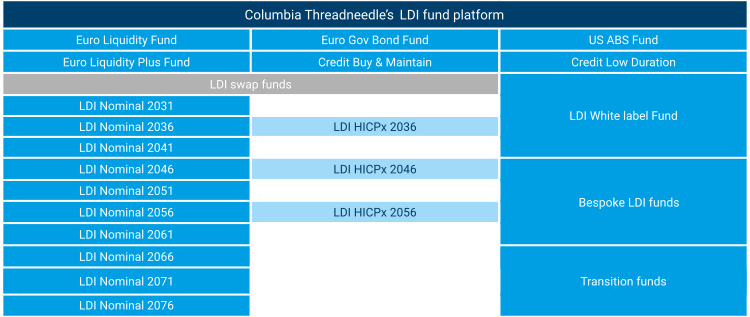
To support these needs, in 2006 we launched a suite of nominal Euro LDI funds. These pooled vehicles offered exposure to long‑dated interest rate swaps, enabling schemes to hedge duration efficiently without the need to build complex derivative infrastructures internally. Over time, these funds became a core part of Dutch matching portfolios, used by both large industry‑wide schemes and smaller corporate plans seeking operational simplicity. For the hedging of nominal and inflation risk combined, a series of real rate LDI funds were launched in 2009, known as LDI HICPx funds (Figure 1).
Figure 1: Our Euro LDI fund platform
Why Irish and German schemes adopted LDI later
Although the Netherlands were early LDI adopters, Irish and German schemes typically moved into LDI at a later stage, shaped by the evolution of their own regulatory and accounting environments. Both jurisdictions now face increasingly stringent expectations around risk management, making interest rate – as well as inflation risk – hedging a priority.
Ireland: de‑risking and maturity
In Ireland, many DB plans are closed and maturing. Sponsors are actively de‑risking, preparing schemes for long‑term sustainability and, in some cases, the pathway towards buy‑out or self‑sufficiency. Several factors contribute to the increased
adoption of LDI:
- Regulatory governance under IORP II1 has elevated standards for risk measurement, liquidity oversight and operational controls.
- Corporate sponsors prioritise stability of contributions and funding ratios.
- An ageing membership base makes liability volatility more material.
- Trustees seek simplicity, and pooled LDI funds remove operational and collateral management burden.
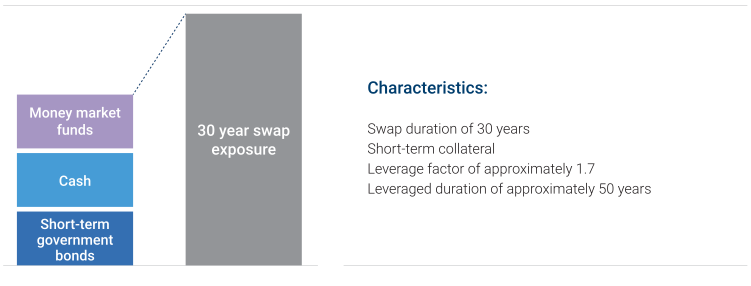
Figure 2: Illustration of the workings of LDI Nominal fund 2056
Source: Columbia Threadneedle, 2026
Germany: aligning liabilities with long‑term rates
German pension arrangements are structurally diverse, spanning Pensionskassen, Unterstützungskassen, contractual trust arrangement (CTA) vehicles and corporate pension funds. Despite their differences, many face similar challenges:
- Accounting standards (such as the International Financial Reporting Standards, or IFRS) link pension obligations to long‑term discount rates.
- Germany’s integrated financial regulatory authority, BaFin, places strong emphasis on risk management, liquidity and collateral processes.
- Corporate sponsors are increasingly motivated to reduce volatility in reported liabilities.
- Many pension vehicles seek capital‑efficient solutions that avoid direct ISDA (International Swaps and Derivatives Association) or collateral agreements.
How the Euro LDI funds work
The principle at the heart of LDI is straightforward: when interest rates fall and liabilities rise, the LDI funds gain value; when rates rise and liabilities fall, the funds decline accordingly.
To achieve the appropriate duration exposure, the funds employ:
- Interest rate swaps as the primary hedging tool.
- Short‑dated government bonds providing collateral support.
- Money market instruments ensuring liquidity.
- Carefully managed leverage (typically 1.5-3x) to efficiently
achieve long‑duration sensitivity.
The funds’ structure reduces complexity. Daily collateral management is handled within the vehicles, meaning schemes do not need to manage derivative exposures directly. Interactions with investors occur only when collateral thresholds trigger
drawdowns or distributions.
Relevance across Ireland and Germany
Irish pension trustees and sponsors increasingly integrate LDI as part of a long‑term strategy. The Euro LDI funds can help stabilise funding levels through accurate duration matching and support buy‑in or buy‑out preparation. Their daily liquidity and transparency characteristics align well with IORP II oversight standards.
For German investors, the benefits include strong liquidity and collateral processes aligned with BaFin expectations, capital‑efficient hedging for CTAs, and the flexibility to integrate LDI into diversified matching portfolios.
A proven platform for the next 20 years
With more than €40 billion in LDI assets under management across LDI funds and LDI segregated mandates2, our Euro LDI platform has developed into one of the longest‑standing and most experienced solutions of its kind in Europe. Today, its
relevance extends well beyond its Dutch origins. As Irish and German pension schemes continue to mature, the demand for reliable, transparent and operationally efficient LDI solutions will only increase.
20 years of Euro LDI funds: A proven foundation now widely supporting European pension schemes