This year’s annual revision to the Pensions and Lifetime Savings Association’s (PLSA) retirement living standards has seen double-digit increases to each of its illustrative expenditures in retirement, with the cost of financing the minimum standard of living in retirement rising by almost 20%. Against the backdrop of wholly inadequate Defined Contribution (DC) pot sizes and the enormous decision-making burden placed, at and in retirement, on the shoulders of a largely unsupported and rapidly ageing population, ill-equipped to decide for themselves, suggests that without urgent reform many DC savers will continue to sleepwalk into retirement penury.
The PLSA’s Retirement Living Standards1
To make the three high level expenditures relatable, each of the standards, which are derived from working with focus groups,2 drill down into what could typically be spent annually on household bills, home maintenance, food and drink, transport, holidays and leisure, clothing, personal items, presents and charitable donations. However, rent, mortgage, health and social care costs, which are specific to each individual, are excluded. The RLS are further humanised via eight personas, each at various stages of their working lives. These personas aim to encourage DC savers to better engage with their retirement savings by illustrating what standard of living different people could reasonably expect in retirement depending on their income, current pension savings and contribution rates.3 Indeed, given that more than three quarters (77%) of DC savers do not know how much money they need in retirement to support their desired lifestyle, and with only 20% confident that they are saving enough, the RLS provide a much needed anchor for this somewhat rudderless decision-making process. Accessible to more than 14 million savers via the PLSA’s dedicated RLS website, as well as the scheme members, clients and savers of 50 UK-based organisations, almost three-quarters (74%) of DC savers believe that the RLS make it easier to plan for retirement.4
So what level of expenditure do the three Retirement Living Standards meet?5
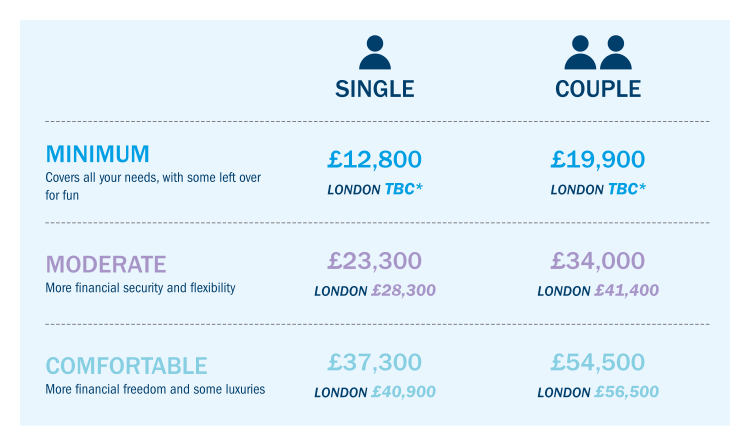
Retirement Living Standards: post-tax income requirements in 2023
Aligning with the Joseph Rowntree Foundation’s Minimum Income Standard (MIS), the minimum RLS covers all basic needs with provision for a little discretionary spending. To achieve a minimum standard of retirement living outside of London requires a post-tax retirement income of £12,800 if single and £19,900 for a couple.6 This income comprises, for each individual, a full new state pension (£10,600 for 2023/24)7 supplemented for a single retiree by the income from a level annuity purchased with a DC pot of £36,500.8 The latter should result from paying the minimum mandated contribution rate into an auto enrolled workplace pension during a full working life. A retired couple can achieve the minimum RLS simply by each receiving the full new state pension.
The moderate standard of retirement (£23,300 post-tax if single; £34,000 post-tax for a couple, each living outside of London)9 builds on the minimum standard by providing a little more financial security and flexibility. For example, raising the minimum standard of a £54 per week spend on food (£96 for a couple) to £74 and £127 per week respectively. Moderate requires the income received from a full new state pension and that from a level annuity from a DC fund of £248,000 for a single person, and two £121,000 pots for a couple.
The comfortable standard of retirement (£37,300 post-tax if single; £54,500 post-tax for a couple, each living outside of London)10 provides yet more financial freedom and affords more of life’s luxuries, such as three weeks spent holidaying in Europe every year. However, this is still a far cry from living the millionaire lifestyle as, for example, it only accommodates replacing a two-year old car (two cars for a couple) every five years and installing a new kitchen and bathroom every 10-15 years. In addition to a full new state pension, a comfortable retirement for non-London dwellers requires the income generated by a level annuity from two £328,000 DC pots for a couple and a whopping £530,000 for a single retiree.
As we approach the point of peak pension income, in the absence of a dramatic increase in contribution rates, stellar long-term investment performance, and a renewed focus on value for money, DC simply won’t
substitute for the abrupt decline of private sector Defined Benefit (DB) pension rights. Indeed, the state pension will increasingly form the mainstay of most retirement outcomes, consigning the majority of DC savers to the minimum standard of living in retirement.11
Moreover, with around one in five of the UK population already aged 65+, the direction of travel is to one in four by the early 2040s,12 as the so-called “sandwich generation”13 of tail-end baby boomers (now in their late-50s to early-60s) and the early Generation Xers (now in their late-40s to mid-50s) start to turn 65.14 Therefore, not only will we likely see a marked increase in the proportion of a growing population hitting state pension age over the next two decades, but it is also a generation that will be the most long-lived in history15 and whose financial commitments are likely to increase throughout retirement.