Property
Carbon Neutral Real Estate Fund
Carbon reduction through commercial real estate investment
Climate change is firmly back on the agenda. As large asset owners, institutional investors have an important role to play in helping to reduce carbon emissions.
UK office buildings are bad offenders, contributing around a fifth of total carbon emissions in the UK. New build, carbon-compliant real estate only accounts for 1-2% of total supply. To meet the Government’s 2050 carbon reduction targets, emissions from existing buildings will need to be reduced by 80%. Realistically, this can only be achieved via refurbishment.
*Source: Carbon Trust, October 2020
Investment Process
Step 1: Identification
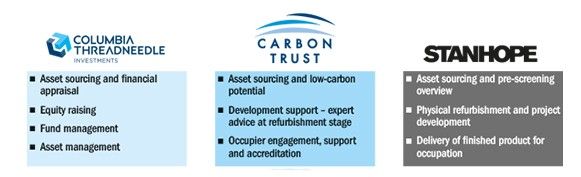
Columbia Threadneedle Investments leads in the identification of suitable redundant/obsolete/vacant/short-term let office property showing the optimal combination of location, building fabric, original construction, configuration and local market conditions, offering the potential for a desirable occupational solution that will benefit from a Low Carbon Workplace refurbishment.
The rigorous economic assessment by all three Partners to confirm the achievability of an economic, risk adjusted, profitable and low emission end product, which meets the needs of both occupiers and investors. The entry price, carbon engineering/ refurbishment budget and rental value equation will be computed under a number of potential scenarios.
Step 3: Carbon engineering/refurbishment
The ‘on site’ phase, where Stanhope and the Carbon Trust work in tandem to deliver the agreed physical and carbon specification, within the agreed budget and time scales. Concurrently, Columbia Threadneedle Investments leads early engagement with the potential occupiers, supported by the Carbon Trust.
Step 4: Completed projects and continuing carbon appraisal
Following and during the completion of projects the Carbon Trust applies rigorous carbon oversight of the strategy’s development and investment portfolios. Such oversight includes maintaining ongoing occupier engagement under the Low Carbon Charter, in order to provide training, support and assistance to occupiers with the target of ensuring annual certification under the Charter. This level of continuous occupier engagement provides the strategy with a clear competitive edge over its peers and increases the likelihood of occupier retention.
Step 5: Portfolio management
The strategic asset allocation of the portfolio is reviewed by reference to Columbia Threadneedle Investments assessment of the UK Investment Market and the relative prospects for the underlying geographical areas. Columbia Threadneedle Investments utilises the capabilities of its large and long-established investment team and seeks to generate outperformance in line with similar track records of Columbia Threadneedle Investments-managed property funds.
Value for occupiers and investors
Value to occupiers | Value to investors |
|---|---|
Reduced running costs | Lower energy costs mean properties are resistant to functional and environmental obsolescence |
Future-proofing against future energy price hikes and new legislation | Due to the imbalance between supply and demand, low carbon properties also benefit from better security and quality of income, greater potential for capital gains, shorter void periods and access to pre-let developments |
Improved employee satisfaction and workforce productivity | Together with the strong risk-adjusted returns we have generated, this is good news for investors |
Enhanced corporate reputation |
Explore the portflio
To date the Carbon Neutral Real Estate Fund has raised over £175m and the portfolio currently comprises of six buildings.
- Acquired in December 2014
- Currently under development
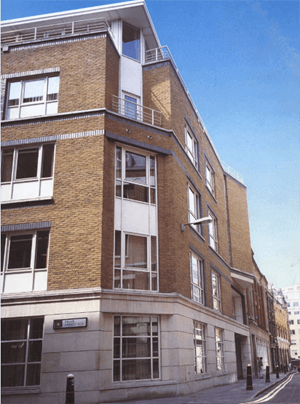
- Acquisition price band £15-20m – 30,000 sqft office
- Location – prime London EC4 postcode in close proximity to St Pauls underground station and Blackfriars mainline station
- £6m Refurbishment programme – full replacement of M&E and development plan to increase lettable area
- Vacant possession achieved – 2Q 2015
- Planning consent obtained for additional floor on top and reconfiguration of reception and entrance
- Strong Letting Prospects – Targeting blue chip institutional occupiers in a local city market currently considered to be buoyant
- Forecast end value £29m – delivering a RoE of 17%
Past performance is not a guide to future returns.
- Hammersmith
- Completed in June 2013
- Upgraded from EPC E to B
- Acquisition price band £10-15m – 63,000 sqft office acquired at £165 capital value per sqft
- Refurbishment programme £10-15m – mixed mode operation, natural ventilation, innovative mechanical cooling system affording maximum occupational capacity, and a 15% increase in net lettable area
- 100% pre-let to major hedge fund operator – Entire building let to Winton Capital Management Limited at £34.50 per sqft for a 10-year term
- Current value £46.5m
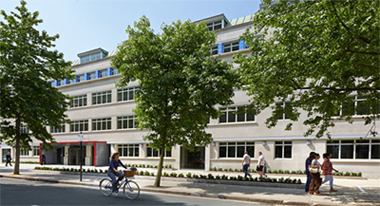
- Completed in August 2014
- Upgraded from EPC F to B
- Acquisition price band £5-10m – 31,500 sqft office
- Situated in central Richmond – located 300 metres from Richmond mainline and underground stations, being in an extremely affluent London borough
- Refurbishment programme – comprehensive low carbon refurbishment, upgrading façade and windows, full replacement of M&E
- Extremely strong letting market – target ERV of c£40 per sqft within an area experiencing strong rental growth
- 100% pre-let to major e-tailer – Entire building let to Not On The High Street at £43.50 per sqft for a 10-year term
- Current value £27.6m
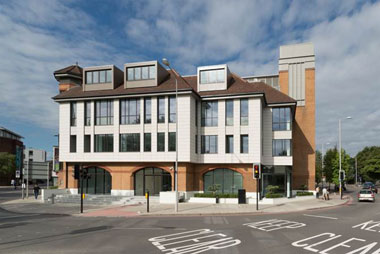
- Wimbledon
- Completed in December 2013
- Upgraded from EPC C to B
- Acquisition price band £0-5m – 12,000 sq ft office acquired off market
- Refurbishment programme £5-10m – comprehensive low carbon refurbishment. Re-clad, chilled slab and high efficiency lighting and a 60%+ increase in net lettable area
- Full let let at rents up to £41.15psf – tenants include Statpro Limited, RAP Limited and Winshuttle
- Current value £17.25m

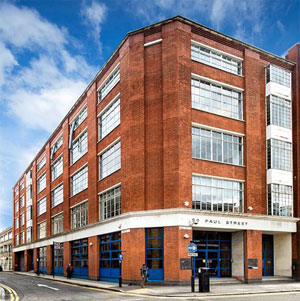
- Shoreditch
- Acquired in July 2014
- Currently under development
- Acquisition price band £10-15 m – 23,400 sqft office
- Location – Close proximity of “Silicon Roundabout” at Old Street and minutes from transport links at Liverpool Street, Moorgate and Old Street stations
- Self-contained, office accommodation of traditional construction configured in a “L” shape over 5 upper floors and basement
- £7m Refurbishment programme – full replacement of M&E and development plan to increase lettable area
- Strong Letting Prospects – (Discussion ongoing with fashion e-tailer)
- Forecast end value £26m – delivering a RoE in excess of 24%
- Twickenham
- Completed in August 2012
- Upgraded from EPC E to B
- Acquisition price band £0-5m – 38,000 sqft office acquired off market at £85 cap value per sqft
- Refurbishment programme £0-5m – comprehensive low carbon refurbishment. Building fabric improvements, heat recovery, chilled beam cooling solution and a 12% increase in net lettable area
- 100% let, 70% pre-let to Thames Valley Housing Association – 15-year term at £23.50 per sqft. with fixed uplifts. Remaining
- 30% let for a 10-year term at £24.50 per sqft to Adobe completed 1 June 2013
- Current value of £17.15m
Low Carbon Workplace Standard

The Carbon Neutral Real Estate Standard assesses three things:
- Quantitative performance: Workplace carbon emissions are quantified per unit of floor area and per person. Occupiers must either meet best practice emissions benchmarks or demonstrate year-on-year improvements.
- Qualitative criteria: Occupiers are assessed against a set of broad sustainability performance indicators, together with occupant satisfaction. This assessment provides a holistic picture of the workplace’s overall environmental performance.
- Carbon management: Occupiers are required to have implemented a carbon management system that embeds energy efficiency and carbon management in the day-to-day activities of the workplace.
Awards
In 2015, the Low Carbon Workplace Partnership won three industry awards.
In May, The Carbon Trust has been presented with a Guardian Sustainable Business Award in recognition of its innovative and unique approach to reducing the carbon footprint of non-domestic buildings.
"The redevelopment of old buildings, while not a sexy task, is exactly where more works needs to be done. Old buildings have a big negative impact and the redevelopment of Wimbledon’s Mansel Court, into a low carbon workplace, was considered a project others could learn from and replicate."

In July, Columbia Threadneedle Investments won the Real Estate Manager of the Year Award at the Investment Excellence Awards 2015. Now in their 15th year, the Investment Excellence Awards by Global Investor recognise outstanding achievements by asset managers, investment consultants and fund administrators.
With climate change firmly on the agenda, the partnership and its refurbishment of outdated UK commercial properties to a low carbon standard strongly impressed the independent judging panel, which included representatives from the BOC Pension Scheme, the Pensions Protection Fund, Aon Hewitt and others.

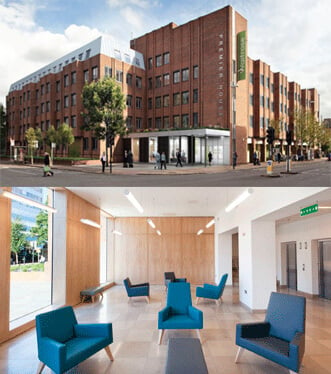
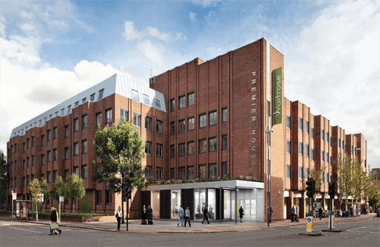
The refurbishment of Premier House, a 1970s concrete/brick-skinned office building, was one of the first projects to be undertaken by Low Carbon Workplace, a collaboration between The Carbon Trust, Columbia Threadneedle Investments, and Stanhope. The building was typical of its age and type: existing services included an inefficient, high-energy-usage, high-carbon-emitting, VAV air conditioning system with split system DX cooling units.
Using existing mainstream technologies, the refurbishment set out to introduce low-carbon design techniques and technologies for internal climate environmental control and ‘sustainable’ solutions, to achieve a building with low emissions and low water use. The building fabric and structure were generally retained, with principal improvements consisting of replacement windows, upgraded insulation, provision of external solar shading, exposing the building thermal mass, provision of an active, ventilated chilled-beam comfort cooling and heating system, new energy-efficient central plant and a low-carbon lighting system.
A key aspect of the refurbishment was the provision of facilities and systems that allowed occupants to take responsibility for and control of their energy usage and emissions. Extensive individual energy metering was therefore provided to each tenant for the various systems and sub-systems. Tenants were also required to sign the Low Carbon Charter, indicating their firm intention to minimise the building’s energy consumption and emissions. The Carbon Trust then worked with them to develop their Cat B fit-out plans and continues to provide ongoing support to tenants, including monthly reporting on carbon emissions.
This has enabled the identification and realisation of opportunities to improve performance. At the end of the first full year of occupation, energy consumption had been reduced by 64%. This equated to a reduction of 370.9 tonnes of CO2 per year.