

Concerns around inflation have driven core government bond yields upwards to levels not seen for more than a decade
This has increased not only the income these assets offer, but also their scope to rally in a ‘classic’ risk-off environment
As multi-asset investors this offers the prospect of increased portfolio diversification without having to sacrifice income
The global inflation acceleration – and associated increase in bond yields – has been driven primarily by an accumulation of excess disposable income throughout the Covid pandemic, the subsequent reopenings across key consumer-driven economies, and ongoing lockdown-related supply-chain issues in vital manufacturing/distribution hubs. Russia’s invasion of Ukraine compounded the commodity component of this from February onwards. In addition to the yield increases attributable to anticipated central bank policy tightening aimed at quashing price increases, the yield on UK government debt (gilts) spiked dramatically higher in September (Figure 1). This began as the accommodation of a meaningful risk premium to account for the Truss-Kwarteng mini budget’s detrimental impact on the future path of the UK’s balance sheet. However, this soon initiated a self-perpetuating “doom loop” whereby Liability-Driven Investment (LDI) schemes became forced sellers of large gilt positions.
Figure 1: UK and US 10-year government bond yields
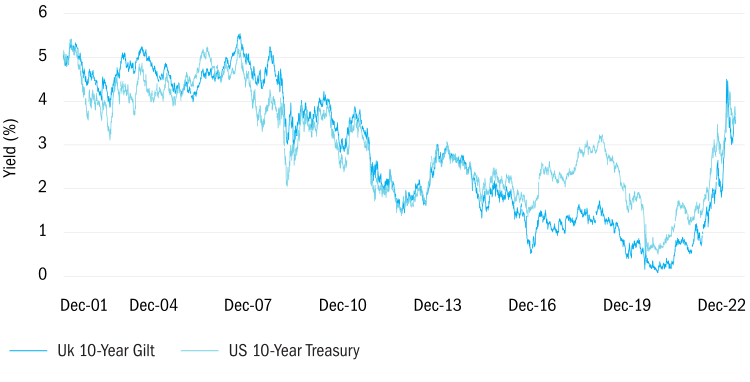
Source: Bloomberg, 31 December 2022
These yield increases across the assets deemed to have the least risky cashflows led to proportionate asset price decreases across the risk asset spectrum. As a result an investor at the start of 2022 with perfect foresight would have likely held a portfolio with a lot of cash, commodities up to June and not much else – not an ideal portfolio from an income generation perspective. Despite this, a number of factors helped our multi-asset income strategy perform in 2022.
In the recent low yield environment where risks to yield direction were viewed as asymmetric towards the upside we have run a low duration (price sensitivity to yield movement) position. This was maintained well into 2022 and reduced the impact of yield increases on our fixed income holdings’ capital values. We also maintained a significant US dollar position associated with our US equity position, which rallied significantly in the
risk-off environment. In addition to these factors, as an income strategy our underlying equity positions exhibit a quality income bias. This naturally steers away from the highly interest rate-sensitive speculative tech stocks that saw the sharpest deratings (Figure 2).
Figure 2: CT Global Multi-Asset Income versus Global Equities and Bonds*
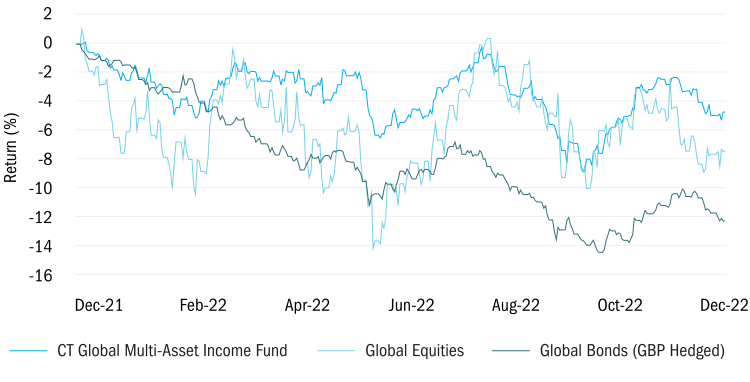
Source: Bloomberg, 5 December 2022. * All total returns in GBP. Global equities as per the MSCI World Index and
Global Bonds as per the Bloomberg Global Aggregate
As implemented policy tightening continues to feed through to underlying economies and supply chains realign across the globe, we believe we have seen the peak in inflation, hawkish central bank rhetoric and, as a result, yield increases. Over the second half of 2022, as our conviction around the proximity of this peak grew, we began to take advantage of
increased yield levels and build up duration exposures to high-quality fixed income (Figure 3). This was primarily done through investment grade credit, US treasuries and UK gilts, with most of the gilt duration added at a significant discount at the peak of the LDI crisis. We also took advantage of the lows in sterling to materially reduce the strategy’s large US dollar position.
Figure 3: CT Global Multi-Asset Income Duration (years)
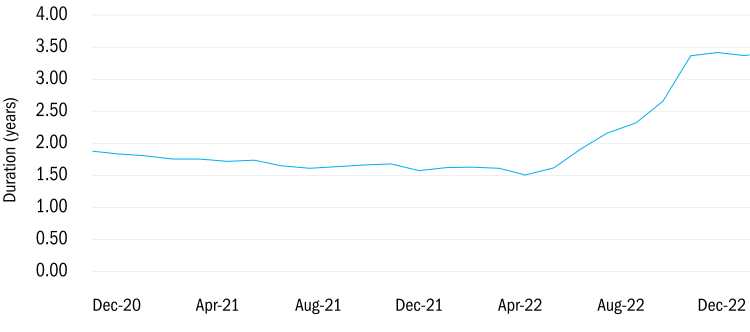
Source: Columbia Threadneedle Investments, 31 October 2022
We have since rotated some of the gilt exposure into US treasuries as gilts recovered alongside the UK’s political environment. With yields at 3.5%-4% we continue to believe US treasuries and gilts offer an attractive level of income and increased diversification properties. From here, although we expect core yields to fall from current levels, we do not anticipate a rapid reduction to 2020 levels. Labour markets remain tight and structural themes born out of Covid and ongoing trade tensions, such as deglobalisation, have the potential to lead to structurally higher inflation than 2%. Associated with this would be a higher average core
government bond yield level than we have seen since 2010. This should improve prospects for our multi-asset income strategy as the lack of income disincentive associated with holding these diversifiers is largely removed. The ability to hold core government bonds without sacrificing income adds a significant string to our bow in seeking to manage volatility while maintaining an attractive level of income. Indeed, the strategy today is arguably better hedged for a classic activity slowdown risk-off move than it was at the start of 2022, while holding an increased allocation-weighted forward yield of 4.5%