



AI hyperscalers are reshaping the IG credit market, creating attractive dislocations in fundamentally strong issuers – and an attractive entry point.
The artificial intelligence (AI) buildout is reshaping the investment grade (IG) corporate bond market in real time. Technology companies racing to build AI infrastructure – dubbed “hyperscalers” for the unprecedented pace of their capital spending – are flooding the market with new debt. This wave of issuance is creating something we don’t often see: fundamentally strong credits trading at technically driven wide spreads.
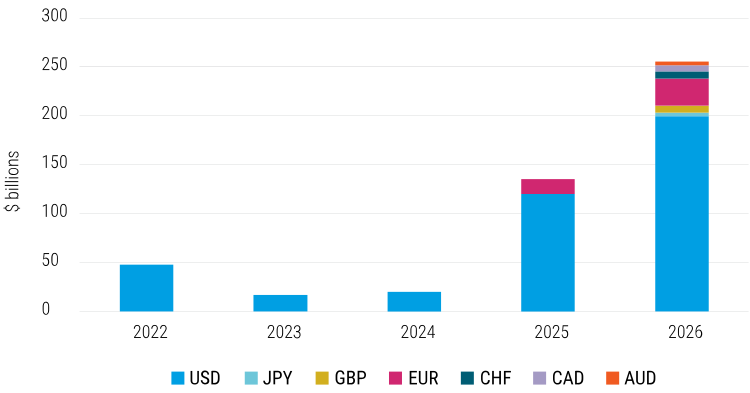
The scale of investment is staggering, with the competitive dynamics of the AI race compelling them to bring forward capital expenditure (capex) plans. Issuance has accelerated from just $20 billion in 2024 to $136 billion in 2025, with $256 billion issued year-to-date in 2026.1 Hyperscaler capex estimates for 2027 alone have surged to $968 billion, up from the $600 billion that was projected late last year.2 While these companies generate substantial internal cash flows, roughly 20%-25% of their funding requirements are being financed through IG markets.
This surge is materially reshaping the IG universe. Technology sector exposure in the Global Corporate Aggregate index has increased to 8.4% from 6.7% in May 2024. Measured by contribution to duration (CTD) – a gauge of how much each sector drives the index’s sensitivity to spread moves – technology now represents 0.5 years of the index’s 5.6-year spread duration, up from 0.4 years a year ago. In other words, the sector is becoming a larger source of benchmark risk, not merely a larger slice of issuance.
More tellingly, when we look at duration times spread, our preferred measure of risk-weighted benchmark allocation, the impact is stark. Oracle now ranks as the largest risk contributor to global corporate indices, jumping from 10th place just a year ago. Meta, Google, and Amazon have similarly vaulted into the top 20, climbing more than 100 positions each.
The technical pressure
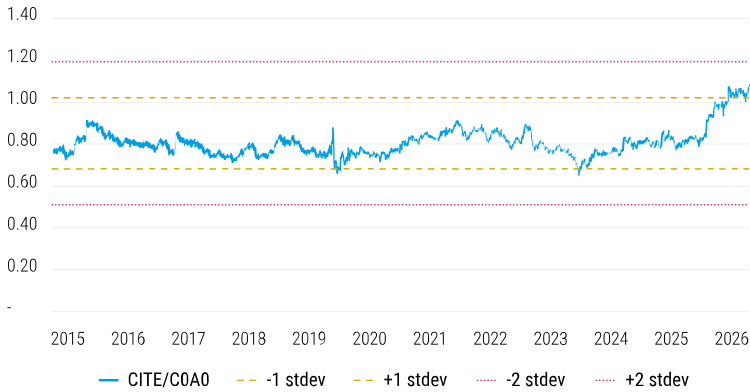
To absorb this volume of issuance, markets are demanding a concession. As such, the technology sector is now trading approximately two standard deviations cheap versus the US corporate index, despite credit fundamentals remaining robust (Figure 1). These are AA-rated companies with low leverage, strong earnings growth and solid cash flow generation. The capex spending is adding only modest leverage – perhaps 0.1x-0.2x – to balance sheets that started from very strong positions.
Figure 1: Issuance pressure has pushed tech spreads wider
ICE BofA ML Tech option-adjusted spread / ICE BofA US Corp Index OAS
Source: Bloomberg, September 2026
The issuers recognise the digestion challenge and are responding strategically by diversifying funding sources. We are seeing increased issuance in non-US dollar currencies in order to tap fresh investor bases (Figure 2).
Figure 1: Issuance pressure has pushed tech spreads wider
Total hyperscaler issuance by currency ($bn)
Source: Bloomberg/Columbia Threadneedle analysis, September 2026
More notably, hyperscalers are turning to different investment structures such as Special Purpose Vehicles (SPVs), with $70 billion now issued through benchmark-eligible SPVs like the pioneering $27 billion Meta/Beignet transaction. These highly structured, asset-backed vehicles spread funding risk beyond traditional unsecured corporate bond investors. Private markets may also act as a release valve, providing alternative funding channels if public market spreads show further signs of indigestion.
An attractive entry point
From our bottom-up, fundamental credit research perspective, this presents a compelling opportunity. In this instance, the spread widening is driven by market technicals (investor capacity constraints and supply concerns) rather than material deteriorating credit quality. Revenue growth from AI investments is validating the capex decisions, and once this investment cycle moderates, we expect free cash flow generation to strengthen materially.
That said, we remain vigilant. Our downside risk management framework includes monitoring revenue forecasts that justify the expenditure and maintaining appropriate issuer concentration limits. We are also cautious about overly complex SPV structures that may obscure underlying risks.
The current environment exemplifies why fundamental research matters: it allows us to distinguish between technical dislocations and genuine credit deterioration, positioning portfolios to exploit the former while avoiding the latter.