Inflation: a word that has sparked huge debate as well as rotation in the market. But is it temporary or permanent, helpful or harmful? One thing is clear: it has been rising around the world. With successful vaccine rollout programmes in many developed countries, markets are
optimistically looking to a full economic reopening.
However, the economic
recovery is also being fuelled by strong
consumer balance sheets – not much
spending happens in lockdown – and impressive government fiscal stimulus
packages. In the US, for example,
President Biden has proposed an
Infrastructure Plan that envisages
spending $2.25 trillion over eight years on
a wide range of infrastructure and social
initiatives.1 This plan also supports the
US’s “green” transition – namely investing
in a clean power sector, the electrification
of transport, and the decarbonisation of
buildings and agriculture.
At the same time global supply chain
disruptions – from auto chip shortages to
a lack of Marmite on supermarket shelves
(supposedly due to shortages in yeast as
breweries have closed during lockdowns
while demand for the product has gone
up) – is leading to a squeeze on input
costs. Where manufacturers have pricing
power, this is in turn being passed through
to the customer. Our strategy’s focus on
companies and industries with strong
competitive dynamics becomes vital in
such an environment as these corporates
tend to have greater ability to pass through
rising costs and sustain financial returns.
Q1 company earnings calls were
dominated by both optimistic management
outlooks on sales recovery, but also
cautionary warnings around rising
inflationary cost pressures. This in turn
has sustained the rotation into value
cyclical sectors such as banks and
commodities that began in Q4 2020.
Suddenly near-term earnings growth here
looks compelling versus traditional growth
sectors such as technology.
Although the Threadneedle Global
Sustainable Equity strategy was up 2.4%2
over the quarter, it lagged the MSCI All-
Country World Index by 2.1%,3 with our
underweight in developed market banks
and commodity sectors such as oil and
gas hurting relative performance.
We did, however, have several positive
sustainable updates over the quarter.
Firstly, Sika,4 a leading construction
materials company, announced an
innovative recycling process it has
developed for old concrete. According to
the European commission, 25%-30% of
all waste generated in the EU consists of
construction demolition waste materials.5
Recycling these materials is vital
particularly in dense urban areas where
most old concrete accumulates. In Sika’s
process, old concrete is broken down
into individual parts which in turn enables
the reuse of the components of the old
concrete as well as increased recycling
of cement aggregates. This innovation,
called «reCO2ver», will make a significant
contribution to reducing the ecological
footprint of the construction industry.6
Paul Schuler, Sika CEO, said in
a statement: “In the five largest EU
countries alone, roughly 300 million tons
of old concrete are generated every year.
With complete recycling of these materials,
up to 15 million tons of CO2 emissions can
be captured. We are convinced that our
new process has the potential to benefit
both our customers and the environment.”7
Another innovative specialty materials
holding is Croda,8 which recently held
its 2021 Sustainability Day. At this,
management highlighted several exciting
initiatives including:
In March, we attended Exane’s “Future
of Packaging” conference where we heard
positive updates from two of our holdings:
UPM, a manufacturer of forest-based
products, and SIG Combibloc, a global
supplier of aseptic carton packaging.
The key takeaway was that consumer
pressure is growing on governments and
corporates around the world to limit singleuse
plastic, with regulation around plastic
waste gaining momentum. This is leading
to strong tailwinds for more sustainable
paper-based packaging solutions and
away from plastic packaging.
In addition, UPM highlighted its
concern that the EU taxonomy did not
view existing forestry management as a
taxonomy-aligned activity. However, the
European Commission subsequently
has presented its new act on taxonomy
regulation where they now classified
existing forestry management as a
taxonomy-eligible activity.
Although markets remain volatile, we
believe our sustainable themes are robust
with government policy and consumer trends
around the world continuing to shift towards
a greener and more inclusive future.
Engagement highlight: Nextera10
Nextera has been a longstanding
holding in the strategy as the leading
developer of renewable energy in North
America. FPL (Florida Power & Light), part
of Nextera, has set a “30-by-30” plan to
install more than 30 million solar panels
by 2030 and make Florida a world leader
in solar energy. The end result will be the
largest installation of solar panels by a
regulated utility in the world and a 67%
fleet-wide reduction in CO2 emissions by
2030 compared to the national average.
The company has also developed the
largest combined solar-plus-storage facility
in the country. This cutting-edge project
incorporates a 10MW battery storage
project into the operations of a 74.5MW
solar power plant.11
Given all of this work we were
surprised to see that the company had
a fairly average score according to the
Transition Pathway Initiative, which is a
global, asset owner-led initiative which
assesses companies’ preparedness for
the transition to a low-carbon economy.
We scheduled a call to discuss this
with the company in more detail and
discovered that it was due to disclosure
gaps rather than poor practice. We were
reassured to hear that it was already
working to close these gaps and we are
confident its strategy is well aligned to
the energy transition.
As active managers we see the
importance of regularly engaging with
the companies we own, to ensure that
their values remain align with our own.
Through regular communication and close
relationships, we are able to ensure we
maximise sustainable outcomes for this
strategy.
1 Bloomberg, March 2021.
2 Gross of fees. Past performance is not a guide to future returns.
3 Bloomberg, as at April 2021.
4 Mention of specific stocks should not be taken as a
recommendation to buy.
5 https://www.interregeurope.eu/policylearning/news/1770/
construction-and-demolition-waste/
6 https://www.sika.com/en/media/media-releases/2021/sikaachieves-
breakthrough-in-concrete-recycling.html
7 https://www.sika.com/en/media/media-releases/2021/sikaachieves-
breakthrough-in-concrete-recycling.html
8 Mention of stocks is not a recommendation to buy or sell.
9 https://www.croda.com/en-gb/sustainability/targets
10 Mention of stocks is not a recommendation to buy or sell.
11 https://newsroom.nexteraenergy.com/2019-01-16-FPLannounces-
groundbreaking-30-by-30-plan-to-install-morethan-
30-million-solar-panels-by-2030-make-Florida-a-worldleader-
in-solar-energy
I love shopping for clothes – I admit it, writes Pauline Grange. But increasingly, my shopping
is tinged with guilt. I am now much more aware of the terrible environmental impact that
comes with fashion, with the textiles industry one of the most pollutive in the world.
Around 100 billion apparel items are sold
per year, which is a circa 50% increase
versus 2006.1 This is in large part due
to the rise of “fast fashion” – ie cheap,
high-fashion items. In fact, the industry
now emits more CO2 than the aviation and
shipping industries combined, and uses
79 billion m3 of fresh water a year while
causing around 20% of industrial water
pollution. But unfortunately, very little of
what the industry produces is recycled and
reused, with the majority of items ending
up in landfill or incinerated within a year of
production.2 Indeed, according to the Ellen
Macarthur foundation, the global fashion
industry produces about 53 million tonnes
of fibre a year, of which more than 70% ends
up in landfills or on bonfires. Less than 1%
is reused to make new clothes.3
This raised awareness has changed
my consumption patterns – I now buy
fewer but higher-quality items. In addition,
I have changed my negative view of buying
second-hand clothing and now happily
scour for bargains either through online
platforms or local charity shops. And it
looks like I’m not alone: 70% of women
have or are now open to shopping secondhand
up from 45% in 2016.4 As a result,
rental and resale fashion platforms are
seeing strong growth. In the Threadneedle
Global Sustainable Global Equity strategy
we own one such resale platform, Mercari,
which has seen accelerated growth over
the past year in its two key markets
of Japan and US, with both users and
engagement on its platform increasing.
In fact, consumers are increasingly
prioritising sustainability, which is starting
to influence the way they shop. Nearly 2.5x
more consumers plan to shift their spend
to sustainable brands.5 At the same time,
regulation around building a more circular
economy is rising too, such as the EU
Circular Economy Action plan which aims
to shift production and consumption from
the linear “Take, Make, Dispose” model
to more circular use of products and
materials.6
Adidas has been a core holding
since the inception of the Threadneedle
Global Sustainable Equity strategy. Its
production and promotion of technical
sports performance products contributes
positively to our social theme of “Good
Health and Wellbeing”.
But if we own a textile company, we
also want its products to not have a
detrimental impact on the environment.
Fitness wear is generally worn more
frequently and retained for longer than
high-fashion items. In addition, Adidas is
a sustainable leader in the industry. At its
Capital Markets day in March, sustainability
was once again front and centre of its
agenda. It detailed its innovation around
making its products more circular and
sustainable and highlighted its target
to have nine out of 10 of its articles
environmentally sustainable by 2025 using
a “Three-loop” strategy:7
Management has in fact set a target for
100% of its products to use only recycled
polyester by 2024 aided by the introduction
of their Primeblue and Primegreen fabrics
(see below).
All of which sounds positive, but we
wanted to see first-hand how sustainability
was embedded into the company’s
marketing and products on the shop floor.
So, more than a year since our last visit
we revisited the Adidas flagship store on
Oxford Street, London.
Adidas has improved the integration of
sustainability across its product ranges.
Before, “green” ranges were showcased
separately and in very limited parts of the
store. Today, recycled materials are evident
across all their ranges throughout the store.
Adidas uses two sustainable materials
in its ranges, which are clearly marked
(via a label) on different apparel items and
trainers:
Rummaging through men’s, women’s
and children’s apparel and trainers,
these products made up a substantial
percentage of each range. This is a huge
advance from a year ago.
Adidas also aims to implement
sustainability innovation at scale to
make its most popular products its most
sustainable. This was on display upon
entering the flagship London store where
you are greeted with its new “green” Stan
Smith selection, one of Adidas’s most
iconic trainer franchises which are now
made from either Primeblue or Primegreen
materials. It also showcased an industry
first: a Stan Smith made using Mylo, a
mushroom-based material that performs
like leather but is biodegradable.
Another in-store service is the
“Sneaker services” repair station. This
allows customers to repair their trainers,
preventing early and unnecessary disposal.
Extending the life of a garment by just nine
months reduces its environmental impact
by an impressive 20-30%.8
There was also evidence of progress
in targeting our social outcome of “Good
health and Wellbeing”:
Digital is another key area of
investment for the firm, and the integration
of digital and sustainability was on display
in the store. For example, there were photo
booths where you can take and share your
picture and environmental pledge with the
online Adidas community.
Overall, we walked away confident
that Adidas might achieve its corporate
mission: “Through sport we have the
power to change lives. By striving to
expand the limits of human possibilities,
to include and unite all people in sport
and to create a more sustainable world”.9
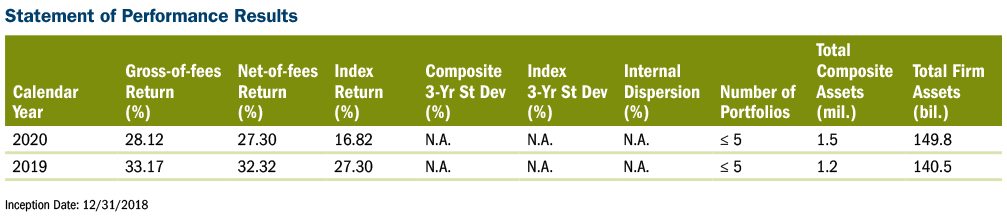
Threadneedle Global Sustainable Equity Composite
GIPS Report: Columbia Threadneedle Investments EMEA APAC
1. Columbia Threadneedle Investments EMEA APAC ‘the Firm’
claims compliance with the Global Investment Performance
Standards (GIPS®) and has prepared and presented this report
in compliance with the GIPS Standards. Columbia Threadneedle
Investments EMEA APAC has been independently verified by Ernst
& Young LLP for the periods 1st January 2000 to 31st December
2018. The verification reports are available upon request. A firm
that claims compliance with the GIPS standards must establish
policies and procedures for complying with all the applicable
requirements of the GIPS standards. Verification provides
assurance on whether the firm’s policies and procedures related
to composite and pooled fund maintenance, as well as the
calculation, presentation, and distribution of performance, have
been designed in compliance with the GIPS standards and have
been implemented on a firm-wide basis. Verification does not
provide assurance on the accuracy of any specific performance
report. GIPS® is a registered trademark of CFA Institute. CFA
Institute does not endorse or promote this organization, nor does
it warrant the accuracy or quality of the content contained herein.
2. The ‘Firm’ is defined as all portfolios managed by Columbia
Threadneedle Investments EMEA APAC (prior to 1 January 2021,
the firm was known as Threadneedle Asset Management) which
includes Threadneedle Asset Management Limited, (TAML),
Threadneedle International Limited, (TINTL), Threadneedle
Investments Singapore (Pte.) Limited, (TIS), and Threadneedle
Management Luxembourg S.A. (TMLSA), excluding directly
invested property portfolios. The firm definition was expanded in
2015 to include portfolios managed by then newly established
affiliates of Threadneedle Asset Management in Singapore. TAML
& TINTL are authorised and regulated in the UK by the Financial
Conduct Authority (FCA). TINTL is also registered as an investment
adviser with the U.S. Securities and Exchange Commission and
as a Commodities Trading Advisor with the U.S. Commodity
Futures Trading Commission. TIS is regulated in Singapore by
the Monetary Authority of Singapore. TMLSA is authorised and
regulated in Luxembourg by the Commission de Surveillance du
Secteur Financier (CSSF). On 1 July 2020, Threadneedle Asset
Management Malaysia Sdn. Bhd (TAMM) was removed from the
firm. Columbia Threadneedle Investments is the global brand
name of the Columbia and Threadneedle group of companies.
Beginning 30 March 2015, the Columbia and Threadneedle
group of companies, which includes multiple separate and
distinct GIPS-compliant firms, began using the global offering
brand Columbia Threadneedle Investments.
3. A concentrated global equity strategy with a focus on high
quality companies that seeks to deliver both positive sustainable
outcomes, in accordance with the UN Sustainable Development
Goals (SDGs), and superior financial returns. The composite was
created November 30, 2018.
4. The portfolio returns used in composites are calculated
using daily authorised global close valuations with cash flows
at start of the day. Composite returns are calculated by using
underlying portfolio beginning of period weights and monthly
returns. Periodic returns are geometrically linked to produce
longer period returns. Gross of fee returns are presented before
management and custodian fees but after the deduction of
trading expenses. Returns are gross of withholding tax. Net of
fee returns are calculated by deducting the representative fee
from the monthly gross return. Policies for valuing investments,
calculating performance, and preparing GIPS Reports, as well as
the list of composite descriptions, list of pooled fund descriptions
for limited distribution pooled funds, and the list of broad
distribution pooled funds are available upon request.
5. The dispersion of annual returns is measured by the equal
weighted standard deviation of portfolio returns represented
within the composite for the full year. Dispersion is only shown
in instances where there are six or more portfolios throughout
the entire reporting period. The Standard Deviation will not be
presented unless there is 36 months of monthly return data
available.
6. The three year annualised ex-post standard deviation
measures the variability of the gross-of-fees composite and
benchmark returns over the preceding 36 month period.
7. The following fee schedule represents the current representative
fee schedule for institutional clients seeking investment
management services in the designated strategy: 0.65% per annum. Gross of fee performance information does not reflect
the deduction of management fees. The following statement
demonstrates, with a hypothetical example, the compound effect
fees have on investment return: If a portfolio’s annual rate of
return is 10% for 5 years and the annual management fee is 65
basis points, the gross total 5-year return would be 61.1% and
the 5-year return net of fees would be 55.9%.
8. The MSCI AC World Index is designed to provide a broad
measure of equity-market performance throughout the world
and is comprised of stocks from 23 developed countries and
24 emerging markets. Index returns reflect the reinvestment of
dividends and other earnings and are not covered by the report
of the independent verifiers.
9. Past performance is no guarantee of future results and there is
the possibility of loss of value. There can be no assurance that an
investment objective will be met or that return expectations will
be achieved. Care should be used when comparing these results
to those published by other investment advisers, other investment
vehicles and unmanaged indices due to possible differences in
calculation methods.