In this article, Nish Patel, Fund Manager of The Global Smaller Companies Trust, explores why smaller companies may be poised to outperform in an environment of higher inflation, rising geopolitical uncertainty and changing market leadership.
Inflationary forces and an attractive relative valuation could herald a cycle of smaller company stock outperformance
The beginning of 2026 was marked by geopolitical shocks, contributing to heightened market volatility. The Iran war has stoked inflationary forces that were already proving higher than expected as the soothing themes of globalisation and comparatively stable geopolitics enjoyed in the 2010s has reversed. Indeed, the 2020s have seen the opposite: gradual de‑globalisation, activist fiscal policies, and rising populism. Few stocks have been untouched, and smaller companies are no exception.
However, an environment of higher inflation can favour smaller capitalisation stocks in the medium term. Many operate in traditional sectors that actually benefit from rises in inflation. What’s more, small caps may also prove more resilient simply because they entered 2026 on lower valuations than large caps.
As shown in the table below, the MSCI ACWI Small Cap Index has greater exposure to the inflation beneficiaries of industrials, materials and energy than its large-cap counterpart, while large-cap leadership remains concentrated in technology. In commodity-led, fiscally expansive regimes, this tilt has historically favoured smaller companies.
Small caps lean towards sectors gaining from inflation
Index sector weightings, Mar 31, 2026
Sector | MSCI ACWI Small Cap Index | MSCI ACWI Large Cap Index |
|---|---|---|
Industrials | 20.1% | 9.6% |
Financials | 13.9% | 17.1% |
Information technology | 12.6% | 29.0% |
Consumer discretionary | 10.7% | 9.7% |
Healthcare | 9.9% | 9.0% |
Materials | 9.3% | 3.4% |
Real Estate | 7.7% | 1.1% |
Energy | 5.3% | 4.8% |
Consumer Staples | 4.5% | 5.2% |
Utilities | 3.1% | 2.1% |
Communication services | 3.0% | 9.2% |
Are small caps beginning a cycle of outperformance?
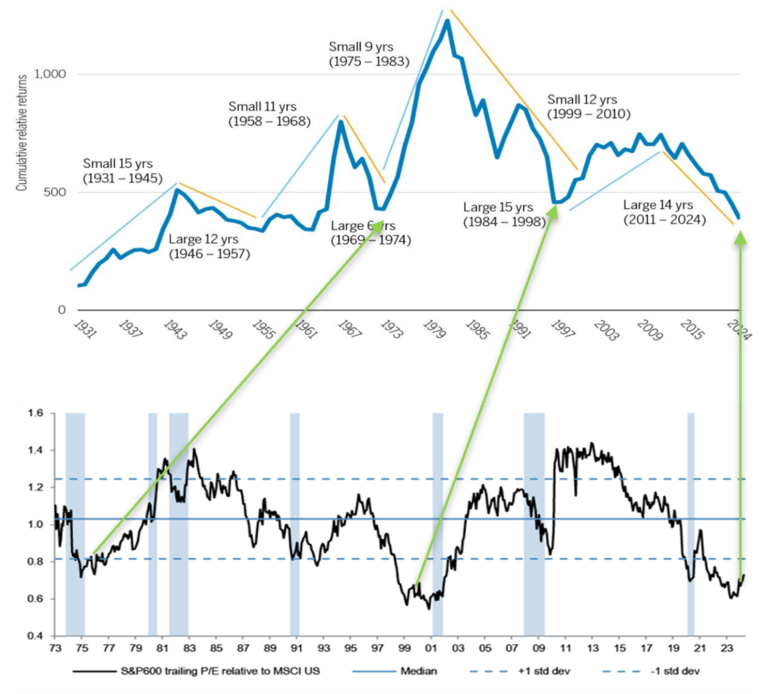
Small caps and large caps go through long cycles of outperformance, with the average cycle lasting about 12 years. With large caps having outperformed for the past 14 years, history suggests a reversal may follow. Our analysis suggests these cycles tend to turn well when small-cap valuation discounts reach extremes relative to large caps. This has occurred when the relative small-cap P/E ratios are around one standard deviation below their long-term average – a threshold illustrated in the valuations table below. That is where markets stand today.
On two previous occasions when this happened in the US stock market, a long period of small cap outperformance followed. The chart below shows these occasions, with the S&P 600 Index representing US small cap stocks and the MSCI US large caps.
Low valuations signalling it’s time for small caps
Source: Columbia Threadneedle Investments, 31-Aug-2025. Source: Wellington Management, JP Morgan
The two episodes were:
- Early 1970s (Nifty Fifty era): A handful of large‑cap ‘Nifty Fifty’ stocks (e.g., iconic technology/consumer names of the era such as Kodak and IBM) commanded extreme P/E valuation multiples. Small caps were approximately one standard deviation cheap; they then outperformed from 1975 to 1983. Highlighted by the first green arrow
- Late 1990s (Dot‑com era): Mega cap technology stocks traded on very high earnings valuations. Small caps were more than one standard deviation cheap and outperformed for the next 12 years (1999–2010). Illustrated by the second green arrow
Today echoes these patterns. After an extended period of large-cap technology outperformance, small caps are once again more than one standard deviation cheap (third green arrow). As in the 1970s, an oil shock may be altering the backdrop in ways that favour smaller, old-economy businesses.
Balancing opportunity with discipline
Of course, we are not advocating buying all small caps indiscriminately. The Global Smaller Companies Trust focuses on high-quality smaller companies, taking advantage of the investment trust structure to make long-term investments. In an unstable environment, quality and price are crucial. As ever, we:
- Focus on businesses with strong competitive advantages, healthy free cash generation and robust balance sheets
- Tilt toward industrials, energy and materials, where structural tailwinds are strongest, while staying opportunistic and valuation aware
- Buy with a margin of safety versus intrinsic value
That combination aims to capture the cycle as economic conditions move to favour small caps whilst controlling downside risk, seeking to deliver strong, risk-adjusted returns over the long term.
It seems that small caps may be at a turning point, with similarities to the 1970s especially. To quote the famous American author Mark Twain, history doesn’t repeat itself – but it often rhymes.
Capital at risk. Past performance is not an indication of future returns. The value of your investments can do gown as well as up meaning you can get back less than you invest. Where investments are made in smaller companies, higher levels of volatility may increase the risk to both the value of, and the income from, the investment.
Approved for distribution 14/04/2026 by Columbia Threadneedle Management Limited.
© Columbia Threadneedle Management Limited. No. 517895, Authorised and regulated in the UK by the Financial Conduct Authority. Columbia Threadneedle Investments is the global brand name of the Columbia and Threadneedle group of companies.