



sg
SG
Singapore
en-SG
sg_intm_classes
intm
Intermediary
en
en
For use by professional clients and/or equivalent investor types in your jurisdiction (not to be used with or passed on to retail clients).

Insights

Are high yield bonds the place to hide in levered credit?

Kris keller
Kris Keller
CFA, Senior Portfolio Manager, Head of US High Yield Fixed Income
Chris Jorel
Chris Jorel
Client Portfolio Manager, US High Yield

High yield bonds combine improved credit quality with limited exposure to AI-driven disruption, setting them apart within levered credit.

Key Takeaways

  • High yield enters late cycle in stronger shape, backed by higher credit quality and disciplined issuance.
  • Artificial intelligence (AI) is widening fault lines within levered credit.
  • If losses rise, high yield looks more resilient, with less exposure to AI‑vulnerable sectors and aggressive structures.

The levered credit universe – encompassing high yield bonds, leveraged loans and the now equal-sized private credit market – is not a monolith. As the credit cycle matures and AI-driven disruption reshapes the competitive landscape for highly leveraged companies, distinctions among these asset classes, while always important, now matter enormously.

We believe that high yield bonds represent the most defensible position within levered credit today – a market that has improved its credit quality, avoided the worst excesses of the cycle and maintained a relatively modest footprint in sectors most exposed to AI disruption. Meanwhile, leveraged loans and private credit have grown rapidly, absorbed aggressive deal structures and accumulated meaningful concentrations in software and technology businesses whose fundamental economics are increasingly under pressure. If credit losses are coming, high yield is where we expect to see the least damage.

A new source of credit risk

Highly capable AI models have introduced a new source of credit risk for leveraged borrowers. AI capabilities have grown exponentially since ChatGPT’s debut in late 2022. Agentic models such as Claude Code have proven highly effective at creating, updating and maintaining code – even in the hands of users with no prior programming experience. Anthropic estimates that about half of all requests developers make to its AI systems are related to software engineering work.

While these tools can lower development costs for software companies, they have also raised concerns that competitive moats across many software and technology business models may be far narrower than previously assumed.

UBS recently outlined an AI disruption tail-risk scenario in which defaults rise to as high as 6% in US high yield, 10% in leveraged loans and 15% in private credit1.
Others, including Marathon Asset Management’s Bruce Richards, have gone further, effectively declaring the software lending market uninvestable. Richards has halted new lending to the sector and projects that software defaults will triple over the next five to seven years as AI disruption accelerates2.

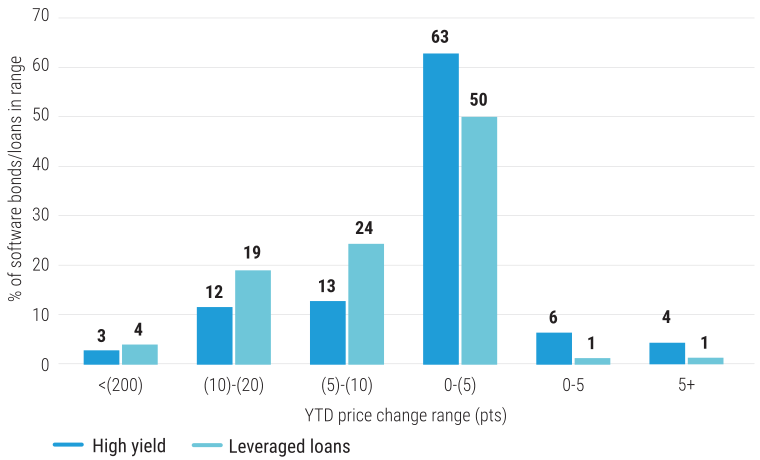
Markets have already begun to respond. As shown in Figure 1, year-to-date through to 9 March, US software bonds and loans have declined by 4.2 and 6.3 basis points (bps) respectively. We expect the longer-term impact to be more nuanced, with clear winners and losers. Business models serving regulated industries such as healthcare and financial services, those with proprietary data or those deeply embedded in customer workflows, should prove more resilient.

By contrast, horizontal application software, IT services and SaaS businesses appear most exposed to AI-driven disruption. As always, issuer selection will be critical, where understanding the idiosyncratic nuance of these risks will help avoid losses but also identify potential opportunities in the liquid portions of credit markets, ie high yield and leveraged loans.

Figure 1: Software bonds and loan price moves
Year-to-date price change distribution (points)
Software bonds and loan price moves

Sources: ICE, JP Morgan, Columbia Threadneedle custom dashboard created via Claude Code

Levered credit exposure varies greatly

Companies most directly exposed to AI disruption are disproportionately concentrated in leveraged loans and private credit, where software represents the largest single sector exposure – not in the high yield bond market (Figure 2). This distinction is central to our thesis.

Figure 2: Estimated software exposure by asset class
Estimated software exposure
US high yield
3.5%
Global high yield
3.0%
Leveraged loans
13.5%
Private credit
>20%

Sources: Bank of America Global Research, Morningstar, Bloomberg

Within the leveraged loan index, technology represents an estimated 13.5% of index weight. Private credit’s exposure is even more pronounced, estimated at a minimum of 20%, with some estimates materially higher given limited disclosure. Over the past decade, private credit has been the preferred financing vehicle for private equity-backed software buyouts, offering flexibility, speed and the ability to support high leverage multiples historically justified by recurring revenue models.

By contrast, the US high yield bond market has just 3.5% exposure to software while global high yield bond indices have even lower exposure. High yield indices remain more heavily weighted toward “HALO” sectors – hard assets with low obsolescence – including energy, health care, consumer cyclicals and telecommunications. These sectors typically feature tangible assets, established cash flow profiles and lower direct exposure to AI disruption.

High yield’s lower software exposure is also higher quality. Only 24bps of high yield software exposure is rated CCC, with another 42bps rated B-. Leveraged loans include 81bps of CCC-rated software exposure and 557bps rated B- by S&P. Private credit, while generally unrated, is widely understood to be of B-/CCC quality in aggregate.

The high yield market has remained disciplined …

One of the defining features of the current high yield market is what has not occurred. Despite years of low rates, ample liquidity and strong investor demand, high yield has not been the primary venue for the most aggressive financial engineering of this cycle.

Leveraged buyout (LBO) issuance in high yield has remained subdued. Over the three years ending in 2025, buyout-related issuance totalled approximately $28.5 billion, less than 4% of total US high yield issuance. Dividend recapitalisations have also been muted. Instead, refinancing has dominated, accounting for roughly 70% of issuance over the same period.

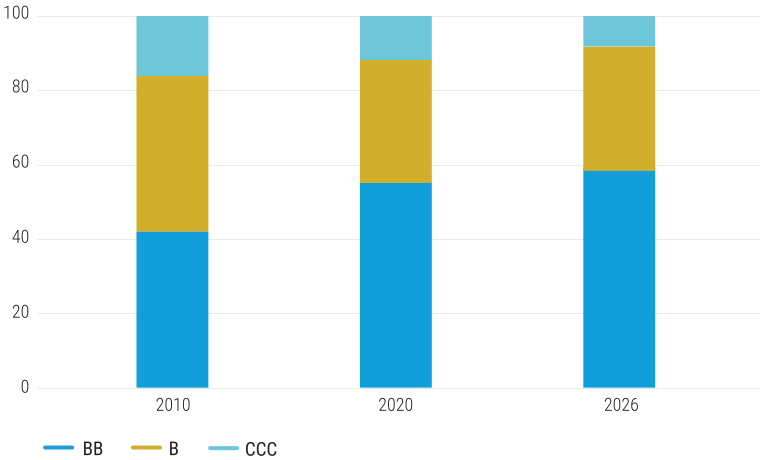
This restraint has materially improved average credit quality. Nearly 60% of the US high yield market is now rated BB, up from roughly 42% 15 years ago. The CCC-rated segment has declined to 9% from 16%, reducing exposure to the portion of the market historically associated with the most severe losses (Figure 3). As a result, average high yield credit quality now exceeds that of the leveraged loan market.

Figure 3: US high yield historical rating trends
Percent of high yield bond universe
US high yield historical rating trends

Source: ICE, Referencing the ICE BofA U.S. High Yield Constrained Index

High yield issuers enter this period from a position of relative financial strength. Leverage has normalised and sits in line with long-term averages. Default rates have increased modestly and are generally expected to trend toward the historical par-weighted average of 3% – well below the stress scenarios contemplated for private credit.

… leveraged loans and private credit have not

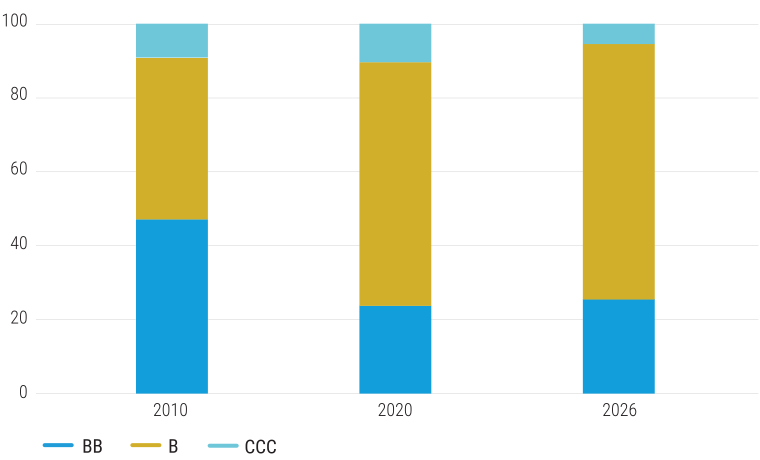
The contrast with leveraged loans and private credit is stark. Aggressive deal structures, elevated leverage and sponsor-friendly terms have proliferated. Today, just 26% of the leveraged loan market is rated BB, down from 48% 15 years ago, while B-rated loans now account for roughly 70% of the market (Figure 4).

Figure 4: Leveraged loans historical rating trends
Percent of leveraged loan universe
Leveraged loans historical rating trends

Source: Morningstar, Referencing the Morningstar LSTA Leveraged Loan Index

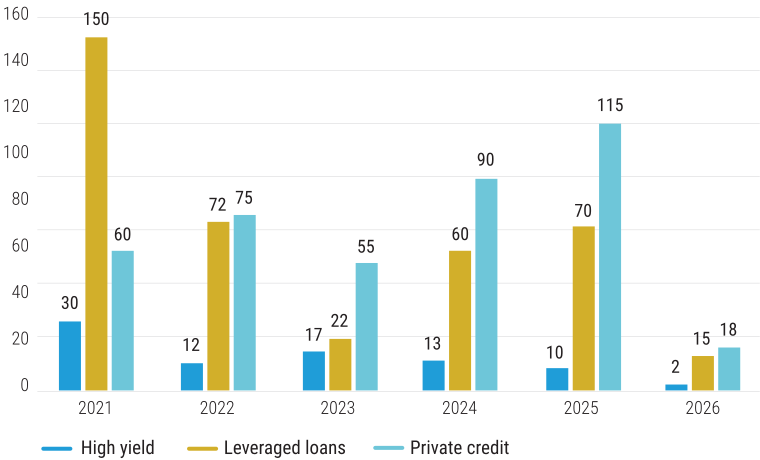
Sponsor preference for pre-payable debt without call protection has pushed much acquisition-related issuance into loans rather than bonds. This shift has driven a rise in loan-only capital structures, which now represent 60% of the loan market, compared with 30% 15 years ago (Figure 5). While total debt levels may be similar, loan-only structures reduce investor protections by shrinking the subordinated capital cushion, lowering recoveries in default. Over the three years ending in 2025, average loan recoveries were 40%, versus a long-term average of 65%. In 2025 alone, recoveries fell to an all-time low of 36%.

Figure 5: Recent LBO financing volumes
Estimated LBO volume (US$ billions)
Recent LBO financing volumes

Source: J.P. Morgan, KBRA

In private credit, competitive pressures have intensified as assets under management have grown and access has expanded to retail investors. To secure deal flow, lenders have increasingly offered borrower-friendly terms, including tighter spreads, payment-in-kind (PIK) features and covenant-lite structures.

PIK loans now account for more than 11% of the market, up from roughly 5% in early 2022. S&P estimates that 3%-4% of private credit deals have amended terms midstream to add PIK features – effectively a form of shadow default, with lenders deferring cash interest in hopes of operational improvement.

Spread compression further underscores competitive strain. In 2025, 57% of deals priced inside 500bps, compared with just 3% in 2023. Covenant protections have also weakened. Upper-middle-market borrowers – those overlapping most with leveraged loans – have largely eliminated maintenance covenants when accounting for covenant-loose issuance, defined by S&P Global as allowing a 40% or greater increase in leverage from issuance.

Leverage in private credit has continued to rise. S&P estimates debt-to-EBITDA ratios reaching 7.5x-8x in some sectors, excluding certain addbacks. Interest coverage has improved modestly but remains pressured by elevated rates, with middle-market deals averaging 1.7x-1.8x. These metrics suggest growing vulnerability to macro shocks, sector disruptions or liquidity stress.


Shale: A cautionary tale

History offers a powerful template for what happens when massive capital flows chase a compelling narrative into a single sector or asset class. The US shale revolution of 2010-13 provides the most instructive recent example. The combination of technological innovation (hydraulic fracturing), high commodity prices and abundant capital created a seemingly irresistible investment opportunity. The high yield bond market became the primary financing vehicle for shale producers – many of whom were burning cash and relying on debt markets to fund growth. Between 2008 and mid-2014, the high yield market grew 74% in size, from approximately $700 billion to $1.25 trillion, while energy’s weight within the US high yield market increased 36%, rising from 11% to 15%.

The outcome was predictable in retrospect. When OPEC flooded the market with supply in late 2014, oil prices collapsed, highly leveraged shale producers defaulted en masse and the high yield market absorbed significant credit losses.

The lesson is not that the shale narrative was wrong – US oil production did double to 11 million barrels a day by 2018. Rather, it is that massive capital flows into a compelling narrative tend to produce excess leverage, erode underwriting discipline and ultimately result in poor capital allocation and credit losses.

Today, we see clear parallels between the shale experience in high yield bonds and what may be unfolding in the software sector within private credit and leveraged loan markets. Private credit assets under management have nearly tripled, rising from approximately $400 billion in 2015 to $1.5 trillion by the end of 2025. Capital flows have been substantial, and competition for deals intense enough that underwriting standards have deteriorated materially – as reflected in the PIK, covenant-lite and spread data discussed above. Similarly, the leveraged loan market has grown 86% since 2015, credit quality has deteriorated and capital structures have increasingly featured less subordinated debt.

As a share of the leveraged loan market, software exposure has increased 62% since 2015, rising from 8.3% to 13.5%. Private credit’s software concentration, estimated to exceed 20%, has also left the asset class vulnerable to an exogenous shock akin to OPEC’s market flooding – potentially realised through AI-driven disruption. Critically, the US high yield bond market has not experienced this kind of explosive growth. The market has expanded only modestly – approximately 10% over the past decade – and software exposure remains limited at 3.5%. The relative stability of high yield’s size is itself a signal: It has not been the recipient of the excess capital that tends to produce excess risk (Figure 6).

Figure 6: US high yield, leveraged loan and private credit growth
Assets under management (US4 billions)
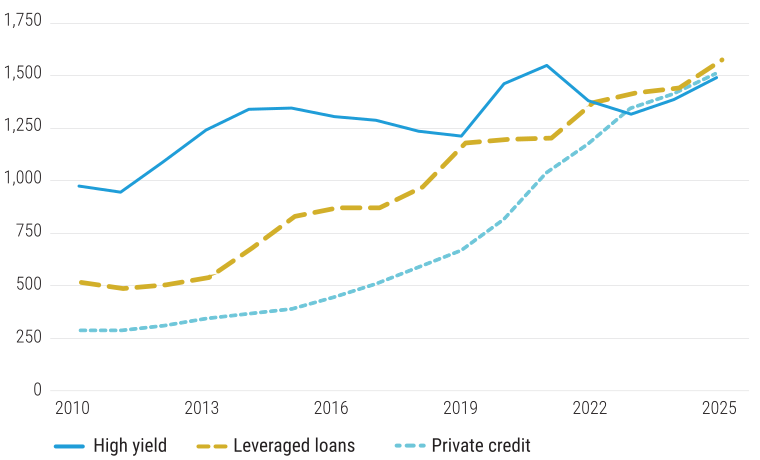
US high yield, leveraged loan and private credit growth

Source: ICE, Morningstar, U.S. Federal Reserve, Preqin

The risks to high yield

Risk 1: Spread contagion. High yield bonds are liquid and publicly traded. In risk-off environments, spreads tend to widen alongside broader markets, regardless of underlying fundamentals. If private credit losses trigger broader risk aversion, high yield spreads may widen even if issuer fundamentals remain sound. Investors should expect mark-to-market volatility in such scenarios.

Risk 2: Throwing the baby out instead of the bathwater. Private credit and direct lending are inherently illiquid. When investors need liquidity, they may be forced to sell what they can – liquid high yield bonds – rather than what they want to sell. For long-term investors able to tolerate volatility, these dislocations may create opportunity. However, short-term mark-to-market pain can be significant.

The bottom line

The high yield bond market enters this period in its strongest position in decades. Credit quality is historically high, leverage is reasonable and issuance has been used primarily for refinancing rather than aggressive M&A or dividends. Exposure to AI-disrupted sectors is structurally lower than in leveraged loans or private credit, and the market has avoided the explosive capital inflows that typically mark late-cycle excess.

The same cannot be said for leveraged loans and, especially, private credit. Late-cycle behaviour is no longer anecdotal – it is visible in rising leverage, PIK proliferation, covenant erosion and shadow defaults. The $1 trillion that flowed into private credit over the past decade has almost certainly produced excesses.

For investors navigating this environment, the message is clear: high yield bonds remain the place to hide within levered credit. They offer elevated yield without the concentrated software exposure, structural opacity, PIK-heavy balance sheets or illiquidity that characterise the alternatives. If credit losses are coming – and the evidence suggests they may be – high yield is where we expect to see the least damage.


Key topics

Subscribe to insights

Get the most out of your email by tailoring the types of insights and information you would like to receive from us.

Latest articles

High yield bonds combine improved credit quality with limited exposure to AI-driven disruption, setting them apart within levered credit.
Rising petrol prices will eventually feed into higher inflation, which is being reflected in the pricing of government bonds.
EM spreads are holding up well as energy route disruption from the Iran war continues, but differentiation is occurring across sovereign credits as investors reassess future risk.
Key topics
Related topics

1UBS Global Strategy, AI disruption and private credit: what is the risk scenario? 24 February 2026

2 Private market insights, Private Credit Dominates While AI Threatens Software, 14 June 2025


Important information

For use by professional clients and/or equivalent investor types in your jurisdiction (not to be used with or passed on to retail clients). For marketing purposes.

This document is intended for informational purposes only and should not be considered representative of any particular investment. This should not be considered an offer or solicitation to buy or sell any securities or other financial instruments, or to provide investment advice or services. Investing involves risk including the risk of loss of principal. Your capital is at risk.  Market risk may affect a single issuer, sector of the economy, industry or the market as a whole. The value of investments is not guaranteed, and therefore an investor may not get back the amount invested. International investing involves certain risks and volatility due to potential political, economic or currency fluctuations and different financial and accounting standards. The securities included herein are for illustrative purposes only, subject to change and should not be construed as a recommendation to buy or sell. Securities discussed may or may not prove profitable. The views expressed are as of the date given, may change as market or other conditions change and may differ from views expressed by other Columbia Threadneedle Investments (Columbia Threadneedle) associates or affiliates. Actual investments or investment decisions made by Columbia Threadneedle and its affiliates, whether for its own account or on behalf of clients, may not necessarily reflect the views expressed. This information is not intended to provide investment advice and does not take into consideration individual investor circumstances. Investment decisions should always be made based on an investor’s specific financial needs, objectives, goals, time horizon and risk tolerance. Asset classes described may not be suitable for all investors. Past performance does not guarantee future results, and no forecast should be considered a guarantee either. Information and opinions provided by third parties have been obtained from sources believed to be reliable, but accuracy and completeness cannot be guaranteed. This document and its contents have not been reviewed by any regulatory authority.

In Australia: Issued by Threadneedle Investments Singapore (Pte.) Limited [“TIS”], ARBN 600 027 414.  TIS is exempt from the requirement to hold an Australian financial services licence under the Corporations Act 2001 (Cth) and relies on Class Order 03/1102 in respect of the financial services it provides to wholesale clients in Australia. This document should only be distributed in Australia to “wholesale clients” as defined in Section 761G of the Corporations Act.  TIS is regulated in Singapore (Registration number: 201101559W) by the Monetary Authority of Singapore under the Securities and Futures Act (Chapter 289), which differ from Australian laws.

In Singapore: Issued by Threadneedle Investments Singapore (Pte.) Limited, 3 Killiney Road, #07-07, Winsland House 1, Singapore 239519, which is regulated in Singapore by the Monetary Authority of Singapore under the Securities and Futures Act (Chapter 289). Registration number: 201101559W. This advertisement has not been reviewed by the Monetary Authority of Singapore.

In Hong Kong: Issued by Threadneedle Portfolio Services Hong Kong Limited 天利投資管理香港有限公司. Unit 3004, Two Exchange Square, 8 Connaught Place, Hong Kong, which is licensed by the Securities and Futures Commission (“SFC”) to conduct Type 1 regulated activities (CE:AQA779). Registered in Hong Kong under the Companies Ordinance (Chapter 622), No. 1173058.

In Japan: Issued by Columbia Threadneedle Investments Japan Co., Ltd. Financial Instruments Business Operator, The Director-General of Kanto Local Finance Bureau (FIBO) No.3281, and a member of Japan Investment Advisers Association and Type II Financial Instruments Firms Association.

In the UK: Issued by Threadneedle Asset Management Limited, No. 573204 and/or Columbia Threadneedle Management Limited, No. 517895, both registered in England and Wales and authorised and regulated in the UK by the Financial Conduct Authority.

In the EEA: Issued by Threadneedle Management Luxembourg S.A., registered with the Registre de Commerce et des Sociétés (Luxembourg), No. B 110242 and/or Columbia Threadneedle Netherlands B.V., regulated by the Dutch Authority for the Financial Markets (AFM), registered No. 08068841.

In Switzerland: Issued by Threadneedle Portfolio Services AG, Registered address: Claridenstrasse 41, 8002 Zurich, Switzerland.

In the Middle East: This document is distributed by Columbia Threadneedle Investments (ME) Limited, which is regulated by the Dubai Financial Services Authority (DFSA).  For Distributors: This document is intended to provide distributors with information about Group products and services and is not for further distribution. For Institutional Clients: The information in this document is not intended as financial advice and is only intended for persons with appropriate investment knowledge and who meet the regulatory criteria to be classified as a Professional Client or Market Counterparties and no other Person should act upon it.

This document may be made available to you by an affiliated company which is part of the Columbia Threadneedle Investments group of companies: Columbia Threadneedle Management Limited in the UK; Columbia Threadneedle Netherlands B.V., regulated by the Dutch Authority for the Financial Markets (AFM), registered No. 08068841.

Columbia Threadneedle Investments is the global brand name of the Columbia and Threadneedle group of companies. © 2026 Columbia Threadneedle. All rights reserved. columbiathreadneedle.com                                                                                                 

Related Insights

31 March 2026

In Credit Weekly Snapshot – Pump it up (when you don’t really need it)

Rising petrol prices will eventually feed into higher inflation, which is being reflected in the pricing of government bonds.
24 March 2026

In Credit Weekly Snapshot – The curve that got away

The EUR swap curve is telling a fascinating story amid the Iran conflict.
17 March 2026

In Credit Weekly Snapshot – I won’t back down: stalemate in Strait of Hormuz

There seems to be no easy way out of the Iran war, as the ongoing closure of the crucial seaway continues to impact prices and economies around the world. Read on for a breakdown of fixed income news across sectors and regions.
31 March 2026

In Credit Weekly Snapshot – Pump it up (when you don’t really need it)

Rising petrol prices will eventually feed into higher inflation, which is being reflected in the pricing of government bonds.
30 March 2026

Adrian Hilton

Head of Emerging Market Debt

What five weeks of conflict mean for emerging market debt

EM spreads are holding up well as energy route disruption from the Iran war continues, but differentiation is occurring across sovereign credits as investors reassess future risk.
30 March 2026

Anthony Willis

Senior Economist, Multi-Asset Solutions team

Market Perspectives: Where next for commodity prices?

Today we look at the potential upside – and even downside – risks to the oil price and other commodities from the Iran war and where they might go from here.

Important information

For use by professional clients and/or equivalent investor types in your jurisdiction (not to be used with or passed on to retail clients). For marketing purposes.

This document is intended for informational purposes only and should not be considered representative of any particular investment. This should not be considered an offer or solicitation to buy or sell any securities or other financial instruments, or to provide investment advice or services. Investing involves risk including the risk of loss of principal. Your capital is at risk.  Market risk may affect a single issuer, sector of the economy, industry or the market as a whole. The value of investments is not guaranteed, and therefore an investor may not get back the amount invested. International investing involves certain risks and volatility due to potential political, economic or currency fluctuations and different financial and accounting standards. The securities included herein are for illustrative purposes only, subject to change and should not be construed as a recommendation to buy or sell. Securities discussed may or may not prove profitable. The views expressed are as of the date given, may change as market or other conditions change and may differ from views expressed by other Columbia Threadneedle Investments (Columbia Threadneedle) associates or affiliates. Actual investments or investment decisions made by Columbia Threadneedle and its affiliates, whether for its own account or on behalf of clients, may not necessarily reflect the views expressed. This information is not intended to provide investment advice and does not take into consideration individual investor circumstances. Investment decisions should always be made based on an investor’s specific financial needs, objectives, goals, time horizon and risk tolerance. Asset classes described may not be suitable for all investors. Past performance does not guarantee future results, and no forecast should be considered a guarantee either. Information and opinions provided by third parties have been obtained from sources believed to be reliable, but accuracy and completeness cannot be guaranteed. This document and its contents have not been reviewed by any regulatory authority.

In Australia: Issued by Threadneedle Investments Singapore (Pte.) Limited [“TIS”], ARBN 600 027 414.  TIS is exempt from the requirement to hold an Australian financial services licence under the Corporations Act 2001 (Cth) and relies on Class Order 03/1102 in respect of the financial services it provides to wholesale clients in Australia. This document should only be distributed in Australia to “wholesale clients” as defined in Section 761G of the Corporations Act.  TIS is regulated in Singapore (Registration number: 201101559W) by the Monetary Authority of Singapore under the Securities and Futures Act (Chapter 289), which differ from Australian laws.

In Singapore: Issued by Threadneedle Investments Singapore (Pte.) Limited, 3 Killiney Road, #07-07, Winsland House 1, Singapore 239519, which is regulated in Singapore by the Monetary Authority of Singapore under the Securities and Futures Act (Chapter 289). Registration number: 201101559W. This advertisement has not been reviewed by the Monetary Authority of Singapore.

In Hong Kong: Issued by Threadneedle Portfolio Services Hong Kong Limited 天利投資管理香港有限公司. Unit 3004, Two Exchange Square, 8 Connaught Place, Hong Kong, which is licensed by the Securities and Futures Commission (“SFC”) to conduct Type 1 regulated activities (CE:AQA779). Registered in Hong Kong under the Companies Ordinance (Chapter 622), No. 1173058.

In Japan: Issued by Columbia Threadneedle Investments Japan Co., Ltd. Financial Instruments Business Operator, The Director-General of Kanto Local Finance Bureau (FIBO) No.3281, and a member of Japan Investment Advisers Association and Type II Financial Instruments Firms Association.

In the UK: Issued by Threadneedle Asset Management Limited, No. 573204 and/or Columbia Threadneedle Management Limited, No. 517895, both registered in England and Wales and authorised and regulated in the UK by the Financial Conduct Authority.

In the EEA: Issued by Threadneedle Management Luxembourg S.A., registered with the Registre de Commerce et des Sociétés (Luxembourg), No. B 110242 and/or Columbia Threadneedle Netherlands B.V., regulated by the Dutch Authority for the Financial Markets (AFM), registered No. 08068841.

In Switzerland: Issued by Threadneedle Portfolio Services AG, Registered address: Claridenstrasse 41, 8002 Zurich, Switzerland.

In the Middle East: This document is distributed by Columbia Threadneedle Investments (ME) Limited, which is regulated by the Dubai Financial Services Authority (DFSA).  For Distributors: This document is intended to provide distributors with information about Group products and services and is not for further distribution. For Institutional Clients: The information in this document is not intended as financial advice and is only intended for persons with appropriate investment knowledge and who meet the regulatory criteria to be classified as a Professional Client or Market Counterparties and no other Person should act upon it.

This document may be made available to you by an affiliated company which is part of the Columbia Threadneedle Investments group of companies: Columbia Threadneedle Management Limited in the UK; Columbia Threadneedle Netherlands B.V., regulated by the Dutch Authority for the Financial Markets (AFM), registered No. 08068841.

Columbia Threadneedle Investments is the global brand name of the Columbia and Threadneedle group of companies. © 2026 Columbia Threadneedle. All rights reserved. columbiathreadneedle.com                                                                                                 

Thank you. You can now visit your preference centre to choose which insights you would like to receive by email.

To view and control which insights you receive from us by email, please visit your preference centre.

Woman listens to music through headphones
Play Video

CT Property Trust- Fund Manager Update

Sed ut perspiciatis unde omnis iste natus error sit voluptatem accusantium doloremque laudantium