
se
SE
Sweden
en-SE
se_inst_classes
inst
Institutional
en
en
Insights

Is the US about to move into recession?

Before discussing the US, it’s worth highlighting the exceptionally good news in Europe of late. Last year, soaring natural gas prices led to high inflation and fears of recession and electricity blackouts in Europe. But a remarkably mild January coupled with a strong response in terms of reduced demand and increased supply have transformed the situation. Gas prices have tumbled. Coupled with much lower reported inflation, last week saw the biggest fall in German bund yields since unification over 30 years ago. Europe’s problems aren’t over yet, but the outlook has definitely brightened.

Turning to the US, Friday’s employment data showed another big rise in jobs and a decline in unemployment to the lowest level in modern times. So why am I talking of recession? The reason relates to the purchasing managers’ index for services. This slumped from a healthy 56.5 to 49.6, below the threshold of 50 that signals contraction. We have been waiting for this index to fall this low because it has a high weight on the housing sector, which is clearly in recession.

US Purchasing Managers’ Indices move into recession territory
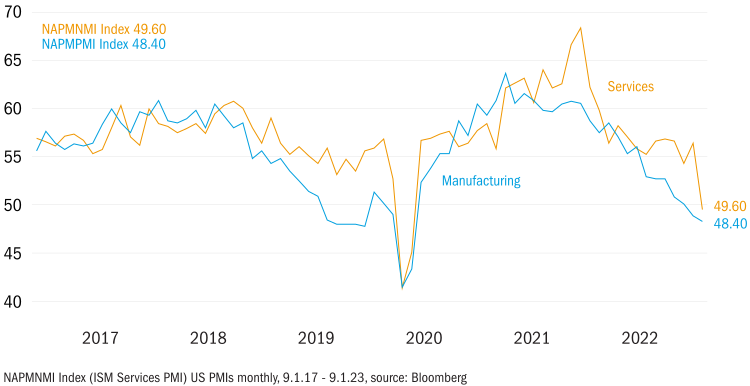
US Purchasing Managers’ Indices move into recession territor

Of course, one data point does not prove anything, but we think the overall tide is turning. One of the key supports for the US economy over the last year has been consumer spending, which remained strong despite the squeeze on real incomes. Households have been drawing on the huge fiscal support – ‘covid piggy banks’ – provided during the pandemic to fund their spending. Their confidence has been boosted by the low level of unemployment and, in recent months, by declining gasoline prices. But the covid piggy banks are beginning to run out and inflation has eroded the real value of existing savings.

Even if the economy does slow, as we expect, and demand for labour weakens, there is a long way to go before the Federal Reserve will feel confident that inflation is under control. This week should see another decline in both headline and core inflation, as measured by the consumer price index. The problem is that wage inflation is still too high. Don’t be misled by the decline in average hourly earnings figures published last week as they are distorted by compositional effects. The average increase fell because more low paid workers were employed. We got a much better read from the Atlanta wage tracker which showed that underling wage inflation remains high, far too high to be consistent with the Fed’s 2% inflation target. Even more worrying for the Fed is that wage rises for job switchers are accelerating so firms are being forced to raise pay for their existing workforce to avoid losing them to rivals.

The Fed’s preferred measure of wage inflation is the employment cost index. That’s only published quarterly, but it comes out at the end of January. That will matter more than this week’s CPI numbers.

So, what does all this mean for markets? First, weak economic data has been taking the pressure off bond markets and leading to a rally in equities. But if, as I expect, we need a recession to control wage and price inflation, equities would struggle as margins come under pressure. Second, the improvement in inflation is welcome but the Fed will not feel reassured until they see a sustained fall in wage increases. And unemployment needs to rise well above the current level of 3.5% to achieve that.

There is much talk of a pivot by the Fed and the markets pricing in only a modest further increase in Fed funds rate with cuts later this year. I expect the Fed to raise rates further than the markets expect and to hold them at that level for an extended period. A pause not a pivot.

We will hear from Jerome Powell, chair of the Fed, at a major conference in Sweden this week. I think he will push back on market optimism about US interest rates and this will be bad news for bonds and equities.


9 January 2023
Steven Bell
Steven Bell
Chief Economist, EMEA
Key topics
Related topics
Listen on Stitcher badge
Key topics
Related topics

Important information

© 2023 Columbia Threadneedle Investments

For marketing purposes. Your Capital is at Risk. Columbia Threadneedle Investments is the global brand name of the Columbia and Threadneedle group of companies. Not all services, products and strategies are offered by all entities of the group. Awards or ratings may not apply to all entities of the group.

This document should not be considered as an offer, solicitation, advice, or an investment recommendation.
The material attached may be made available to you by an affiliated company which is also part of the Columbia Threadneedle Investments group of companies.
In the UK: Threadneedle Asset Management Limited, No. 573204 and/or Columbia Threadneedle Management Limited, No. 517895, both registered in England and Wales and authorised and regulated in the UK by the Financial Conduct Authority.
In the EEA: Threadneedle Management Luxembourg S.A., registered with the Registre de Commerce et des Sociétés (Luxembourg), No. B 110242 and/or Columbia Threadneedle Netherlands B.V., regulated by the Dutch Authority for the Financial Markets (AFM), registered No. 08068841.
In Switzerland: Threadneedle Portfolio Services AG, an unregulated Swiss firm or Columbia Threadneedle Management (Swiss) GmbH, acting as representative office of Columbia Threadneedle Management Limited, authorised and regulated by the Swiss Financial Market Supervisory Authority

Related Insights

27 July 2026

Senior Economist, Multi-Asset Solutions team

Market Perspectives: Tipping point?

The coming week may turn out to be a tipping point for markets over the summer, as investors assess key developments in monetary policy, corporate earnings and geopolitics.
22 July 2026

Asset Allocation update - Q3 2026

Hopes of a swift resolution to the conflict in the Middle East are being challenged by recent events. We have once again seen the ‘closure’ of the Strait of Hormuz by Iran and a blockade of Iranian shipping reinstated by the US.
20 July 2026

Senior Economist, Multi-Asset Solutions team

Market Perspectives: A(nother) new dawn for the UK

The UK has a new prime minister – its seventh in just over a decade – and another opportunity to reset the country’s economic narrative.
18 August 2026

In Credit Weekly Snapshot – If I could turn back time

The US 30-year Treasury yield is at its highest since 2001. Although the level is not extreme historically, the speed of the rise is.
18 August 2026

In Credit Weekly Snapshot – A little less conversation

The US July jobs report had plenty to say – little of it good. The economy shed 23,000 jobs versus consensus expectations for an 80,000 gain. Rates markets reacted swiftly, trimming expectations for future rate rises.
11 August 2026

Central banks face a global reserves paradox

Reserves are growing, but so is the reluctance to use them.
true
true

Important information

© 2023 Columbia Threadneedle Investments

For marketing purposes. Your Capital is at Risk. Columbia Threadneedle Investments is the global brand name of the Columbia and Threadneedle group of companies. Not all services, products and strategies are offered by all entities of the group. Awards or ratings may not apply to all entities of the group.

This document should not be considered as an offer, solicitation, advice, or an investment recommendation.
The material attached may be made available to you by an affiliated company which is also part of the Columbia Threadneedle Investments group of companies.
In the UK: Threadneedle Asset Management Limited, No. 573204 and/or Columbia Threadneedle Management Limited, No. 517895, both registered in England and Wales and authorised and regulated in the UK by the Financial Conduct Authority.
In the EEA: Threadneedle Management Luxembourg S.A., registered with the Registre de Commerce et des Sociétés (Luxembourg), No. B 110242 and/or Columbia Threadneedle Netherlands B.V., regulated by the Dutch Authority for the Financial Markets (AFM), registered No. 08068841.
In Switzerland: Threadneedle Portfolio Services AG, an unregulated Swiss firm or Columbia Threadneedle Management (Swiss) GmbH, acting as representative office of Columbia Threadneedle Management Limited, authorised and regulated by the Swiss Financial Market Supervisory Authority

You may also like

Investment approach

Teamwork defines us and is fundamental to our investment approach, which is structured to facilitate the generation, assessment and implementation of good, strong investment ideas for our portfolios.

Funds and Prices

Columbia Threadneedle Investments has a comprehensive range of investment funds catering for a broad range of objectives.

Our Capabilities

We offer a broad range of actively managed investment strategies and solutions covering global, regional and domestic markets and asset classes.
Icon checked

Thank you. You can now visit your preference centre​ to choose which insights you would like to receive by email.

Icon checked

Thank you. You can now visit your preference centre​ to choose which insights you would like to receive by email.