


Filter insights on this page
Repo rates are expressed relative to SONIA, and the chart below displays the average repo rates that we have achieved over the past four quarters for three, six, nine and 12-month repos, shown as a spread to average SONIA levels at the time. The volatility and market uncertainty that resulted from the mini-Budget also weighed upon funding markets, particularly for shorter dated trades as can be seen from the achieved spreads below. Note that during the fourth quarter of 2022 no repos were traded with a 12m tenor so the chart reflects the previous quarter’s value.
Capabilities
Media type
Themes
Figure 2: Change in swap rates over the next quarter
The secondary impact of the mini-Budget crisis centred around collateral and the velocity of movement; rather than a lack of balance sheet for repo funding (a la March 2020). Yet, the difficulties around collateral substitutions and settlements did in many cases prompt a review by individual banks’ credit officers, resulting in a temporary reduction or hiatus in repo balance sheet provision in some cases. Once these reviews were completed balance sheet availability opened up again – some with the addition of haircuts to provide additional protection to the bank. Of course, the momentous lack of certainty in the future path of interest rates also impacted the typical repo spread to SONIA as trading a fixed rate forced the banks to take a conservative view on where yields could reach.
The funding ratio index published by the Pension Protection Fund showed a slight decrease in funding levels quarter-on-quarter (124.7% at end March vs 125.7% at end December). Higher yields benefitted the liability side of the equation, however the dramatic fall in equities weighed upon funding ratios. High hedging levels mean that schemes saw only a modest gain from the higher yields but still retain some exposure to equities.
Market Outlook
Source: Columbia Threadneedle Investments. As at 31 March 2025
Inflation hedging rose by 12% quarter on quarter, whilst interest rate hedging activity increased by 27% from the previous quarter.
All data and sources Columbia Threadneedle Management Limited, as at 30 June 2024 and Valid to: 30 September 2024
Regions

European central bank expectations were muted in the final quarter of 2025, allowing focus to fall squarely on the Dutch Pension Reform transition date of 1st January 2026 and what that could entail for markets. This centred upon the global and local curve steepening trend where longer dated yields rise relative to shorter dated yields.
Overall global markets were relatively benign over the fourth quarter as investors looked through the political alarums and excursions including warlike posturing and further tariff threats. Much has been made of the negotiation tactic of tariffs and now there appears to be a sense of ennui with threats delivering barely a ripple in markets. However, European bond and swap markets underperformed their peers over this period. This is a reflection of preparations for Dutch Pension Reform, known as Wet Toekomst Pensioenen (WTP). The reform sets the transition of traditional defined benefit pension arrangements into collective defined contribution schemes. A key part of the change is in the way that interest rate or LDI hedging is determined; shifting from an equal hedge across maturities to a stepped hedging requirement per age cohort with older cohorts receiving more hedging (at shorter tenors). Over the quarter the ECB held firm on their base rate of 2.00% whilst the UK and the US cut rates by 0.25% and 0.50% respectively to both end the quarter at 3.75%.
The underperformance towards the end of 2025 was expected to be the forerunner of further yield rises and curve steepening around the transition date of 1st January 2026. This expectation was predicated on several key tenets; firstly that given the binary nature of the reform that schemes would aim to effect hedge changes as close as possible to the transition date; secondly that there would be a significant amount of interest rate risk to be traded both in terms of outright hedging demand and curve impacts as hedges shortened; and finally that Dutch pension funds are a major participant in the longer maturities of European swaps and bonds and that there was no natural replacement buyer in that size. In the event the transition was orderly and the curve even exhibited flattening (longer dated yields decreased relative to shorter dated yields). In fact, there was an extraordinary confluence of factors that defied expectations:
Given the importance of pension reform on the market with further upcoming transition dates we asked our counterparty banks for their thoughts on this matter. Estimates of how much risk trading was expected and how much actually transpired varied widely. This is a clear indication of how few counterparties were involved in the key risk transfers and that the majority of risk was offset between pension funds transitioning in 2026 vs 2027 or against hedge fund profit taking. Interestingly though the majority agreed that the implied risk traded had disappointed versus their expectations and thus that there would be more unwinding of hedges to come over the next few months. We also polled our counterparties on their thoughts and expectations for the 1st January 2027 cohort. Whilst the January 2026 transition may have been managed smoothly this one does present some more challenges:
W – World markets. The strength in equity markets in particular resulted in significant improvements in funding ratios. This translates to higher hedging ratios thus increasing the amount of hedging required post transition.
T – Timing. Higher funding ratios allowed more pension funds to act in anticipation of the transition, with significant activity seen in the fourth quarter (hence the underperformance). A few schemes have also taken advantage of recent legislation to spread the hedge adjustment over a longer period post transition.
P – Positioning. Dutch reform has been widely discussed and in a world rocked by political instability and unpredictability a structural change is an attractive trade view to maintain. This culminated in significant positioning by hedge funds who were able to provide liquidity by taking the other side of the market and taking profits on their positions – that mystery buyer referred to earlier.
- Much will depend on funding ratio levels with AI disruption taking its toll on equity markets
- The 2027 cohort is on current levels significantly larger than the 2026 cohort but is dominated by the largest Dutch pension fund ABP so they will be a key determinant in terms of their decision making around trade sizing and timing
- Possibility of 2027 cohort schemes deferring to 2028 impacting the trade expectations
- Continued presence and positioning of hedge funds
- More schemes taking up the option of spreading the hedge adjustments over longer time periods
Overall the experience of the 2026 transition date has provided useful context for those transitioning at later dates – preparation is key! Our experience of shepherding clients through the 1st January 2025 and 2026 transition dates has proved instrumental in achieving the optimal outcome in terms of hedge and asset level protection with a smooth conversion to the new system.
A nuance of the new pension system is around the Reserves pots. These typically have a conservative investment policy tailored to the goal of the reserve pots, oftentimes involving a considerable amount of interest rate risk hedging. We have been able to offer our segregated clients who manage these pots separately use of our longstanding Euro swap pooled funds to support efficient and accurate matching.
Chart 1: Columbia Threadneedle European pooled fund offering
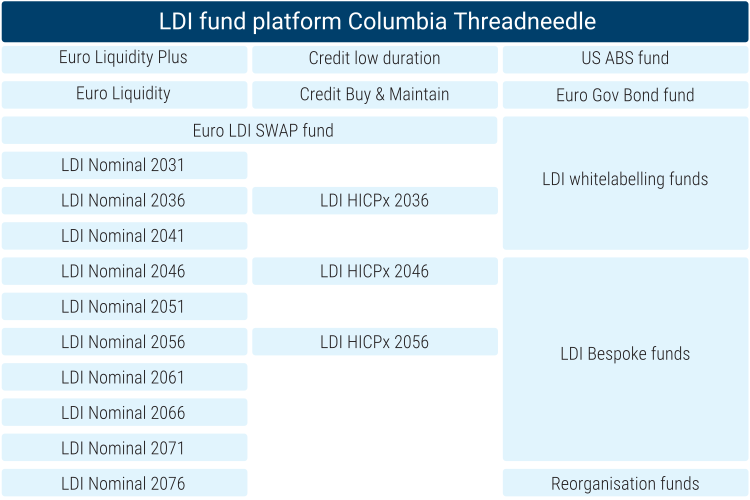
The Euro swaps pools can provide either interest rate or real rate hedging in a bucketed format allowing a tailored hedge to match exposures with precision. They were launched in 2006 and in January celebrated their 20-year anniversary of supplying hedging to Dutch, Irish & German defined benefit and defined contribution pension funds. Adjacent funds sit alongside the swap funds for supporting collateral. If you would like to learn more about our pooled fund offering, please contact your client director.
Market Outlook
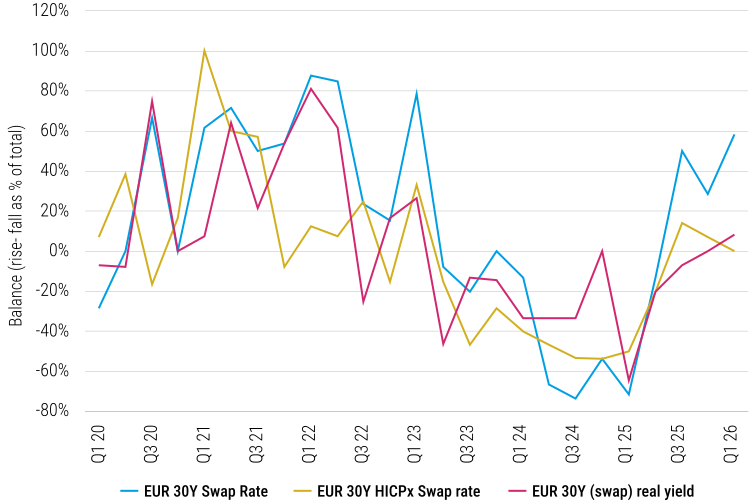
We also asked investment bank derivatives trading desks for their opinions on the likely direction of key rates for liability hedging. The aim is to get information from those closest to the market to aid investors in their decision-making.
The results are shown below as the number of those predicting a rise less those predicting a fall, as a percentage of the number of responses. The larger the balance, the more responses predict a rise. The more negative the balance, the more responses predict a fall.
Chart 2: Change in swap rates over the next quarter.
Source: Columbia Threadneedle Investments. As at 31 December 2025
In the previous quarter there was a lack of conviction, with the most popular view for higher swap yields which came to fruition because of Dutch pension reform.
Looking forwards to the end of the first quarter there is little certainty on how inflation or real yields will progress, but there is a renewed expectation for higher swap yields – this is partly a consequence of unmet expectations for long-dated hedge unwinds from WTP to be completed over the next few months. Yet there are additional factors suggesting higher yields to our counterparties such as increased issuance exerting upward pressure, especially coupled with growing term premia for longer dated tenors. European bond issuance has been predicted to grow as the geopolitical situation worsens and defence spending comes to the fore. Recent US threats to annexe Greenland have only exacerbated these concerns. In the absence of strong growth, increased spending and debt will have a consequent drag on fiscal deficits.
If you would like to learn more about any of the topics discussed, please contact your client director.