





Insights
The European Union Securitisation Regulation (EUSR) took effect in 2019 (concurrently with an equivalent UKSR framework for UK investors). EUSR imposes compliance obligations on many EU-regulated entities, including UCITS (Undertakings for Collective Investment in Transferable Securities) funds, which invest in securitised assets.
EUSR does not apply directly to US or other non-EU originators of securitisations. However, the regulation does demand that EU investors only purchase securities that meet the EUSR requirements. Therefore, in practice, EUSR has an extraterritorial effect: issuers of US securitisations marketed to EU investors must comply with the regulatory requirements. These are summarised in the following EUSR articles:
Article 5: Due diligence
Investors must verify that originators (or the equivalent sponsoring/issuing party) have followed sound lending standards and creditworthiness assessments.
Article 7: Reporting and disclosure
The reporting regime requires the originator to make certain documents and information available to investors, including asset-level information, generally on a quarterly basis. Reporting is templated and differs based on the nature of the asset pool (for example, mortgages/corporate loans/credit receivables).
The EUSR (and the UKSR) share a common basis with US regulation (the Dodd-Frank Act) developed post-global financial crisis as a means to reduce moral hazard and improve overall market stability. The key principles are an alignment of interests between investors and originators and an enhancement of transparency.
In many regards the US and European regulation are well aligned. However, there are some key differences, especially on risk retention:
EUSR does not permit such exemptions, and the risk retention must be on an ongoing basis. As a result, there is a need for asset compliance monitoring through time to ensure EUSR eligibility is maintained.
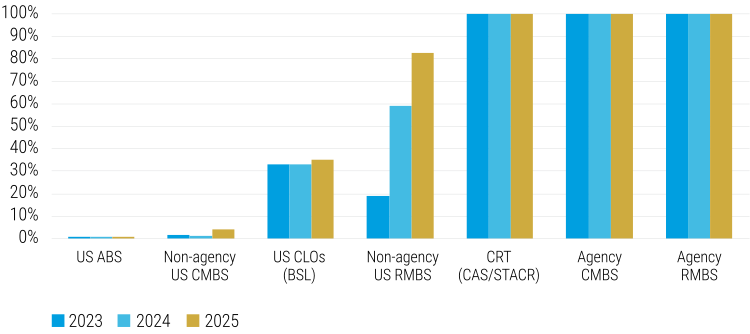
Since both EUSR and Dodd-Frank state that securitisations guaranteed by central governments are not in scope of the regulation, the largest component of the US securitised market – Agency RMBS, which is around $10 trillion in size – remains fully eligible for EU investors. Equally, the smaller related agency commercial mortgage-backed securities (CMBS) market is also 100% eligible, adding an additional $250 billion addressable market.
Within non-agency RMBS, many originators have in recent years sought to structure deals that are compatible with EUSR requirements in order to market to a wider international investor base. Seasoned deals prior to 2022 generally show lower compliance rates, but new issuance in 2024 and 2025 has seen compliance rates of more than 90% in non-qualified mortgages, and 60%-70% in other structures such as reperforming loans or second lien financing. In total this represents around $100 billion of eligible new supply from January to October 2025.
Broadly syndicated CLOs have experienced a similar trend, with compliance rates up to around 35% of new issuance this year. Given that the US CLO market has recently grown to more than $1 trillion in size, the outlook for EUSR-eligible opportunities looks attractive.
The most challenging areas for compliance are in non-agency CMBS and ABS, such as auto loans and credit card receivables, where less than 5% of issuance from January to October 2025 was EUSR-compliant (Figure 1).
On average over the past three years, we estimate the total volume of eligible new supply across all US securitised sectors has been around $1.3 trillion per year.
Source: Columbia Threadneedle Investments, Bank of America, Intex, Bloomberg. ABS = Asset-backed Securities, CMBS = Commercial Mortgage-backed Securities, CLOs = Collateralised Loan Obligations, BSL = Broadly Syndicated Loans, CRT = Credit Risk Transfers (structures that transfer agency-MBS credit risk to investors), CAS/STACR = the CRT programmes of Fannie Mae and Freddie Mac government agencies, RMBS = Residential Mortgage-backed Securities. Non-agency RMBS is defined as non-qualified mortgages, reperforming and non-performing loans, second lien financing and home equity lines of credit. As of 31 October 2025.
Our US Securitised Credit team operates a research-intensive approach to security selection, driven by fundamental analysis and data science. This facilitates loan-level analysis for all potential investments.
Within this research process we have the key principals of EUSR well covered. We favour deals with stronger underwriting standards from originators with sound governance practices and track records. We favour originators who keep “skin in the game” for the lifetime of the security – ie ongoing risk retention. And we engage with issuers on their reporting and disclosure – transparency is key.
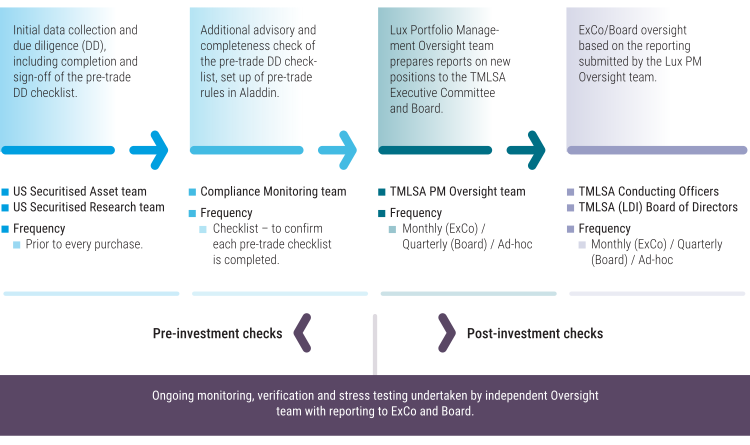
Specifically for our US ABS strategy we have formalised our approach to include a dedicated EUSR “checklist” to cover the articles of the regulation. This is initiated by the US Securitised Credit team for each new investment on a pre-trade basis. The data collection and verification steps cover:
Additional layers of independent oversight then validate the team’s findings. Our Compliance Monitoring team reviews each checklist and provides advisory support in instances where eligibility criteria is less clear.
We adopt a conservative approach: if we cannot be highly assured of eligibility, we will avoid a security. This involves understanding each issuer’s intention with regards to risk retention transfer and sunset triggers. We focus on securities where the issuer is clearly committed to risk retention until maturity. In addition, we can further mitigate against sunset risk by focusing on MBS deals with less than a five-year average life.
Ongoing compliance monitoring post-trade is led by a combination of the Compliance Monitoring and Risk Oversight teams (Figure 2).
Navigating the complexities of EUSR (and UKSR) is essential for EU and UK investors seeking exposure to US securitised credit. While regulatory alignment with Dodd-Frank provides a strong foundation, differences in risk retention and ongoing compliance create challenges that demand rigorous oversight.
At Columbia Threadneedle Investments, we combine deep fundamental research with robust compliance frameworks to ensure eligibility and transparency across every trade. Our checklist-driven approach prioritises issuers with strong governance and enduring risk retention, helping clients manage regulatory risk while capturing attractive opportunities in a growing, EU-compliant market.
As active managers, we are committed to seeking to deliver superior risk-adjusted returns within the rules – aligning our expertise with client objectives.
Key topics


1A first-loss piece is the tranche in a financial structure that absorbs the initial losses before other tranches are affected, making it a higher-risk investment.
2This is the retention of at least 5% of the nominal value of each class of notes.
For use by professional clients and/or equivalent investor types in your jurisdiction (not to be used with or passed on to retail clients). For marketing purposes.
This document is intended for informational purposes only and should not be considered representative of any particular investment. This should not be considered an offer or solicitation to buy or sell any securities or other financial instruments, or to provide investment advice or services. Investing involves risk including the risk of loss of principal. Your capital is at risk. Market risk may affect a single issuer, sector of the economy, industry or the market as a whole. The value of investments is not guaranteed, and therefore an investor may not get back the amount invested. International investing involves certain risks and volatility due to potential political, economic or currency fluctuations and different financial and accounting standards. The securities included herein are for illustrative purposes only, subject to change and should not be construed as a recommendation to buy or sell. Securities discussed may or may not prove profitable. The views expressed are as of the date given, may change as market or other conditions change and may differ from views expressed by other Columbia Threadneedle Investments (Columbia Threadneedle) associates or affiliates. Actual investments or investment decisions made by Columbia Threadneedle and its affiliates, whether for its own account or on behalf of clients, may not necessarily reflect the views expressed. This information is not intended to provide investment advice and does not take into consideration individual investor circumstances. Investment decisions should always be made based on an investor’s specific financial needs, objectives, goals, time horizon and risk tolerance. Asset classes described may not be suitable for all investors. Past performance does not guarantee future results, and no forecast should be considered a guarantee either. Information and opinions provided by third parties have been obtained from sources believed to be reliable, but accuracy and completeness cannot be guaranteed. This document and its contents have not been reviewed by any regulatory authority.
In Australia: Issued by Threadneedle Investments Singapore (Pte.) Limited [“TIS”], ARBN 600 027 414. TIS is exempt from the requirement to hold an Australian financial services licence under the Corporations Act 2001 (Cth) and relies on Class Order 03/1102 in respect of the financial services it provides to wholesale clients in Australia. This document should only be distributed in Australia to “wholesale clients” as defined in Section 761G of the Corporations Act. TIS is regulated in Singapore (Registration number: 201101559W) by the Monetary Authority of Singapore under the Securities and Futures Act (Chapter 289), which differ from Australian laws.
In Singapore: Issued by Threadneedle Investments Singapore (Pte.) Limited, 3 Killiney Road, #07-07, Winsland House 1, Singapore 239519, which is regulated in Singapore by the Monetary Authority of Singapore under the Securities and Futures Act (Chapter 289). Registration number: 201101559W. This advertisement has not been reviewed by the Monetary Authority of Singapore.
In Hong Kong: Issued by Threadneedle Portfolio Services Hong Kong Limited 天利投資管理香港有限公司. Unit 3004, Two Exchange Square, 8 Connaught Place, Hong Kong, which is licensed by the Securities and Futures Commission (“SFC”) to conduct Type 1 regulated activities (CE:AQA779). Registered in Hong Kong under the Companies Ordinance (Chapter 622), No. 1173058.
In Japan: Issued by Columbia Threadneedle Investments Japan Co., Ltd. Financial Instruments Business Operator, The Director-General of Kanto Local Finance Bureau (FIBO) No.3281, and a member of Japan Investment Advisers Association and Type II Financial Instruments Firms Association.
In the UK: Issued by Threadneedle Asset Management Limited, No. 573204 and/or Columbia Threadneedle Management Limited, No. 517895, both registered in England and Wales and authorised and regulated in the UK by the Financial Conduct Authority.
In the EEA: Issued by Threadneedle Management Luxembourg S.A., registered with the Registre de Commerce et des Sociétés (Luxembourg), No. B 110242 and/or Columbia Threadneedle Netherlands B.V., regulated by the Dutch Authority for the Financial Markets (AFM), registered No. 08068841.
In Switzerland: Issued by Threadneedle Portfolio Services AG, Registered address: Claridenstrasse 41, 8002 Zurich, Switzerland.
In the Middle East: This document is distributed by Columbia Threadneedle Investments (ME) Limited, which is regulated by the Dubai Financial Services Authority (DFSA). For Distributors: This document is intended to provide distributors with information about Group products and services and is not for further distribution. For Institutional Clients: The information in this document is not intended as financial advice and is only intended for persons with appropriate investment knowledge and who meet the regulatory criteria to be classified as a Professional Client or Market Counterparties and no other Person should act upon it.
This document may be made available to you by an affiliated company which is part of the Columbia Threadneedle Investments group of companies: Columbia Threadneedle Management Limited in the UK; Columbia Threadneedle Netherlands B.V., regulated by the Dutch Authority for the Financial Markets (AFM), registered No. 08068841.
Columbia Threadneedle Investments is the global brand name of the Columbia and Threadneedle group of companies. © 2026 Columbia Threadneedle. All rights reserved.
For use by professional clients and/or equivalent investor types in your jurisdiction (not to be used with or passed on to retail clients). For marketing purposes.
This document is intended for informational purposes only and should not be considered representative of any particular investment. This should not be considered an offer or solicitation to buy or sell any securities or other financial instruments, or to provide investment advice or services. Investing involves risk including the risk of loss of principal. Your capital is at risk. Market risk may affect a single issuer, sector of the economy, industry or the market as a whole. The value of investments is not guaranteed, and therefore an investor may not get back the amount invested. International investing involves certain risks and volatility due to potential political, economic or currency fluctuations and different financial and accounting standards. The securities included herein are for illustrative purposes only, subject to change and should not be construed as a recommendation to buy or sell. Securities discussed may or may not prove profitable. The views expressed are as of the date given, may change as market or other conditions change and may differ from views expressed by other Columbia Threadneedle Investments (Columbia Threadneedle) associates or affiliates. Actual investments or investment decisions made by Columbia Threadneedle and its affiliates, whether for its own account or on behalf of clients, may not necessarily reflect the views expressed. This information is not intended to provide investment advice and does not take into consideration individual investor circumstances. Investment decisions should always be made based on an investor’s specific financial needs, objectives, goals, time horizon and risk tolerance. Asset classes described may not be suitable for all investors. Past performance does not guarantee future results, and no forecast should be considered a guarantee either. Information and opinions provided by third parties have been obtained from sources believed to be reliable, but accuracy and completeness cannot be guaranteed. This document and its contents have not been reviewed by any regulatory authority.
In Australia: Issued by Threadneedle Investments Singapore (Pte.) Limited [“TIS”], ARBN 600 027 414. TIS is exempt from the requirement to hold an Australian financial services licence under the Corporations Act 2001 (Cth) and relies on Class Order 03/1102 in respect of the financial services it provides to wholesale clients in Australia. This document should only be distributed in Australia to “wholesale clients” as defined in Section 761G of the Corporations Act. TIS is regulated in Singapore (Registration number: 201101559W) by the Monetary Authority of Singapore under the Securities and Futures Act (Chapter 289), which differ from Australian laws.
In Singapore: Issued by Threadneedle Investments Singapore (Pte.) Limited, 3 Killiney Road, #07-07, Winsland House 1, Singapore 239519, which is regulated in Singapore by the Monetary Authority of Singapore under the Securities and Futures Act (Chapter 289). Registration number: 201101559W. This advertisement has not been reviewed by the Monetary Authority of Singapore.
In Hong Kong: Issued by Threadneedle Portfolio Services Hong Kong Limited 天利投資管理香港有限公司. Unit 3004, Two Exchange Square, 8 Connaught Place, Hong Kong, which is licensed by the Securities and Futures Commission (“SFC”) to conduct Type 1 regulated activities (CE:AQA779). Registered in Hong Kong under the Companies Ordinance (Chapter 622), No. 1173058.
In Japan: Issued by Columbia Threadneedle Investments Japan Co., Ltd. Financial Instruments Business Operator, The Director-General of Kanto Local Finance Bureau (FIBO) No.3281, and a member of Japan Investment Advisers Association and Type II Financial Instruments Firms Association.
In the UK: Issued by Threadneedle Asset Management Limited, No. 573204 and/or Columbia Threadneedle Management Limited, No. 517895, both registered in England and Wales and authorised and regulated in the UK by the Financial Conduct Authority.
In the EEA: Issued by Threadneedle Management Luxembourg S.A., registered with the Registre de Commerce et des Sociétés (Luxembourg), No. B 110242 and/or Columbia Threadneedle Netherlands B.V., regulated by the Dutch Authority for the Financial Markets (AFM), registered No. 08068841.
In Switzerland: Issued by Threadneedle Portfolio Services AG, Registered address: Claridenstrasse 41, 8002 Zurich, Switzerland.
In the Middle East: This document is distributed by Columbia Threadneedle Investments (ME) Limited, which is regulated by the Dubai Financial Services Authority (DFSA). For Distributors: This document is intended to provide distributors with information about Group products and services and is not for further distribution. For Institutional Clients: The information in this document is not intended as financial advice and is only intended for persons with appropriate investment knowledge and who meet the regulatory criteria to be classified as a Professional Client or Market Counterparties and no other Person should act upon it.
This document may be made available to you by an affiliated company which is part of the Columbia Threadneedle Investments group of companies: Columbia Threadneedle Management Limited in the UK; Columbia Threadneedle Netherlands B.V., regulated by the Dutch Authority for the Financial Markets (AFM), registered No. 08068841.
Columbia Threadneedle Investments is the global brand name of the Columbia and Threadneedle group of companies. © 2026 Columbia Threadneedle. All rights reserved.

Sed ut perspiciatis unde omnis iste natus error sit voluptatem accusantium doloremque laudantium