

se
SE
Sweden
en-SE
se_inst_classes
inst
Institutional
en
en
Capitol Hill

Insights

Q4 2025 repo update

Rosa Fenwick
Rosa Fenwick
Head of LDI Implementation

Market Update

In the fourth quarter of 2025, fiscal risks took precedence over monetary policy moves which, due to clear forward guidance, didn’t offer many surprises.  In the UK, much of the final quarter was dominated by Budget leaks and speculation, as the Government prepared it over a period of 12 weeks.  Although their propensity for floating ideas through the press has been criticised, it did in the end deliver a stable result, with greater forward-looking headroom than anticipated, despite not pulling the trigger on manifesto-breaking income tax rises.  Yet there was also little to support a growth agenda, as fiscal tightening continued to prove difficult to deliver. Instead, the Chancellor provided a smorgasbord of tax measures – many of which are due for delivery close to the end of Parliament, which may provoke challenge in an election cycle.  Much of the praise for the benign outcome should fall to the Debt Management Office (DMO), who capped a transformational year responding to market needs by dropping long end issuance – thus supporting bond yields which in turn provided a fillip to the Government coffers.  Meanwhile, the US celebrated its longest ever government shutdown, a clear indication of the polarisation in US politics breeding a reluctance to compromise, lest individuals could be seen as a political liability in the next election.  A typical threat is for party support to fall behind an alternative challenger in the primary elections.  In France, the 2026 Social Security Budget finally squeaked through the Assembly but with major caveats reducing the efficacy of the Budget in reducing fiscal expenditure, leaving France vulnerable to market pressures.  The 2026 Budget discussions will continue in January.

The monetary loosening cycle continued its momentum, with the US Federal Reserve cutting their rate by 1.5% over the quarter (after a slow start to the year) and the Bank of England also completing their much-anticipated Christmas cut of 0.25%, bringing the Base Rate to 3.75%.  This was in contrast to the ECB, who remained on hold throughout the fourth quarter with some market participants holding the belief that the next move will be a rate increase as early as the first half of 2026.

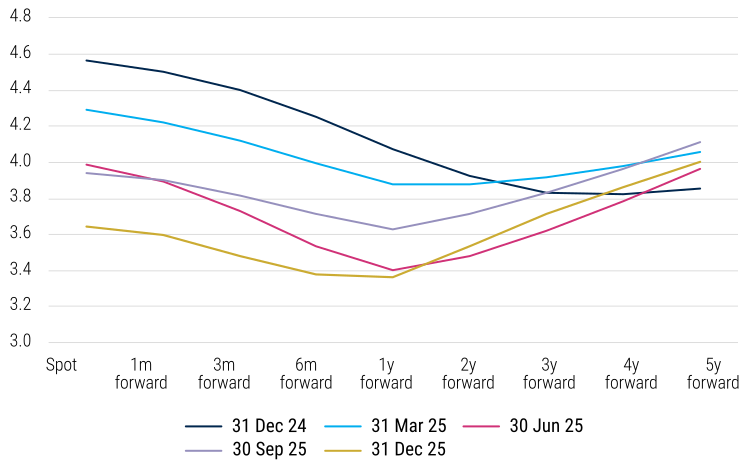
The market’s view of where long-term rates could move to in the future is encapsulated in forward rates. The chart below shows where the six-month SONIA swap rate is currently (spot) and at various forward rates out to five years.  The Bank of England have progressed on the rate cutting journey, helped by lower than anticipated inflation, and the view is that rate cuts will be limited from this point, marking close to the end of this cycle.  One-year forward rate expectations have reversed the move from the prior quarter.

Figure 1: Six-month SONIA rate
Source: Barclays Live, as at 31st December 2025

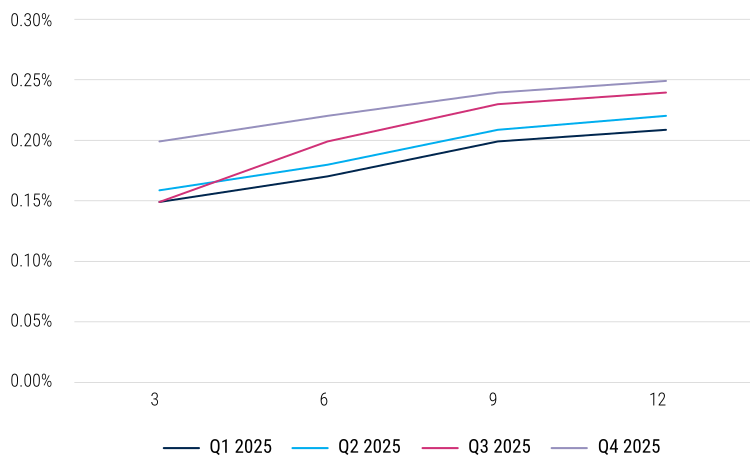
Repo rates are expressed relative to SONIA, and the chart below displays the average repo rates that we have achieved over the past four quarters for three, six, nine and 12-month repos, shown as a spread to average SONIA levels at the time.  Repo costs are slowly creeping upwards as quantitative tightening continues to drain liquidity from the market.  This was exacerbated by year end window dressing of balance sheets by bank counterparties, reducing the availability of repo (and increasing the cost) into year end.  There was some nervousness in the market as the US Fed restarted its Quantitative Easing programme of $40bn to buy Treasury bills – with the stated purpose to ease strain in funding markets.  This was a quick turnaround from halting its quantitative tightening programme less than a month before.  Governor Bailey of the Bank of England reiterated the focus on reducing their balance sheet to pivot to repo market operations as its primary tool for managing market liquidity and stability.  Through judicious use of axes and netted repo opportunities, Columbia Threadneedle Investments were able to access attractively tight repo spreads, thereby keeping the costs incurred by our clients down. 

Figure 2: Spread to SONIA
Source: Columbia Threadneedle Investments, as at 31st December 2025

In September, the Bank of England released a consultation paper regarding the structure of the repo market.  Recent events such as the March 2020 “dash for cash” at the start of the COVID pandemic put strain on the repo markets, such that some participants were unable to obtain requisite funding.  Further investigation into such points of market stress was undertaken in the system-wide exploratory scenario (SWES) led by the Bank of England.   The paper aims to investigate potential reforms to the market which could enhance the resilience of the repo market.  There are two main areas of focus: greater central clearing of repos and/or minimum haircuts for bilateral repo transactions.  There is much to consider within this exploratory discussion, both in terms of potential reforms and how they may impact the market and the consequences therein. However, given the desire for the Bank of England to use repo operations as their key tool, it is important to maintain liquidity and access without creating inefficiencies that may hinder transmission of their policies.

Credit Repo

Following the gilt crisis in 2022, we are seeing interest from clients in credit repo and an appetite from more and more banks to support the same.  Credit repo allows portfolios with directly held credit to raise cash to support hedging without selling their credit once their gilt positions are depleted.  Pricing is highly bank and bond dependent and as a corollary can also be ‘special’ or in high demand.  Specials in the corporate bond market are typically fleeting rather than persistent as is seen in the gilt market and, as such, credit repo should be thought of as a short-term contingency solution rather than a long-term funding tool.  However, it is a beneficial addition to the toolbox and something we are putting in place for relevant portfolios.  It has now grown from a niche offering to one with relatively widespread availability; however, pricing and appetite varies considerably, necessitating engagement to ensure the appropriate access to counterparties in the event of credit repo being needed.  An alternative to credit repo is to margin gilt repo with corporate bonds; however, for this to have use in a crisis it means paying the cost of the less liquid collateral on an ongoing basis, thereby increasing the overall cost of funding in the portfolio.

Alternate Funding

Repo funding generally remains cheaper for creating leveraged exposure to gilts over the lifetime than the equivalent total return swap (TRS) and so continues to be used within our LDI portfolios.  However, pricing for total return swaps can be very bond specific and, where the bank counterparty can obtain an exact netted position, the rate can be extremely competitive. TRS can be longer dated, with maturities ranging from one to three years and even five years, as compared to repo which typically vary in term from one to 12 months. Hence, TRS can be beneficial for locking in funding costs for longer and for minimising the roll risk associated with shorter-term repo contracts. On the other hand, repo facilitates tactical portfolio adjustments more easily and tends to be slightly cheaper. We ensure portfolios have access to both repo and TRS for leveraged gilt funding, so we can strike the right balance between cost, flexibility, and minimisation of roll risk. It is essential to maintain a range of counterparties to manage the funding requirements of a pension fund. We have legal documentation in place with a diversified suite of 24 counterparties for GMRA (Global Master Repo Agreement) and ISDA (International Swaps and Derivatives Association).

Indicative current pricing shows leverage via gilt TRS for a six-month tenor is very bank dependent but is on average similar to repo – this depends on the bank’s view of the repo market and whether they are impacted by Net Stable Funding Ratio regulations (NSFR).  Part of the reason for higher costs for TRS is a reflection of the lack of straight-through-processing available.  Columbia Threadneedle are engaging with various market providers and participants to redefine TRS and the way it is traded and confirmed.   

Another way to obtain leverage in a portfolio is to leverage the equity holdings via an equity total return swap (or equity futures). An equity TRS on the FTSE 100 (where the client receives the equity returns) would indicatively price around 0.20% higher than the repo (also as a spread to six-month SONIA).  Clearly, this pricing can vary considerably from bank to bank and at different times due to positioning, which gives the potential for opportunistic diversification of leverage. 

Contingent NBFI Repo Facility (CNRF)

We welcome the efforts of the Bank of England to create a repo facility for Non-Bank Financial Institutions (NBFIs) – known as the Contingent NBFI Repo Facility (CNRF).  In January the Bank of England released more details of the facility and eligibility criteria.  At the outset the client or fund must own over £2bn of gilts, there is a concentration limit of £500m of a specific gilt and each client has a borrowing limit of 50% of gilt holdings rounded to the nearest billion.  Participants will need to pay an annual fee for access as well as committing to participate in periodic test trades and providing regular information to the Bank.   Technically, the facility will be structured as a secured borrowing arrangement rather than a traditional repo so investors will need to ensure they have the appropriate permissions for regular borrowing to use the facility.  Please get in touch if you would like to know more about this facility.

Key topics

Subscribe to insights

Get the most out of your email by tailoring the types of insights and information you would like to receive from us.

Latest articles

How geopolitical shifts and policies are shaping market dynamics.
Corporate governance reforms, capital reallocation and attractive valuations create a compelling multi-year investment thesis.
US ambitions in Greenland, and the subsequent levying of tariffs on nonsupportive European nations, have dominated headlines.
Share article
Key topics
Related topics

Important information

For use by professional clients and/or equivalent investor types in your jurisdiction (not to be used with or passed on to retail clients).


This document is intended for informational purposes only and should not be considered representative of any particular investment. This should not be considered an offer or solicitation to buy or sell any securities or other financial instruments, or to provide investment advice or services. Investing involves risk including the risk of loss of principal. Your capital is at risk. Market risk may affect a single issuer, sector of the economy, industry or the market as a whole. The value of investments is not guaranteed, and therefore an investor may not get back the amount invested. International investing involves certain risks and volatility due to potential political, economic or currency fluctuations and different financial and accounting standards. The securities included herein are for illustrative purposes only, subject to change and should not be construed as a recommendation to buy or sell. Securities discussed may or may not prove profitable. The views expressed are as of the date given, may change as market or other conditions change and may differ from views expressed by other Columbia Threadneedle Investments (Columbia Threadneedle) associates or affiliates. Actual investments or investment decisions made by Columbia Threadneedle and its affiliates, whether for its own account or on behalf of clients, may not necessarily reflect the views expressed. This information is not intended to provide investment advice and does not take into consideration individual investor circumstances. Investment decisions should always be made based on an investor’s specific financial needs, objectives, goals, time horizon and risk tolerance. Asset classes described may not be suitable for all investors. Past performance does not guarantee future results, and no forecast should be considered a guarantee either. Information and opinions provided by third parties have been obtained from sources believed to be reliable, but accuracy and completeness cannot be guaranteed. This document and its contents have not been reviewed by any regulatory authority.

In Australia: Issued by Threadneedle Investments Singapore (Pte.) Limited [“TIS”], ARBN 600 027 414. TIS is exempt from the requirement to hold an Australian financial services licence under the Corporations Act and relies on Class Order 03/1102 in marketing and providing financial services to Australian wholesale clients as defined in Section 761G of the Corporations Act 2001. TIS is regulated in Singapore (Registration number: 201101559W) by the Monetary Authority of Singapore under the Securities and Futures Act (Chapter 289), which differ from Australian laws.


In Singapore: Issued by Threadneedle Investments Singapore (Pte.) Limited, 3 Killiney Road, #07-07, Winsland House 1, Singapore 239519, which is regulated in Singapore by the Monetary Authority of Singapore under the Securities and Futures Act (Chapter 289). Registration number: 201101559W. This advertisement has not been reviewed by the Monetary Authority of Singapore.


In Hong Kong: Issued by Threadneedle Portfolio Services Hong Kong Limited 天利投資管理香港有限公司. Unit 3004, Two Exchange Square, 8 Connaught Place, Hong Kong, which is licensed by the Securities and Futures Commission (“SFC”) to conduct Type 1 regulated activities (CE:AQA779). Registered in Hong Kong under the Companies Ordinance (Chapter 622), No. 1173058.

In Japan: Issued by Columbia Threadneedle Investments Japan Co., Ltd. Financial Instruments Business Operator, The Director-General of Kanto Local Finance Bureau (FIBO) No.3281, and a member of Japan Investment Advisers Association and Type II Financial Instruments Firms Association.


In UK: Issued by Threadneedle Asset Management Limited. Registered in England and Wales, Registered No. 573204, Cannon Place, 78 Cannon Street, London EC4N 6AG, United Kingdom. Authorised and regulated in the UK by the Financial Conduct Authority.


In the EEA: Issued by Threadneedle Management Luxembourg S.A. Registered with the Registre de Commerce et des Societes (Luxembourg), Registered No. B 110242, 44, rue de la Vallée, L-2661 Luxembourg, Grand Duchy of Luxembourg.


In Switzerland: Issued by Threadneedle Portfolio Services AG, Registered address: Claridenstrasse 41, 8002 Zurich, Switzerland.


This document is distributed by Columbia Threadneedle Investments (ME) Limited, which is regulated by the Dubai Financial Services Authority (DFSA). For Distributors: This document is intended to provide distributors’ with information about Group products and services and is not for further distribution. For Institutional Clients: The information in this document is not intended as financial advice and is only intended for persons with appropriate investment knowledge and who meet the regulatory criteria to be classified as a Professional Client or Market Counterparties and no other Person should act upon it.


Columbia Threadneedle Investments is the global brand name of the Columbia and Threadneedle group of companies.

Related Insights

3 December 2025

Luke Copley

Client Portfolio Manager, Fixed Income

Jason Callan

Co-Head of Structured Assets, Senior Portfolio Manager

Ryan Osborn

Co-Head of Structured Assets, Senior Portfolio Manager

LDI focus: Diversification benefits of US securitised credit

US securitised assets offer diversification benefits in a marketplace that offers attractive yields for its high-quality nature. When blended into LDI portfolios there is opportunity to enhance collateral waterfall resilience while improving risk/return dynamics.
18 November 2025

LDI market review and outlook – October 2025, what next for Europe?

In the quarterly Columbia Threadneedle Investments EURO LDI Survey, we poll investment bank trading desks for their opinions on the likely direction of key rates for liability hedging
12 November 2025

Rosa Fenwick

Head of LDI Implementation

LDI market review and outlook – October 2025, where next for central banks?

Tariffs have largely faded into the background as central bank activity and fiscal sustainability concerns came to the fore. We review recent developments and explore what’s next.
22 January 2026

Daisuke Nomoto

Global Head of Japanese Equities

Simon Morton-Grant

Client Portfolio Manager

The early innings: Why Japan's structural story has years to run

Corporate governance reforms, capital reallocation and attractive valuations create a compelling multi-year investment thesis.
20 January 2026

In Credit Weekly Snapshot – It’s not easy being Greenland

US ambitions in Greenland, and the subsequent levying of tariffs on nonsupportive European nations, have dominated headlines.
20 January 2026

Gary Smith

Head of EMEA Client Portfolio Manager team, Fixed Income

Luke Copley

Client Portfolio Manager, Fixed Income

Why investors should choose active for fixed income

Passive fixed income strategies may look efficient, but their structural flaws have long created opportunities for active managers to shine.

Important information

For use by professional clients and/or equivalent investor types in your jurisdiction (not to be used with or passed on to retail clients).


This document is intended for informational purposes only and should not be considered representative of any particular investment. This should not be considered an offer or solicitation to buy or sell any securities or other financial instruments, or to provide investment advice or services. Investing involves risk including the risk of loss of principal. Your capital is at risk. Market risk may affect a single issuer, sector of the economy, industry or the market as a whole. The value of investments is not guaranteed, and therefore an investor may not get back the amount invested. International investing involves certain risks and volatility due to potential political, economic or currency fluctuations and different financial and accounting standards. The securities included herein are for illustrative purposes only, subject to change and should not be construed as a recommendation to buy or sell. Securities discussed may or may not prove profitable. The views expressed are as of the date given, may change as market or other conditions change and may differ from views expressed by other Columbia Threadneedle Investments (Columbia Threadneedle) associates or affiliates. Actual investments or investment decisions made by Columbia Threadneedle and its affiliates, whether for its own account or on behalf of clients, may not necessarily reflect the views expressed. This information is not intended to provide investment advice and does not take into consideration individual investor circumstances. Investment decisions should always be made based on an investor’s specific financial needs, objectives, goals, time horizon and risk tolerance. Asset classes described may not be suitable for all investors. Past performance does not guarantee future results, and no forecast should be considered a guarantee either. Information and opinions provided by third parties have been obtained from sources believed to be reliable, but accuracy and completeness cannot be guaranteed. This document and its contents have not been reviewed by any regulatory authority.

In Australia: Issued by Threadneedle Investments Singapore (Pte.) Limited [“TIS”], ARBN 600 027 414. TIS is exempt from the requirement to hold an Australian financial services licence under the Corporations Act and relies on Class Order 03/1102 in marketing and providing financial services to Australian wholesale clients as defined in Section 761G of the Corporations Act 2001. TIS is regulated in Singapore (Registration number: 201101559W) by the Monetary Authority of Singapore under the Securities and Futures Act (Chapter 289), which differ from Australian laws.


In Singapore: Issued by Threadneedle Investments Singapore (Pte.) Limited, 3 Killiney Road, #07-07, Winsland House 1, Singapore 239519, which is regulated in Singapore by the Monetary Authority of Singapore under the Securities and Futures Act (Chapter 289). Registration number: 201101559W. This advertisement has not been reviewed by the Monetary Authority of Singapore.


In Hong Kong: Issued by Threadneedle Portfolio Services Hong Kong Limited 天利投資管理香港有限公司. Unit 3004, Two Exchange Square, 8 Connaught Place, Hong Kong, which is licensed by the Securities and Futures Commission (“SFC”) to conduct Type 1 regulated activities (CE:AQA779). Registered in Hong Kong under the Companies Ordinance (Chapter 622), No. 1173058.

In Japan: Issued by Columbia Threadneedle Investments Japan Co., Ltd. Financial Instruments Business Operator, The Director-General of Kanto Local Finance Bureau (FIBO) No.3281, and a member of Japan Investment Advisers Association and Type II Financial Instruments Firms Association.


In UK: Issued by Threadneedle Asset Management Limited. Registered in England and Wales, Registered No. 573204, Cannon Place, 78 Cannon Street, London EC4N 6AG, United Kingdom. Authorised and regulated in the UK by the Financial Conduct Authority.


In the EEA: Issued by Threadneedle Management Luxembourg S.A. Registered with the Registre de Commerce et des Societes (Luxembourg), Registered No. B 110242, 44, rue de la Vallée, L-2661 Luxembourg, Grand Duchy of Luxembourg.


In Switzerland: Issued by Threadneedle Portfolio Services AG, Registered address: Claridenstrasse 41, 8002 Zurich, Switzerland.


This document is distributed by Columbia Threadneedle Investments (ME) Limited, which is regulated by the Dubai Financial Services Authority (DFSA). For Distributors: This document is intended to provide distributors’ with information about Group products and services and is not for further distribution. For Institutional Clients: The information in this document is not intended as financial advice and is only intended for persons with appropriate investment knowledge and who meet the regulatory criteria to be classified as a Professional Client or Market Counterparties and no other Person should act upon it.


Columbia Threadneedle Investments is the global brand name of the Columbia and Threadneedle group of companies.

Thank you. You can now visit your preference centre to choose which insights you would like to receive by email.

To view and control which insights you receive from us by email, please visit your preference centre.

Woman listens to music through headphones
Play Video

CT Property Trust- Fund Manager Update

Sed ut perspiciatis unde omnis iste natus error sit voluptatem accusantium doloremque laudantium