




Insights
The baked-in inefficiencies of passive benchmark trackers have always provided a source of alpha opportunities for active fixed income managers. As investment risks and market dynamics evolve in 2026, the role of passive trackers as “observers”, and active risk managers as “navigators”, may become even more clearcut.
We start the year with an intriguing market backdrop. Competition for capital is heating up, government deficits are growing larger, and public credit markets will be tested with a wave of new supply from the broadening of AI-related investment.
The adoption and roll-out of AI technologies will drive a broadening of the capex cycle beyond technology sector investment and into areas such as networking infrastructure (telecommunications), energy capacity (utilities), data centre storage (real estate), as well as various manufacturing processes.
Traditional businesses in other sectors, with less existing rating headroom, may find that their bond supply requires a greater spread premium, which may lead to more yield spread volatility. Issuers may mitigate this by innovating bond features or their capital structure – hybrid issuance could grow further, and we may see renewable-linked financing for AI-energy projects. An active manager can take a risk-based view on this evolving capex cycle, especially as we gain insights into sector concentration and quantity of new issuance.
Finally, the rapid growth in private credit is expected to continue, and the news flow associated with this may contribute to a more volatile investment environment for wider credit markets.
With that in mind, how might investors go about successfully navigating such an environment? For us it’s a straightforward answer: those who want credit exposure should opt for an active manager. Here are four key reasons for choosing active over passive in fixed income.
Market-cap weighting is a function of bond price multiplied by the amount of outstanding debt. This means that the most indebted issuers have the largest index representation – regardless of credit quality. Index tracking funds will replicate this exposure without adjusting for risk and be forced to build more exposure to the weaker names who issue more debt.
Index construction bias can also drive suboptimal trends at the sector level. For example, sectors experiencing rapid growth in leverage – for example, technology in 2001 or banks in 2008 – grow as a share of benchmark weight, leaving passive investors most exposed just at the moment of maximum crisis. As a sector de-levers during its recovery stage, its market-cap shrinks, and passive investors will also under-participate in the bounce back. A double whammy.
The most impactful index inclusion rule is based on credit rating. Most indices will differentiate between investment grade and high yield-rated securities, creating different index families for these two cohorts. Passive trackers often treat the two universes as different asset classes, which can lead to sub-optimal outcomes.
When a bond is downgraded to high yield (known as a “fallen angel”), it is removed from investment grade indices at the next rebalancing date (usually month-end). This forces passive funds to sell, regardless of price or fundamental outlook. This can lead to price dislocations if a wave of simultaneous selling by passive trackers occurs. Fallen angels often initially trade at depressed levels due to this index-induced flow.
Conversely, when a bond is upgraded to investment grade (a “rising star”), passive funds have to buy, often after the price has already appreciated. This can lead to momentum-driven price behaviour, which can benefit active managers who have anticipated such upgrades.
These passive flows are driven by rules, not fundamentals. Active managers can exploit this by avoiding forced selling and buying events and accessing fallen angels or rising stars at more opportune pricing moments.
The first step to outperforming in investment grade is avoidance of capital loss related to downgrade and default. Passive trackers will own all downgrades and defaults.
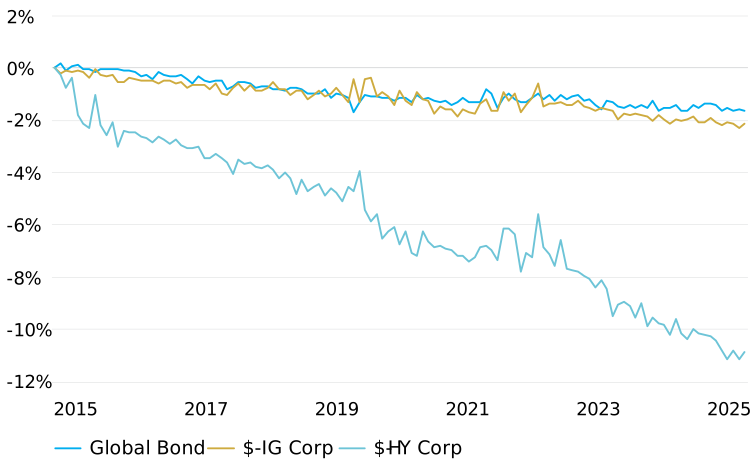
Fixed income indices incur frequent turnover due to their inclusion rules (for example, credit migration) as well as new issuance and maturities. A global credit index typically experiences around 15%-25% average turnover per year. Index tracker funds will follow this rebalancing, incurring the associated transactional costs. Since indices are “frictionless” (ie their return calculations do not fully reflect the bid/offer spreads of buying and selling securities), tracking funds have a bias to structurally underperform their benchmark due to these costs and fees.
Active funds can choose which benchmark turnover events to participate in, and time their rebalancing ahead of potential index moves. The alpha generated by an active approach should offset the drag imposed by costs and fees.
Source: Bloomberg, largest ETF vehicles per asset class chosen (BNDX, LQD, JNK) as of 30 November 2025.
A passive investor will not be able to readily control the evolving market risk/beta exposure of an index universe, which can trend through time with significant changes. Over the past 20 years, global credit benchmarks have seen a downward rating migration from AA/A to A/BBB, and index duration risk extend by up to two years in the post-Covid period. In short, benchmarks do not provide stable beta exposure.
Active management can help mitigate against trending risk factors and allow for pre-emptive consultation on how to adapt investment guidelines or return ambitions for changes in asset class dynamics.
In aggregate, the 2026 fiscal deficit for G7 governments is forecast to be 5.1% (according to Bloomberg consensus economic surveys). This will provide an additional test for bond markets – increased supply, deteriorating debt fundamentals, and the potential for government borrowing to crowd-out private sector borrowing.
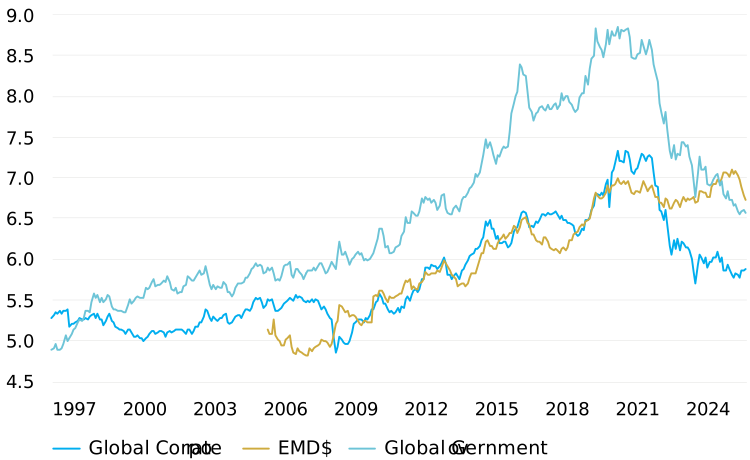
The inflationary cycle post-Covid has brought duration risk into sharp focus. Many fixed income sectors – from corporate credit to emerging market sovereign bonds – have seen duration risk make a significant contribution to their total return outcomes (Figure 2). In order to optimise total returns for active portfolios, active duration and active yield curve risks should also be considered.
Source: Bloomberg, ICE indices (G0BC, W0G1, WSBV) as of 30 November 2025.
Major fixed income indices are typically both market-capitalisation-weighted in terms of construction and have strict rules-based inclusion criteria. In passive trackers, these features drive inefficiencies such as forced buying and selling, an over-exposure to indebted issuers, and uncontrolled turnover. This results in performance leakage because costs and fees detract from index returns.
A typical investment grade borrower may have dozens of bonds outstanding. These bonds will vary in terms of maturity date, seniority within the capital structure, yield relationship to other bonds from the same issuer, and even in terms of currency denomination. This complexity is an opportunity for an active manager and should help a research-driven manager to deliver both superior total returns and a more efficient utilisation of risk.
Ahead of an uncertain outlook for global markets in 2026, the argument for working with active navigators rather than passive observers is compelling.
Key topics



For use by professional clients and/or equivalent investor types in your jurisdiction (not to be used with or passed on to retail clients). For marketing purposes.
This document is intended for informational purposes only and should not be considered representative of any particular investment. This should not be considered an offer or solicitation to buy or sell any securities or other financial instruments, or to provide investment advice or services. Investing involves risk including the risk of loss of principal. Your capital is at risk. Market risk may affect a single issuer, sector of the economy, industry or the market as a whole. The value of investments is not guaranteed, and therefore an investor may not get back the amount invested. International investing involves certain risks and volatility due to potential political, economic or currency fluctuations and different financial and accounting standards. The securities included herein are for illustrative purposes only, subject to change and should not be construed as a recommendation to buy or sell. Securities discussed may or may not prove profitable. The views expressed are as of the date given, may change as market or other conditions change and may differ from views expressed by other Columbia Threadneedle Investments (Columbia Threadneedle) associates or affiliates. Actual investments or investment decisions made by Columbia Threadneedle and its affiliates, whether for its own account or on behalf of clients, may not necessarily reflect the views expressed. This information is not intended to provide investment advice and does not take into consideration individual investor circumstances. Investment decisions should always be made based on an investor’s specific financial needs, objectives, goals, time horizon and risk tolerance. Asset classes described may not be suitable for all investors. Past performance does not guarantee future results, and no forecast should be considered a guarantee either. Information and opinions provided by third parties have been obtained from sources believed to be reliable, but accuracy and completeness cannot be guaranteed. This document and its contents have not been reviewed by any regulatory authority.
In Australia: Issued by Threadneedle Investments Singapore (Pte.) Limited [“TIS”], ARBN 600 027 414. TIS is exempt from the requirement to hold an Australian financial services licence under the Corporations Act 2001 (Cth) and relies on Class Order 03/1102 in respect of the financial services it provides to wholesale clients in Australia. This document should only be distributed in Australia to “wholesale clients” as defined in Section 761G of the Corporations Act. TIS is regulated in Singapore (Registration number: 201101559W) by the Monetary Authority of Singapore under the Securities and Futures Act (Chapter 289), which differ from Australian laws.
In Singapore: Issued by Threadneedle Investments Singapore (Pte.) Limited, 3 Killiney Road, #07-07, Winsland House 1, Singapore 239519, which is regulated in Singapore by the Monetary Authority of Singapore under the Securities and Futures Act (Chapter 289). Registration number: 201101559W. This advertisement has not been reviewed by the Monetary Authority of Singapore.
In Hong Kong: Issued by Threadneedle Portfolio Services Hong Kong Limited 天利投資管理香港有限公司. Unit 3004, Two Exchange Square, 8 Connaught Place, Hong Kong, which is licensed by the Securities and Futures Commission (“SFC”) to conduct Type 1 regulated activities (CE:AQA779). Registered in Hong Kong under the Companies Ordinance (Chapter 622), No. 1173058.
In Japan: Issued by Columbia Threadneedle Investments Japan Co., Ltd. Financial Instruments Business Operator, The Director-General of Kanto Local Finance Bureau (FIBO) No.3281, and a member of Japan Investment Advisers Association and Type II Financial Instruments Firms Association.
In the UK: Issued by Threadneedle Asset Management Limited, No. 573204 and/or Columbia Threadneedle Management Limited, No. 517895, both registered in England and Wales and authorised and regulated in the UK by the Financial Conduct Authority.
In the EEA: Issued by Threadneedle Management Luxembourg S.A., registered with the Registre de Commerce et des Sociétés (Luxembourg), No. B 110242 and/or Columbia Threadneedle Netherlands B.V., regulated by the Dutch Authority for the Financial Markets (AFM), registered No. 08068841.
In Switzerland: Issued by Threadneedle Portfolio Services AG, Registered address: Claridenstrasse 41, 8002 Zurich, Switzerland.
In the Middle East: This document is distributed by Columbia Threadneedle Investments (ME) Limited, which is regulated by the Dubai Financial Services Authority (DFSA). For Distributors: This document is intended to provide distributors with information about Group products and services and is not for further distribution. For Institutional Clients: The information in this document is not intended as financial advice and is only intended for persons with appropriate investment knowledge and who meet the regulatory criteria to be classified as a Professional Client or Market Counterparties and no other Person should act upon it.
This document may be made available to you by an affiliated company which is part of the Columbia Threadneedle Investments group of companies: Columbia Threadneedle Management Limited in the UK; Columbia Threadneedle Netherlands B.V., regulated by the Dutch Authority for the Financial Markets (AFM), registered No. 08068841.
Columbia Threadneedle Investments is the global brand name of the Columbia and Threadneedle group of companies. © 2026 Columbia Threadneedle. All rights reserved. columbiathreadneedle.com
For use by professional clients and/or equivalent investor types in your jurisdiction (not to be used with or passed on to retail clients). For marketing purposes.
This document is intended for informational purposes only and should not be considered representative of any particular investment. This should not be considered an offer or solicitation to buy or sell any securities or other financial instruments, or to provide investment advice or services. Investing involves risk including the risk of loss of principal. Your capital is at risk. Market risk may affect a single issuer, sector of the economy, industry or the market as a whole. The value of investments is not guaranteed, and therefore an investor may not get back the amount invested. International investing involves certain risks and volatility due to potential political, economic or currency fluctuations and different financial and accounting standards. The securities included herein are for illustrative purposes only, subject to change and should not be construed as a recommendation to buy or sell. Securities discussed may or may not prove profitable. The views expressed are as of the date given, may change as market or other conditions change and may differ from views expressed by other Columbia Threadneedle Investments (Columbia Threadneedle) associates or affiliates. Actual investments or investment decisions made by Columbia Threadneedle and its affiliates, whether for its own account or on behalf of clients, may not necessarily reflect the views expressed. This information is not intended to provide investment advice and does not take into consideration individual investor circumstances. Investment decisions should always be made based on an investor’s specific financial needs, objectives, goals, time horizon and risk tolerance. Asset classes described may not be suitable for all investors. Past performance does not guarantee future results, and no forecast should be considered a guarantee either. Information and opinions provided by third parties have been obtained from sources believed to be reliable, but accuracy and completeness cannot be guaranteed. This document and its contents have not been reviewed by any regulatory authority.
In Australia: Issued by Threadneedle Investments Singapore (Pte.) Limited [“TIS”], ARBN 600 027 414. TIS is exempt from the requirement to hold an Australian financial services licence under the Corporations Act 2001 (Cth) and relies on Class Order 03/1102 in respect of the financial services it provides to wholesale clients in Australia. This document should only be distributed in Australia to “wholesale clients” as defined in Section 761G of the Corporations Act. TIS is regulated in Singapore (Registration number: 201101559W) by the Monetary Authority of Singapore under the Securities and Futures Act (Chapter 289), which differ from Australian laws.
In Singapore: Issued by Threadneedle Investments Singapore (Pte.) Limited, 3 Killiney Road, #07-07, Winsland House 1, Singapore 239519, which is regulated in Singapore by the Monetary Authority of Singapore under the Securities and Futures Act (Chapter 289). Registration number: 201101559W. This advertisement has not been reviewed by the Monetary Authority of Singapore.
In Hong Kong: Issued by Threadneedle Portfolio Services Hong Kong Limited 天利投資管理香港有限公司. Unit 3004, Two Exchange Square, 8 Connaught Place, Hong Kong, which is licensed by the Securities and Futures Commission (“SFC”) to conduct Type 1 regulated activities (CE:AQA779). Registered in Hong Kong under the Companies Ordinance (Chapter 622), No. 1173058.
In Japan: Issued by Columbia Threadneedle Investments Japan Co., Ltd. Financial Instruments Business Operator, The Director-General of Kanto Local Finance Bureau (FIBO) No.3281, and a member of Japan Investment Advisers Association and Type II Financial Instruments Firms Association.
In the UK: Issued by Threadneedle Asset Management Limited, No. 573204 and/or Columbia Threadneedle Management Limited, No. 517895, both registered in England and Wales and authorised and regulated in the UK by the Financial Conduct Authority.
In the EEA: Issued by Threadneedle Management Luxembourg S.A., registered with the Registre de Commerce et des Sociétés (Luxembourg), No. B 110242 and/or Columbia Threadneedle Netherlands B.V., regulated by the Dutch Authority for the Financial Markets (AFM), registered No. 08068841.
In Switzerland: Issued by Threadneedle Portfolio Services AG, Registered address: Claridenstrasse 41, 8002 Zurich, Switzerland.
In the Middle East: This document is distributed by Columbia Threadneedle Investments (ME) Limited, which is regulated by the Dubai Financial Services Authority (DFSA). For Distributors: This document is intended to provide distributors with information about Group products and services and is not for further distribution. For Institutional Clients: The information in this document is not intended as financial advice and is only intended for persons with appropriate investment knowledge and who meet the regulatory criteria to be classified as a Professional Client or Market Counterparties and no other Person should act upon it.
This document may be made available to you by an affiliated company which is part of the Columbia Threadneedle Investments group of companies: Columbia Threadneedle Management Limited in the UK; Columbia Threadneedle Netherlands B.V., regulated by the Dutch Authority for the Financial Markets (AFM), registered No. 08068841.
Columbia Threadneedle Investments is the global brand name of the Columbia and Threadneedle group of companies. © 2026 Columbia Threadneedle. All rights reserved. columbiathreadneedle.com

Sed ut perspiciatis unde omnis iste natus error sit voluptatem accusantium doloremque laudantium