


Filter insights on this page
Repo rates are expressed relative to SONIA, and the chart below displays the average repo rates that we have achieved over the past four quarters for three, six, nine and 12-month repos, shown as a spread to average SONIA levels at the time. The volatility and market uncertainty that resulted from the mini-Budget also weighed upon funding markets, particularly for shorter dated trades as can be seen from the achieved spreads below. Note that during the fourth quarter of 2022 no repos were traded with a 12m tenor so the chart reflects the previous quarter’s value.
Capabilities
Media type
Themes
Figure 2: Change in swap rates over the next quarter
The secondary impact of the mini-Budget crisis centred around collateral and the velocity of movement; rather than a lack of balance sheet for repo funding (a la March 2020). Yet, the difficulties around collateral substitutions and settlements did in many cases prompt a review by individual banks’ credit officers, resulting in a temporary reduction or hiatus in repo balance sheet provision in some cases. Once these reviews were completed balance sheet availability opened up again – some with the addition of haircuts to provide additional protection to the bank. Of course, the momentous lack of certainty in the future path of interest rates also impacted the typical repo spread to SONIA as trading a fixed rate forced the banks to take a conservative view on where yields could reach.
The funding ratio index published by the Pension Protection Fund showed a slight decrease in funding levels quarter-on-quarter (124.7% at end March vs 125.7% at end December). Higher yields benefitted the liability side of the equation, however the dramatic fall in equities weighed upon funding ratios. High hedging levels mean that schemes saw only a modest gain from the higher yields but still retain some exposure to equities.
Market Outlook
Source: Columbia Threadneedle Investments. As at 31 March 2025
Inflation hedging rose by 12% quarter on quarter, whilst interest rate hedging activity increased by 27% from the previous quarter.
All data and sources Columbia Threadneedle Management Limited, as at 30 June 2024 and Valid to: 30 September 2024
Regions

Europe faces the challenge of weaker growth, persistent inflation pressures and rising debt issuance. This is further complicated by rising political uncertainty with upcoming elections in France and Italy promoting additional yield premia. Meanwhile the ECB remains committed to its monetary tightening cycle despite the deteriorating economic backdrop.
Exogeneous geopolitical factors have buffeted Europe over the course of 2026, the Iran conflict impacting energy and production inputs and the war in Ukraine ramping up domestic defence commitments. This pressure on both sides of the supply and demand inflation equation threatened every central bank’s nightmare – that of stagflation, where the economy fails to grow but inflation runs rampant. Whilst the global (ex-US) discomfort with President Trump could presage a cycling of demand into European fixed income, this is counterbalanced by the expansion in issuance, not helped by the hyperscalers targeting Europe as the secondary liquidity centre outside the US. Issuance by these entities including Amazon, Alphabet, Meta, Microsoft and Oracle in the first half of 2026 has already massively exceeded that of the entire year of 2025. This wall of supply has put further pressure on long-term yields that are already sensitive to the changes to Dutch pension regulation. Whilst the picture is complicated by individual approaches to current and future hedging and timing choices, there is no doubt that demand for long-dated debt from Dutch schemes will decrease. This is the challenging backdrop to increased political risks as the season of elections approaches, including France and Italy.
French political instability dominated headlines last year as the revolving door of prime ministers managed to return a previous one, adopting a more conciliatory tone to fiscal reform to balance the complex parliamentary mathematics. This allowed other geopolitical considerations to take centre stage – yet with no end in sight to either the Ukraine or Iran conflict, eyes have returned to the situation in France. The centrists will be hoping that this election will restore their position allowing greater ambition in reducing spending; however, on current polling that appears unlikely. The Le Pen appeal may have succeeded in shortening the ban from public office allowing her to run in the coming elections; however, the conviction for public funds embezzlement was upheld – hardly a ringing endorsement of an ambitious public figure with sights on the presidency. The base case scenario for many political commentators is a run-off between the far-right and the far-left. That may be a binary choice in politics, but both parties have limited interest in curbing the growth of the state so may end up being relatively similar from a market perspective. As a consequence, the yield that investors need to receive to hold French debt versus German debt has increased to levels last seen during the height of recent political crises, indicating markets have already priced in political and fiscal risks. However, French yields could remain under pressure, particularly amid extended uncertainty over budget negotiations. The chart below shows that 10-year French debt has a higher yield versus swaps than Italy. Anecdotally it is believed that hedge fund positioning in French relative value spreads is short, implying further underperformance expected.
Relative value in Euro Governments
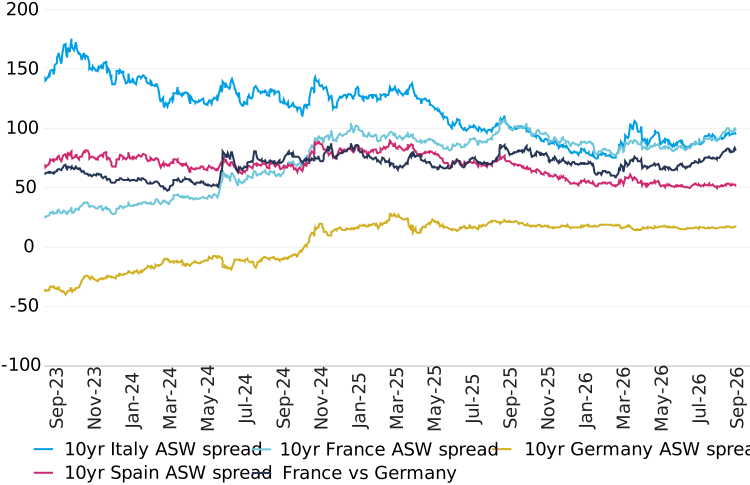
Chart 1: Movement in relative value of key Euro governments bonds
Source: Barclays Live. As at 4 September 2026
Italy, meanwhile, has remained somewhat under the radar but, as ever, the maths of coalitions can make outcomes hard to predict. The recent stability under the leadership of Prime Minister Giorgia Meloni in a centre-right coalition has helped, however the polling of that grouping is suffering in recent months, impacted by the success of a new right-wing party now polling of around 7% making it the fourth largest party. The general election is expected in April 2027, although it has not yet been announced.
Meanwhile the European Central Bank is firmly tackling the risks of inflation by committing to their hiking trajectory with the market pricing in a 99% likelihood of a rate hike at the September meeting at the time of writing and a 95% expectation of a further hike in December. This can be set against an ‘active’ hold in the UK and rhetoric rather than action in the US despite the new Fed Chair.
Market trends
Minimum reserve requirement (MRR)
The ECB is mulling an increase in the reserve requirements that banks are required to place at the central bank to ensure sufficient capital in the event of market turmoil. Proposals suggest that this reserve requirement could increase from 1% to 2%. Banks typically hold excess liquidity in the deposit facility so this does not appear designed to tackle a concern around bank reserves, rather, by redefining the requirement it would reduce interest costs for the ECB. This is because the required reserves attract a 0% interest return versus the deposit facility rate ~ expected savings are in the region of c. EUR 4bn at current rates. This move could also make room for the ECB to continue its hiking cycle whilst mitigating the cost. The consensus is that this would have limited but non-trivial implications for funding liquidity and short-term asset swap spreads as banks would endeavour to fill this return gap. The key expectation is that this is unlikely to materially impact outright yields. However, there are some more negative views, centring on the uneven distribution of excess reserves across the Eurozone’s banks and a concern that in the event of market upset this reduces liquidity just when it is needed most. It is also possible that this could worsen month- or quarter-end volatility in ESTR and repo rates – a key focus for central banks.
LCH margin requirements
LCH has noted a reduction in cash posted as collateral for margin. In the name of robust liquidity provisions, they therefore have enacted a 25% minimum cash collateral requirement for clearing members. As posting cash is inefficient, most client users of clearing services will post bonds to meet initial margin requirements, resulting in clearing members having to translate bond collateral into cash to meet this; thus, putting further pressure on the funding markets.
These developments contribute to the growing trend of higher demand for liquid assets which, if considered independently, could miss a broader impact on the stability of markets.
If you would like to discuss any of the matters raised above, please contact your client representative.