



Insights
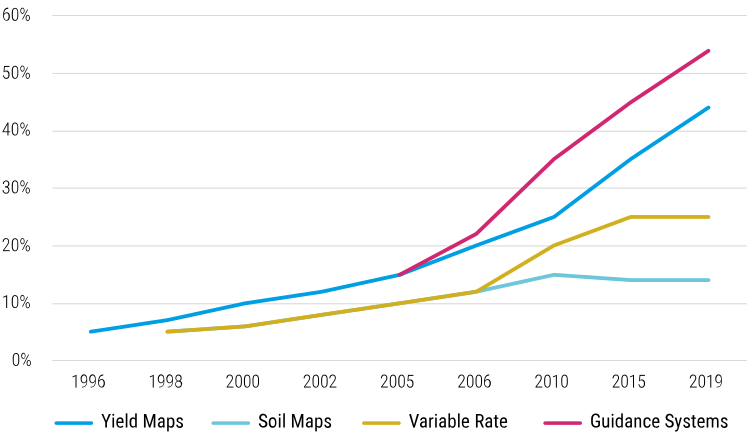
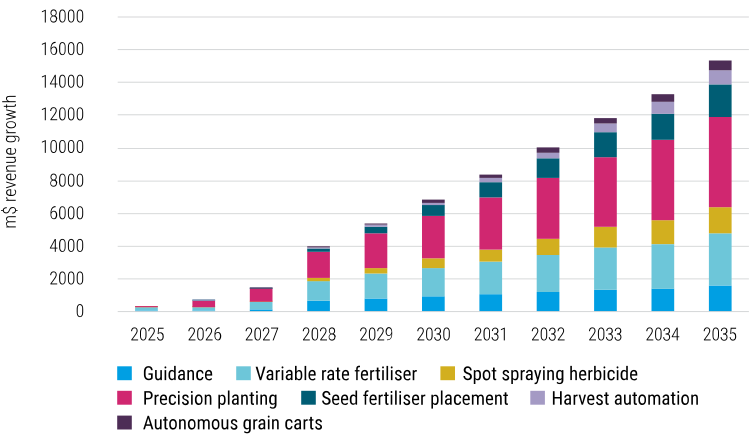
Global agriculture faces mounting pressures – from climate change and resource inefficiencies to demographic shifts – threatening food security and profitability. Yet these challenges are catalysing a transformative opportunity. Precision agriculture technologies, which optimise input use and automate operations, are poised to deliver both sustainability gains and compelling economic returns. Our analysis suggests adoption could unlock $15 billion in incremental agricultural equipment industry revenue by 2035, while improving yields and reducing chemical use. The adoption curve ahead signals a multi-decade opportunity for capital allocation into technologies that redefine agricultural efficiency and address myriad environmental impacts.
Source: Columbia Threadneedle Investments, November 2025.
Farm management software is simultaneously becoming more sophisticated, connecting field operations with administrative functions. These platforms integrate data from multiple sources to optimise decision-making and automate regulatory compliance tasks, creating additional value for farmers beyond hardware improvements.
Several converging factors support the increased adoption rate of precision agriculture technologies. Regulatory developments, particularly in Europe, are creating tailwinds by limiting agricultural chemical use and establishing clearer frameworks for autonomous equipment operation. Labour shortages are
simultaneously intensifying across major agricultural markets, with demographic trends and immigration policies further constraining labour availability
Source: Columbia Threadneedle Investments, November 2025
Farmer attitudes toward technology are also evolving, with younger producers more willing to adopt new solutions. Our analysis found that education levels and digital familiarity are strong predictors of precision agriculture adoption, both of which are on the rise among farm operators. Additionally, the growing support ecosystem of dealerships and advisors is helping farmers navigate the transition to more technologically advanced operations.
Market conditions for adoption vary significantly by region. Our analysis indicates North America and Western Europe will drive 76% of precision agriculture growth due to farm size, labour constraints, and regulatory environments. The United States, with its larger average farm size (463 acres) and high equipment spending per acre ($600-1,200), presents particularly favourable adoption conditions. Brazil is emerging as another key market as internet connectivity improves, with larger farm sizes in key regions like Mato Grosso and multiple annual cropping cycles supporting quicker payback periods for precision technology investments.
Precision agriculture represents a substantial growth opportunity for agricultural equipment manufacturers. Based on our analysis, related technologies could drive $11 billion (+14%) of incremental industry revenue by 2035 as equipment manufacturers capture 30-40% of farmer savings from yield increases and input efficiencies. This growth will fundamentally shift the economics of agricultural equipment, increasing the percentage of agricultural GDP spent on machinery from the historical average of 15% to 15.9% by 2030 and 18.3% by 2035.
Even more compelling is the margin impact of precision agriculture. Precision equipment solutions typically command gross margins 1.5-2x higher than conventional agricultural equipment. Deere’s large precision agriculture equipment achieves 45% gross margins compared to 30% across their overall business, while AGCO’s Precision Planting division operates at margins twice the company average. Our projections suggest precision agriculture could contribute a 4-9 percentage point improvement in gross margins for leading agricultural equipment makers by 2030, with variation depending on company positioning and strategy execution.
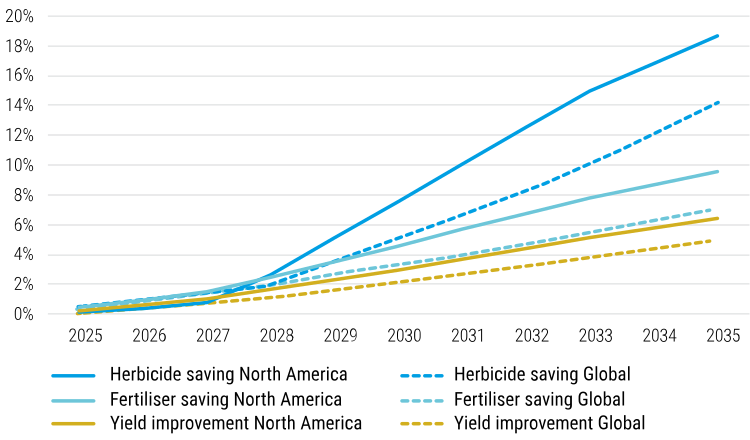
We estimate that global adoption of precision agriculture technologies will drive substantial environmental benefits. In our base case scenario for technology adoption, global herbicide application rates per hectare would be reduced by 14% by 2035 compared to 2024, fertiliser application rates reduced by 7% and yields improved by 5%.
Source: Columbia Threadneedle Investments, November 2025
We see three clear routes through which agricultural equipment manufacturers can capitalise further on this opportunity. First, they can enhance recurring revenue through pushing equipment-as-a-service models. For example, Deere aims to increase subscription fees to 10% of total revenue by 2030. Second, agricultural equipment companies can further commercialise their data platforms and sales to grow revenues. These companies have built up large user bases for their software platforms, with Deere already connecting 455 million acres. We believe that as additional functionality is built into these platforms, these companies can start charging subscription fees and partnering with different commercial data users. Finally, agricultural equipment companies can increasingly offer retrofit solutions to accelerate technology adoption by overcoming the slow replacement cycle of agricultural equipment. In North America, only 7% of planters and sprayers are replaced annually, but retrofits allow farmers to access precision technology without purchasing entirely new machinery. AGCO is particularly focused on the retrofit opportunity.
The convergence of technology advances, regulatory tailwinds, and shifting farmer demographics positions precision agriculture for accelerated adoption. Beyond improving operational efficiency and reducing environmental impact, these technologies offer attractive economics for equipment manufacturers, with highermargin products and recurring revenue streams set to reshape industry dynamics. Our analysis suggests precision agriculture could unlock billions in incremental revenue while delivering measurable sustainability gains.
Key topics



1 https://www.mdpi.com/2073-4441/16/21/3146#
2 https://www.sciencedirect.com/science/article/abs/pii/S0013935123019047
3 https://www.nature.com/articles/s41586-025-09085-w
4 https://www.academie-agriculture.fr/publications/notes-academiques/opinion-looking-back-causes-25-year-crop-yield-stagnation-europe
5 https://www.nass.usda.gov/Publications/Highlights/2024/Census22_HL_FarmProducers_FINAL.pdf
6 https://ec.europa.eu/eurostat/statistics-explained/index.php/Farmers_and_the_agricultural_labour_force_-_statistics
7 https://investors.agcocorp.com/static-files/97c1408c-6ee9-4f14-b532-f24d5a87c62b
8 https://mssoy.org/sites/default/files/2025-01/McFADDEN%20%20PA%20PROC%202024.pdf
9 https://www.mdpi.com/2073-4395/13/11/2812
10 https://www.cambridge.org/core/journals/weed-technology/article/comparing-herbicide-application-methods-with-see-spray-technology-in-soybean/05967C11D1BF0B174A13BE687B865AF2
11 https://www.rbgdr.net/revista/index.php/rbgdr/article/download/7333/1408/17643
For use by professional clients and/or equivalent investor types in your jurisdiction (not to be used with or passed on to retail clients). For marketing purposes.
This document is intended for informational purposes only and should not be considered representative of any particular investment. This should not be considered an offer or solicitation to buy or sell any securities or other financial instruments, or to provide investment advice or services. Investing involves risk including the risk of loss of principal. Your capital is at risk. Market risk may affect a single issuer, sector of the economy, industry or the market as a whole. The value of investments is not guaranteed, and therefore an investor may not get back the amount invested. International investing involves certain risks and volatility due to potential political, economic or currency fluctuations and different financial and accounting standards. The securities included herein are for illustrative purposes only, subject to change and should not be construed as a recommendation to buy or sell. Securities discussed may or may not prove profitable. The views expressed are as of the date given, may change as market or other conditions change and may differ from views expressed by other Columbia Threadneedle Investments (Columbia Threadneedle) associates or affiliates. Actual investments or investment decisions made by Columbia Threadneedle and its affiliates, whether for its own account or on behalf of clients, may not necessarily reflect the views expressed. This information is not intended to provide investment advice and does not take into consideration individual investor circumstances. Investment decisions should always be made based on an investor’s specific financial needs, objectives, goals, time horizon and risk tolerance. Asset classes described may not be suitable for all investors. Past performance does not guarantee future results, and no forecast should be considered a guarantee either. Information and opinions provided by third parties have been obtained from sources believed to be reliable, but accuracy and completeness cannot be guaranteed. This document and its contents have not been reviewed by any regulatory authority.
In Australia: Issued by Threadneedle Investments Singapore (Pte.) Limited [“TIS”], ARBN 600 027 414. TIS is exempt from the requirement to hold an Australian financial services licence under the Corporations Act 2001 (Cth) and relies on Class Order 03/1102 in respect of the financial services it provides to wholesale clients in Australia. This document should only be distributed in Australia to “wholesale clients” as defined in Section 761G of the Corporations Act. TIS is regulated in Singapore (Registration number: 201101559W) by the Monetary Authority of Singapore under the Securities and Futures Act (Chapter 289), which differ from Australian laws.
In Singapore: Issued by Threadneedle Investments Singapore (Pte.) Limited, 3 Killiney Road, #07-07, Winsland House 1, Singapore 239519, which is regulated in Singapore by the Monetary Authority of Singapore under the Securities and Futures Act (Chapter 289). Registration number: 201101559W. This advertisement has not been reviewed by the Monetary Authority of Singapore.
In Hong Kong: Issued by Threadneedle Portfolio Services Hong Kong Limited 天利投資管理香港有限公司. Unit 3004, Two Exchange Square, 8 Connaught Place, Hong Kong, which is licensed by the Securities and Futures Commission (“SFC”) to conduct Type 1 regulated activities (CE:AQA779). Registered in Hong Kong under the Companies Ordinance (Chapter 622), No. 1173058.
In Japan: Issued by Columbia Threadneedle Investments Japan Co., Ltd. Financial Instruments Business Operator, The Director-General of Kanto Local Finance Bureau (FIBO) No.3281, and a member of Japan Investment Advisers Association and Type II Financial Instruments Firms Association.
In the UK: Issued by Threadneedle Asset Management Limited, No. 573204 and/or Columbia Threadneedle Management Limited, No. 517895, both registered in England and Wales and authorised and regulated in the UK by the Financial Conduct Authority.
In the EEA: Issued by Threadneedle Management Luxembourg S.A., registered with the Registre de Commerce et des Sociétés (Luxembourg), No. B 110242 and/or Columbia Threadneedle Netherlands B.V., regulated by the Dutch Authority for the Financial Markets (AFM), registered No. 08068841.
In Switzerland: Issued by Threadneedle Portfolio Services AG, Registered address: Claridenstrasse 41, 8002 Zurich, Switzerland.
In the Middle East: This document is distributed by Columbia Threadneedle Investments (ME) Limited, which is regulated by the Dubai Financial Services Authority (DFSA). For Distributors: This document is intended to provide distributors with information about Group products and services and is not for further distribution. For Institutional Clients: The information in this document is not intended as financial advice and is only intended for persons with appropriate investment knowledge and who meet the regulatory criteria to be classified as a Professional Client or Market Counterparties and no other Person should act upon it.
This document may be made available to you by an affiliated company which is part of the Columbia Threadneedle Investments group of companies: Columbia Threadneedle Management Limited in the UK; Columbia Threadneedle Netherlands B.V., regulated by the Dutch Authority for the Financial Markets (AFM), registered No. 08068841.
Columbia Threadneedle Investments is the global brand name of the Columbia and Threadneedle group of companies. © 2026 Columbia Threadneedle. All rights reserved. columbiathreadneedle.com
For use by professional clients and/or equivalent investor types in your jurisdiction (not to be used with or passed on to retail clients). For marketing purposes.
This document is intended for informational purposes only and should not be considered representative of any particular investment. This should not be considered an offer or solicitation to buy or sell any securities or other financial instruments, or to provide investment advice or services. Investing involves risk including the risk of loss of principal. Your capital is at risk. Market risk may affect a single issuer, sector of the economy, industry or the market as a whole. The value of investments is not guaranteed, and therefore an investor may not get back the amount invested. International investing involves certain risks and volatility due to potential political, economic or currency fluctuations and different financial and accounting standards. The securities included herein are for illustrative purposes only, subject to change and should not be construed as a recommendation to buy or sell. Securities discussed may or may not prove profitable. The views expressed are as of the date given, may change as market or other conditions change and may differ from views expressed by other Columbia Threadneedle Investments (Columbia Threadneedle) associates or affiliates. Actual investments or investment decisions made by Columbia Threadneedle and its affiliates, whether for its own account or on behalf of clients, may not necessarily reflect the views expressed. This information is not intended to provide investment advice and does not take into consideration individual investor circumstances. Investment decisions should always be made based on an investor’s specific financial needs, objectives, goals, time horizon and risk tolerance. Asset classes described may not be suitable for all investors. Past performance does not guarantee future results, and no forecast should be considered a guarantee either. Information and opinions provided by third parties have been obtained from sources believed to be reliable, but accuracy and completeness cannot be guaranteed. This document and its contents have not been reviewed by any regulatory authority.
In Australia: Issued by Threadneedle Investments Singapore (Pte.) Limited [“TIS”], ARBN 600 027 414. TIS is exempt from the requirement to hold an Australian financial services licence under the Corporations Act 2001 (Cth) and relies on Class Order 03/1102 in respect of the financial services it provides to wholesale clients in Australia. This document should only be distributed in Australia to “wholesale clients” as defined in Section 761G of the Corporations Act. TIS is regulated in Singapore (Registration number: 201101559W) by the Monetary Authority of Singapore under the Securities and Futures Act (Chapter 289), which differ from Australian laws.
In Singapore: Issued by Threadneedle Investments Singapore (Pte.) Limited, 3 Killiney Road, #07-07, Winsland House 1, Singapore 239519, which is regulated in Singapore by the Monetary Authority of Singapore under the Securities and Futures Act (Chapter 289). Registration number: 201101559W. This advertisement has not been reviewed by the Monetary Authority of Singapore.
In Hong Kong: Issued by Threadneedle Portfolio Services Hong Kong Limited 天利投資管理香港有限公司. Unit 3004, Two Exchange Square, 8 Connaught Place, Hong Kong, which is licensed by the Securities and Futures Commission (“SFC”) to conduct Type 1 regulated activities (CE:AQA779). Registered in Hong Kong under the Companies Ordinance (Chapter 622), No. 1173058.
In Japan: Issued by Columbia Threadneedle Investments Japan Co., Ltd. Financial Instruments Business Operator, The Director-General of Kanto Local Finance Bureau (FIBO) No.3281, and a member of Japan Investment Advisers Association and Type II Financial Instruments Firms Association.
In the UK: Issued by Threadneedle Asset Management Limited, No. 573204 and/or Columbia Threadneedle Management Limited, No. 517895, both registered in England and Wales and authorised and regulated in the UK by the Financial Conduct Authority.
In the EEA: Issued by Threadneedle Management Luxembourg S.A., registered with the Registre de Commerce et des Sociétés (Luxembourg), No. B 110242 and/or Columbia Threadneedle Netherlands B.V., regulated by the Dutch Authority for the Financial Markets (AFM), registered No. 08068841.
In Switzerland: Issued by Threadneedle Portfolio Services AG, Registered address: Claridenstrasse 41, 8002 Zurich, Switzerland.
In the Middle East: This document is distributed by Columbia Threadneedle Investments (ME) Limited, which is regulated by the Dubai Financial Services Authority (DFSA). For Distributors: This document is intended to provide distributors with information about Group products and services and is not for further distribution. For Institutional Clients: The information in this document is not intended as financial advice and is only intended for persons with appropriate investment knowledge and who meet the regulatory criteria to be classified as a Professional Client or Market Counterparties and no other Person should act upon it.
This document may be made available to you by an affiliated company which is part of the Columbia Threadneedle Investments group of companies: Columbia Threadneedle Management Limited in the UK; Columbia Threadneedle Netherlands B.V., regulated by the Dutch Authority for the Financial Markets (AFM), registered No. 08068841.
Columbia Threadneedle Investments is the global brand name of the Columbia and Threadneedle group of companies. © 2026 Columbia Threadneedle. All rights reserved. columbiathreadneedle.com