




ie
IE
Ireland
en-IE
ie_inst_classes
inst
Institutional
en
en
For use by professional clients and/or equivalent investor types in your jurisdiction (not to be used with or passed on to retail clients).
Server rack with connected data cables and glowing network status lights.

Insights

AI data centres: Powering through the constraints

Natalia Luna
Natalia Luna
Energy Transition
Mary Titler headshot
Mary Titler
US Fixed Income Utilities Analyst
Sean Lenahan headshot
Sean Lenahan
US Equity Utilities Analyst

Artificial intelligence (AI) is driving one of the largest infrastructure investment cycles in decades. But converting billions of dollars of planned spending into operating data centres will depend on more than access to electricity. Grid connections, specialised equipment, skilled labour and political support may all determine how quickly projects move from announcement to operation.

Investors often view power availability as the defining constraint on AI data-centre development. Our proprietary bottom-up analysis presents a more nuanced picture. By modelling additions to US power supply by technology and timeline through 2030, we find that generation capacity at the system level could support significant data-centre growth. The more immediate challenge may be delivering that power where and when it is needed.

This distinction has important investment implications. As the AI build-out advances, opportunities are emerging across utilities, electrical equipment, cooling, construction and behind-the-meter (BTM) power technologies. Yet the potential beneficiaries will not be determined by demand alone. In our view, the companies best positioned to resolve the infrastructure constraints could capture some of the most compelling opportunities.

Key takeaways

  • Power generation may not be the primary near-term constraint. Our bottom-up model suggests additions to US power supply could support meaningful data-centre growth, although capacity and transmission conditions vary significantly by region.
  • Other bottlenecks may determine the pace of development. Grid interconnection, power equipment, construction labour and community or political opposition could delay projects even when sufficient generation capacity exists.
  • Hybrid power can help bridge the gap. Gas turbines, fuel cells, reciprocating engines and battery storage can allow selected projects to begin operating while they await full grid connections.
  • Investment opportunities extend across the infrastructure ecosystem. Potential beneficiaries include regulated utilities and suppliers of electrical equipment, cooling systems, backup power and other technologies that help overcome constraints.

The build-out of AI data centres is happening at scale across the US, yet the timing and eventual magnitude of this infrastructure transformation remain uncertain. In a phase of AI’s evolution that’s centred on the construction of physical infrastructure, the pace of progress is key for investment opportunities.

Potential beneficiaries range across the data centre value chain. They include the big US utility companies, as well as electrical equipment makers, cooling suppliers, engineering, procurement and construction (EPC) companies, and industrial companies that provide hybrid power solutions.

Yet much depends on how many data centres are built and when. Our bottom-up research framework shows near-term supply additions adequately meeting power demand from new data centres, suggesting power may not be the only bottleneck to data centre growth. Other relevant constraints include shortages of skilled labour and some power equipment, growing local opposition and the wild card of political opposition.

To help understand the data centre build-out’s evolution, we built a proprietary bottom-up power analysis – modelling supply additions by technology and by timeline in the US to assess what the electric system can realistically produce through to 2030. Our analysis helps distinguish between the availability of power at the system level and the equipment, transmission and construction constraints affecting individual projects. Frequently, it seems that investors may conflate power availability with other factors such as the availability of industrial power equipment within a data centre.

A bottom-up view of US power capacity

When forming our bottom-up model of US power supply, we started with the utilities’ and independent power producers’ announcements of new power plants set to be commissioned through 2030. Our view is that future supply will come from both new generation from different sources and improved utilisation of existing grid infrastructure, which should contribute to power availability. The inclusion of this factor differentiates our work. Even modest improvements in transmission and generation utilisation, power flow management, and storage optimisation will unlock significant additional power.

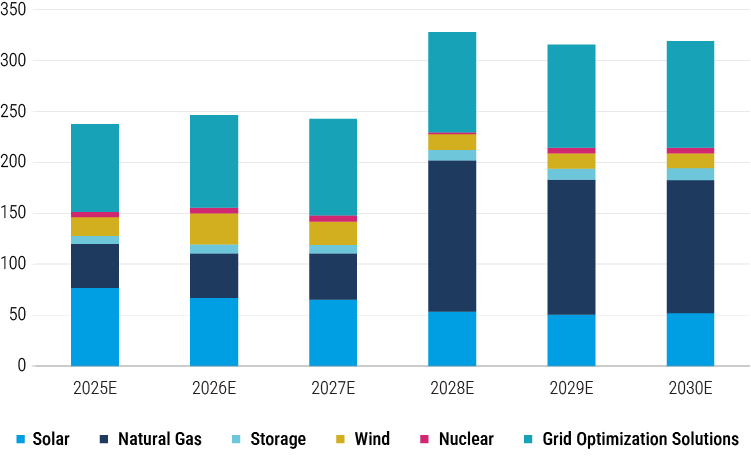
The chart below shows our forecast of annual incremental US power supply through to 2030. Solar is the dominant near-term contributor, while our estimates suggest that natural-gas generation and grid-optimisation measures together account for roughly 70% of incremental power supply through 2030. Nuclear is not expected to have a material impact until after 2030.

Powering the AI build-out

Forecast incremental annual US power supply 2025-2030E terawatt-hours (TWh)
Graph

Source: Columbia Threadneedle Investments analysis, July 2026. While our power-supply forecast is modelled in TWh, our analysis is presented in gigawatts (GW) given it is the standard industry metric used to describe data-centre capacity. 1TWh equals 1,000 GWh.

Assuming approximately 65% of incremental power capacity is available for data centres, with the balance supporting broad economic growth and electrification, our model suggests power availability is not necessarily the primary near-term bottleneck for data-centre growth. Based on our current assumptions, we concluded that the grid could theoretically support approximately 31 GW of incremental data-centre capacity additions in 2026, rising to around 169 GW of cumulative grid-supported data-centre capacity by 2030.

These figures represent system-level potential rather than guaranteed project delivery. The framework does not consider BTM generation – gas turbines, fuel cells and batteries. To overcome near-term transmission constraints in select areas, these BTM sources are increasingly being used as bridge solutions until projects can connect to the grid. It is worth noting that some regions have power and transmission constraints, while others still have surplus capacity.

Myriad constraints: from equipment to skilled labour to political risk

Our power model therefore suggests that US generation capacity should accommodate meaningful data-centre growth. But power sufficiency at the system level does not mean projects can get built and powered up on time. Our review of bottlenecks beyond power for data-centre development indicates that other critical constraints are looming.

Sufficient generation capacity does not guarantee that projects can be connected, equipped and completed on schedule. Our company research points to shortages of transformers, turbines and other electrical equipment, as well as constraints in engineering and construction labour. These bottlenecks could limit the pace of deployment even where electricity is theoretically available.

Community concerns about electricity costs, noise, water use and land requirements are contributing to opposition to some projects. As the November 2026 midterm elections approach, these issues could receive greater political attention, adding uncertainty to permitting and development timelines.

The bottleneck scorecard

Assessing the potential impact of constraints:

Constraint
Severity
Community and political opposition
Critical
EPC / construction labour
Critical
Power transformers
Critical
Gas turbines (BTM equipment)
Significant
Grid interconnection
Significant
800V DC architecture transition*
Significant
Cooling and electrical equipment
Emerging

*As AI servers become more power-intensive, data-centre operators are evaluating higher-voltage direct-current architectures. Proponents argue that 800V DC systems can distribute power more efficiently to ultra-high-density AI racks, although adoption remains at an early stage and is expected to be concentrated in the most demanding AI training environments.

Key

Critical = binding today. Directly limits GW delivery and no near-term resolution.

Significant = creates meaningful delays. Partially addressable through workarounds.

Emerging = adds cost and complexity but not the ceiling. Manufacturers expanding sufficiently.

Source: Columbia Threadneedle Investments analysis, July 2026.

Hybrid power as a bridge

For projects facing lengthy grid-connection timelines, BTM generation can provide a bridge to operation. Hybrid configurations combine available grid capacity with on-site sources such as gas turbines, reciprocating engines or fuel cells, supported by battery storage to improve resilience and balance power delivery. Fuel cells, for instance, are winning data-centre contracts for two simple reasons: they can typically be swiftly deployed in under a year, and their low emissions profile is less likely to raise air-quality concerns. However, according to our analysis they are not the cheapest option and are currently mainly used for smaller requirements of below 100 megawatts.

Investment opportunities across the spectrum

The investment opportunities arising from today’s extraordinary infrastructure build-out can be found across a broad range of energy and industrial sectors.

Electric utilities are likely investment beneficiaries. We prefer regulated utilities, especially those which are vertically integrated and are poised to benefit from infrastructure investments across generation, transmission and distribution capital projects. For these entities, the load growth from data centres should spread fixed costs over more units of consumption, potentially benefitting residential customer affordability. The companies supplying BTM power such as gas turbines, fuel cells and batteries are also worth highlighting. Lastly, scarcity could benefit data centre equipment makers, including makers of switchgear, transformers and cooling technologies.

The bottom line

The AI infrastructure build-out is creating opportunities across the power ecosystem, but electricity supply is only part of the equation. Grid connections, equipment, skilled labour and political support will also shape the pace of development and determine where opportunities emerge.

Our bottom-up, cross-sector approach and research help us track these constraints, identify shifts in momentum and uncover the most compelling investment opportunities.


Key topics

Subscribe to insights

Get the most out of your email by tailoring the types of insights and information you would like to receive from us.

Latest articles

Artificial intelligence (AI) is driving one of the largest infrastructure investment cycles in decades. But converting billions of dollars of planned spending into operating data centres will depend on more than access to electricity.
Bond markets are moving to a beat that equity markets have yet to hear. The MOVE Index has surged while the VIX remains near its lows – a divergence that has historically preceded broader risk repricing.
Government bond yields are rising again – but this is not simply a repeat of 2022. We consider what fiscal pressures, inflation uncertainty and higher borrowing costs could mean for bonds, equities and portfolio positioning.
Key topics
Related topics

Important information

For use by professional clients and/or equivalent investor types in your jurisdiction (not to be used with or passed on to retail clients). For marketing purposes.

This document is intended for informational purposes only and should not be considered representative of any particular investment. This should not be considered an offer or solicitation to buy or sell any securities or other financial instruments, or to provide investment advice or services. Investing involves risk including the risk of loss of principal. Your capital is at risk. Market risk may affect a single issuer, sector of the economy, industry or the market as a whole. The value of investments is not guaranteed, and therefore an investor may not get back the amount invested. International investing involves certain risks and volatility due to potential political, economic or currency fluctuations and different financial and accounting standards. The securities included herein are for illustrative purposes only, subject to change and should not be construed as a recommendation to buy or sell. Securities discussed may or may not prove profitable. The views expressed are as of the date given, may change as market or other conditions change and may differ from views expressed by other Columbia Threadneedle Investments (Columbia Threadneedle) associates or affiliates. Actual investments or investment decisions made by Columbia Threadneedle and its affiliates, whether for its own account or on behalf of clients, may not necessarily reflect the views expressed. This information is not intended to provide investment advice and does not take into consideration individual investor circumstances. Investment decisions should always be made based on an investor’s specific financial needs, objectives, goals, time horizon and risk tolerance. Asset classes described may not be suitable for all investors. Past performance does not guarantee future results, and no forecast should be considered a guarantee either. Information and opinions provided by third parties have been obtained from sources believed to be reliable, but accuracy and completeness cannot be guaranteed. This document and its contents have not been reviewed by any regulatory authority.

In Australia: Issued by Threadneedle Investments Singapore (Pte.) Limited [“TIS”], ARBN 600 027 414. TIS is exempt from the requirement to hold an Australian financial services licence under the Corporations Act 2001 (Cth) and relies on Class Order 03/1102 in respect of the financial services it provides to wholesale clients in Australia. This document should only be distributed in Australia to “wholesale clients” as defined in Section 761G of the Corporations Act. TIS is regulated in Singapore (Registration number: 201101559W) by the Monetary Authority of Singapore under the Securities and Futures Act (Chapter 289), which differ from Australian laws.

In Singapore: Issued by Threadneedle Investments Singapore (Pte.) Limited, 3 Killiney Road, #07-07, Winsland House 1, Singapore 239519, which is regulated in Singapore by the Monetary Authority of Singapore under the Securities and Futures Act (Chapter 289). Registration number: 201101559W. This advertisement has not been reviewed by the Monetary Authority of Singapore.

In Hong Kong: Issued by Threadneedle Portfolio Services Hong Kong Limited 天利投資管理香港有限公司. Unit 3004, Two Exchange Square, 8 Connaught Place, Hong Kong, which is licensed by the Securities and Futures Commission (“SFC”) to conduct Type 1 regulated activities (CE:AQA779). Registered in Hong Kong under the Companies Ordinance (Chapter 622), No. 1173058.

In Japan: Issued by Columbia Threadneedle Investments Japan Co., Ltd. Financial Instruments Business Operator, The Director-General of Kanto Local Finance Bureau (FIBO) No.3281, and a member of Investment Management Association of Japan and Type II Financial Instruments Firms Association.

In the UK: Issued by Threadneedle Asset Management Limited, No. 573204 and/or Columbia Threadneedle Management Limited, No. 517895, both registered in England and Wales and authorised and regulated in the UK by the Financial Conduct Authority.

In the EEA: Issued by Threadneedle Management Luxembourg S.A., registered with the Registre de Commerce et des Sociétés (Luxembourg), No. B 110242 and/or Columbia Threadneedle Netherlands B.V., regulated by the Dutch Authority for the Financial Markets (AFM), registered No. 08068841.

In Switzerland: Issued by Threadneedle Portfolio Services AG, Registered address: Claridenstrasse 41, 8002 Zurich, Switzerland.

In the Middle East: This document is distributed by Columbia Threadneedle Investments (ME) Limited, which is regulated by the Dubai Financial Services Authority (DFSA). For Distributors: This document is intended to provide distributors with information about Group products and services and is not for further distribution. For Institutional Clients: The information in this document is not intended as financial advice and is only intended for persons with appropriate investment knowledge and who meet the regulatory criteria to be classified as a Professional Client or Market Counterparties and no other Person should act upon it.

This document may be made available to you by an affiliated company which is part of the Columbia Threadneedle Investments group of companies: Columbia Threadneedle Management Limited in the UK; Columbia Threadneedle Netherlands B.V., regulated by the Dutch Authority for the Financial Markets (AFM), registered No. 08068841.

Columbia Threadneedle Investments is the global brand name of the Columbia and Threadneedle group of companies. © 2026 Columbia Threadneedle. All rights reserved.

Related insights

6 October 2026

In Credit Weekly Snapshot – Move it

Bond markets are moving to a beat that equity markets have yet to hear. The MOVE Index has surged while the VIX remains near its lows – a divergence that has historically preceded broader risk repricing.
29 September 2026

In Credit Weekly Snapshot – Let’s dance

Oil prices and bond yields are once again moving in step, as inflation concerns keep both markets firmly in focus.
28 September 2026

Investment Grade Credit Research, Fixed Income

Data with destiny: Information services show structural resilience in the age of AI

Disruption fears look overdone – trusted data, regulation and embedded workflows should continue to support resilient information services credits.
6 October 2026

In Credit Weekly Snapshot – Move it

Bond markets are moving to a beat that equity markets have yet to hear. The MOVE Index has surged while the VIX remains near its lows – a divergence that has historically preceded broader risk repricing.
5 October 2026

Senior Economist, Multi-Asset Solutions team

Market Perspectives: Déjà vu – another bond sequel

Government bond yields are rising again – but this is not simply a repeat of 2022. We consider what fiscal pressures, inflation uncertainty and higher borrowing costs could mean for bonds, equities and portfolio positioning.
5 October 2026

Artificial intelligence: implications for the economy and equity and fixed income markets

Artificial intelligence has moved from a narrow technology theme to a broad investment, productivity and financing cycle that will impact almost every aspect of financial markets.

Important information

For use by professional clients and/or equivalent investor types in your jurisdiction (not to be used with or passed on to retail clients). For marketing purposes.

This document is intended for informational purposes only and should not be considered representative of any particular investment. This should not be considered an offer or solicitation to buy or sell any securities or other financial instruments, or to provide investment advice or services. Investing involves risk including the risk of loss of principal. Your capital is at risk. Market risk may affect a single issuer, sector of the economy, industry or the market as a whole. The value of investments is not guaranteed, and therefore an investor may not get back the amount invested. International investing involves certain risks and volatility due to potential political, economic or currency fluctuations and different financial and accounting standards. The securities included herein are for illustrative purposes only, subject to change and should not be construed as a recommendation to buy or sell. Securities discussed may or may not prove profitable. The views expressed are as of the date given, may change as market or other conditions change and may differ from views expressed by other Columbia Threadneedle Investments (Columbia Threadneedle) associates or affiliates. Actual investments or investment decisions made by Columbia Threadneedle and its affiliates, whether for its own account or on behalf of clients, may not necessarily reflect the views expressed. This information is not intended to provide investment advice and does not take into consideration individual investor circumstances. Investment decisions should always be made based on an investor’s specific financial needs, objectives, goals, time horizon and risk tolerance. Asset classes described may not be suitable for all investors. Past performance does not guarantee future results, and no forecast should be considered a guarantee either. Information and opinions provided by third parties have been obtained from sources believed to be reliable, but accuracy and completeness cannot be guaranteed. This document and its contents have not been reviewed by any regulatory authority.

In Australia: Issued by Threadneedle Investments Singapore (Pte.) Limited [“TIS”], ARBN 600 027 414. TIS is exempt from the requirement to hold an Australian financial services licence under the Corporations Act 2001 (Cth) and relies on Class Order 03/1102 in respect of the financial services it provides to wholesale clients in Australia. This document should only be distributed in Australia to “wholesale clients” as defined in Section 761G of the Corporations Act. TIS is regulated in Singapore (Registration number: 201101559W) by the Monetary Authority of Singapore under the Securities and Futures Act (Chapter 289), which differ from Australian laws.

In Singapore: Issued by Threadneedle Investments Singapore (Pte.) Limited, 3 Killiney Road, #07-07, Winsland House 1, Singapore 239519, which is regulated in Singapore by the Monetary Authority of Singapore under the Securities and Futures Act (Chapter 289). Registration number: 201101559W. This advertisement has not been reviewed by the Monetary Authority of Singapore.

In Hong Kong: Issued by Threadneedle Portfolio Services Hong Kong Limited 天利投資管理香港有限公司. Unit 3004, Two Exchange Square, 8 Connaught Place, Hong Kong, which is licensed by the Securities and Futures Commission (“SFC”) to conduct Type 1 regulated activities (CE:AQA779). Registered in Hong Kong under the Companies Ordinance (Chapter 622), No. 1173058.

In Japan: Issued by Columbia Threadneedle Investments Japan Co., Ltd. Financial Instruments Business Operator, The Director-General of Kanto Local Finance Bureau (FIBO) No.3281, and a member of Investment Management Association of Japan and Type II Financial Instruments Firms Association.

In the UK: Issued by Threadneedle Asset Management Limited, No. 573204 and/or Columbia Threadneedle Management Limited, No. 517895, both registered in England and Wales and authorised and regulated in the UK by the Financial Conduct Authority.

In the EEA: Issued by Threadneedle Management Luxembourg S.A., registered with the Registre de Commerce et des Sociétés (Luxembourg), No. B 110242 and/or Columbia Threadneedle Netherlands B.V., regulated by the Dutch Authority for the Financial Markets (AFM), registered No. 08068841.

In Switzerland: Issued by Threadneedle Portfolio Services AG, Registered address: Claridenstrasse 41, 8002 Zurich, Switzerland.

In the Middle East: This document is distributed by Columbia Threadneedle Investments (ME) Limited, which is regulated by the Dubai Financial Services Authority (DFSA). For Distributors: This document is intended to provide distributors with information about Group products and services and is not for further distribution. For Institutional Clients: The information in this document is not intended as financial advice and is only intended for persons with appropriate investment knowledge and who meet the regulatory criteria to be classified as a Professional Client or Market Counterparties and no other Person should act upon it.

This document may be made available to you by an affiliated company which is part of the Columbia Threadneedle Investments group of companies: Columbia Threadneedle Management Limited in the UK; Columbia Threadneedle Netherlands B.V., regulated by the Dutch Authority for the Financial Markets (AFM), registered No. 08068841.

Columbia Threadneedle Investments is the global brand name of the Columbia and Threadneedle group of companies. © 2026 Columbia Threadneedle. All rights reserved.

Icon checked

Thank you. You can now visit your preference centre​ to choose which insights you would like to receive by email.

Icon checked

Thank you. You can now visit your preference centre​ to choose which insights you would like to receive by email.