



Historically, the US securitised credit market has demonstrated strong risk-adjusted return outcomes, often decorrelated to traditional fixed income assets. When blended into LDI portfolios there is the opportunity to enhance collateral waterfall liquidity while improving risk/return dynamics.
Attractive return potential
US securitised credit has typically offered higher yields than similarly rated corporate credit. There is a complexity premium to be harvested given that the asset class is much less saturated than many other fixed income sectors – retail investors are a reduced presence and there is a lack of ETF replication. It is typically only available for professional investors and requires a specialised research capability to provide the appropriate due diligence on asset selection.
What is the benefit to pension schemes?
An allocation to securitised credit can provide a yield enhancement opportunity for pension schemes, relative to traditional corporate bonds, without sacrificing quality. It also allows schemes to access a different risk premium that is distinct from corporate credit spreads.
LDI focus: Diversification benefits of US securitised credit
Risk and diversification
Most securitised assets are amortising in nature, meaning the cashflows investors receive are a combination of coupon income and a gradual return of principle (unlike traditional bullet bonds where the full principal is returned only at final maturity). As a result, most securitised assets have an average life of only around three to six years. This can drive a lower credit sensitivity versus similarly rated corporate bonds where issuance typically has tenors of around seven to 15 years (and has been increasingly termed out as issuers take advantage of the compressed spread environment).
In addition, many securitised assets – and especially collateralised loan obligations (CLOs) – offer floating-rate coupons, eliminating interest rate risk. In periods of elevated yield volatility, floating-rate assets can show much greater stability than their fixed counterparts, with bond prices staying much closer to their par value.
This combination of lower interest rate and credit sensitivity has historically driven attractive risk-adjusted returns for senior tranche securitised assets versus corporate bonds, especially in times of market stress.
What is the benefit to pension schemes?
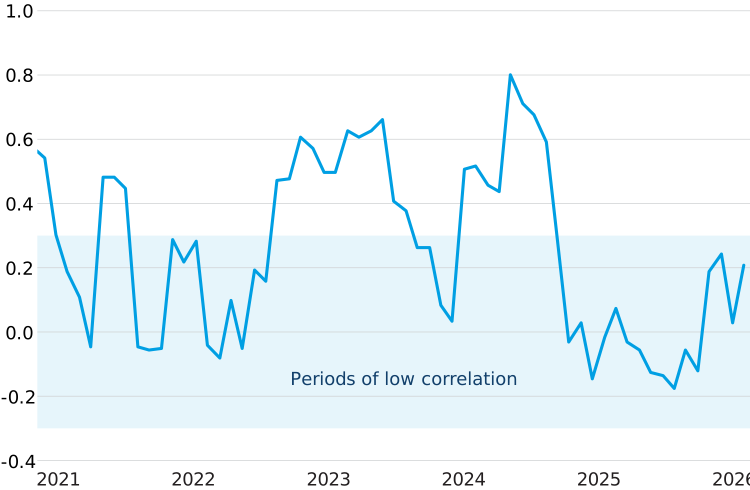
The floating structure and shorter life of securitised assets has driven a lower correlation to traditional fixed income sectors (Figure 1), and especially versus LDI portfolios – a useful diversifying feature in some collateral resilience scenarios. In addition, securitised assets offer a source of high-quality capital in times of market stress.
Figure 1: AAA CLOs versus US corporates (rolling 12-month correlation)
Source: BAML, Bloomberg, Columbia Threadneedle Investments, as of 31 March 2026 (monthly data).
Liquidity and collateral management
The main advantage of the US market for securitised opportunities is its size and depth. At more than $14 trillion in total it overshadows all US high grade corporate credit ($9 trillion) and especially the European securitised market ($1.5 trillion). The daily flow volumes are also at multiple levels of that seen in UK and European markets, creating a consistent pool of liquidity, even in times of volatility.
In addition, the US market attracts a broader investor base with participants including money managers, pension funds, hedge funds, banks and insurers – there is no dominant pension scheme position.
What is the benefit to pension schemes?
The strong liquidity dynamics of US securitised credit make it a natural fit for use within an LDI collateral liquidity waterfall toolkit. If there were to be another coordinated collateral squeeze in the LDI space – as a result of surging gilt yields – we should expect that any pension scheme liquidations of US securitised allocations, in order to meet collateral calls, would not be disruptive to a $14 trillion dollar asset class spread across so many investor types. This is a feature that contrasts strongly with regional Euro ABS markets, which are heavily owned by LDI managers.
The bottom line
- High quality US securitised credit is a largely untapped market for UK and European pension schemes, yet the asset class provides a powerful combination of risk and return benefits:
- Attractive historic returns versus corporate credit, driven by higher yields/income capture.
- Lower volatility and reduced credit sensitivity means more optimised income per unit of credit risk.
- Floating-rate profile drives decorrelation from LDI assets and diversification versus corporate credit.
- Robust liquidity underpinned by diverse investor base.
As a result, we believe the asset class merits consideration as a core component of collateral waterfalls within LDI portfolios.