



Europe is undergoing a transformation, with new pockets of emerging quality. In an uncertain environment, where capital intensity is a growing barrier to entry, our pragmatism allows us to identify industry leaders at the most profitable parts of the value chain.
At the start of the year, the consensus forecast a big year for Europe – double-digit corporate earnings growth. This was reinforced by multiple factors: strong bank balance sheets and the potential for renewed loan growth; supportive German fiscal policy following the relaxation of the ‘debt brake’; relative consumer strength (compared to the US and China); easing inflation; the potential for interest rate cuts; and cheaper energy.
Evolving geopolitics
However, following unforeseen geopolitical events – in particular the conflict in the Middle East – this ‘Goldilocks’ scenario has not materialised. Iran’s closure of the Strait of Hormuz is disrupting approximately 20% of global energy flows, altering the energy and inflation outlook. In Europe, effective use of new liquified natural gas (LNG) infrastructure is limited, stemming from the near‑halt of Qatari supply, and the damage to critical infrastructure following an attack on the South Pars gas field. Reconstruction could take five years, and Qatar has already declared force majeure on numerous LNG contracts.
Despite US attempts to limit the subsequent impact, including relaxing sanctions on Russian crude, the conflict has pushed oil prices towards $100 a barrel, with considerable intraday volatility, resulting in inflationary pressures. Against this backdrop, even in the event of successful Washington-Tehran negotiations and a permanent ceasefire, interest rate cuts are increasingly improbable.
AI uncertainty
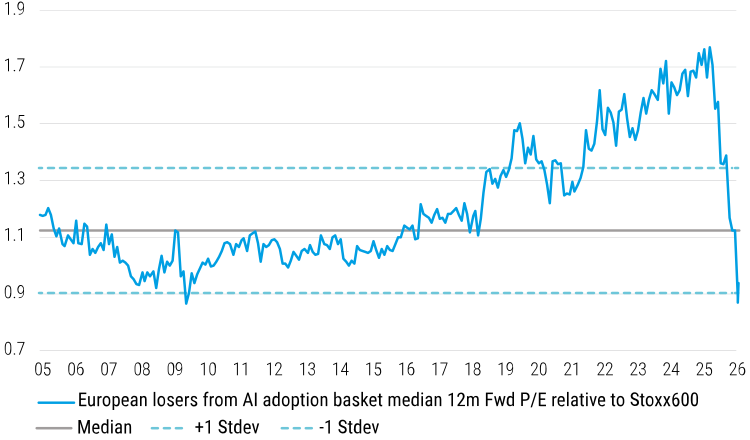
Figure 1: Valuations of perceived ‘AI losers’ have cratered
Source: JP Morgan, March 2026
New sources of quality have emerged
2026 has also seen a continuation of what has become known as the ‘HALO effect’ – the outperformance of Heavy Assets with Low Obsolescence. These are businesses with high physical barriers to entry – including cost, regulation, networks, infrastructure and engineering complexity – combined with a low risk of technological replacement.
This trend has been observed by our European portfolio management team and Europe is moving from an economy of ideas to an economy of things. This underscores the importance of, and growth within, the industrial sector, infrastructure and tangible assets. After decades of underinvestment, capital expenditure (capex) in these areas is rising, and Germany may have a big role to play. As such, quality is emerging in different, unexpected areas.
Within European banks, regulation, capital requirements and operational complexity are barriers to entry. Years of progressive structural change in the banking landscape have created pockets of opportunity. With stronger balance sheets, consolidation and renewed loan growth, some banks can now sustain higher returns.
Separately, the AI hyperscalers have shifted from being asset- and capital-light winners in the 2010s to becoming some of the most capital-intensive businesses globally. Following the launch of Chat GPT in 2022, hyperscalers have accelerated their investment. Between 2023 and 2026 they are projected to spend a staggering $1.5 trillion3 – three times their pre-Chat GPT capex.
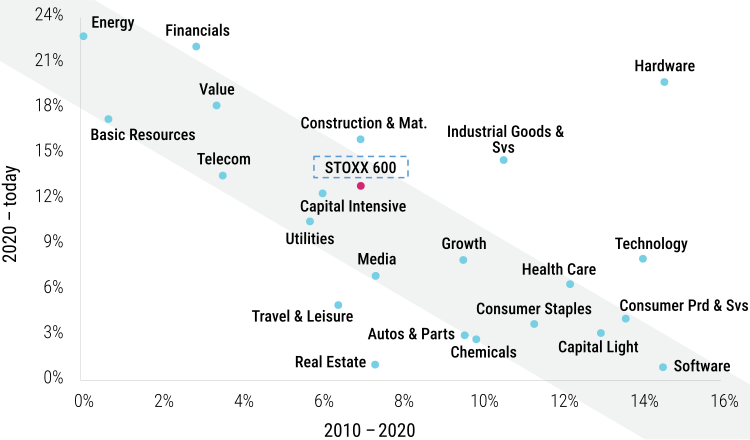
Traditionally, many businesses with high capital employed have been categorised as value, but we argue that this definition is outdated. Recent strong performance and valuation increases are justified (Figure 2). For example, companies in the utility value chain (grid infrastructure rather than power generation), critical industrials and electrical equipment makers have high barriers to entry. Margins are improving and European capex can bring increased volumes.
Figure 2: Since 2020, the performance of capital-intensive stocks has reversed
Total return performance (annualised)
Source: Goldman Sachs Global Investment Research, March 2026
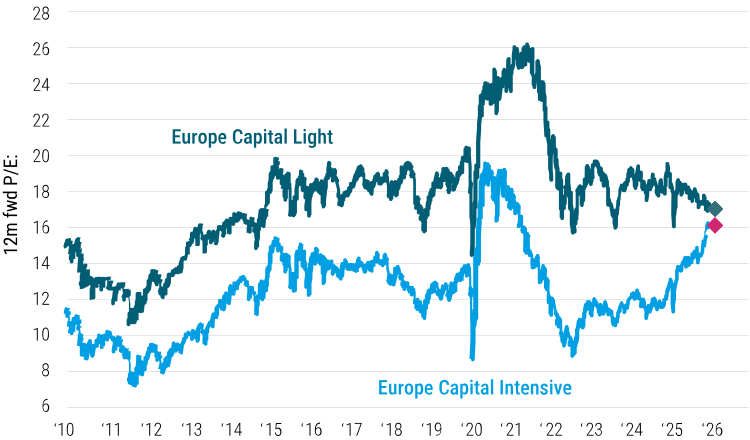
More broadly, sources of quality and growth are shifting in an era where inflation is structurally higher than the period since the global financial crisis. The valuation picture has also evolved. For many years, the traditional sources of quality – pharmaceuticals, luxury goods and software – commanded a premium. Since 2020 that has reversed. Banks, defence and construction, formerly value sectors with high capital employed, have re-rated. Valuations have converged and capital intensive/capital light assets now trade in line (Figure 3).
Figure 3: Valuations of capital-light and capital-intensive stocks have converged
Source: Goldman Sachs Global Investment Research, March 2026
So, the traditional definitions of value and growth are less relevant. Economic durability, barriers to entry, and free cash generation – what we refer to as quality – are still important, but are now found in new areas.
Our approach
After a strong start to 2026, with positive European equity market returns in both January and February, sentiment was negative in March. Value and defensive sectors have outperformed, including energy, telecoms and utilities. After outperforming in 2025, banks and commercial aerospace stocks have de-rated. Growth has been weaker too, although the degree of underperformance is less than 2025.
In Pan European Focus we have been reducing portfolio beta, adding to defensive stocks. We bought utility businesses Iberdrola and Engie, which would be beneficiaries of rising power prices. We have increased our pharmaceutical exposure, including AstraZeneca and Bayer. In consumer staples we have started positions in Coca Cola Hellenic and AB InBev – companies with brand power and attractive emerging market exposure. More recently, we have added to banking stocks in consolidated markets with strong economies, including the Spanish banks CaixaBank and BBVA. This is because persistent higher inflation means net interest income should remain elevated for longer.
This has been funded by reducing exposure to cyclical industrials and software-exposed stocks. While we remain underweight energy, we have exposure to the wider value chain via Siemens Energy. Our structural overweight positions in industrials (including thematic exposure to the energy transition, power demand and defence), and IT, where we prefer hardware (both semiconductors and semiconductor capital equipment) over software, remain. We are underweight financials, the consumer sectors, and have no exposure to real estate.
The bottom line: the quality growth opportunity
The short and medium term is unpredictable, but we remain focused on the longer-term investment case for portfolio companies.
History suggests we should be patient and ignore the noise during periods of intense market volatility. President Trump will have an eye on the US mid-term elections in late 2026 and will be keen to retain the Republican majority. With the US consumer focused on fuel prices, which drive spending patterns, he cannot afford for the price at the fuel pump to rise further.
We believe active investment in Europe is a necessity. Our job is to be selective and identify the leaders at the most profitable portions of value chains. The key is to ignore the macroeconomic noise and shorter-term shock events. We seek businesses and industries that are growing, transforming, consolidating and delivering high returns. Quality can be found in atypical places, and we capitalise on this. In Europe, the market is broadening and the time is right for active equities and for bottom-up quality investors focusing on secular growth opportunities.
Even with higher inflation, the strength in the banking sector and potential for loan growth, constructive German fiscal policy, and relative consumer strength should help propel companies that meet our pragmatic interpretation of quality growth.
Europe’s quality growth opportunity