
fi
FI
Finland
en-FI
fi_inst_classes
inst
Institutional
en
en
Insights

China is making good RI progress, despite its contradictions

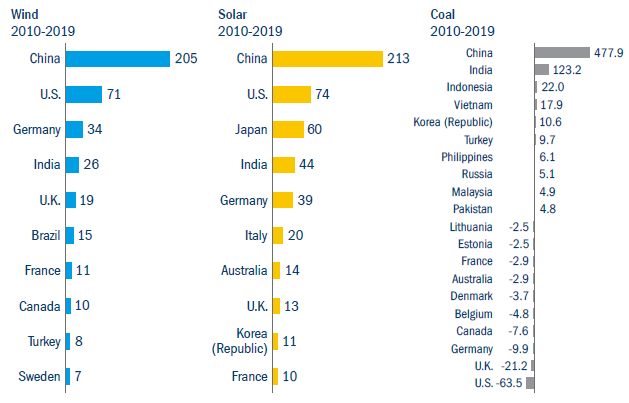
China is a double-edged sword: it is the world-leading renewables developer, installing more than double the gigawatt (GW) capacity of its nearest competitor over the past decade both in terms of wind and solar power (Figure 1), but at the same time it has seen the highest coal capacity additions over the same period – nearly quadruple that seen in India. The Chinese government announced it is aiming to reach peak coal emissions by the end of the current five-year plan ending in 2025, but new coal plants with 40-year life spans do not fit well with a 2060 net zero emissions target. China is a country of great progress and great opportunity, but also of contradictions.
Figure 1: China’s renewable output
China renewable output
Source: Bloomberg New Energy Finance, 2020.
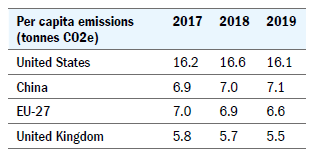
In absolute terms, China is the biggest contributor to global emissions – but this is mostly due to its size. When looking at emissions on a per person basis it is much lower than the US and roughly in line with the EU – the big difference, however, is that after more than a century of rising emissions, the EU is now on a downward trajectory while China’s are not (Figure 2). Another point to consider with country level emissions is that these are production based emissions figures.
Figure 2: Comparing emissions
Comparing emissions
Source: Our world in data, 2020.
This means that the emissions generated from theproduction of Chinese-made goods which are consumed in the EU or the US is captured in China’s footprint. If we looked at per capita consumption emissions, China would likely look much better than the EU, the US and the UK.
With China’s new net zero targets and its existing leadership in the renewables space – the country produces 70% of the world’s solar panels, half the electric vehicles and has a large share of a lot of the materials that underpin battery technology – it is unsurprising that investors have been taking a closer look at the Chinese renewables market. Increasing investor attention, especially from ESG-conscious investors, has driven a rise in corporate attention to sustainability disclosure. The use of forced labour in supply chains is a particular area of focus and risk currently.
Towards the end of 2021 it is expected that a more detailed decarbonisation roadmap will be published. This could solve some of the coal conundrums and is likely to focus on three key areas: carbon pricing, green finance and tech investment. These developments have the potential to accelerate the already bullish scenario.
The market size of the opportunity is huge. The International Renewable Energy Agency (IRENA) predict that by 2050 8,519 GW of solar would be required in a <2 °C degrees of warming scenario in line with the Paris agreement – this represents an 18x increase on 2018 levels. Asia, and mostly China, is predicted to account for more than 50% of total installed solar power compared to 20% in North America and 10% in Europe.
With the recent announcements indicating a step change in the focus on energy transition, the improving disclosure standards and the significant opportunity set, we believe the Chinese market could be one to watch. Although, importantly for international ESG investors, this will be conditional on ensuring that supply chains have no exposure to the Uyghur human rights abuses in Xinjiang.

14 September 2021
Jin xu wearing pink tie
Jin Xu
Portfolio Manager
Share article
Key topics
Related topics
Listen on Stitcher badge
Share article
Key topics
Related topics

Important information

The research and analysis included on this website has been produced by Columbia Threadneedle Investments for its own investment management activities, may have been acted upon prior to publication and is made available here incidentally. Any opinions expressed are made as at the date of publication but are subject to change without notice and should not be seen as investment advice. Information obtained from external sources is believed to be reliable but its accuracy or completeness cannot be guaranteed.

Related Insights

11 September 2026

Head of European Large Cap Equities

Europe: better momentum but structural hurdles remain

Although global growth expectations fell after the Iran conflict started, US growth expectations have crept up.
10 September 2026

Senior Portfolio Manager

Global Head of Emerging Market Equities

From Monopoly to Age of Empires - Part II: AI and the new terms of trade: When intelligence becomes abundant, what remains scarce?

In From Monopoly to Age of Empires , we described a world fragmenting into competing technological and economic blocs. Technology, we argued, would not end scarcity.
23 July 2026

Climate Strategist

Security, supply and the energy transition

Geopolitical shocks have reframed the energy transition as a question of security as well as climate. As governments seek more resilient, affordable energy systems, long-term investors can find opportunities in the infrastructure powering the shift.
11 September 2026

Head of European Large Cap Equities

Europe: better momentum but structural hurdles remain

Although global growth expectations fell after the Iran conflict started, US growth expectations have crept up.
10 September 2026

Senior Portfolio Manager

Global Head of Emerging Market Equities

From Monopoly to Age of Empires - Part II: AI and the new terms of trade: When intelligence becomes abundant, what remains scarce?

In From Monopoly to Age of Empires , we described a world fragmenting into competing technological and economic blocs. Technology, we argued, would not end scarcity.
8 September 2026

Senior Economist, Multi-Asset Solutions team

Delegate OCIO & Strategist

Multi-Asset Investment Outlook 2027: Technological tailwind, geopolitical headwind

The global economy has proved more resilient than many expected, but the investment landscape of 2027 looks materially different from a year ago – shaped by conflict in the Middle East, a reversal in interest rate expectations, and an AI-driven capital expenditure (capex) boom of unprecedented scale.
true
true

Important information

The research and analysis included on this website has been produced by Columbia Threadneedle Investments for its own investment management activities, may have been acted upon prior to publication and is made available here incidentally. Any opinions expressed are made as at the date of publication but are subject to change without notice and should not be seen as investment advice. Information obtained from external sources is believed to be reliable but its accuracy or completeness cannot be guaranteed.

You may also like

Investment approach

Teamwork defines us and is fundamental to our investment approach, which is structured to facilitate the generation, assessment and implementation of good, strong investment ideas for our portfolios.

Funds and Prices

Columbia Threadneedle Investments has a comprehensive range of investment funds catering for a broad range of objectives.

Our Capabilities

We offer a broad range of actively managed investment strategies and solutions covering global, regional and domestic markets and asset classes.
Icon checked

Thank you. You can now visit your preference centre​ to choose which insights you would like to receive by email.

Icon checked

Thank you. You can now visit your preference centre​ to choose which insights you would like to receive by email.