



Earnings expectations
From a fundamental standpoint, earnings are inflecting higher for small cap companies after an earnings downturn in 2023 and into 2024. As of January 2026, bottom‑up consensus from Bloomberg suggests the Russell 2000 will deliver 43% year‑over‑year earnings growth over the coming twelve months, the Russell 2500 will grow by 18%, and the large cap S&P 500 is expected to deliver 11% over the same period. While the whole market is forecast to see meaningful earnings growth, smaller companies are expected to lead. In 2025, earnings were one of the main drivers of stock market returns (rather than multiple expansion / contraction), so a strong showing from small cap earnings could support further share price performance.
Small cap EPS growth rate estimates easily surpassing large caps into 2026
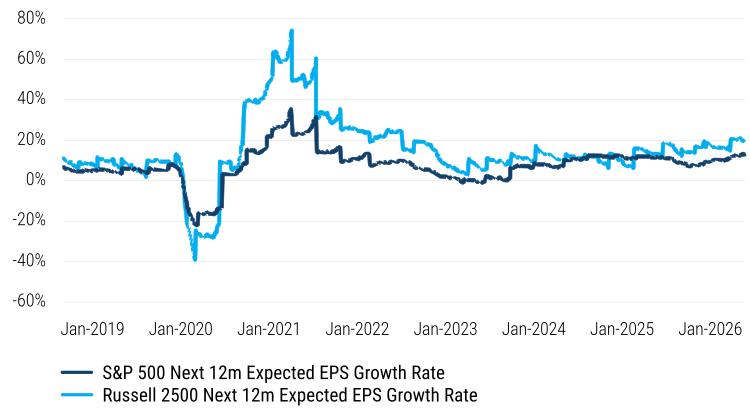
Source: Bloomberg L.P. and Columbia Threadneedle Investments, as of December 31, 2025. It is not possible to invest directly in an index.
Valuations
With expectations for small caps to grow earnings at a meaningfully faster rate than large caps, it might be expected that smaller companies would trade on a higher multiple. In reality, small caps still trade at a wide discount to large caps and remain broadly in line with their historical ranges. Before the Covid pandemic, small caps typically traded at a small premium to larger stocks, reflecting both risk premium and faster potential rate of growth. As of December 31, 2025, however, the Russell 2500 trades at 18.5x on a 12‑month forward P/E basis, compared with 23.0x for the S&P 500, creating a nearly 5x valuation gap.
The valuation gap has widened since the pandemic, driven in part by macro uncertainty, investor preference for mega cap stocks and the exceptional earnings power of the largest companies, which now dominate market cap weighted indices. From a relative value standpoint, though, this leaves small caps at an attractive entry point. This opens the door for forward‑looking investors who are willing to look through short‑term volatility.
Mega cap concentration
A small cohort of very large tech‑adjacent US companies, the mega‑cap “Magnificent 7”, has generated the bulk of earnings growth in the S&P 500 in recent years. This has been a major driver of large‑cap outperformance. As small cap earnings begin to improve, this may help narrow the performance gap between large and small caps, particularly if the Magnificent 7 cannot sustain such exceptional growth rates. Another factor behind mega‑cap strength is the sheer concentration of these companies within large‑cap benchmarks. The top three companies alone account for nearly 21% of the S&P 500’s market cap, and the top 10 together make up 39%, placing even greater reliance on their continued outperformance to support index returns.
12m Forwarded P/E ratio: Russell 2500 vs. S&P 500
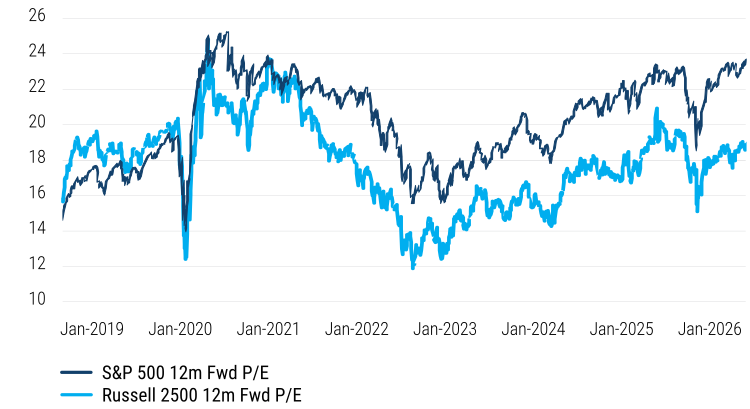
Source: Bloomberg L.P. and Columbia Threadneedle Investments, as of December 31, 2025. It is not possible to invest directly in an index.
Sentiment
Earnings sentiment for small caps, measured by the pace of upward EPS estimate revisions, strengthened toward the end of 2025. The more positive revision trend in small caps suggests growing confidence in their earnings outlook relative to large caps.
Domestic tailwinds
For many years, US companies focused on outsourcing production to lower‑cost countries. Given the Trump administration’s protectionist stance, rising geopolitical tensions and the supply chain disruptions experienced during the Covid‑19 pandemic, there is now greater potential for this trend to reverse. Re‑shoring initiatives, the US federal government’s CHIPS Act, the Infrastructure Investment and Jobs Act (IIJA) and, more recently, the One Big Beautiful Bill (OBBB) are expected to drive increased domestic capital expenditure and put money in the pockets of US consumers. Small caps, with their higher exposure to domestic investment and US economic trends, stand to benefit more directly from this shift.
Diversification benefits & cyclical exposure in small caps
A key benefit of holding US small caps is the diversification they bring to equity portfolios. By construction, US large cap benchmarks such as the S&P 500 have become increasingly concentrated in technology and related sectors. As of December 31, 2025, around 34.4% of the index’s market cap sits in technology, compared with 14.3% in the Russell 2500. By contrast, cyclical sectors like industrials and financials make up a far greater share of the small cap versus large cap indices (37% versus 22%). This gives small caps a more cyclical profile and greater sensitivity to US economic growth. If the economy and labor market remain resilient, as they have to date, this bias toward economically sensitive sectors should be supportive for small caps.
Falling interest rates
In the second half of 2024, the Fed began its dovish pivot, cutting rates in September, November and December, followed by three further reductions in 2025. These moves brought the Federal Funds Rate down from a two‑decade high of 5.25–5.50% to its current range of 3.5–3.75%, with markets expecting further easing in 2026. Small caps tend to outperform when monetary policy becomes more accommodative, as they typically carry a larger share of floating‑rate debt and are more sensitive to changes in financing costs. Lower borrowing costs also make it more attractive for smaller companies to fund growth initiatives.
Other structural supports
Despite the noise, small caps are also benefiting from a multi‑year tailwind of increased domestic capital spending, largely driven by major US government programs such as the CHIPS Act, the IIJA and the Inflation Reduction Act. These initiatives continue to support the renewal of domestic manufacturing and the modernization of critical infrastructure. Trump has already indicated he is unlikely to repeal the CHIPS Act, which incentivizes semiconductor production in the US.
We have also heard from a number of advisory banks that the US M&A pipeline remains full, with activity expected to pick up once volatility and policy uncertainty subside. This is especially evident in healthcare and biotech. Many large pharma companies face a significant patent expiry cliff, with roughly $170 billion of 2024 sales due to go off‑patent by the end of the decade. Replacing these revenues is essential, and given the concentration of biotech names within small cap indices, many could become acquisition targets as big pharma seeks to replenish drug pipelines.
Volatility and policy uncertainty have also led some management teams to delay transactions, but this should ease as corporate leaders gain clearer visibility on the policy backdrop.
Separately, a number of small cap tech companies are benefiting indirectly from the massive AI‑related capital spending undertaken by larger firms. These smaller players often act as suppliers or enablers within the ecosystem, positioning them to benefit as AI investment continues to scale.
Capturing these opportunities
As long‑term active investors, we aim to look through short‑term volatility and focus on companies with durable cashflows, improving margins and credible earnings trajectories that can thrive regardless of political or macro noise. We run a core/blend approach and allocate most of our risk budget to stock selection. By keeping sector and factor tilts broadly neutral, we allow bottom‑up research to drive returns and reduce our sensitivity to style rotations.
The bottom line
Small caps remain an important component of a diversified portfolio, and current dynamics suggest their role could strengthen as market conditions evolve. US small caps are beginning to show signs of renewed momentum: improving earnings fundamentals, attractive valuations and a gradually stabilising macro backdrop have helped narrow the gap between smaller companies and their large cap peers in recent times. While near term volatility is still part of the story, long term investors may find that today’s environment offers a more compelling entry point than in recent years.