



A repeatable, rules-based investment process can help active ETFs navigate concentrated markets, capture opportunities created by stock-level dispersion and offer investors a more purposeful approach to core equity exposure.
For many investors the logic of portfolio construction has been straightforward: use passive strategies for efficient core exposure and reserve active management for the satellites. But that distinction is becoming less clear-cut as index concentration rises and stock-level dispersion increases. In this environment, active ETFs are opening up new possibilities for the core.
The concentration challenge
Broad global indices may appear diversified by number of holdings, but capitalisation weighting tells a different story. In the S&P 500 Index, just 10 stocks account for more than a third of the index, while in the MSCI All Country World Index (ACWI) the equivalent figure is around a quarter. As a result, a small group of mega-cap companies exerts a disproportionate influence on overall risk and return.
This concentration is less apparent while the largest stocks are leading markets higher, as US mega-cap technology has done. The risk becomes clearer when leadership broadens, valuations reset or performance among the largest names diverges.
In such markets, index exposure can be a less reliable proxy for diversification, leaving passive allocations with more stock- and factor-specific risk than investors may realise.
Dispersion is increasing the opportunity set for stock selection
Dispersion within indices has risen as the gap between winners and losers has widened. The Cboe S&P 500 Dispersion Index, which measures expected variation between stock returns, has a long-term average of around 25 but exceeded 45 in July 2026 and remains over 35 at the time of writing.1 Higher dispersion can create a more fertile environment for stock selection.
This dispersion pattern extends to the largest index constituents. Among the ‘Magnificent Seven’, the gap between the strongest and weakest performers has exceeded 40% so far this year.2
Top-heavy markets increase concentration risk, while elevated dispersion can reward selectivity. This favours active approaches that can manage crowded exposures, avoid deteriorating businesses and target companies with improving fundamentals.
What the research shows: consistency matters
Academic research suggests that the degree and consistency of a fund’s differentiation from its benchmark can be important when assessing active management. This is particularly relevant when wider gaps between winners and losers increase the potential value of stock selection.
The aim is not to be occasionally different, but consistently and deliberately active, using a disciplined, repeatable process to turn dispersion into opportunity.
We will explore the research and its implications for investors in a forthcoming paper on assessing active management.
A structured approach to selective active investing
An effective active approach uses rules-based stock selection to capture dispersion, intentional positioning to manage concentration risk, and maintains a consistent level of activeness over time.
A structured process combining Quality, Value and Catalyst factors can support these aims:
- Quality focuses on durable earnings and strong fundamentals
- Value introduces robust price discipline
- Catalyst identifies forward-looking change drivers.
While the specific metrics vary by industry, the framework applies a consistent and objective methodology across the investment universe. This enables the model to identify the strongest stocks within each peer group, exclude those expected to underperform and construct a diversified portfolio that remains benchmark-aware without being benchmark-constrained.
A dynamic sell discipline also enables the portfolio to exit deteriorating holdings between rebalances – a flexibility that is unavailable to passive or benchmark-constrained strategies.
Rethinking the core: the portfolio construction case
These dynamics have implications for portfolio construction. The traditional ‘passive core, active satellite’ model has served investors well, but it places much of the portfolio’s risk in the component least able to respond to concentration and dispersion.
A benchmark-aware active ETF offers a middle path: more selective than a passive index fund, more cost-efficient and transparent than many traditional active investment funds, and familiar to investors already using ETFs for core exposure.
This means that, rather than adding active risk only at the margins, investors can introduce structured active stock selection directly into the core allocation.
The portfolio case study below illustrates the potential benefits. Reallocating part of a Global equity exposure from passive and high-conviction active strategies to the CT QR Series Global Equity Active ETF (QRGE3) can help improve portfolio efficiency.
Portfolio Case Study: Global Exposure
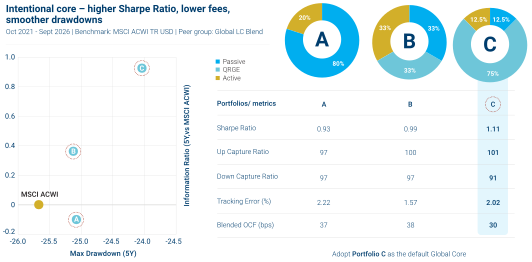
QRGE: CT QR Series Global Equity Active ETF. Active: 25th percentile mutual fund as part of the portfolio construction process. Past performance does not predict future returns.
Our analysis used simulated ETF returns generated by the Global quantitative model, which has been live since 2013. A related model developed by the same quantitative research team has underpinned one of our US-domiciled Columbia Threadneedle ETF strategies since 2019. While simulated outcomes do not guarantee future returns, they do offer a realistic proxy for the blend’s historical performance.
For a Global equity allocation comprising 75% in the active ETF and 12.5% in both a passive strategy and a top-quartile active fund4, the results indicate several potential advantages:
- Improved risk-adjusted returns, with a higher Sharpe ratio
- Adherence to risk budgets, with a similar level of tracking error
- More attractive downside capture
- A reduction in overall third-party fees
The active ETF may therefore serve as an efficient core building block, retaining broad market exposure while introducing more deliberate security selection, risk management and cost control.
The bottom line: from passive to purposeful
Today’s concentrated, high-dispersion market strengthens the case for a more deliberate approach to core equity exposure.
Broad indices may offer less diversification than investors assume, while wider performance gaps increase the opportunity cost of holding every stock at index weight. Active ETFs can help address both challenges by combining the structural advantages of the ETF wrapper with disciplined stock selection and active risk management. This makes them a potentially valuable core allocation, not simply an active addition at the portfolio’s edge.
