




Insights
AI is reshaping the opportunity set across markets, but from our perspective the real story is not the technology itself – it’s the multi‑year transformation unfolding in distinct waves, each with its own leaders and beneficiaries. We see capital flowing through the AI ecosystem in sequence, creating cascading opportunities as adoption deepens. Active managers who anticipate these rotations – and position ahead of them – are better placed to capture value as leadership shifts along the AI value chain.
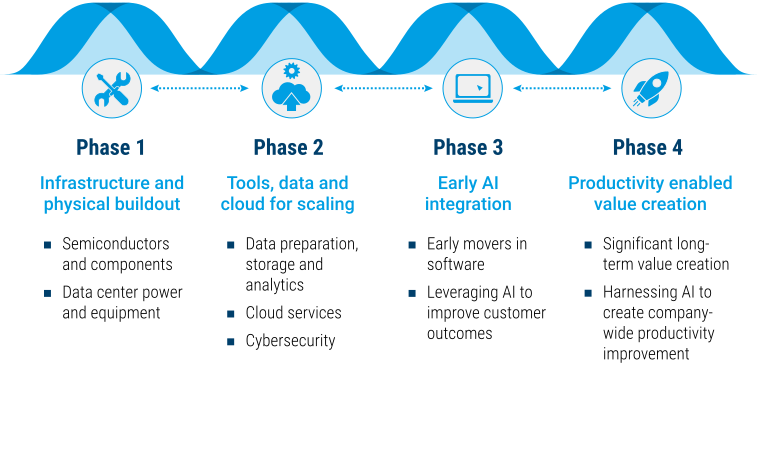
We focus on the following four waves to understand where capital builds next and which companies have the structural advantages to benefit across multiple phases (Figure 1). Today, we sit squarely in the first wave and are beginning to transition into the second. Early signs of the third wave are emerging in software, while a fourth wave of economy‑wide productivity gains sits on the horizon. Understanding where we are now and what comes next can help you align portfolios to the full scope of the opportunity.
We remain early in the infrastructure phase. This foundation is the most visible and capital‑intensive stage. Hyperscalers alone are on track to invest more than $500 billion in 2026 to expand AI‑ready infrastructure1. This unprecedented scale reflects the intensity of model development and the physical demands required to train complex models.
We see this phase having another two to three years of strong momentum. The physical requirements of AI, the rise of model‑as‑a‑service offerings and the global race to build sovereign AI capacity drive this growth. Core exposure to infrastructure remains relevant, but leadership will evolve as the buildout matures.
As infrastructure expands, companies move from early experimentation to scaled deployment. This transition fuels the second wave where tools, data architecture, cybersecurity and cloud‑based AI platforms play a defining role.
Snowflake and MongoDB stand out for their ability to help companies make data usable, structured and secure, and ready for AI. At the same time, cybersecurity becomes even more critical. Palo Alto Networks and CrowdStrike are positioned to protect data and AI models as enterprises expand their digital footprint.
Hyperscalers remain central at this stage because they lower the barriers to AI adoption. They provide pre‑trained models, managed services, guardrail tooling and integrated developer environments. We expect this wave to run three to five years as enterprises operationalise AI across business units.
We now see early evidence of AI integration within enterprise software. Unlike infrastructure, which scales quickly once capacity is built, enterprise adoption is methodical. Companies test, validate and pilot before they roll out at scale. But the traction is real.
Microsoft is embedding Copilot across the productivity stack and cloud services. ServiceNow integrates AI into workflows that redefine service delivery, HR, IT operations and customer support. Datadog layers AI into observability to help companies troubleshoot increasingly complex systems.
We expect this phase to unfold over three to four years, accelerating as the first wave of adopters begin to demonstrate measurable ROI.
As with any major technological transition, moments of pullback or shifting expectations are to be expected. The path from AI investment to monetisation is measured in years, not quarters. Companies must gather data, build and test models, and determine deployment strategies, while their customers simultaneously vet those offerings for security and utility. In our view, these pauses serve to separate short-term experimentation from durable, enterprise-wide value creation, and we see recent pockets of caution as part of that healthy refinement process rather than a reversal in direction.
The fourth wave is the most powerful and most difficult to quantify in the near term. Here, AI becomes an economic force rather than just a technology category. We estimate that AI currently contributes 10-20 basis points (bps) of productivity per year. We believe this could expand to 50-150bps annually as adoption scales, workflows adapt and companies fully integrate AI into core operations.
The differentiation here will be significant. Companies that move effectively from pilots to enterprise‑wide deployment will widen their competitive lead. These organisations leverage proprietary data, redesign processes and demonstrate real productivity gains. We expect the largest dispersion in performance across industries during this phase.
Most companies will benefit from one or two waves. However, we see the hyperscalers – Amazon, Microsoft and Google – as unique multi‑wave beneficiaries who participate in every stage:
The breadth of their exposure, strong balance sheets and deep customer relationships position them as long‑term anchors in AI‑driven growth.
AI is a succession of waves rather than a single investment theme. Each wave creates new leadership and opportunities for active investors. At the same time, the path forward will include periods of adjustment as companies refine where AI delivers sustainable value. But early evidence of AI’s impact on revenue growth, margin expansion and competitive differentiation – across use cases from code development to clinical research – reinforces why adoption is becoming less optional than essential. We believe these represent healthy normalisation rather than a challenge to the broader multi-year opportunity. The key is to understand where capital flows next and identify companies with the structural advantages to benefit across multiple phases.
The transformation ahead will be uneven, iterative and multi‑year, but the opportunity set is broad and expanding. As these waves unfold, we believe disciplined research, selective positioning and early recognition of leadership transitions will be essential to capturing the full value of this AI‑driven cycle.
Key topics



1Internal Columbia Threadneedle Investments analyst estimates.
2Mention of specific companies is not a recommendation to buy or sell.
For use by professional clients and/or equivalent investor types in your jurisdiction (not to be used with or passed on to retail clients). For marketing purposes.
This document is intended for informational purposes only and should not be considered representative of any particular investment. This should not be considered an offer or solicitation to buy or sell any securities or other financial instruments, or to provide investment advice or services. Investing involves risk including the risk of loss of principal. Your capital is at risk. Market risk may affect a single issuer, sector of the economy, industry or the market as a whole. The value of investments is not guaranteed, and therefore an investor may not get back the amount invested. International investing involves certain risks and volatility due to potential political, economic or currency fluctuations and different financial and accounting standards. The securities included herein are for illustrative purposes only, subject to change and should not be construed as a recommendation to buy or sell. Securities discussed may or may not prove profitable. The views expressed are as of the date given, may change as market or other conditions change and may differ from views expressed by other Columbia Threadneedle Investments (Columbia Threadneedle) associates or affiliates. Actual investments or investment decisions made by Columbia Threadneedle and its affiliates, whether for its own account or on behalf of clients, may not necessarily reflect the views expressed. This information is not intended to provide investment advice and does not take into consideration individual investor circumstances. Investment decisions should always be made based on an investor’s specific financial needs, objectives, goals, time horizon and risk tolerance. Asset classes described may not be suitable for all investors. Past performance does not guarantee future results, and no forecast should be considered a guarantee either. Information and opinions provided by third parties have been obtained from sources believed to be reliable, but accuracy and completeness cannot be guaranteed. This document and its contents have not been reviewed by any regulatory authority.
In Australia: Issued by Threadneedle Investments Singapore (Pte.) Limited [“TIS”], ARBN 600 027 414. TIS is exempt from the requirement to hold an Australian financial services licence under the Corporations Act 2001 (Cth) and relies on Class Order 03/1102 in respect of the financial services it provides to wholesale clients in Australia. This document should only be distributed in Australia to “wholesale clients” as defined in Section 761G of the Corporations Act. TIS is regulated in Singapore (Registration number: 201101559W) by the Monetary Authority of Singapore under the Securities and Futures Act (Chapter 289), which differ from Australian laws.
In Singapore: Issued by Threadneedle Investments Singapore (Pte.) Limited, 3 Killiney Road, #07-07, Winsland House 1, Singapore 239519, which is regulated in Singapore by the Monetary Authority of Singapore under the Securities and Futures Act (Chapter 289). Registration number: 201101559W. This advertisement has not been reviewed by the Monetary Authority of Singapore.
In Hong Kong: Issued by Threadneedle Portfolio Services Hong Kong Limited 天利投資管理香港有限公司. Unit 3004, Two Exchange Square, 8 Connaught Place, Hong Kong, which is licensed by the Securities and Futures Commission (“SFC”) to conduct Type 1 regulated activities (CE:AQA779). Registered in Hong Kong under the Companies Ordinance (Chapter 622), No. 1173058.
In Japan: Issued by Columbia Threadneedle Investments Japan Co., Ltd. Financial Instruments Business Operator, The Director-General of Kanto Local Finance Bureau (FIBO) No.3281, and a member of Japan Investment Advisers Association and Type II Financial Instruments Firms Association.
In the UK: Issued by Threadneedle Asset Management Limited, No. 573204 and/or Columbia Threadneedle Management Limited, No. 517895, both registered in England and Wales and authorised and regulated in the UK by the Financial Conduct Authority.
In the EEA: Issued by Threadneedle Management Luxembourg S.A., registered with the Registre de Commerce et des Sociétés (Luxembourg), No. B 110242 and/or Columbia Threadneedle Netherlands B.V., regulated by the Dutch Authority for the Financial Markets (AFM), registered No. 08068841.
In Switzerland: Issued by Threadneedle Portfolio Services AG, Registered address: Claridenstrasse 41, 8002 Zurich, Switzerland.
In the Middle East: This document is distributed by Columbia Threadneedle Investments (ME) Limited, which is regulated by the Dubai Financial Services Authority (DFSA). For Distributors: This document is intended to provide distributors with information about Group products and services and is not for further distribution. For Institutional Clients: The information in this document is not intended as financial advice and is only intended for persons with appropriate investment knowledge and who meet the regulatory criteria to be classified as a Professional Client or Market Counterparties and no other Person should act upon it.
This document may be made available to you by an affiliated company which is part of the Columbia Threadneedle Investments group of companies: Columbia Threadneedle Management Limited in the UK; Columbia Threadneedle Netherlands B.V., regulated by the Dutch Authority for the Financial Markets (AFM), registered No. 08068841.
Columbia Threadneedle Investments is the global brand name of the Columbia and Threadneedle group of companies. © 2026 Columbia Threadneedle. All rights reserved. columbiathreadneedle.com
For use by professional clients and/or equivalent investor types in your jurisdiction (not to be used with or passed on to retail clients). For marketing purposes.
This document is intended for informational purposes only and should not be considered representative of any particular investment. This should not be considered an offer or solicitation to buy or sell any securities or other financial instruments, or to provide investment advice or services. Investing involves risk including the risk of loss of principal. Your capital is at risk. Market risk may affect a single issuer, sector of the economy, industry or the market as a whole. The value of investments is not guaranteed, and therefore an investor may not get back the amount invested. International investing involves certain risks and volatility due to potential political, economic or currency fluctuations and different financial and accounting standards. The securities included herein are for illustrative purposes only, subject to change and should not be construed as a recommendation to buy or sell. Securities discussed may or may not prove profitable. The views expressed are as of the date given, may change as market or other conditions change and may differ from views expressed by other Columbia Threadneedle Investments (Columbia Threadneedle) associates or affiliates. Actual investments or investment decisions made by Columbia Threadneedle and its affiliates, whether for its own account or on behalf of clients, may not necessarily reflect the views expressed. This information is not intended to provide investment advice and does not take into consideration individual investor circumstances. Investment decisions should always be made based on an investor’s specific financial needs, objectives, goals, time horizon and risk tolerance. Asset classes described may not be suitable for all investors. Past performance does not guarantee future results, and no forecast should be considered a guarantee either. Information and opinions provided by third parties have been obtained from sources believed to be reliable, but accuracy and completeness cannot be guaranteed. This document and its contents have not been reviewed by any regulatory authority.
In Australia: Issued by Threadneedle Investments Singapore (Pte.) Limited [“TIS”], ARBN 600 027 414. TIS is exempt from the requirement to hold an Australian financial services licence under the Corporations Act 2001 (Cth) and relies on Class Order 03/1102 in respect of the financial services it provides to wholesale clients in Australia. This document should only be distributed in Australia to “wholesale clients” as defined in Section 761G of the Corporations Act. TIS is regulated in Singapore (Registration number: 201101559W) by the Monetary Authority of Singapore under the Securities and Futures Act (Chapter 289), which differ from Australian laws.
In Singapore: Issued by Threadneedle Investments Singapore (Pte.) Limited, 3 Killiney Road, #07-07, Winsland House 1, Singapore 239519, which is regulated in Singapore by the Monetary Authority of Singapore under the Securities and Futures Act (Chapter 289). Registration number: 201101559W. This advertisement has not been reviewed by the Monetary Authority of Singapore.
In Hong Kong: Issued by Threadneedle Portfolio Services Hong Kong Limited 天利投資管理香港有限公司. Unit 3004, Two Exchange Square, 8 Connaught Place, Hong Kong, which is licensed by the Securities and Futures Commission (“SFC”) to conduct Type 1 regulated activities (CE:AQA779). Registered in Hong Kong under the Companies Ordinance (Chapter 622), No. 1173058.
In Japan: Issued by Columbia Threadneedle Investments Japan Co., Ltd. Financial Instruments Business Operator, The Director-General of Kanto Local Finance Bureau (FIBO) No.3281, and a member of Japan Investment Advisers Association and Type II Financial Instruments Firms Association.
In the UK: Issued by Threadneedle Asset Management Limited, No. 573204 and/or Columbia Threadneedle Management Limited, No. 517895, both registered in England and Wales and authorised and regulated in the UK by the Financial Conduct Authority.
In the EEA: Issued by Threadneedle Management Luxembourg S.A., registered with the Registre de Commerce et des Sociétés (Luxembourg), No. B 110242 and/or Columbia Threadneedle Netherlands B.V., regulated by the Dutch Authority for the Financial Markets (AFM), registered No. 08068841.
In Switzerland: Issued by Threadneedle Portfolio Services AG, Registered address: Claridenstrasse 41, 8002 Zurich, Switzerland.
In the Middle East: This document is distributed by Columbia Threadneedle Investments (ME) Limited, which is regulated by the Dubai Financial Services Authority (DFSA). For Distributors: This document is intended to provide distributors with information about Group products and services and is not for further distribution. For Institutional Clients: The information in this document is not intended as financial advice and is only intended for persons with appropriate investment knowledge and who meet the regulatory criteria to be classified as a Professional Client or Market Counterparties and no other Person should act upon it.
This document may be made available to you by an affiliated company which is part of the Columbia Threadneedle Investments group of companies: Columbia Threadneedle Management Limited in the UK; Columbia Threadneedle Netherlands B.V., regulated by the Dutch Authority for the Financial Markets (AFM), registered No. 08068841.
Columbia Threadneedle Investments is the global brand name of the Columbia and Threadneedle group of companies. © 2026 Columbia Threadneedle. All rights reserved. columbiathreadneedle.com

Sed ut perspiciatis unde omnis iste natus error sit voluptatem accusantium doloremque laudantium