

Artificial intelligence (AI) has been around for decades, but in the last eighteen months, it has increasingly moved out of the shadows to position itself as perhaps the defining technology of the next decade
Consumer facing language generative AI tools like ChatGPT have captured the public’s imagination, going from completely unknown to household names in a matter of months. ChatGPT is the fastest-growing app of all time, moving from zero to 100 million active users in the two months after its launch, a feat that took TikTok nine months, and Instagram a comparatively glacial two and a half years.
Trained on a vast amount of data from the internet – and fine-tuned through interactions with those hundreds of millions of users – ChatGPT can write books and poems, answer questions, draft emails and pitch documents, plan holidays, summarise legal precedents, and write sophisticated code. It can even conjure jokes. When I prompted it to write a joke about investing, it took less than two seconds to spit out the following reply: Question: Why did the investor put his money in a freezer? Answer: Because he wanted cold, hard cash!
It might not sell out on the comedy circuit any time soon, but I’ve heard a lot worse. As it becomes clear that AI will automate decision making and creative tasks even more profoundly than robots will automate physical tasks (i.e. your plumber may be around much longer than your accountant), creating potentially a surplus of near free labour across a swathe of white-collar work, investor capital is flooding into the space to try to pick out a winner. There are already over 500 language generative AI start-ups, and even excluding Microsoft’s $10bn investment into OpenAI, these start-ups have raised more than $11bn in short order from a Venture Capital community desperate for a new theme to coalesce around.
In a goldrush – buy the shovels
As investors though, it is incredibly difficult to know which of these start-ups will become the great businesses of the future, and which will end up in the graveyard of corporate endeavour, or even whether AI technology will become commoditised and ubiquitous, with no one able to charge for it at all. But in any gold rush, you can always get rich selling shovels, even if nobody ends up striking gold. In the artificial intelligence rush, these shovels are chips, which will underpin the inevitable computational intensity of a world where machines think for us.
One way we play this is through TSMC, the world’s leading semi-conductor foundry, with a well over 50% global market share of chip manufacturing. Chips made by TSMC are used everywhere from smartphones to cars to hardware in the healthcare industry, helping speed up and reduce the cost of computational power and memory storage, which in turn has democratised the spread of technology across the world to a staggering degree, with each of the 7bn smartphones that 85% of the world’s population carry around in their pockets exponentially more powerful than the computer NASA used to guide the Apollo 11.
AI will continue to drive greater computational intensity, and hence the thirst for chips. OpenAI’s own research has shown that the computational power used to train the largest AI models has doubled every 3.4 months since 2012, a staggering increase. Nvidia, Google, Apple and others will pour enormous amounts of money into developing sophisticated chips to underpin this accelerating compute power, and they will go to TSMC to manufacture these chips. Applied Materials has talked about the ‘AI Era’ seeing chip industry revenue rising from USD500 billion a year to USD1 trillion. TSMC, as well as Nvidia, whose Graphics Processing Units (GPU) dominate within AI, will be at the heart of this growth, regardless of which consumer facing AI business ends up dominating the space.
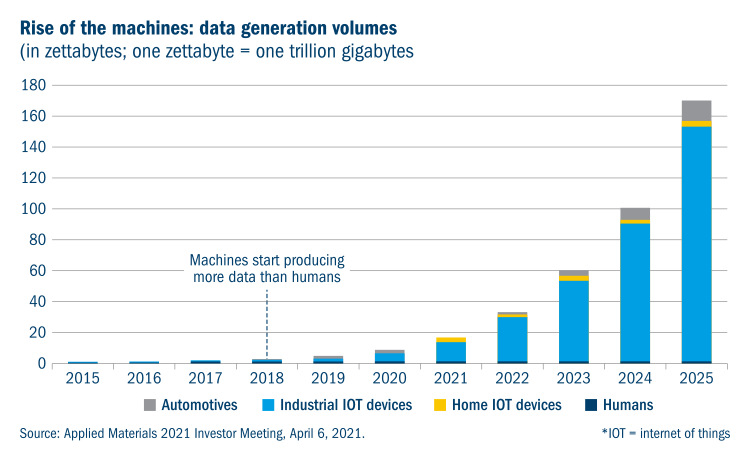
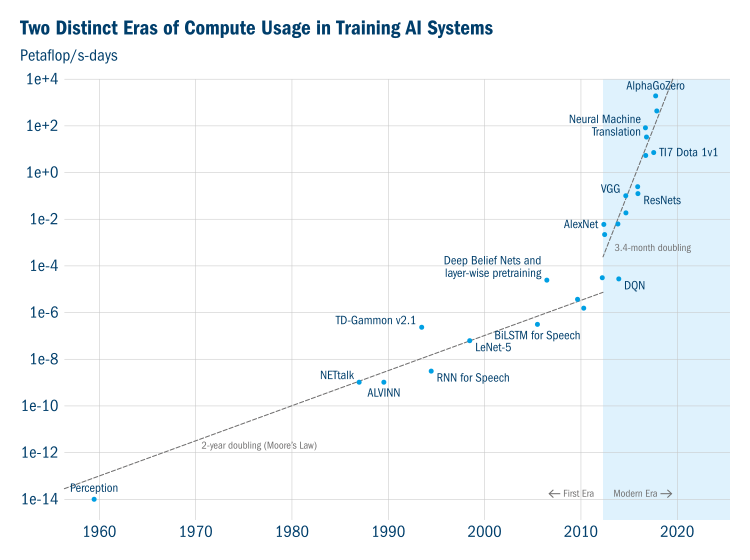
Source: OpenAI
Further upstream, we own ASML, the dominant global player in lithography equipment, which uses light to pattern circuity onto silicon wafers. Without this patterning equipment, the miniaturisation of semi-conductors is impossible. Investing billions of dollars into Research & Development over a 17-year period, ASML developed a 100% global market share of Extreme Ultraviolet (EUV) lithography, which creates extraordinarily finely patterned circuity on chips. To generate this EUV light, a CO2 laser fires two separate laser pulses at a fast-moving drop of tin, which vaporises the tin and creates EUV light. It does this up to 50,000 times per second.
Each of these EUV machines cost hundreds of millions of dollars, take 12-18 months to make, and involve the coordination of literally thousands of suppliers. Shipped to TSMC, Intel and Samsung, each machine weighs a staggering 180 tonnes, and must be disassembled and transported in 40 shipping containers, across multiple aeroplanes, and once on site at a chipmaker, an ASML team must be onsite to maintain them. ASML has an enormous R&D lead versus its peers, and an order backlog worth tens of billions of dollars and its incredibly sophisticated machines are theoretically precise enough to hit your thumb with a laser pointer from the moon.
Structural demand for chips
The spread of artificial intelligence through the economy and through the world will be a remarkable, profound, and perhaps nerve-racking process. It will likely involve both the creation and destruction of companies and change the way work is done forever. But one thing is almost certain: it will require more and more compute power, and chips will underpin this. We believe that TSMC and ASML are two of the best, most dominantly positioned businesses in the world to form the backbone of this chip manufacturing boom.