


at
AT
Austria
de-AT
at_intm_classes
intm
Intermediary
de
de
For use by professional clients and/or equivalent investor types in your jurisdiction (not to be used with or passed on to retail clients).
Electrical pylon against red sky at sunset

Insights

Security, supply and the energy transition

Vicki Bakhshi
Vicki Bakhshi
Climate Strategist

Geopolitical shocks have reframed the energy transition as a question of security as well as climate. As governments seek more resilient, affordable energy systems, long-term investors can find opportunities in the infrastructure powering the shift.

For much of the past decade, the energy transition has been framed primarily as a climate story. That no longer captures the reality. Russia’s invasion of Ukraine and the recent conflict in the Middle East have been a stark demonstration to governments and investors that energy systems are also sources of macroeconomic risk, geopolitical vulnerability and industrial advantage. The transition is now being shaped by all these forces at once, and long-term capital needs to understand how they interact.

A more security-conscious world

The Iran conflict produced the largest supply disruption in the history of the global oil market as flows through the Strait of Hormuz fell from 20 million barrels per day to an average of 2.7 million in March, April and May. Oil prices doubled, but record inventory drawdowns, a surge in US exports and remarkable agility from Gulf producers in rerouting supply helped absorb the disruption.1 Nevertheless these are short-term buffers and uncertainty remains as to whether a lasting US-Iran agreement can be reached.

The political response will prove more enduring than any single ceasefire. Both the Ukraine and Middle East conflicts have shaken confidence in imported fossil fuels, prompting policymakers to reassess their exposure to distant geopolitical shocks. Energy security has moved back to the top of the agenda, alongside affordability, and is unlikely to slip simply if oil and gas prices stabilise.

Fossil fuel importers, including much of Europe and large parts of Asia, have the strongest incentive to reduce exposure, while producers such as the US are cushioned by domestic resources.

The economics have shifted

A crucial part of this story is the improved economics of mature clean energy technologies. Solar, onshore wind, batteries and grids are now among the cheapest sources of new electricity across large parts of the world2. For many governments, particularly net importers, clean energy is no longer solely a climate choice; it is increasingly the most cost-effective route to stable domestic energy prices and greater energy security.

Europe’s AccelerateEU programme reflects this alignment. It is framed around energy security and homegrown clean energy, with electrification, grids and renewables at its core. Yet there is pragmatism about what „homegrown“ can realistically mean. Policymakers recognise it is not feasible to compete directly with China’s scale and cost position. The more realistic path is to focus on joint ventures, domestic content requirements and local assembly, supporting jobs, technical capability and supply chain resilience while accepting that much of the intellectual property will come from China.

The crisis has also had a divergent impact across the EU, depending on the existing penetration levels of non-fossil fuel energy. Gas price spikes during the Ukraine and the Middle East conflicts had an outsized impact on how much European electricity costs due to the way electricity is priced on the marginal (or last) unit of electricity bought – which typically tends to be gas. But through growing its renewable energy, Spain has largely decoupled electricity prices from the price of gas (Figure 1) – demonstrating a durable route to stable, affordable energy prices. Nonetheless delivery depends on planning reform, grid connections and policy stability.

Figure 1: European divergence

Countries with more non-fossil fuels have been less affected by the Middle East crisis
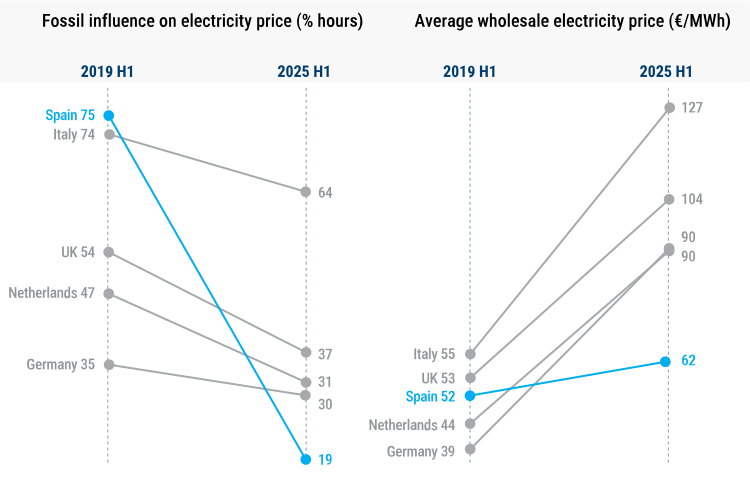
Figure 1: European divergence

Source: EMBER, Decoupled: how Spain cut the link between gas and power prices using renewables”, 2025. Charts show top five countries in EU plus UK by installed gas generation capacity. Fossil influence on electricity prices measured by % hours when electricity price is above the cost of gas power.

China and the US prioritise security and growth

China itself has spent years building greater energy independence, with leaders highly conscious of the need to decouple its domestic energy requirements from global oil and gas markets, given its lack of domestic resources. With energy security goals in mind, it has built domestic clean-energy manufacturing and now dominates global supply chains for solar, batteries, wind and hydrogen inputs, as well as being by far the world’s largest investor in deployment. Alongside this, huge strategic reserves of oil have enabled China to drastically cut imports during this latest crisis to an eight-year low3 – this has cushioned the domestic economic impact of the war, as well as reducing the severity of the global oil price spike.

In the US, meanwhile, energy policy is dominated by the need to meet growing electricity demand – primarily a result of data centre growth as well as other factors including industrial electrification. Unlike in Europe and Asia, domestic natural gas prices have been largely insulated from the current crisis, due to plentiful domestic supply.  However, while gas is expected to remain the single largest generation source at 40% into 2027, renewable generation, particularly from solar, is expected to supply the majority of growth in total US electricity generation.4 This reflects the favourable economics of renewables as well as supply chain bottlenecks for new gas generation, leading to strong growth despite political headwinds.

Sequencing, not slowdown

Recent events are changing the sequencing of the transition rather than derailing it. Mature, cost-competitive renewable technologies with clear security benefits should continue to see strong momentum. Less mature technologies dependent on subsidy, such as green hydrogen and some carbon capture applications, face a tougher environment. Columbia Threadneedle’s energy transition scoring framework, which assesses around 2,500 companies across base, slow and rapid scenarios, reflects this differentiation, with utilities and selected industrials emerging as structural beneficiaries.

The investment opportunity: Grids and storage

Grids sit at the intersection of almost every structural theme in today’s energy system: rising electricity demand, renewable integration, storage to manage intermittency, and the resilience of ageing networks. Global grid investment has already risen from around $300 billion in 2020 to more than $500 billion today, while battery storage has grown from roughly $5 billion to $100 billion.5

Further growth potential is significant. As more renewable capacity comes online, the need for transmission, distribution, storage and grid automation will intensify. Bottlenecks, from multi-year waiting lists for transformers to constrained grid connections, are already a feature of many markets. This creates opportunities across the value chain: regulated grid operators expanding their asset base; manufacturers of transformers, cables and smart-grid technologies; and the materials that make grid build-out possible, most notably copper.

A similar dynamic is playing out in transport. As EVs move closer to price parity with internal combustion engines, competitive positioning across autos is being reshaped by battery cost, range, technology strategy and supply chain access. This creates clear differentiation between winners and losers among global automakers, as well as opportunities further down the value chain – for example, in premium tyres, where heavier EVs generate greater wear and higher replacement demand.

Figure 2: Investment opportunities in grids and storage
Annual investment growth by country or region and category, 2020-2026e
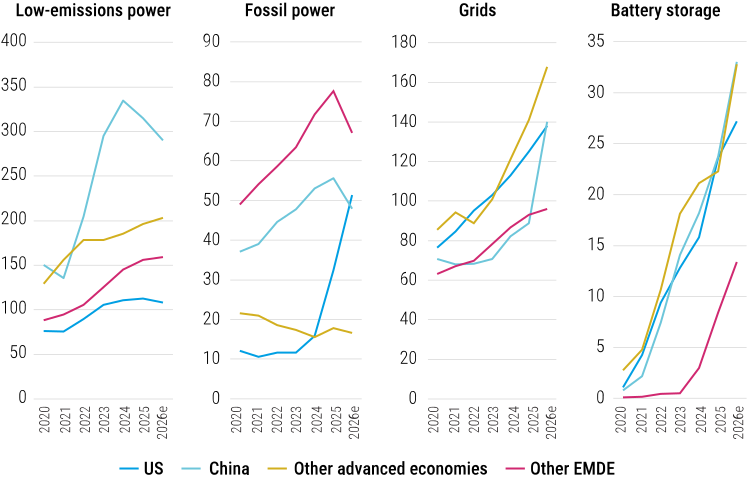
Figure 2: Investment opportunities in grids and storage

Source: IEA World Energy Investment 2026. MER = market exchange rate. 2026e = estimated. Estimates and forecasts are provided for illustrative purposes only. They are not a guarantee of future performance and should not be relied upon for any investment decision. Estimates are based on assumptions and subject to change without notice.

The bottom line

The energy transition has not paused; its investment character is evolving. It is becoming more security-led, infrastructure-heavy, regionally differentiated and embedded in national industrial strategy. The war in the Middle East has accelerated these existing trends.

This has three practical implications. First, scenario analysis matters more than ever, as a single central case is unlikely to capture the range of plausible outcomes. Second, opportunities are increasingly concentrated in the physical build-out of resilient energy systems, with grids a particularly compelling focus. Third, transition finance is likely to grow as investors support high-emitting companies with credible decarbonisation plans, alongside dedicated climate solutions providers.

Recent events have not weakened the case for the energy transition. They have reframed it. Energy security and climate ambition are increasingly two sides of the same investment story, and long-term investors positioned to recognise that convergence should be well placed for the decade ahead.


Hauptthemen

Abonnieren Sie Insights

Optimieren Sie unsere auf Sie zugeschnittene E-Mail, indem Sie die Arten von Insights und Informationen, die Sie von uns erhalten möchten, individuell anpassen.

Aktuelle Beiträge

As hyperscalers commit vast sums to data centres, the more compelling story for credit investors may be the manufacturers supplying the physical infrastructure.
Geopolitical shocks have reframed the energy transition as a question of security as well as climate. As governments seek more resilient, affordable energy systems, long-term investors can find opportunities in the infrastructure powering the shift.
Hopes of a swift resolution to the conflict in the Middle East are being challenged by recent events. We have once again seen the ‘closure’ of the Strait of Hormuz by Iran and a blockade of Iranian shipping reinstated by the US.
Hauptthemen
Verwandte Themen

1 How global oil supplies have readjusted to help fill the huge gap left by the Strait of Hormuz shock – IEA
2 Bloomberg NEF, Battery Storage Costs Hit Record Lows as Costs of Other Clean Power Technologies Increased, 18 February 2026
3 Bloomberg, China Oil Imports Fall to Eight-Year Low as Run Cuts Ease Demand, 9 June 2026
4 US Energy Information Administration, Short-Term Energy Outlook, July 2026
5 International Energy Agency, World Energy Investment 2026, 2026

Important information

For use by professional clients and/or equivalent investor types in your jurisdiction (not to be used with or passed on to retail clients). For marketing purposes.

This document is intended for informational purposes only and should not be considered representative of any particular investment. This should not be considered an offer or solicitation to buy or sell any securities or other financial instruments, or to provide investment advice or services. Investing involves risk including the risk of loss of principal. Your capital is at risk.  Market risk may affect a single issuer, sector of the economy, industry or the market as a whole. The value of investments is not guaranteed, and therefore an investor may not get back the amount invested. International investing involves certain risks and volatility due to potential political, economic or currency fluctuations and different financial and accounting standards. The securities included herein are for illustrative purposes only, subject to change and should not be construed as a recommendation to buy or sell. Securities discussed may or may not prove profitable. The views expressed are as of the date given, may change as market or other conditions change and may differ from views expressed by other Columbia Threadneedle Investments (Columbia Threadneedle) associates or affiliates. Actual investments or investment decisions made by Columbia Threadneedle and its affiliates, whether for its own account or on behalf of clients, may not necessarily reflect the views expressed. This information is not intended to provide investment advice and does not take into consideration individual investor circumstances. Investment decisions should always be made based on an investor’s specific financial needs, objectives, goals, time horizon and risk tolerance. Asset classes described may not be suitable for all investors. Past performance does not guarantee future results, and no forecast should be considered a guarantee either. Information and opinions provided by third parties have been obtained from sources believed to be reliable, but accuracy and completeness cannot be guaranteed. This document and its contents have not been reviewed by any regulatory authority.

In Australia: Issued by Threadneedle Investments Singapore (Pte.) Limited [“TIS”], ARBN 600 027 414.  TIS is exempt from the requirement to hold an Australian financial services licence under the Corporations Act 2001 (Cth) and relies on Class Order 03/1102 in respect of the financial services it provides to wholesale clients in Australia. This document should only be distributed in Australia to “wholesale clients” as defined in Section 761G of the Corporations Act.  TIS is regulated in Singapore (Registration number: 201101559W) by the Monetary Authority of Singapore under the Securities and Futures Act (Chapter 289), which differ from Australian laws.

In Singapore: Issued by Threadneedle Investments Singapore (Pte.) Limited, 3 Killiney Road, #07-07, Winsland House 1, Singapore 239519, which is regulated in Singapore by the Monetary Authority of Singapore under the Securities and Futures Act (Chapter 289). Registration number: 201101559W. This advertisement has not been reviewed by the Monetary Authority of Singapore.

In Hong Kong: Issued by Threadneedle Portfolio Services Hong Kong Limited 天利投資管理香港有限公司. Unit 3004, Two Exchange Square, 8 Connaught Place, Hong Kong, which is licensed by the Securities and Futures Commission (“SFC”) to conduct Type 1 regulated activities (CE:AQA779). Registered in Hong Kong under the Companies Ordinance (Chapter 622), No. 1173058.

In Japan: Issued by Columbia Threadneedle Investments Japan Co., Ltd. Financial Instruments Business Operator, The Director-General of Kanto Local Finance Bureau (FIBO) No.3281, and a member of Investment Management Association of Japan and Type II Financial Instruments Firms Association.

In the UK: Issued by Threadneedle Asset Management Limited, No. 573204 and/or Columbia Threadneedle Management Limited, No. 517895, both registered in England and Wales and authorised and regulated in the UK by the Financial Conduct Authority.

In the EEA: Issued by Threadneedle Management Luxembourg S.A., registered with the Registre de Commerce et des Sociétés (Luxembourg), No. B 110242 and/or Columbia Threadneedle Netherlands B.V., regulated by the Dutch Authority for the Financial Markets (AFM), registered No. 08068841.

In Switzerland: Issued by Threadneedle Portfolio Services AG, Registered address: Claridenstrasse 41, 8002 Zurich, Switzerland.

In the Middle East: This document is distributed by Columbia Threadneedle Investments (ME) Limited, which is regulated by the Dubai Financial Services Authority (DFSA).  For Distributors: This document is intended to provide distributors with information about Group products and services and is not for further distribution. For Institutional Clients: The information in this document is not intended as financial advice and is only intended for persons with appropriate investment knowledge and who meet the regulatory criteria to be classified as a Professional Client or Market Counterparties and no other Person should act upon it.

This document may be made available to you by an affiliated company which is part of the Columbia Threadneedle Investments group of companies: Columbia Threadneedle Management Limited in the UK; Columbia Threadneedle Netherlands B.V., regulated by the Dutch Authority for the Financial Markets (AFM), registered No. 08068841.

Columbia Threadneedle Investments is the global brand name of the Columbia and Threadneedle group of companies. © 2026 Columbia Threadneedle. All rights reserved.

Verwandte Beiträge

30 April 2026

Emma Lupton

Vice President, Responsible Investment

Is the world on track for a more sustainable future?

Understanding sustainability trends and the interactions between people and planet is fundamental to identifying future investment opportunities.
26 Februar 2026

Vicki Bakhshi

Climate Strategist

The evolving landscape of climate investing

Climate change and the energy transition are multi-decadal themes that are shaping the world we live in, with wide-ranging implications for investors.
19 November 2025

Natalia Luna

Senior Thematic Investment Analyst

Vicki Bakhshi

Climate Strategist

Evaluating the impact of the energy transition: Our systematic view of risks and opportunities

We view the energy transition as a global megatrend set to drive capital flows for decades to come.
23 Juli 2026

Gregory Turnbull Schwartz

Senior Analyst, Fixed Income

Data centres: the credit opportunity beyond hyperscalers

As hyperscalers commit vast sums to data centres, the more compelling story for credit investors may be the manufacturers supplying the physical infrastructure.
22 Juli 2026

Asset Allocation update - Q3 2026

Hopes of a swift resolution to the conflict in the Middle East are being challenged by recent events. We have once again seen the ‘closure’ of the Strait of Hormuz by Iran and a blockade of Iranian shipping reinstated by the US.
22 Juli 2026

David Moss

Senior Portfolio Manager and Head of European Equity Research Strategy

Europe’s industrial revolution brings new growth opportunities

Europe is at a pivot point, caught between geopolitical uncertainties, industrial change and an inversion of the sources of growth. Behind this volatility lies deep structural change.

Important information

For use by professional clients and/or equivalent investor types in your jurisdiction (not to be used with or passed on to retail clients). For marketing purposes.

This document is intended for informational purposes only and should not be considered representative of any particular investment. This should not be considered an offer or solicitation to buy or sell any securities or other financial instruments, or to provide investment advice or services. Investing involves risk including the risk of loss of principal. Your capital is at risk.  Market risk may affect a single issuer, sector of the economy, industry or the market as a whole. The value of investments is not guaranteed, and therefore an investor may not get back the amount invested. International investing involves certain risks and volatility due to potential political, economic or currency fluctuations and different financial and accounting standards. The securities included herein are for illustrative purposes only, subject to change and should not be construed as a recommendation to buy or sell. Securities discussed may or may not prove profitable. The views expressed are as of the date given, may change as market or other conditions change and may differ from views expressed by other Columbia Threadneedle Investments (Columbia Threadneedle) associates or affiliates. Actual investments or investment decisions made by Columbia Threadneedle and its affiliates, whether for its own account or on behalf of clients, may not necessarily reflect the views expressed. This information is not intended to provide investment advice and does not take into consideration individual investor circumstances. Investment decisions should always be made based on an investor’s specific financial needs, objectives, goals, time horizon and risk tolerance. Asset classes described may not be suitable for all investors. Past performance does not guarantee future results, and no forecast should be considered a guarantee either. Information and opinions provided by third parties have been obtained from sources believed to be reliable, but accuracy and completeness cannot be guaranteed. This document and its contents have not been reviewed by any regulatory authority.

In Australia: Issued by Threadneedle Investments Singapore (Pte.) Limited [“TIS”], ARBN 600 027 414.  TIS is exempt from the requirement to hold an Australian financial services licence under the Corporations Act 2001 (Cth) and relies on Class Order 03/1102 in respect of the financial services it provides to wholesale clients in Australia. This document should only be distributed in Australia to “wholesale clients” as defined in Section 761G of the Corporations Act.  TIS is regulated in Singapore (Registration number: 201101559W) by the Monetary Authority of Singapore under the Securities and Futures Act (Chapter 289), which differ from Australian laws.

In Singapore: Issued by Threadneedle Investments Singapore (Pte.) Limited, 3 Killiney Road, #07-07, Winsland House 1, Singapore 239519, which is regulated in Singapore by the Monetary Authority of Singapore under the Securities and Futures Act (Chapter 289). Registration number: 201101559W. This advertisement has not been reviewed by the Monetary Authority of Singapore.

In Hong Kong: Issued by Threadneedle Portfolio Services Hong Kong Limited 天利投資管理香港有限公司. Unit 3004, Two Exchange Square, 8 Connaught Place, Hong Kong, which is licensed by the Securities and Futures Commission (“SFC”) to conduct Type 1 regulated activities (CE:AQA779). Registered in Hong Kong under the Companies Ordinance (Chapter 622), No. 1173058.

In Japan: Issued by Columbia Threadneedle Investments Japan Co., Ltd. Financial Instruments Business Operator, The Director-General of Kanto Local Finance Bureau (FIBO) No.3281, and a member of Investment Management Association of Japan and Type II Financial Instruments Firms Association.

In the UK: Issued by Threadneedle Asset Management Limited, No. 573204 and/or Columbia Threadneedle Management Limited, No. 517895, both registered in England and Wales and authorised and regulated in the UK by the Financial Conduct Authority.

In the EEA: Issued by Threadneedle Management Luxembourg S.A., registered with the Registre de Commerce et des Sociétés (Luxembourg), No. B 110242 and/or Columbia Threadneedle Netherlands B.V., regulated by the Dutch Authority for the Financial Markets (AFM), registered No. 08068841.

In Switzerland: Issued by Threadneedle Portfolio Services AG, Registered address: Claridenstrasse 41, 8002 Zurich, Switzerland.

In the Middle East: This document is distributed by Columbia Threadneedle Investments (ME) Limited, which is regulated by the Dubai Financial Services Authority (DFSA).  For Distributors: This document is intended to provide distributors with information about Group products and services and is not for further distribution. For Institutional Clients: The information in this document is not intended as financial advice and is only intended for persons with appropriate investment knowledge and who meet the regulatory criteria to be classified as a Professional Client or Market Counterparties and no other Person should act upon it.

This document may be made available to you by an affiliated company which is part of the Columbia Threadneedle Investments group of companies: Columbia Threadneedle Management Limited in the UK; Columbia Threadneedle Netherlands B.V., regulated by the Dutch Authority for the Financial Markets (AFM), registered No. 08068841.

Columbia Threadneedle Investments is the global brand name of the Columbia and Threadneedle group of companies. © 2026 Columbia Threadneedle. All rights reserved.

Icon checked

Vielen Dank. Sie können jetzt Ihr Präferenzzentrum besuchen, um auszuwählen, welche Insights Sie per E-Mail erhalten möchten.

Bitte bestätigen Sie einige Angaben zu Ihrer Person, um Ihr Präferenzzentrum zu besuchen

*Pflichtfelder

Etwas ist schiefgelaufen, bitte versuchen Sie es erneut

Vielen Dank. Sie können jetzt Ihr Präferenzzentrum besuchen, um auszuwählen, welche Einblicke Sie per E-Mail erhalten möchten.

Um zu sehen und zu aktualisieren, welche Erkenntnisse Sie von uns per E-Mail erhalten, besuchen Sie bitte Ihr Preference Center.