
es
ES
Spain
es-ES
es_inst_classes
inst
Institutional
es
es
Insights

Asset Allocation Monthly

Please enter latest Asset Allocation text

We all know – or rather, have heard of – Warren Buffet. One of his more famous mantras is: to get rich you need to be fearful when others are greedy, and greedy when others are fearful. Of course, this is much harder than it sounds, particularly over the long term. But it captures well how we have traversed asset markets in the short but tumultuous recent months, raising our appetite for risk near the March nadir, and then reversing back down to neutral at the end of June.

Risk appetite can be a loaded term. Put simply, it reflects expectations of how volatile assets might be rewarded, with high prospective returns per unit of risk associated with greater risk appetite, and vice versa.

Central banks responded by attempting to maintain market liquidity. As a result of all the pandemic financial support programs central banks’ balance sheets have grown – the European Central Bank (ECB) by €645 billion, and the US Federal Reserve’s by $2.3 trillion.1 Fed action sought to buy the “Fallen Angels” – bonds that were investment grade but whose credit ratings had been reduced to junk bond status – and high yield ETFs. There was also talk that the ECB might follow suit.

In March, as economies were buffeted by “sudden stops” in economic activity as countries were shut down to contain the spread of Covid-19, fear percolated the valuation of pretty much every asset class. Investment grade corporate bonds were compensating investors for 50 times the historical rate of defaults, for instance, while several equity indices were priced at or close to book value, stripped down to the realisable value of assets in liquidation. Yet at the same time, unprecedented global policy stimulus was released into credit and labour markets. We believed that although sharp recessions were likely – far greater than any experienced in post-war history – this would ultimately prove to be a temporary shock, with the US economy for instance regaining Q4-2019 levels by the end of 2022.

So in March and April we “leaned in” to the prospect of super-normal returns in select risk markets that seemed well placed to benefit. By investing in highly rated corporate bonds and raising and rotating our equity exposure towards the US and away from cyclical areas of Japan and the UK, we simultaneously raised both the quality and quantity of risk in total return multi-asset portfolios.

Fast forward to today, and the world feels different – taking some risk off the table feels prudent, hence our move to neutral. Equity markets and credit spreads have recouped much of what was lost in March, denting valuations (Figure 1). Expectations of reward, or asset returns, are necessarily lower than they were in March. And at the fringes, uncertainty is mounting – from second waves of the virus to trade tensions/Chinese geopolitics, US elections and how labour markets emerge once furlough and support schemes fade.
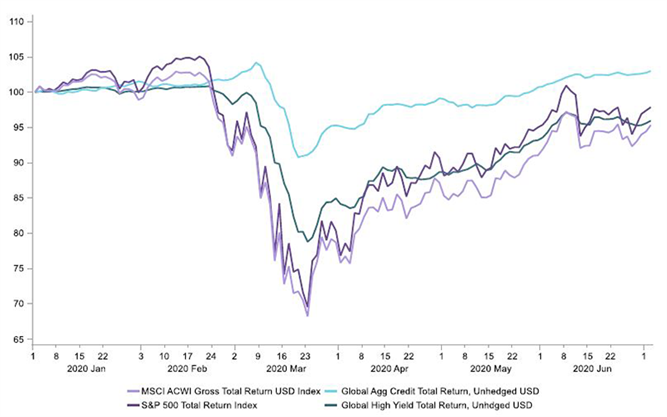
Figure 1: The year so far: a round trip for many asset markets (1 January = 100)
Source: Macrobond, June 2020

This move does not put us in a defensive mode; indeed, it leaves us quite exposed to both equity and credit risk that we continue to favour within overall risk neutrality. Policy easing continues to run at an extraordinary clip: China, Japan and Europe are among regions that are upping their games, and we expect a fresh dose of US fiscal stimulus to come through by late July-early August. Lower effective discount rates are a powerful support as economies recover and we are keen to be long assets that are most impacted, such as IG credit. As economies reset in early stages of recovery, higher equity multiples might also be expected.

Furthermore, although investor positions have been built from the March shakeout, there seems considerable room for further increases: allocations by non-bank investors to equities, for example, are still at the low end of the post-Lehman crisis period and below historical averages, with elevated offsetting cash balances.
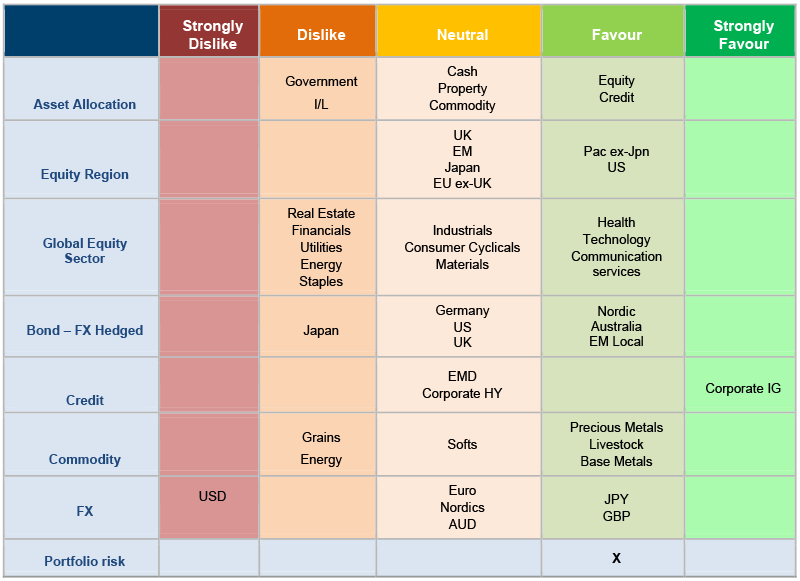
Figure 2: Asset allocation snapshot
The table showing asset allocation snapshot

Columbia Threadneedle Investments, 3 July 2020. The mention of any specific shares or bonds should not be taken as a recommendation to deal.


20 septiembre 2018
Maya Bhandari
Maya Bhandari
Fund Manager
Share article
Temas clave
Temas relacionados
Listen on Stitcher badge
Share article
Temas clave
Temas relacionados

Información importante

La investigación y el análisis incluidos en este documento han sido realizados por Columbia Threadneedle Investments para sus propias actividades de gestión, podrían haber sido utilizados con antelación a su publicación y están disponibles aquí de forma incidental. Las opiniones expresadas son en la fecha de publicación pero están sujetas a cambios sin preaviso y no deberían ser tomadas como consejo de inversión. La información obtenida de fuentes externas se considera fiable pero su exactitud o integridad no puede ser garantizada.

Opiniones relacionadas

14 septiembre 2026

¿Por qué la Reserva Federal se ve obligada a endurecer su política monetaria?

La política de los bancos centrales vuelve a estar en el primer plano de la atención de los inversores, ya que los datos de inflación desafían las expectativas de un ciclo de relajación inminente.
9 septiembre 2026

El mercado vuelve a cuestionar a los bancos centrales

Los bancos centrales vuelven a situarse en el centro del debate a las puertas de una intensa ronda de reuniones de política monetaria en septiembre.
31 julio 2026

Actualización sobre la asignación de activos: T3 2026

Los recientes acontecimientos ponen a prueba las esperanzas de una rápida resolución del conflicto en Oriente Próximo.
14 septiembre 2026

¿Por qué la Reserva Federal se ve obligada a endurecer su política monetaria?

La política de los bancos centrales vuelve a estar en el primer plano de la atención de los inversores, ya que los datos de inflación desafían las expectativas de un ciclo de relajación inminente.
9 septiembre 2026

El mercado vuelve a cuestionar a los bancos centrales

Los bancos centrales vuelven a situarse en el centro del debate a las puertas de una intensa ronda de reuniones de política monetaria en septiembre.
2 septiembre 2026

Head of EMEA Active ETFs and Investment Trust Distribution

Mercados emergentes: amplia participación y una selección de valores más precisa

Los mercados emergentes ofrecen un terreno fértil para los gestores activos, aunque la volatilidad es inherente a esta clase de activos.
true
true

Información importante

La investigación y el análisis incluidos en este documento han sido realizados por Columbia Threadneedle Investments para sus propias actividades de gestión, podrían haber sido utilizados con antelación a su publicación y están disponibles aquí de forma incidental. Las opiniones expresadas son en la fecha de publicación pero están sujetas a cambios sin preaviso y no deberían ser tomadas como consejo de inversión. La información obtenida de fuentes externas se considera fiable pero su exactitud o integridad no puede ser garantizada.

También puede resultar de interés

Enfoque de inversión

El trabajo en equipo nos define y es fundamental en nuestro proceso de inversión, estructurado para facilitar la generación, consecución e implementación de grandes y fuertes ideas de inversión para nuestras carteras.

Fondos

Columbia Threadneedle Investments dispone de una amplia gama de fondos de inversión que cubre diversos objetivos de inversión.

Capacidades de inversión

Ofrecemos un amplio abanico de soluciones y estrategias de inversión gestionadas activamente que abarcan mercados y clases de activos a escala mundial, regional y nacional.
Icon checked

Gracias. Ahora puedes visitar tu centro de preferencias​ para elegir qué información deseas recibir por correo electrónico.

Confirma algunos detalles para visitar tu centro de preferencias

*Campos obligatorios

Algo salió mal, inténtalo de nuevo

Gracias. Ahora puedes visitar tu centro de preferencias para elegir qué información te gustaría recibir por correo electrónico.

Para ver y actualizar qué información recibes de nosotros por correo electrónico, visita tu centro de preferencias.