


lu
LU
Luxembourg
en-LU
lu_intm_classes
intm
Intermediary
en
en
For use by professional clients and/or equivalent investor types in your jurisdiction (not to be used with or passed on to retail clients).

Insights

Is UK airport expansion about to take flight?

Jake Lunness
Jake Lunness
Client Portfolio Analyst, High Yield and Emerging Market Debt

Four London airports have set out plans to increase their capacity. With the costs running into the billions what will the projects actually deliver and, perhaps most importantly, who will pay for it? Bondholders take note ….

In 2024, UK airports carried 292 million passengers against a population of 69 million. That is 98% of 2019 levels (ie pre-Covid). Among the five largest UK airports, Heathrow, Manchester and Stansted all exceed 2019 levels at +4%, +5% and +6% respectively, with Heathrow, Gatwick and Luton all within touching distance of their stated capacity (Heathrow are 2 million above). In their 2024 long-term aviation outlook (using 2023 traffic as a baseline), the European Organisation for the Safety of Air Navigation (commonly known as Eurocontrol) expect annual UK flight growth of 1.3% a year to 2050. This equates to a 42% rise on 2023 levels or an extra 114 million passengers. In the context of this, and backed by London’s position as the second best financial centre globally (according to the Global Financial Centres Index), and its attractiveness as a tourist destination, airport expansion is back on the menu.

Thoughts on individual projects

In the table below we have pieced together publicly available information on the four largest London expansion projects. We have adjusted costings to 2024 prices and scaled them in order to give a cost per extra million passengers. These four airports plan extra capacity of 124.5 million versus a Eurocontrol-expected increase of 114 million.

Heathrow
Gatwick
Luton
Stansted
Traffic 2024 (millions)
83.9
43.2
16.9
29.6
Stated capacity (millions)
82
45
18
35
Current excess capacity
-1.9
1.8
1.1
5.4
Expansion aim
150
80
32
43
Extra capacity
68
35
14
8
Expansion cost (£ billion)
£33bn (2024 prices)
£2.2bn (2022 prices)
£2.4bn (first costing in 2023 assuming 2022 prices)
£1.1bn (2023 prices)
Notes
Heathrow costings for runway plus new terminal. Excludes improvements to existing infostructure.
Northern runway, moving 12 metres.
Phase 1: Expand existing terminal. Phase 2: New terminal and rail links.
£600mn for terminal expansion. £500mn for larger security hall, taxiway upgrade and broader refurbishments.
Inflation adjustment
1
1.07
1.07
1.03
2024 prices
33.00
2.35
2.56
1.13
Cost per 1mn passengers (£)
485,294,118
67,005,714
182,742,857
140,937,500
Timing for extra capacity
Third runway operational within a decade. 150 million of capacity by 2065.
Runway could be operational by 2030.
2019 submission saw 25 milion capacity and new terminal by 2027 and 32 million capacity by 2038 (now targeting 2043).
First part of extra capacity in 2029. Ambition to reach 43 million by the next decade.
Planning permission
Approval target: 2029
Approved: October 2025
Approved: April 2025
Approved: October 2023 (planning permission)

Heathrow: The estimated £33 billion expansion cost delivers an additional terminal, three new satellite terminals, extra airfield infrastructure and a new full-length runway (including the diversion of the M25). The expansion is the costliest, yet to be fully approved and one of the farthest into the future. Heathrow is unique in its role as the UK’s only hub airport (meaning it facilitates connecting flights, which can make otherwise non-viable point-to-point routes feasible), it has the highest proportion of business traffic (23% versus 10% for Gatwick), and has 98% of carriers being full cost (of which carriers lean on premium customers), which is supportive of lower customer price sensitivity. To expand, Heathrow requires planning reform from the government, airspace modernisation and a return to an A- credit rating at Fitch. The Civil Aviation Authority is also revisiting the current regulatory model in an effort to suppress high passenger charges.  

Gatwick: This project screens favourably in terms of cost per one million passengers. However what £2.2 billion delivers is unclear. Gatwick’s expansion involves moving the existing standby runway 12 metres, allowing both runways to operate simultaneously. However, it is not clear how much extra terminal capacity (if any) is created. We understand that the runway is the main capacity constraint. However, increasing capacity by 78% using existing terminals would be a stretch. Additionally, we assume the pricing is subject to revisions, as this costing was revealed in 2023.  

Luton: Phase one of the plan retains a single runway but creates extra taxiways and expands its existing (sole) terminal (originally on an eight-year timeline starting in 2019). Phase two will add new railway links alongside a second terminal. The cost per additional passenger screens higher than Gatwick or Stansted. The costing, which is larger than Gatwick or Stansted, should be seen in the context of Luton being 40% smaller than Stansted and having a primarily ultra-low-cost carrier base (Wizz and Ryanair), so you would expect more price sensitivity here, especially given Ryanair recently cut three million seats to Spanish airports following a 6.5% charge increase.

Stansted: From a fixed income perspective our preferred project. This is due to less operational complexity (the retention of one terminal and runway and its location further away from large population centres, meaning less need for local housing purchases) and costings are lower than Luton and screen similar to Gatwick on a cost-per-1 million passengers basis. Stansted have costed the terminal expansion and departure lounge reconfiguration element of this at £600million. The owner, Manchester Airports Group, is also in the fortunate position of already having excess capacity and approval for the expansion. The first additional part of capacity is expected in 2029. Stansted also have the lowest airport charges of the London airports, according to Gatwick Airport at a recent investor roadshow (Figure 1).

Figure 1: Net airport charges1 (£s per passenger, 2023)
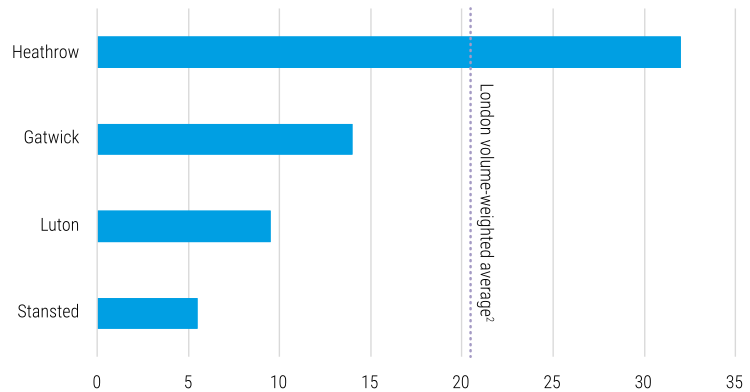
Source: Company information / Oxera data / London City Airport Annual Report 2023. Notes: 1Calculated based on 2023 annual reports, inflated to 2024 prices. Luton based on year-to-date 2024 aero yield/pax. Other airports based on Oxera data. 2Average weighted by 2023 passenger volumes.

Who is paying for this?

Not the government. The expansions will be funded by a combination of debt, equity and retained cash flows in the absence of sufficient war chests or divestitures. Higher cash flows can be driven by higher traffic volumes (which won’t happen instantaneously) or higher margins (efficiency comes over time). However, upfront funding comes in the form of higher airport charges (up to around 25% of ticket prices), which are set based on bilateral negotiations with airlines or through regulatory mechanisms in the case of economically regulated airports like Heathrow. For example, as part of Heathrow’s upcoming five-year plan they are seeking a 17% tariff uplift and a £2 billion equity contribution (derived from deferred dividends) alongside bondholder financing. The problem each airport faces, to varying degrees, is how far can they raise tariffs without becoming uncompetitive – a problem somewhat alleviated by expansions in the UK and wider Europe (for example, Amsterdam, Madrid and Frankfurt).

Winners and losers

Winners: The government and the wider economy. Heathrow claim their expansion will add 0.4% to the UK’s GDP by 2050; Luton, Stansted and Gatwick claim there will be an extra £1.5 billion, £2 billion and £1 billion of economic activity respectively following the completion of their projects. You would expect some interim capacity and benefits to be felt as the projects approach completion, and if executed correctly the government is getting something for nothing in the long run.

Losers: Larger incumbent airlines in the short to medium term. Airlines will be expected to partially foot the bill for these expansions, with airports trying to sway airlines with the prospect of better services and more capacity for growth. However, the attractiveness of this prospect depends on the extent to which airlines expect to grow – they could pay for opening themselves up to more competition. Higher capacity will almost certainly reduce the value of lucrative Heathrow slots that are traded between airlines, which have previously been traded for as much as £75 million.

Unclear: Bondholders will also be expected to fund growth and as such face exposure to project risk (think HS2). However, this will very much depend on the equity holder contribution and the extent to which airports are allowed to raise tariffs. Heathrow are targeting a rating upgrade to A- ahead of expansion and view that as a contingency to growth. It is also unclear where the consumer sits in all this. On one hand, airport tariffs will be – at least partially – passed on to the consumer; but limited slots and anti-competitive underutilised slot retention will restrict competition and isn’t supportive of competitive ticket prices. Having more slots at a hub airport such as Heathrow could also open more direct routes, with connecting traffic having the potential to make routes to certain destinations viable that otherwise would not have been on a point-to-point basis. 

The bottom line

The successes of each expansion will hinge on balancing the needs of airlines and customers alongside debt and equity investors. London’s airports have proven their resilience during previous crises but now face a new challenge: funding their expansions while maintaining competitiveness, as well as appeasing financial markets that may react emotionally to headlines. Being active investment managers, we are afforded the opportunity to invest in an airport that compensates us for its expansion risk rather than buying the whole sector.

Airports, interestingly, benefit from a fiscally constrained UK government eager to support growth despite declining productivity. And with London’s enduring status as a cultural and financial hub, the appetite to visit (and escape) persists. In a sector where strategic execution and market sentiment can shift rapidly, adaptability isn’t optional – it’s essential. For those seeking to turn long-term aviation growth into resilient returns, active management stands out as the smarter choice.


Key topics

Subscribe to insights

Get the most out of your email by tailoring the types of insights and information you would like to receive from us.

Latest articles

A spectacular start to 2026 saw the Venezuelan president whisked off to jail in the US, which caused a spike in bond prices. We wrap up the end of 2025 and focus on what’s to come in 2026. Read on for a breakdown of fixed income news across sectors and regions.
Four London airports have set out plans to increase their capacity. With the costs running into the billions what will the projects actually deliver and, perhaps most importantly, who will pay for it?
Welcome to the first market perspectives of 2026. Today we focus on geopolitics and US actions in removing Venezuelan President Maduro over the weekend.
Key topics
Related topics

Important information

For use by professional clients and/or equivalent investor types in your jurisdiction (not to be used with or passed on to retail clients). For marketing purposes.

This document is intended for informational purposes only and should not be considered representative of any particular investment. This should not be considered an offer or solicitation to buy or sell any securities or other financial instruments, or to provide investment advice or services. Investing involves risk including the risk of loss of principal. Your capital is at risk.  Market risk may affect a single issuer, sector of the economy, industry or the market as a whole. The value of investments is not guaranteed, and therefore an investor may not get back the amount invested. International investing involves certain risks and volatility due to potential political, economic or currency fluctuations and different financial and accounting standards. The securities included herein are for illustrative purposes only, subject to change and should not be construed as a recommendation to buy or sell. Securities discussed may or may not prove profitable. The views expressed are as of the date given, may change as market or other conditions change and may differ from views expressed by other Columbia Threadneedle Investments (Columbia Threadneedle) associates or affiliates. Actual investments or investment decisions made by Columbia Threadneedle and its affiliates, whether for its own account or on behalf of clients, may not necessarily reflect the views expressed. This information is not intended to provide investment advice and does not take into consideration individual investor circumstances. Investment decisions should always be made based on an investor’s specific financial needs, objectives, goals, time horizon and risk tolerance. Asset classes described may not be suitable for all investors. Past performance does not guarantee future results, and no forecast should be considered a guarantee either. Information and opinions provided by third parties have been obtained from sources believed to be reliable, but accuracy and completeness cannot be guaranteed. This document and its contents have not been reviewed by any regulatory authority.

In Australia: Issued by Threadneedle Investments Singapore (Pte.) Limited [“TIS”], ARBN 600 027 414.  TIS is exempt from the requirement to hold an Australian financial services licence under the Corporations Act 2001 (Cth) and relies on Class Order 03/1102 in respect of the financial services it provides to wholesale clients in Australia. This document should only be distributed in Australia to “wholesale clients” as defined in Section 761G of the Corporations Act.  TIS is regulated in Singapore (Registration number: 201101559W) by the Monetary Authority of Singapore under the Securities and Futures Act (Chapter 289), which differ from Australian laws.

In Singapore: Issued by Threadneedle Investments Singapore (Pte.) Limited, 3 Killiney Road, #07-07, Winsland House 1, Singapore 239519, which is regulated in Singapore by the Monetary Authority of Singapore under the Securities and Futures Act (Chapter 289). Registration number: 201101559W. This advertisement has not been reviewed by the Monetary Authority of Singapore.

In Hong Kong: Issued by Threadneedle Portfolio Services Hong Kong Limited 天利投資管理香港有限公司. Unit 3004, Two Exchange Square, 8 Connaught Place, Hong Kong, which is licensed by the Securities and Futures Commission (“SFC”) to conduct Type 1 regulated activities (CE:AQA779). Registered in Hong Kong under the Companies Ordinance (Chapter 622), No. 1173058.

In Japan: Issued by Columbia Threadneedle Investments Japan Co., Ltd. Financial Instruments Business Operator, The Director-General of Kanto Local Finance Bureau (FIBO) No.3281, and a member of Japan Investment Advisers Association and Type II Financial Instruments Firms Association.

In the UK: Issued by Threadneedle Asset Management Limited, No. 573204 and/or Columbia Threadneedle Management Limited, No. 517895, both registered in England and Wales and authorised and regulated in the UK by the Financial Conduct Authority.

In the EEA: Issued by Threadneedle Management Luxembourg S.A., registered with the Registre de Commerce et des Sociétés (Luxembourg), No. B 110242 and/or Columbia Threadneedle Netherlands B.V., regulated by the Dutch Authority for the Financial Markets (AFM), registered No. 08068841.

In Switzerland: Issued by Threadneedle Portfolio Services AG, Registered address: Claridenstrasse 41, 8002 Zurich, Switzerland.

In the Middle East: This document is distributed by Columbia Threadneedle Investments (ME) Limited, which is regulated by the Dubai Financial Services Authority (DFSA).  For Distributors: This document is intended to provide distributors with information about Group products and services and is not for further distribution. For Institutional Clients: The information in this document is not intended as financial advice and is only intended for persons with appropriate investment knowledge and who meet the regulatory criteria to be classified as a Professional Client or Market Counterparties and no other Person should act upon it.

This document may be made available to you by an affiliated company which is part of the Columbia Threadneedle Investments group of companies: Columbia Threadneedle Management Limited in the UK; Columbia Threadneedle Netherlands B.V., regulated by the Dutch Authority for the Financial Markets (AFM), registered No. 08068841.

Columbia Threadneedle Investments is the global brand name of the Columbia and Threadneedle group of companies. © 2026 Columbia Threadneedle. All rights reserved. columbiathreadneedle.com                                                                                                 

Related Insights

6 January 2026

In Credit Weekly Snapshot – Leaving on a jet plane

A spectacular start to 2026 saw the Venezuelan president whisked off to jail in the US, which caused a spike in bond prices. We wrap up the end of 2025 and focus on what’s to come in 2026. Read on for a breakdown of fixed income news across sectors and regions.
19 December 2025

Christopher Hult

Portfolio Manager, Investment Grade Credit

Tammie Tang

Portfolio Manager, Investment Grade Credit

Investment grade credit: Positioning for decompression

With valuations stretched, macro headwinds blowing and spreads near post-global financial crisis tights, our portfolio managers look at the state of the IG market
16 December 2025

In Credit Weekly Snapshot – Look to the future now, it’s only just begun

After an eventful 2025, what might be in store for 2026? Elsewhere, despite a few hurdles throughout the year, core investment grade markets are ending the year tighter than they started.
6 January 2026

In Credit Weekly Snapshot – Leaving on a jet plane

A spectacular start to 2026 saw the Venezuelan president whisked off to jail in the US, which caused a spike in bond prices. We wrap up the end of 2025 and focus on what’s to come in 2026. Read on for a breakdown of fixed income news across sectors and regions.
5 January 2026

Anthony Willis

Senior Economist, Multi-Asset Solutions team

Weekly Perspectives: Will the latest geopolitical shock derail markets?

Welcome to the first market perspectives of 2026. Today we focus on geopolitics and US actions in removing Venezuelan President Maduro over the weekend.
22 December 2025

Asset Allocation update - November 2025

We have seen a softening in market momentum led by US equities and based around two factors. Firstly, there are reduced expectations for an interest rate cut in the aftermath of the October’s Federal Reserve (Fed) meeting.

Important information

For use by professional clients and/or equivalent investor types in your jurisdiction (not to be used with or passed on to retail clients). For marketing purposes.

This document is intended for informational purposes only and should not be considered representative of any particular investment. This should not be considered an offer or solicitation to buy or sell any securities or other financial instruments, or to provide investment advice or services. Investing involves risk including the risk of loss of principal. Your capital is at risk.  Market risk may affect a single issuer, sector of the economy, industry or the market as a whole. The value of investments is not guaranteed, and therefore an investor may not get back the amount invested. International investing involves certain risks and volatility due to potential political, economic or currency fluctuations and different financial and accounting standards. The securities included herein are for illustrative purposes only, subject to change and should not be construed as a recommendation to buy or sell. Securities discussed may or may not prove profitable. The views expressed are as of the date given, may change as market or other conditions change and may differ from views expressed by other Columbia Threadneedle Investments (Columbia Threadneedle) associates or affiliates. Actual investments or investment decisions made by Columbia Threadneedle and its affiliates, whether for its own account or on behalf of clients, may not necessarily reflect the views expressed. This information is not intended to provide investment advice and does not take into consideration individual investor circumstances. Investment decisions should always be made based on an investor’s specific financial needs, objectives, goals, time horizon and risk tolerance. Asset classes described may not be suitable for all investors. Past performance does not guarantee future results, and no forecast should be considered a guarantee either. Information and opinions provided by third parties have been obtained from sources believed to be reliable, but accuracy and completeness cannot be guaranteed. This document and its contents have not been reviewed by any regulatory authority.

In Australia: Issued by Threadneedle Investments Singapore (Pte.) Limited [“TIS”], ARBN 600 027 414.  TIS is exempt from the requirement to hold an Australian financial services licence under the Corporations Act 2001 (Cth) and relies on Class Order 03/1102 in respect of the financial services it provides to wholesale clients in Australia. This document should only be distributed in Australia to “wholesale clients” as defined in Section 761G of the Corporations Act.  TIS is regulated in Singapore (Registration number: 201101559W) by the Monetary Authority of Singapore under the Securities and Futures Act (Chapter 289), which differ from Australian laws.

In Singapore: Issued by Threadneedle Investments Singapore (Pte.) Limited, 3 Killiney Road, #07-07, Winsland House 1, Singapore 239519, which is regulated in Singapore by the Monetary Authority of Singapore under the Securities and Futures Act (Chapter 289). Registration number: 201101559W. This advertisement has not been reviewed by the Monetary Authority of Singapore.

In Hong Kong: Issued by Threadneedle Portfolio Services Hong Kong Limited 天利投資管理香港有限公司. Unit 3004, Two Exchange Square, 8 Connaught Place, Hong Kong, which is licensed by the Securities and Futures Commission (“SFC”) to conduct Type 1 regulated activities (CE:AQA779). Registered in Hong Kong under the Companies Ordinance (Chapter 622), No. 1173058.

In Japan: Issued by Columbia Threadneedle Investments Japan Co., Ltd. Financial Instruments Business Operator, The Director-General of Kanto Local Finance Bureau (FIBO) No.3281, and a member of Japan Investment Advisers Association and Type II Financial Instruments Firms Association.

In the UK: Issued by Threadneedle Asset Management Limited, No. 573204 and/or Columbia Threadneedle Management Limited, No. 517895, both registered in England and Wales and authorised and regulated in the UK by the Financial Conduct Authority.

In the EEA: Issued by Threadneedle Management Luxembourg S.A., registered with the Registre de Commerce et des Sociétés (Luxembourg), No. B 110242 and/or Columbia Threadneedle Netherlands B.V., regulated by the Dutch Authority for the Financial Markets (AFM), registered No. 08068841.

In Switzerland: Issued by Threadneedle Portfolio Services AG, Registered address: Claridenstrasse 41, 8002 Zurich, Switzerland.

In the Middle East: This document is distributed by Columbia Threadneedle Investments (ME) Limited, which is regulated by the Dubai Financial Services Authority (DFSA).  For Distributors: This document is intended to provide distributors with information about Group products and services and is not for further distribution. For Institutional Clients: The information in this document is not intended as financial advice and is only intended for persons with appropriate investment knowledge and who meet the regulatory criteria to be classified as a Professional Client or Market Counterparties and no other Person should act upon it.

This document may be made available to you by an affiliated company which is part of the Columbia Threadneedle Investments group of companies: Columbia Threadneedle Management Limited in the UK; Columbia Threadneedle Netherlands B.V., regulated by the Dutch Authority for the Financial Markets (AFM), registered No. 08068841.

Columbia Threadneedle Investments is the global brand name of the Columbia and Threadneedle group of companies. © 2026 Columbia Threadneedle. All rights reserved. columbiathreadneedle.com                                                                                                 

Thank you. You can now visit your preference centre to choose which insights you would like to receive by email.

To view and control which insights you receive from us by email, please visit your preference centre.

Woman listens to music through headphones
Play Video

CT Property Trust- Fund Manager Update

Sed ut perspiciatis unde omnis iste natus error sit voluptatem accusantium doloremque laudantium