


lu
LU
Luxembourg
en-LU
lu_intm_classes
intm
Intermediary
en
en
For use by professional clients and/or equivalent investor types in your jurisdiction (not to be used with or passed on to retail clients).
Government buildings with US flag on sunny day

Insights

Private credit under the hood: Separating headlines from fundamentals

Anthony Pederson
Senior Analyst, Investment grade credit
Paul Smillie
Paul Smillie
Senior Analyst, Investment grade credit

Headlines about private credit ‘cockroaches’ and Business Development Company investors running for the hills are a regular occurrence. Just how worried should we be about this burgeoning part of the credit landscape?

In this piece, we focus on the relationship between the traditional financial sector (banks and insurers) and ‘private credit’ in the US. What we mean by private credit here is direct lending to US middle market companies (the term can be used more broadly to include, for example, investment grade lending).

We argue that private credit is best understood not as a repeat of past shadow‑banking excesses, but as a leveraged extension of the traditional financial system – one that concentrates risk differently and therefore demands a different lens from investors and regulators alike.

Mapping today’s private credit ecosystem

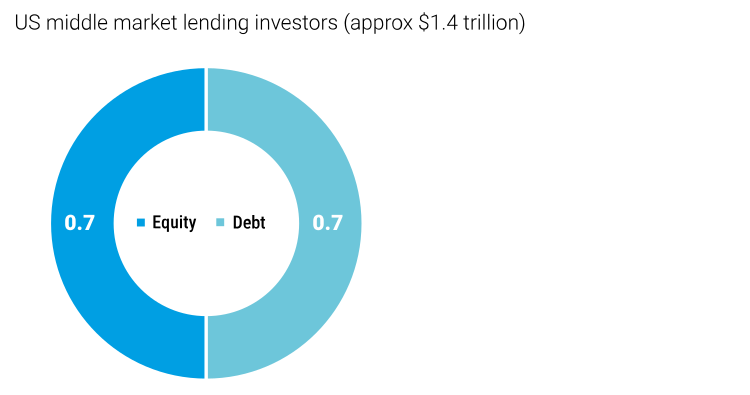
Middle market companies typically have revenues of up to $1 billion. It is called direct lending because the funds go directly from investors to the companies (ie with no banks involved). However, the actual lending decision – which companies get the cash – is typically trusted to private credit fund managers or Business Development Companies (BDCs) in about a 50/50 split. The investment in these vehicles is via both equity and debt (again about half and half). The banking sector provides most of the debt funding (about three quarters).1

Direct middle market lending is leveraged lending. The companies involved are 6x-8x leveraged with an average credit rating of B- to CCC+. The sector makes up about a third of the US leveraged lending market and is about $1.4 trillion in size.2 (We believe this is a good figure, but it is close to impossible to get precise data because it is ‘private’.) The other two thirds are the leveraged loan market and the high yield (HY) bond market, both of a similar size. Figure 1 is a simplified version of this setup.

Figure 1: The middle market lending setup
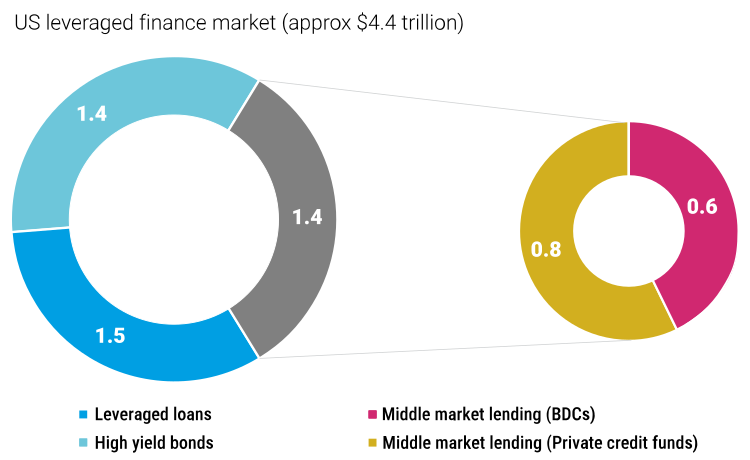
Figure 1: The middle market lending setup, The US leveraged market (LHS)
Figure 1: The middle market lending setup, US middle market credit funding sources (RHS)

Source: Columbia Threadneedle Investments’ analysis, March 2026.

At the beginning of this century, banks in the West exploited capital rules by creating an alphabet soup of credit products. Vehicles such as structured investment vehicles (SIVs), collateralised debt obligations (CDOs) of residential mortgage-backed securities (RMBS) and asset-backed commercial paper (ABCP) conduits were often opaque, off-balance sheet and highly leveraged. These entities grew rapidly, inflating prices in credit and housing markets. We all know how that ended with the global financial crisis (GFC) of 2008.

Fast-forward just five years from then and bankers in China were taking a similar approach. Corporate debt levels exploded through ‘shadow banking’ products such as local government funding vehicles (LGFVs), asset management products (AMPs) and wealth management products (WMPs). Essentially, this is another off-balance sheet debt frenzy, just with different acronyms. The effects of that debt binge are still playing out in Chinese commercial real estate today.

Regulatory constraints, unintended consequences

Have the lessons of the past reshaped credit intermediation? In some important respects the answer is no. Following the GFC, banks did face tighter oversight on leverage, most notably through the 2013 leverage lending guidelines and the subsequent Shared National Credit exams, which effectively capped the amount of leverage banks could extend to borrowers (around 6x). However, companies that wanted larger, more flexible and often cheaper financing began turning to lenders that were not restrained by these supervisory limits. At the same time, investors spent years searching for yield in a very low rate environment. This fuelled rapid expansion in non-depositary financial Institutions (NDFIs) such as private credit funds and Business Development Companies willing to provide the leverage banks could not. Banks responded by increasing their exposure to NDFIs, allowing them to remain involved in the private credit market while staying within supervisory boundaries and maintaining valuable client relationships.

The regulatory environment of the past decade has pushed banks towards lending to NDFIs by giving these exposures far more favorable capital treatment than traditional commercial loans. For example, under Basel III, loans to NDFIs often receive materially lower risk weights – 20%-30% versus 100% for traditional commercial and industrial (C&I) loans. This is because banks sit in a second-loss position and the spreads on these loans are usually higher, driven by supply and demand and complexity of the transaction. Together, these factors raise the economic appeal of NDFI lending and help explain why banks have continued to expand their presence in this channel, with little incentive to slow the growth unless capital rules change.

More recently, the easing of capital requirements and moderation of stress capital buffers for banks has only reinforced this trend. With more balance sheet capacity to deploy, banks have found NDFI lending to be the most attractive outlet relative to originating the same loans directly. This dynamic has reshaped the credit landscape, with NDFI loans rising from around $200 billion a decade ago to around $1.5 trillion in Q4 2025, which represents around 11% of total U.S. bank loans.

Politicians have short memories

This rapid growth has occurred against a backdrop of weakening supervisory oversight. The 2018 rollback of parts of the Dodd-Frank Act raised the threshold for enhanced oversight of banks from $50 billion to $100 billion, which meant category 4-5 regional banks with assets under those levels faced far less scrutiny. That lack of oversight was a driving factor in the regional bank failures we saw in Q1 2023, such as the Silicon Valley Bank.

The trend continued in October 2025 when Vice Chair of Supervision at the US Federal Reserve (Fed), Michelle Bowman, announced plans to cut around 30% of the Fed’s supervision and regulation staff. For context, a 30% cut from the current 499 authorised positions (as per the latest budget of the Federal Reserve System3) would bring headcount down to around 350, the lowest since 2011. All of this points to a clear decline in supervisory intensity since 2018, creating blind spots at a time when bank exposure to NDFIs has become far more significant.

These blind spots matter because NDFI lending has become increasingly complex. Banks now extend subscription lines, net asset value (NAV) loans, and warehouse facilities, each with different collateral structures and risk profiles. These are exposures that require time, expertise and consistent examination, yet the resources devoted to them appear to be moving in the opposite direction.

The Financial Stability Oversight Council’s 2024 annual report noted that ‘the interconnections between banks and nonbank financial institutions remain difficult to monitor and may pose risks to financial stability.’4 The Fed has floated the idea of exploratory stress tests focused on NDFI exposures, but the regulatory direction remains unclear. Meanwhile, concentration risk continues to build, and the opacity of the underlying loan portfolios, including the growing use of payment-in-kind (PIK) features that can amplify loss volatility, has received very limited supervisory attention.

Is this regulatory arbitrage all over again?

These developments are a clear example of regulatory arbitrage at work. By channeling credit to NDFIs, banks exploit gaps between traditional oversight and the shadow banking sector. While these arrangements boost profitability, they introduce opaque credit risks that may surface under stress.

The capital advantage is material. Let’s look at some numbers for bank lending to private credit funds, which roughly account for a quarter of all NDFI lending. The bank makes a loan to the fund. The fund, in turn, makes loans to middle market companies. This sort of bank lending attracts a 20% risk weighting. From the bank’s perspective, a $100 loan requires $2 of capital (50x leveraged). Conversely, when a bank lends directly to this sort of company, the exposure will attract a 100% risk weight. For a loan of $100, the bank will hold approximately $10 of capital (10x leverage).5

However, that is not the full story. In the event of difficulty, the fund equity investors typically take the first losses, so the fund would need to suffer around 50% losses on those loans for the bank to lose money. Cumulative five-year defaults on B-/CCC+ rated loans are around 25%. Even with low recovery rates, that builds in significant protection for the bank. AA-rated tranches of collateralised loan obligations (CLOs) have similar structural protections and losses are extremely rare.

Nothing to worry about then? The picture is more nuanced. Although private credit funds typically hold portfolios of more than 300 loans, that diversification has limits. Around 20% of loans in private credit funds are to software companies. Recent developments in artificial intelligence (AI) have raised questions about the business models of many of these highly leveraged names. Much of the exposure matures in 2030 and beyond, leaving plenty of time for risks to grow. If AI leads to problems at software companies, some of the losses are likely to come back to the banking sector via this channel.

Where do the risks sit?

Pinpointing this is difficult. Concentration risks are obscured by limited and uneven bank disclosure. Visibility of credit quality and concentration risks remains limited. Banks have argued that disclosure around private credit exposures is comparable to that provided for commercial real estate (CRE) and commercial and industrial (C&I) lending. However, the private credit boom largely occured during a period of benign credit conditions. As Warren Buffett has observed, “It’s only when the tide goes out that we discover who’s swimming naked.”

When loans are growing this fast, investors need more information to get comfortable with underwriting. The problem is compounded by significant risk transfers (SRTs), whereby the risks have been transferred elsewhere in the financial system, often to the same private credit investors to whom the banks are lending. In times of market stress, credit markets pull the funding from areas where disclosure is poor. The funding only comes back when disclosure improves, and the market can appropriately price the risk.

Has competition overtaken caution in alternatives?

We believe it has, with rapid asset growth and excess capital putting increasing pressure on underwriting standards. For the past five years, AUM at the large US alternative asset managers has been growing at around 15% per annum. There is a huge amount of dry powder – more than $1 trillion in private equity and $400 billion in private debt – as it becomes increasingly popular for investors to make allocations to alternative managers.6 Between 2004 and 2007 lending standards deteriorated precipitously as lenders competed for assets. In private markets, competition may lead to a loosening of underwriting standards; covenant-light and PIK structures become more popular. Many might argue that the larger alternative asset managers have good track records of allocating capital. They do, but so did banks before the GFC.

Has sentiment turned?

We believe it probably has. Private credit funds and BDCs are now facing redemptions. If all redemption requests had been honored, it would have amounted to a net outflow from the asset class of around 3% in the first quarter of this year. However, these products are gated, meaning only a certain percentage of redemption requests need to be met to prevent forced selling. Gating is a sensible feature of these funds. Illiquid credit is not designed to be sold to realise cash.

The macroeconomic context

When comparing the current explosion of NDFI lending to the US pre-GFC and China in 2015 it is important to look for the buildup of leverage at the economy level. In the early 2000s, US household debt-to-GDP increased by about 30 percentage points to around 100%. In China in the five years to 2017, non-financial corporate debt-to-GDP increased by about 50 percentage points to 200%.

Crucially, that is not happening here. This sort of direct lending has been growing fast, but it has been taking share from the loan and HY bond market. The overall leveraged finance market (HY bonds plus leveraged loans plus directly lending) has not been growing relative to nominal GDP. What is more, the US corporate sector broadly does not have a leverage problem. All this lacks that classic hallmark of a credit bubble.

It is important to note, however, that in both the US pre-GFC and in China in 2015 the government sector was not overly indebted, with government debt-to-GDP at around 60% as the crisis struck. This allowed the government to fiscally stimulate, pulling the economy out of trouble. Now, however, that would be much more difficult. Government debt levels are already high and, in the US, the foot is already to the floor fiscally.

How material are the risks?

Deregulation, rapid credit growth, lack of transparency, sector concentration and leverage are rarely a good combination for bondholders. However, we should not overstate the risks here – it’s not all doom and gloom. Overall, the US economy is in decent shape.

While there will inevitably be some blowback to banks and insurers, first losses will mainly fall to equity investors in private credit funds and BDCs. Banks will have less capital next year than they did last year, but that is still better than it has been for decades. Earnings are strong, most management teams are savvy, allowance for credit losses remain conservative and forward-looking loss estimates at the overall bank level are benign.

Across global portfolios, we are taking a more cautious stance toward US bank‑related credit risk, with a bias toward higher‑quality exposures and positioning for an environment in which credit spreads are likely to widen.


Key topics

Subscribe to insights

Get the most out of your email by tailoring the types of insights and information you would like to receive from us.

Latest articles

Headlines about private credit ‘cockroaches’ and Business Development Company investors running for the hills are a regular occurrence. Just how worried should we be about this burgeoning part of the credit landscape?
Emerging market bonds have been the standout performers recently, with spreads at their narrowest level of the year. Elsewhere, yields in core markets came under marginal downward pressure.
A solid earnings season has helped equities gain ground. Are markets being too complacent?
Key topics
Related topics

1 Preqin, November 2025 / Autonomous, March 2026 / Apollo Outlook for Private Markets Report, October 2025 /Columbia Threadneedle estimates based on company reports and presentations, April 2026
2 Preqin, November 2025 / Autonomous, March 2026 / Apollo Outlook for Private Markets Report, October 2025 /Columbia Threadneedle estimates based on company reports and presentations, April 2026
3 Budget of the Board of Governors of the Federal Reserve System, December 2024.
4 Financial Stability Oversight Council, 2024 Annual Report
5 Columbia Threadneedle estimates, April 2026.
6 Columbia Threadneedle estimates based on company reports / Apollo Outlook for Private Markets Report, October 2025 / PitchBook, Apollo Chief Economist Note, March 2024

Important information

For use by professional clients and/or equivalent investor types in your jurisdiction (not to be used with or passed on to retail clients). For marketing purposes.

This document is intended for informational purposes only and should not be considered representative of any particular investment. This should not be considered an offer or solicitation to buy or sell any securities or other financial instruments, or to provide investment advice or services. Investing involves risk including the risk of loss of principal. Your capital is at risk. Market risk may affect a single issuer, sector of the economy, industry or the market as a whole. The value of investments is not guaranteed, and therefore an investor may not get back the amount invested. International investing involves certain risks and volatility due to potential political, economic or currency fluctuations and different financial and accounting standards. The securities included herein are for illustrative purposes only, subject to change and should not be construed as a recommendation to buy or sell. Securities discussed may or may not prove profitable. The views expressed are as of the date given, may change as market or other conditions change and may differ from views expressed by other Columbia Threadneedle Investments (Columbia Threadneedle) associates or affiliates. Actual investments or investment decisions made by Columbia Threadneedle and its affiliates, whether for its own account or on behalf of clients, may not necessarily reflect the views expressed. This information is not intended to provide investment advice and does not take into consideration individual investor circumstances. Investment decisions should always be made based on an investor’s specific financial needs, objectives, goals, time horizon and risk tolerance. Asset classes described may not be suitable for all investors. Past performance does not guarantee future results, and no forecast should be considered a guarantee either. Information and opinions provided by third parties have been obtained from sources believed to be reliable, but accuracy and completeness cannot be guaranteed. This document and its contents have not been reviewed by any regulatory authority.

In Australia: Issued by Threadneedle Investments Singapore (Pte.) Limited [“TIS”], ARBN 600 027 414. TIS is exempt from the requirement to hold an Australian financial services licence under the Corporations Act 2001 (Cth) and relies on Class Order 03/1102 in respect of the financial services it provides to wholesale clients in Australia. This document should only be distributed in Australia to “wholesale clients” as defined in Section 761G of the Corporations Act. TIS is regulated in Singapore (Registration number: 201101559W) by the Monetary Authority of Singapore under the Securities and Futures Act (Chapter 289), which differ from Australian laws.

In Singapore: Issued by Threadneedle Investments Singapore (Pte.) Limited, 3 Killiney Road, #07-07, Winsland House 1, Singapore 239519, which is regulated in Singapore by the Monetary Authority of Singapore under the Securities and Futures Act (Chapter 289). Registration number: 201101559W. This advertisement has not been reviewed by the Monetary Authority of Singapore.

In Hong Kong: Issued by Threadneedle Portfolio Services Hong Kong Limited 天利投資管理香港有限公司. Unit 3004, Two Exchange Square, 8 Connaught Place, Hong Kong, which is licensed by the Securities and Futures Commission (“SFC”) to conduct Type 1 regulated activities (CE:AQA779). Registered in Hong Kong under the Companies Ordinance (Chapter 622), No. 1173058.

In Japan: Issued by Columbia Threadneedle Investments Japan Co., Ltd. Financial Instruments Business Operator, The Director-General of Kanto Local Finance Bureau (FIBO) No.3281, and a member of Investment Management Association of Japan and Type II Financial Instruments Firms Association.

In the UK: Issued by Threadneedle Asset Management Limited, No. 573204 and/or Columbia Threadneedle Management Limited, No. 517895, both registered in England and Wales and authorised and regulated in the UK by the Financial Conduct Authority.

In the EEA: Issued by Threadneedle Management Luxembourg S.A., registered with the Registre de Commerce et des Sociétés (Luxembourg), No. B 110242 and/or Columbia Threadneedle Netherlands B.V., regulated by the Dutch Authority for the Financial Markets (AFM), registered No. 08068841.

In Switzerland: Issued by Threadneedle Portfolio Services AG, Registered address: Claridenstrasse 41, 8002 Zurich, Switzerland.

In the Middle East: This document is distributed by Columbia Threadneedle Investments (ME) Limited, which is regulated by the Dubai Financial Services Authority (DFSA). For Distributors: This document is intended to provide distributors with information about Group products and services and is not for further distribution. For Institutional Clients: The information in this document is not intended as financial advice and is only intended for persons with appropriate investment knowledge and who meet the regulatory criteria to be classified as a Professional Client or Market Counterparties and no other Person should act upon it.

This document may be made available to you by an affiliated company which is part of the Columbia Threadneedle Investments group of companies: Columbia Threadneedle Management Limited in the UK; Columbia Threadneedle Netherlands B.V., regulated by the Dutch Authority for the Financial Markets (AFM), registered No. 08068841.

Columbia Threadneedle Investments is the global brand name of the Columbia and Threadneedle group of companies. © 2026 Columbia Threadneedle. All rights reserved.

Related Insights

12 May 2026

In Credit Weekly Snapshot – Hold on tight

Emerging market bonds have been the standout performers recently, with spreads at their narrowest level of the year. Elsewhere, yields in core markets came under marginal downward pressure.
28 April 2026

In Credit Weekly Snapshot – Down down

These are turbulent times for the UK, between the Iran war impacting energy prices, a constrained consumer and a political crisis that is weighing on gilts.
24 April 2026

Luke Copley

Client Portfolio Manager, Fixed Income

The role of asset-backed securities in pension scheme LDI portfolios

The US securitised credit market has demonstrated strong risk-adjusted return outcomes, often decorrelated to traditional fixed income assets.
12 May 2026

In Credit Weekly Snapshot – Hold on tight

Emerging market bonds have been the standout performers recently, with spreads at their narrowest level of the year. Elsewhere, yields in core markets came under marginal downward pressure.
11 May 2026

Anthony Willis

Senior Economist, Multi-Asset Solutions team

Taking stock

A solid earnings season has helped equities gain ground. Are markets being too complacent?
5 May 2026

Christine Cantrell

Head of EMEA Active ETFs and Investment Trust Distribution

Conviction in both quant and fundamental research to pursue alpha

How we work to drive client outcomes through a combination of disciplined quantitative models and fundamental research driven company-level insights.

Important information

For use by professional clients and/or equivalent investor types in your jurisdiction (not to be used with or passed on to retail clients). For marketing purposes.

This document is intended for informational purposes only and should not be considered representative of any particular investment. This should not be considered an offer or solicitation to buy or sell any securities or other financial instruments, or to provide investment advice or services. Investing involves risk including the risk of loss of principal. Your capital is at risk. Market risk may affect a single issuer, sector of the economy, industry or the market as a whole. The value of investments is not guaranteed, and therefore an investor may not get back the amount invested. International investing involves certain risks and volatility due to potential political, economic or currency fluctuations and different financial and accounting standards. The securities included herein are for illustrative purposes only, subject to change and should not be construed as a recommendation to buy or sell. Securities discussed may or may not prove profitable. The views expressed are as of the date given, may change as market or other conditions change and may differ from views expressed by other Columbia Threadneedle Investments (Columbia Threadneedle) associates or affiliates. Actual investments or investment decisions made by Columbia Threadneedle and its affiliates, whether for its own account or on behalf of clients, may not necessarily reflect the views expressed. This information is not intended to provide investment advice and does not take into consideration individual investor circumstances. Investment decisions should always be made based on an investor’s specific financial needs, objectives, goals, time horizon and risk tolerance. Asset classes described may not be suitable for all investors. Past performance does not guarantee future results, and no forecast should be considered a guarantee either. Information and opinions provided by third parties have been obtained from sources believed to be reliable, but accuracy and completeness cannot be guaranteed. This document and its contents have not been reviewed by any regulatory authority.

In Australia: Issued by Threadneedle Investments Singapore (Pte.) Limited [“TIS”], ARBN 600 027 414. TIS is exempt from the requirement to hold an Australian financial services licence under the Corporations Act 2001 (Cth) and relies on Class Order 03/1102 in respect of the financial services it provides to wholesale clients in Australia. This document should only be distributed in Australia to “wholesale clients” as defined in Section 761G of the Corporations Act. TIS is regulated in Singapore (Registration number: 201101559W) by the Monetary Authority of Singapore under the Securities and Futures Act (Chapter 289), which differ from Australian laws.

In Singapore: Issued by Threadneedle Investments Singapore (Pte.) Limited, 3 Killiney Road, #07-07, Winsland House 1, Singapore 239519, which is regulated in Singapore by the Monetary Authority of Singapore under the Securities and Futures Act (Chapter 289). Registration number: 201101559W. This advertisement has not been reviewed by the Monetary Authority of Singapore.

In Hong Kong: Issued by Threadneedle Portfolio Services Hong Kong Limited 天利投資管理香港有限公司. Unit 3004, Two Exchange Square, 8 Connaught Place, Hong Kong, which is licensed by the Securities and Futures Commission (“SFC”) to conduct Type 1 regulated activities (CE:AQA779). Registered in Hong Kong under the Companies Ordinance (Chapter 622), No. 1173058.

In Japan: Issued by Columbia Threadneedle Investments Japan Co., Ltd. Financial Instruments Business Operator, The Director-General of Kanto Local Finance Bureau (FIBO) No.3281, and a member of Investment Management Association of Japan and Type II Financial Instruments Firms Association.

In the UK: Issued by Threadneedle Asset Management Limited, No. 573204 and/or Columbia Threadneedle Management Limited, No. 517895, both registered in England and Wales and authorised and regulated in the UK by the Financial Conduct Authority.

In the EEA: Issued by Threadneedle Management Luxembourg S.A., registered with the Registre de Commerce et des Sociétés (Luxembourg), No. B 110242 and/or Columbia Threadneedle Netherlands B.V., regulated by the Dutch Authority for the Financial Markets (AFM), registered No. 08068841.

In Switzerland: Issued by Threadneedle Portfolio Services AG, Registered address: Claridenstrasse 41, 8002 Zurich, Switzerland.

In the Middle East: This document is distributed by Columbia Threadneedle Investments (ME) Limited, which is regulated by the Dubai Financial Services Authority (DFSA). For Distributors: This document is intended to provide distributors with information about Group products and services and is not for further distribution. For Institutional Clients: The information in this document is not intended as financial advice and is only intended for persons with appropriate investment knowledge and who meet the regulatory criteria to be classified as a Professional Client or Market Counterparties and no other Person should act upon it.

This document may be made available to you by an affiliated company which is part of the Columbia Threadneedle Investments group of companies: Columbia Threadneedle Management Limited in the UK; Columbia Threadneedle Netherlands B.V., regulated by the Dutch Authority for the Financial Markets (AFM), registered No. 08068841.

Columbia Threadneedle Investments is the global brand name of the Columbia and Threadneedle group of companies. © 2026 Columbia Threadneedle. All rights reserved.

Thank you. You can now visit your preference centre to choose which insights you would like to receive by email.

To view and control which insights you receive from us by email, please visit your preference centre.

Woman listens to music through headphones
Play Video

CT Property Trust- Fund Manager Update

Sed ut perspiciatis unde omnis iste natus error sit voluptatem accusantium doloremque laudantium